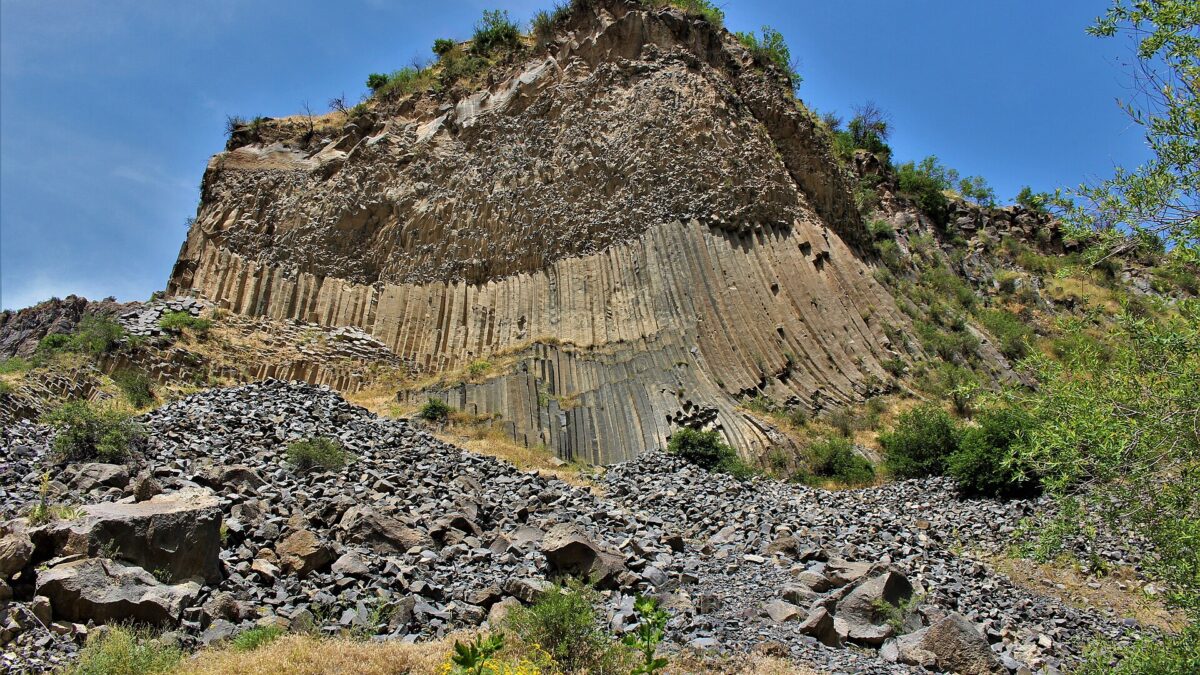
The Symphony of Stones is a natural formation of tightly packed hexagonal and pentagonal basalt columns that line the walls of the Garni gorge, on the cliffs above the Azat River just below Garni temple, roughly 40 km east of Yerevan. There is no ticket to see the columns themselves. You reach them by a short drive or a 35-minute walk down the gorge road from Garni village.
Armenians call it the Basalt Organ, and the nickname fits: the columns hang from the cliff in long vertical bundles that fan and curve like the pipes of a church organ. It is one of the more photogenic geological sites in the country, and because it sits directly below one of Armenia’s most-visited monuments, most people can add it to a trip they are already making. Last verified: July 2026.
What is the Symphony of Stones?
It is a several-kilometre stretch of exposed columnar basalt in the Garni Gorge (also written Garni Canyon), in Kotayk province. The columns are polygonal — mostly six-sided, some five-sided — and in places reach close to 50 metres in height, hanging in tight rows from the sheer canyon wall. The Azat River runs along the floor of the gorge below them.
The formation is often compared to the Giant’s Causeway in Northern Ireland or Devils Postpile in California, and the comparison is geologically sound: they are all examples of the same process, columnar jointing in cooled lava. What makes the Garni example unusual is the scale and the near-vertical arrangement — long curtains of stone that curve and lean rather than the flat stepping-stone tops you see at the Causeway. Some bundles fan outward in a wide arc, which is where the organ-pipe comparison really lands. It is not a manicured attraction with railings and viewing decks; it is a working river gorge that happens to have an extraordinary wall along one side, and part of the appeal is how raw it still feels. Sources: absolutearmenia.com; Wikipedia — Garni Gorge.
How were the basalt columns formed?
The short version: thick lava cooled slowly and cracked into columns. When a deep flow of basaltic lava cools, it contracts, and that contraction pulls the rock apart along evenly spaced fracture lines. Those cracks propagate down into the flow at right angles to the cooling surface, and the most efficient way to relieve the tension is a hexagonal pattern — which is why so many columns end up six-sided. Geologists call this columnar jointing.
At Garni the lava dates to a period of volcanic activity in the region, and over a very long span of time the Azat River cut down through the old flows and exposed the columns you see today. Reported figures for the age of the rock vary by source, so treat any single number as approximate rather than exact. The key point is simple: this is slow-cooled lava that fractured as it shrank, then erosion did the rest. Sources: unusualplaces.org; Wikipedia — Garni Gorge.
How do you get to the Symphony of Stones?
The site sits about 2 km from Garni temple, down inside the gorge. From the village you have a few options:
- Drive down. A road drops from near Garni into the gorge; the upper part is paved and the lower stretch runs unpaved along the riverside. In dry weather a normal car handles it in roughly 7-10 minutes. It is steep and narrow with sharp bends, and after rain or in winter it gets slippery, when many drivers prefer a 4×4. A taxi from the village can run you down and wait.
- Walk down. On foot it is around 35 minutes down through the gorge — pleasant and free, with the river and cliffs the whole way. The catch is the walk back up, which is a steady uphill slog in the heat.
- From Yerevan. By car or taxi the temple is about a 50-minute drive. Public transport (the Garni/Geghard minibus from the Gai statue stop) only reaches Garni village — you cover the last leg into the gorge by taxi or on foot. If you are relying on buses, read our guide to how to get around Armenia before you set out.
Because of that last-leg problem, the honest call for most travellers is to visit as part of a Garni day trip with a car or driver, not as a standalone bus mission. See day trips from Yerevan for how the whole eastern loop fits together. Sources: absolutearmenia.com; backpackmoments.com.
Is the Symphony of Stones free, and what does it cost?
The columns are a natural formation with no entrance ticket in the way Garni temple has one. In practice, though, there is now usually a small fee of around 300 AMD (roughly $1) collected at the bottom of the gorge toward upkeep of the access path, plus about 200 AMD if you park. A small shuttle (sometimes called the Garni Express) runs the uphill return leg for a few hundred AMD if you would rather not climb back on foot. Prices are point-in-time and easy to get wrong online, so treat these as rough and expect them to drift.
| Item | Approx. cost (2026) |
|---|---|
| Viewing the basalt columns | No ticket (natural site) |
| Access path / upkeep fee | ~300 AMD (~$1) |
| Parking | ~200 AMD |
| Shuttle back uphill (optional) | ~300 AMD |
| Garni temple (separate site) | 1,500 AMD (~$4) |
Last verified: July 2026. Source for the columns being a free natural formation: Armenia fact-base and absolutearmenia.com.
Should you combine it with Garni and Geghard?
Yes — and this is how nearly everyone does it. The three sights sit close together east of Yerevan and pair naturally into one half-day or full-day outing. The order that works best is Garni temple first (it is right at the top of the gorge), then down to the Symphony of Stones, then back up and on to Geghard.
- Garni Temple — the 1st-century Greco-Roman colonnaded temple, the only standing one of its kind in the former USSR. Entry is 1,500 AMD (~$4).
- Symphony of Stones — the gorge below Garni, covered here.
- Geghard Monastery — a UNESCO-listed complex partly carved into the rock, about 10 km on. Entry is free.
Budget somewhere between five and eight hours from Yerevan for all three at an unhurried pace. A common mistake is to burn the morning at Garni temple with a tour group and then skip the gorge because time is tight — do it the other way round if you can, and give the columns their due while you have the light. If you only have appetite for two, we would keep Garni and the columns together (they share the same gorge) and treat Geghard as the swap-out. For where this fits in a wider plan, our best things to do in Armenia roundup places it against the country’s other headline sights. Source: Armenia fact-base (Garni/Geghard cluster, ~40 km E of Yerevan, ~5-8 hr trip).
Tips for visiting the columns
- Go for the drive, not around it. The single biggest complaint is the walk back up the gorge in full sun. If you are not up for the climb, arrange a taxi or the shuttle for the return before you go down.
- Mind the road after rain. The lower track is unpaved and gets greasy when wet or icy in winter — a higher-clearance or 4×4 vehicle is the safer choice then.
- Morning light and fewer crowds. The gorge sits in shadow for part of the day; go earlier to beat both the tour-bus wave up top and the midday heat on the walk out.
- Wear real shoes. The riverside path is uneven rock and gravel. It is not a technical hike, but it is not a paved promenade either. If you enjoy this sort of terrain, our hiking in Armenia guide points to longer walks in the same region.
- Bring water and small cash. There is a modest café down at the bottom, but carry AMD in small notes for the path fee, parking and shuttle — card is not a given here.
For more experiences filed alongside this one, browse our things to do category. The Symphony of Stones rewards very little effort with a genuinely striking sight — the main thing that trips people up is treating the gorge road casually. Plan the descent and the climb back, and it is one of the easiest wins on the eastern day trip.
Featured image: VAS (CC BY-SA 4.0) via Wikimedia Commons