Getting around Armenia comes down to four things: marshrutkas (cheap minibuses) and shared taxis for intercity trips, the taxi apps GG and Yandex Go inside cities, and organised day-tours or a hired car for the awkward, remote sights. Trains exist but are limited. Most visitors base themselves in Yerevan and mix all four depending on the route. Here is how each option actually works, what it costs, and when to pick it.
Last verified: July 2026. All fares below are approximate and move with fuel prices and the exchange rate (roughly 370–400 AMD to 1 USD in 2026), so treat every number as a range and confirm on the day.
What are marshrutkas and how do you use them?
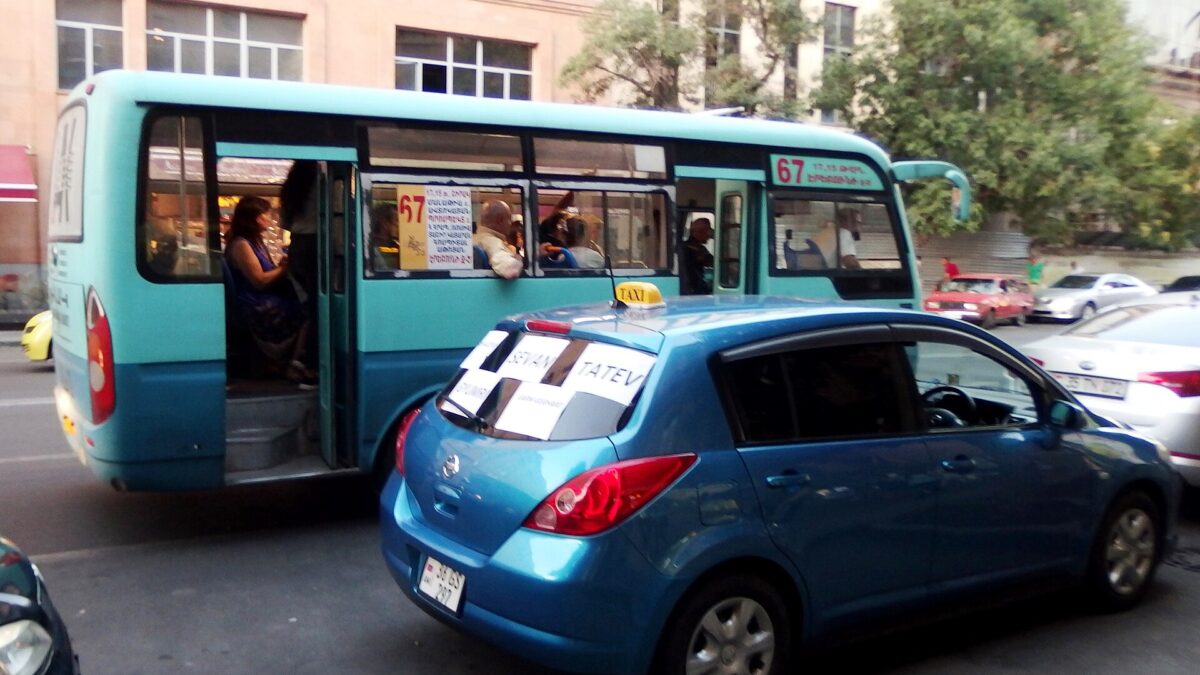
Marshrutkas are shared minibuses, and they are the cheapest way to travel between Armenian towns. There is a catch that trips up most first-timers: many of them have no fixed timetable and simply leave when they fill up. You pay the driver in cash (Armenian dram) either as you board or when you get off, and you flag your stop by telling the driver.
Fares are genuinely low. Yerevan to Lake Sevan runs roughly 800–1,500 AMD; Dilijan around 1,200–1,700 AMD; Gyumri about 1,500–2,000 AMD; and the long haul down to Goris (the gateway to Tatev) roughly 2,500–3,500 AMD over four to six hours. Short hops out to Garni or Geghard cost only 300–600 AMD, and Vanadzor runs roughly 1,500–2,000 AMD over two to two-and-a-half hours. For context, a full public transport ride within Yerevan itself is a flat 100 AMD.
Our honest take: marshrutkas are excellent value and perfectly safe, but they are confusing if you do not speak Armenian or Russian, and the “leaves when full” model means you cannot plan a tight schedule. Screenshot your destination in Armenian to show the driver, carry small notes, and do not count on a specific departure time. For a relaxed day trip from Yerevan, that unpredictability is usually fine. For a same-day return from somewhere with sparse service, it is not.
Which Yerevan bus station do you leave from?
This is where even good guides disagree, so we will be candid: sources genuinely conflict on which station serves which region. Confirm your departure point locally the day before you travel. As a working map:
- Kilikia Central Bus Station (Admiral Isakov Avenue, near Sasuntsi Davit metro, beside the railway station) is the main long-distance hub. It is most often cited for the south and southwest — Goris, Tatev/Kapan, Sisian, Jermuk — plus international routes to Tbilisi and Tehran.
- Gai / Northern station, in northeast Yerevan, is the one usually named for the north and northeast: Sevan, Dilijan, Ijevan, Vanadzor and Gyumri.
- Gai statue / Raykom (Mercury market) stop is an informal roadside pickup, not a proper terminal, for Garni and Geghard.
- Sasuntsi Davit area covers Echmiadzin and some Khor Virap departures.
Because the mapping shifts, a quick call to your hotel front desk or a message to a local tour operator the night before saves you a wasted taxi across town.
What about shared taxis?
Shared taxis sit one step up from marshrutkas: usually around four passengers, they also leave when full, cost roughly 1.5 to 2 times the marshrutka fare, and get you there faster. They collect from the same stations and informal stands, and for a small group they can work out barely more expensive per head than the minibus while cutting the journey time and the standing-around.
They are the sensible middle choice when a marshrutka runs only a couple of times a day. Goris is a good example — two daily marshrutkas is a thin schedule, and a shared taxi gives you more flexibility. Agree the price before you get in, and if you are a group of three or four, ask whether you can charter the whole car; splitting a private fare is often only a little more than paying per seat and saves you the wait for it to fill.
How do taxi apps work in Yerevan?
Inside the city, use an app and never street-hail — that is the single most useful rule in this guide. Tourists who wave down a passing car get overcharged, sometimes badly. Book through an app and the fare is shown and fixed before you confirm.
Two apps dominate. GG is the local favourite, with quick pickups in the centre, though coverage thins out beyond the core. Yandex Go runs a bigger fleet with the best in-app navigation and a cheap base fare — its weakness is aggressive surge pricing when it rains or snows. In-city rides typically cost 500–2,000 AMD, which is cheap enough that most visitors barely bother with buses within Yerevan. Our advice: install both, default to GG in the centre, and switch to Yandex for the outskirts or when GG shows no cars. If you are watching every dram, see our full Armenia budget breakdown for how transport fits the daily total.
How do you get from Zvartnots airport to Yerevan?
Zvartnots (EVN) sits about 13 km west of the centre, roughly a 25-minute drive. You have three options, and the price gap between them is enormous.
- Bus #201 (Airport Express): 300 AMD cash paid on board, runs to and from France Square roughly every 30 minutes between 07:30 and 21:30, taking 30–40 minutes. No night service. Easily the cheapest route.
- GG or Yandex Go: book from the app and expect roughly 2,900–5,000 AMD. This is the option we would pick for most arrivals — fixed price, door to door, no haggling.
- Taxi desk touts: the drivers who approach you in arrivals routinely quote 10,000–20,000 AMD. That is several times the app price for the same ride.
The warning writes itself: ignore the desk touts and open the app. If you land after the last #201 bus, an app taxi is the honest fallback, still a fraction of the tout quote. One practical note — Zvartnots has a single terminal in 2026. A second terminal has been announced but not built, so do not plan around it.
Should you rent a car in Armenia?
For a Yerevan-based trip built around easy day trips, you rarely need to. For the deep south and remote monasteries, a car earns its keep. Rentals are widely available in the city and at the airport: roughly 25–40 USD a day for an economy car, 35–50 for a sedan, and 50–80 for an SUV or 4WD, plus collision damage waiver at around 8–15 USD a day.
Know the road reality before you commit. Main roads are paved and in fair condition, but off the main routes you will meet potholes and unpaved stretches. Mountain driving is demanding, livestock wanders onto roads, and fuel stations get sparse in remote areas — fill up when you can. If your plan is Yerevan plus Garni, Geghard, Khor Virap and Sevan, skip the car and use apps and marshrutkas. If you want to string together the southern monasteries at your own pace, a hired car (ideally an SUV) is the tool for the job. Drive defensively and keep an eye on the fuel gauge; our Armenia safety guide also covers which border-adjacent roads in the far southeast to avoid.
When are organised day-tours worth it?
Day-tours cost roughly 25–50 USD per person and are worth it precisely where public transport is awkward. The classic cases:
- Geghard: many marshrutkas stop at Garni village, about 4 km short, leaving you to sort out the last leg by taxi. A tour removes that friction and pairs Garni, the Symphony of Stones and Geghard in one loop.
- Khor Virap: departures are limited (roughly 09:00, 11:00 and 14:00) and the return timing is genuinely awkward, so a tour or hired taxi is the common fix.
- Tatev: there is no direct marshrutka. Most people do a long day-tour or overnight in Goris, since it is 250 km and four-plus hours south of Yerevan.
We would not book a tour for Sevan or Dilijan, where marshrutkas run frequently and the apps cover the gaps. Reserve tours for the sights where the timetable, not the distance, is the problem. Our roundup of the best things to do in Armenia flags which attractions realistically need one.
How do you get from Yerevan to Tbilisi?
Crossing into Georgia is a well-worn route via the Bagratashen/Sadakhlo border. Three ways across:
- Marshrutka: roughly 7,000–9,000 AMD (about 20–25 USD), around six hours, leaving from Kilikia. You walk through passport control with your luggage.
- Shared taxi: roughly 30–40 USD, around five to six hours, leaving when full — faster and more comfortable than the minibus.
- Overnight train: daily in summer, every other day off-season (an odd/even date rule — verify the calendar). Tbilisi departs around 20:20 and reaches Yerevan around 06:55; fares run from about 18–35 USD in third class up to 65–75 USD in first. Book ahead in summer.
Armenia transport at a glance
| Mode | Rough cost | Best for | Watch-outs |
|---|---|---|---|
| Marshrutka (minibus) | 300–3,500 AMD by route | Cheapest intercity travel | No timetable; leaves when full; cash only; language barrier |
| Shared taxi | ~1.5–2× marshrutka | Faster intercity; thin routes | Also leaves when full; agree price first |
| Taxi app (GG / Yandex) | 500–2,000 AMD in-city | Getting around Yerevan | Surge in rain/snow; never street-hail |
| Airport bus #201 | 300 AMD cash | Cheapest airport transfer | 07:30–21:30 only; no night service |
| Car rental | $25–80/day + CDW $8–15 | The south / remote monasteries | Potholes off main roads; sparse remote fuel; livestock |
| Day-tour | $25–50/person | Awkward sights (Geghard, Khor Virap, Tatev) | Fixed group schedule; less flexibility |
Put together, the pattern for most trips is simple: apps around Yerevan, marshrutkas or shared taxis for the intercity legs, and a tour or hired car only where the timetable forces your hand. For where to point all this transport, our Yerevan travel guide and the wider Armenia travel tips hub cover the rest of the practical planning.
Featured image: Palickap (CC BY 4.0) via Wikimedia Commons
Sources: Verify the latest specifics with Armenia’s official tourism board (armenia.travel). Last verified: July 2026.