One week is enough to cover Armenia’s essentials without rushing. A practical 7-day route bases you in Yerevan, uses three days for the classic day trips (Garni-Geghard, the Ararat valley monasteries, and Lake Sevan-Dilijan), and spends one overnight in the far south so you can reach the Wings of Tatev cable car and Khndzoresk properly rather than as an exhausting single-day dash. You will not see everything, but you will see the country’s headline sights at a sane pace.
This plan assumes you have your own car or a mix of day tours; a fully public-transport version is possible but slower, and we flag the workarounds per day. It is deliberately different from our shorter and longer routes. If a week feels tight or generous, compare the 3-day itinerary, the 5-day itinerary, and the 10-day itinerary before you lock dates. The single best month to run this loop is September (dry, autumn colour, wine harvest); late April to June is the other sweet spot.
Day 1: Yerevan on foot
Spend your first day in the capital and let jet lag settle. Start at Republic Square, walk up to the Cascade complex (the giant limestone stairway housing the Cafesjian art collection), and browse the Vernissage open-air market for carpets, khachkar carvings, and duduks, busiest at weekends. Serious history travellers should add the Matenadaran, the manuscript repository, and the Genocide Memorial and Museum at Tsitsernakaberd.
Tsitsernakaberd is free; the outdoor memorial with its eternal flame is accessible any time, but the museum is closed Mondays (roughly Tue-Sun, 11:00-16:00, reconfirm at genocide-museum.am). It is a solemn place, so dress and behave respectfully. Most Yerevan museums charge around 1,000-2,500 AMD; monasteries later in the week are largely free.
Without a car
Everything here is walkable or a short ride. Use the GG or Yandex Go apps rather than street taxis; in-city rides run roughly 500-2,000 AMD and the fare shows before you book.
Day 2: Garni, Symphony of Stones and Geghard
The easiest and most rewarding day trip, about 40 km east of Yerevan with the two sites roughly 10 km apart. Do them in one loop: Garni Temple first, then walk or drive down into the gorge for the Symphony of Stones basalt columns, then Geghard.
Garni is the only standing Greco-Roman colonnaded temple in the former USSR; entry is 1,500 AMD (roughly USD 4), open about 10:00-21:00 in summer and 10:00-17:00 in winter. The Symphony of Stones, a wall of hexagonal basalt columns in the Garni gorge, is a free natural formation. Geghard, a partly rock-cut UNESCO monastery, is free and open roughly 8:00-20:00. Budget five to eight hours for the whole outing.
Without a car
Marshrutkas to Garni and Geghard leave from the Gai statue / Raykom area (roughly 300-600 AMD). The catch: many stop at Garni village, about 4 km short of Geghard monastery, so you finish the last leg by taxi or negotiate a wait. A half-day group tour (around USD 25-50 per person) removes the hassle and usually covers both plus the Symphony of Stones. See our fuller Garni and Geghard guide.
Day 3: Khor Virap, Noravank and Areni wine
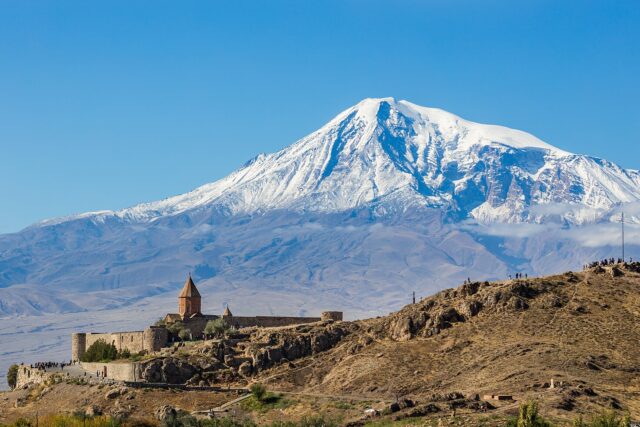
Head south into the Ararat plain and Vayots Dzor. Start early at Khor Virap (about 35-40 km south, roughly 50 minutes), the hilltop monastery framed by Mount Ararat, now just over the border in Turkey. Entry is free. The clearest Ararat views come early morning and in the October-April window; summer haze often swallows the peak by midday.
Continue to Noravank (13th century, about 120 km southeast), a two-storey church with an external stone stair set against dramatic red cliffs. It is free. On the way back, stop in Areni, the wine village: this is home to the Areni-1 cave, the world’s oldest known winery at roughly 6,100 years old and the oldest known leather shoe. Tastings at Hin Areni, Trinity, or family cellars typically cost a few thousand AMD. If you travel in early October, the Areni Wine Festival lands here.
Without a car
This trio is hard to do well by public transport in a day; a day tour or a hired car with driver is the realistic option. Khor Virap alone is doable by marshrutka toward Ararat (around 500 AMD) plus a 1.5 km walk, but returns are awkward. See our Noravank and Areni guide and Khor Virap guide.
Day 4: South to Goris (overnight)
This is what a week buys you that shorter trips cannot: time to reach the deep south properly. Drive from Yerevan to Goris, roughly 4-6 hours depending on stops and road conditions, and check into a guesthouse there for the night. Goris is a pleasant town of stone houses and the base for the two southern highlights.
If you arrive with daylight to spare, visit Old Khndzoresk in the afternoon: an abandoned cave settlement across a gorge, reached by a swaying pedestrian suspension bridge. It is an easy, memorable stop and a good leg-stretch after the long drive.
Without a car
Marshrutkas to Goris leave from Kilikia Central Bus Station (roughly 2,500-3,500 AMD, 4-6 hours, about twice daily). There is no direct minibus to Tatev, so an overnight in Goris plus a local taxi is the standard approach. Confirm departure times locally, as sources conflict on schedules.
Safety note
The Goris and Tatev area itself is a normal, popular destination. Only the far-southeast Syunik highway near the Azerbaijan border is sensitive; advisories flag areas east of Goris and south of Kapan. Check your government’s advice the week you travel, as the situation is volatile. See our Armenia safety guide.
Day 5: Wings of Tatev, then back to Yerevan
From Goris, drive to Halidzor and ride the Wings of Tatev, the world’s longest reversible aerial tramway at 5.7 km, about 11-12 minutes each way, to Tatev Monastery. Round-trip tickets run roughly 6,500-9,000 AMD (about USD 18-25) for adults; prices vary, so confirm on the official page at tatever.am. Hours are seasonal (roughly 9:00-20:00 in Jun-Aug, shorter in shoulder months) and it is usually closed Mondays outside peak summer, so check before you go.
After exploring Tatev, begin the drive back to Yerevan. It is a long haul, so leave the monastery by mid-afternoon. If you would rather not do the return in one push, this is the day where extending to a 10-day trip pays off. Full details in our Wings of Tatev guide.
Without a car
From Goris, a taxi to Halidzor is around 2,500 AMD. Getting back to Yerevan the same day by public transport is impractical; most independent travellers take the outbound Goris marshrutka the next morning, or book a two-day southern tour from Yerevan that bundles the driving.
Day 6: Lake Sevan and Dilijan
A day in the green north-east. Lake Sevan sits about 65 km from Yerevan (roughly one hour), a high-altitude lake at around 1,900 m. Climb to Sevanavank, the 9th-century monastery on what is now a peninsula (formerly an island, before Soviet-era water levels dropped). It is free. Swimming is realistic only in July and August, when the water reaches roughly 20-22 C.
Continue to Dilijan, nicknamed “Armenian Switzerland” for its forested national park. Visit the restored 13th-century Haghartsin Monastery in the woods, and if you have time, Parz Lake. This pairs Sevan and Dilijan into one satisfying loop.
Without a car
Marshrutkas to Sevan (roughly 800-1,500 AMD, 45 min-1.5 hr) and Dilijan (roughly 1,200-1,700 AMD, 1.5-2 hr) both leave from the Gai / Northern station. Sevanavank is a short taxi from Sevan town. Doing both by minibus in one day is tight; a day tour is smoother if you want Haghartsin included. See our Lake Sevan guide and Dilijan guide.
Day 7: Echmiadzin, Zvartnots and departure
Close the loop close to the airport. Echmiadzin Cathedral in Vagharshapat, about 20 km west, is the Mother See of the Armenian Apostolic Church, tied to Armenia becoming the first nation to adopt Christianity as a state religion in 301 AD. Note for planning: it reopened and was re-consecrated on 29 September 2024 after a six-year restoration, so ignore older guides that still call it closed. Entry is free; dress modestly. Nearby Zvartnots is a ruined 7th-century cathedral and UNESCO site.
Both sit on the road to Zvartnots Airport (about 13 km west of the centre, a 25-minute drive), which makes this a natural last day before an evening flight. If you have a late departure and skipped it earlier in the week, you could swap in the Genocide Memorial here instead.
Without a car
Echmiadzin marshrutkas run from the Sasuntsi Davit area. For the airport, use bus #201 (the Airport Express, roughly every 30 minutes, 300 AMD cash on board) from France Square, or book a GG/Yandex ride from the app (around 2,900-5,000 AMD). Ignore the airport taxi-desk touts quoting 10,000-20,000 AMD.
Rough budget for one week
Costs are per person, per day, excluding international flights. Prices are point-in-time (roughly 370-385 AMD to USD in 2026) and volatile, so treat them as ranges.
| Tier | Per day | What it buys |
|---|---|---|
| Budget | ~USD 16-24 | Hostel dorm, street food, marshrutkas |
| Mid-range | ~USD 38+ | 3-star hotel, restaurant meals, paid sights, some tours |
| Higher-end | ~USD 70+ | Better hotels, private driver, taxis |
The two swing costs on this itinerary are the southern leg (a hired car or two-day tour for Days 4-5) and how many day trips you book as tours versus doing by marshrutka. A hired car runs roughly USD 25-40 a day for an economy model plus CDW, and is genuinely worth it for the south. For the full breakdown, see our Armenia budget guide and day trips from Yerevan.
Last verified: September 2026. Prices, hours, and border-safety advice change; reconfirm time-sensitive details the week you travel.
Sources: Wings of Tatev (tatever.am); armenia.travel; Armenian Genocide Museum-Institute; UK FCDO travel advice for Armenia; US State Department travel advisories.
Frequently asked questions
Is one week enough for Armenia?
Yes, for the headline sights. Seven days lets you cover Yerevan, the Garni-Geghard loop, the Ararat valley monasteries, Lake Sevan and Dilijan, plus one overnight in the south for Tatev and Khndzoresk. You won’t reach everything (Gyumri, Debed Canyon, and deep hiking are left out), but you get a well-rounded first trip at a comfortable pace.
Do I need a car for this 7-day itinerary?
Not strictly, but it helps most on Days 3-5 (the Ararat valley and the southern overnight), where public transport is awkward or impractical. Yerevan and the Garni-Geghard and Sevan-Dilijan days work fine by marshrutka or day tour. A common hybrid is to use taxis and tours for the city-based days and hire a car or a driver for the south.
What is the best time of year to do this route?
September is the single best month: dry weather, autumn colour, and the wine harvest around Areni. Late April to June is the other strong window. August can be very hot in Yerevan with afternoon storms, and winter closes some mountain options and hazes the Ararat views less (winter actually gives clearer Ararat), but roads and hours get trickier.
How much does a week in Armenia cost?
Excluding international flights, budget travellers can manage on roughly USD 16-24 a day, mid-range around USD 38 and up, and higher-end from about USD 70. The biggest variables are the southern leg (car hire or a two-day tour) and how many day trips you book as guided tours versus riding marshrutkas.
Is the southern trip to Tatev safe?
The Goris and Tatev area itself is a normal, popular destination. The sensitivity is only along the far-southeast Syunik highway near the Azerbaijan border, with advisories flagging areas east of Goris and south of Kapan. The Wings of Tatev route is well clear of that. Because the situation is volatile, check your government’s current advice the week you travel.
Can I add a Georgia extension to this week?
Yes. Yerevan to Tbilisi is a common add-on: a marshrutka runs roughly USD 20-25 over about six hours from Kilikia station, a shared taxi around USD 30-40, and there is an overnight train in summer. It works best as an extension beyond seven days rather than squeezed into this loop.
Featured image: Ավետիսյան91, CC BY-SA 4.0 — via Wikimedia Commons.