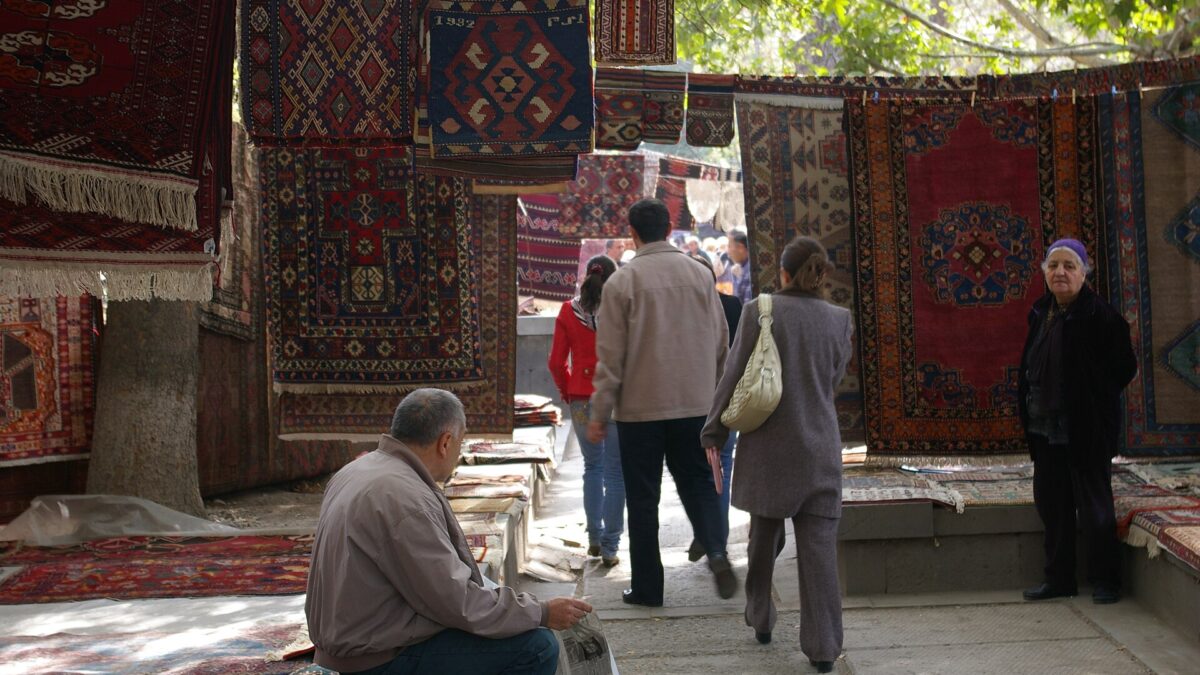
Vernissage is Yerevan’s big open-air weekend market for crafts, antiques and souvenirs, spread along the park beside Aram Street between Republic Square and Hanrapetutyan Street in the city centre. It runs every day but only fills out properly at the weekend: Saturday and Sunday are when almost every stall is open, roughly from morning until late afternoon. Come for carpets, hand-carved khachkars, duduks, silver and antique Soviet oddments, bring cash in Armenian dram, and expect to bargain.
What is Vernissage market?
Vernissage is a sprawling flea-and-craft bazaar that sets up in the open air in the middle of Yerevan. It began informally in the late Soviet years as a place for artists and craftspeople to sell directly to the public, and the name (from the French word for a private art preview) stuck. Today it is the single best place in Armenia to see handmade goods and old curiosities side by side in one walk.
The market is loosely organised into zones. One long stretch leans toward paintings, jewellery and modern crafts; deeper in you hit the carpets, woodwork, musical instruments and the antiques-and-junk end where Soviet cameras, badges, coins and old cutlery pile up on trestle tables. There is no entrance fee and no fixed floor plan, so the pleasure is in wandering and letting things catch your eye. Give yourself at least an hour if you plan to look properly, and longer if you are hunting for a carpet or a good instrument, because those decisions are worth taking slowly.
When is Vernissage open?
The market is busiest and most complete on Saturdays and Sundays, typically from around 9am to roughly 4-6pm depending on the season and the weather. A reduced number of vendors also trade on weekdays, so a Tuesday visit is not pointless, but you will see a fraction of the stalls and far less choice. If your Yerevan days are flexible, plan the market for a weekend.
Timing within the day matters too. Arrive mid-morning and the full spread is up but the crowds are thin, which is the easiest time to browse carpets and talk properly with a seller. By early afternoon it is livelier. Some vendors begin packing up before the official close, especially in colder months or if rain moves in, so do not leave the antiques end until last if that is what you came for.
Where exactly is it, and what to pair it with
Vernissage sits in the heart of the tourist core, a short walk from Republic Square. That makes it easy to fold into a wider day in the centre. Combine it with Republic Square and the museums that ring it, and with the covered GUM market a little further out if you also want to browse fresh produce, spices, dried fruit and churchkhela. Our Yerevan travel guide maps how these sit together, and the market slots neatly into any of our day-trip and city routing plans.
What should you buy at Vernissage?
The range is wide, and quality runs from serious handwork to imported tourist filler. Here is what the market is genuinely known for:
- Carpets and rugs – from small woven pieces to large hand-knotted carpets, some old, some newly made in traditional Armenian and wider regional patterns.
- Khachkars and stone carving – miniature versions of Armenia’s carved cross-stones, plus other worked stone, sold as keepsakes.
- Duduks – Armenia’s apricot-wood double-reed flute, the country’s signature instrument. Player quality varies enormously, so a cheap one is a decoration, not an instrument.
- Jewellery and silver – filigree work, silver rings and pendants, semi-precious stones, and pieces set with obsidian.
- Obsidian – the black volcanic glass is genuinely Armenian and turns up as carved figurines, worry stones, chess sets and jewellery.
- Woodwork – carved boxes, backgammon (nardi) boards, spoons, chess sets and painted items.
- Antiques and Soviet memorabilia – old cameras, watches, pin badges, medals, coins, banknotes, samovars and household bric-a-brac.
- Paintings and prints – work by local artists, from small studies to large canvases.
Authentically Armenian vs. imported filler
Not everything on the tables is made in Armenia. Mass-produced magnets, generic pashmina scarves and “antique” trinkets that appear at every stall in identical form are usually imported. The things worth carrying home are the ones tied to Armenian craft: a proper apricot-wood duduk, obsidian pieces, hand-carved wood or stone, filigree silver, and genuine old carpets. If a seller can tell you who made an item or where it comes from, that is a good sign. If ten stalls have the exact same object, treat it as a souvenir, not a craft piece.
How much do things cost, and how do you bargain?
Bargaining is expected here – the first price is an opening bid, not a fixed tag. Because stock is one-of-a-kind and quality varies hugely, there is no official price list; treat any figure as a rough, current-as-of-2026 guide and settle the real price face to face. As a very broad orientation:
| Item | Rough price range (approx.) |
|---|---|
| Small souvenirs (magnets, pins, small obsidian pieces) | ~1,000-5,000 AMD (~$3-13) |
| Decorative duduk / basic instrument | ~5,000-20,000 AMD (~$13-54) |
| Player-grade apricot-wood duduk | much higher; ask the seller and test it |
| Silver jewellery / filigree | from a few thousand AMD upward, by weight and work |
| Small woven pieces / cushion covers | ~5,000-25,000 AMD (~$13-67) |
| Hand-knotted carpets | tens of thousands of AMD and up, by size, age and knot count |
These are orientation ranges only, not quotes. At roughly 370-385 dram to the US dollar in 2026, the dollar figures drift, so the dram number is what matters at the stall. For a fuller sense of everyday costs in the city, see our Armenia budget guide.
A few habits that make bargaining work and keep it friendly:
- Bring cash in dram. Most vendors do not take cards, and paying in dram avoids poor informal exchange rates. Small notes help.
- Ask the price, then counter. A common approach is to offer somewhat below what you are willing to pay and meet in the middle. Stay polite; this is a normal, good-humoured exchange, not a fight.
- Buy more than one thing from the same seller and ask for a combined price – bundles usually earn a better rate than single items.
- Be ready to walk away. If the number will not move and it is above your limit, thank them and move on. Sometimes the price follows you.
- Judge quality first. On a carpet, check the back for even, dense knotting; on a duduk, ask to hear it or have it played. Bargain on what it is worth, not just on the sticker.
- Do not haggle if you do not intend to buy. Once a seller comes down to your number, the etiquette is that you follow through.
What nobody tells first-timers
Two things trip people up. First, the antiques end is where the real character is, but it is also where fakes live – a “1950s” camera or “silver” coin may be neither, so pay the price of a nice curio, not the price of a verified antique, unless you truly know the field. Second, quality duduks and quality carpets are worth spending real money on and cheap ones are not worth carrying home; decide which side of that line you are shopping on before you start, and you will enjoy the market far more.
Can you take antiques and carpets out of Armenia?
This is the one rule worth taking seriously. Armenia restricts the export of items considered cultural property – genuinely old carpets, antiques, artworks and objects of historical or artistic value can require an export permit or certificate from the relevant cultural authorities, and customs can stop unpermitted items at the airport. New, clearly modern souvenirs are not a problem. But if you buy something that could plausibly be old or valuable, ask the seller whether it needs paperwork, get a receipt, and check the current requirement before you fly. When in doubt, confirm the rules with an official source rather than assuming. It is far better to sort this at the point of purchase than to have a carpet confiscated at Zvartnots.
Practical tips for visiting Vernissage
- Go at the weekend, mid-morning for the full market with room to browse.
- Carry dram in cash, in mixed denominations. There are ATMs nearby in the centre if you run short.
- Wear comfortable shoes – the market is long and you will double back.
- Ask before photographing a vendor or their stall; most are fine with it, some are not.
- Keep valuables secure in the crowd, as in any busy market, though Yerevan has low street crime overall.
- Combine it with Republic Square, the History Museum and a coffee nearby to make a half-day of it. If you want an Armenian gift with a story instead of an object, an ARARAT brandy bottle is a reliable alternative.
Last verified: September 2026. Prices, hours and export rules can change – reconfirm the time-sensitive details before your visit.
Sources
- Armenia.travel – official national tourism portal (Yerevan and shopping information).
Frequently asked questions
What day is best to visit Vernissage market?
Saturday or Sunday. The market operates daily but only fills out at the weekend, when nearly all vendors are open. Mid-morning gives you the full spread with fewer crowds, which is the easiest time to browse and bargain.
What are the opening hours of Vernissage?
Roughly 9am to late afternoon (about 4-6pm), busiest on Saturday and Sunday. Some sellers pack up early in cold weather or rain, and only a limited number trade on weekdays, so plan a weekend visit and do not arrive too late in the day.
Do you need to bargain at Vernissage, and how?
Yes. The first price quoted is an opening bid, not a fixed price. Ask the price, counter politely somewhat below what you will pay, and meet in the middle. Buying several items from one seller earns a better combined rate, and being willing to walk away often lowers the price.
What should I buy at Vernissage market?
The authentically Armenian buys are apricot-wood duduks, obsidian carvings and jewellery, hand-carved wood and stone, filigree silver, and genuine carpets. The antiques end has Soviet cameras, badges, coins and samovars. Skip identical mass-produced trinkets sold at every stall, which are usually imported filler.
Can I take a carpet or antique out of Armenia?
Modern souvenirs are fine, but genuinely old carpets, antiques and artworks can count as cultural property and may need an export permit; customs can stop unpermitted items. Ask the seller about paperwork, keep your receipt, and confirm the current rule with an official source before you fly.
Does Vernissage take cards or only cash?
Bring cash in Armenian dram. Most vendors do not accept cards, and paying in dram avoids poor informal exchange rates. Carry small and mixed notes; there are ATMs nearby in central Yerevan if you run short.
Featured image: Deb Collins, CC BY 2.0 — via Wikimedia Commons.