The Armenian diaspora is the large population of ethnic Armenians who live outside Armenia. It is genuinely enormous: Armenia itself has a population of roughly 3 million, yet the worldwide Armenian community is estimated to be far larger, with well over half of all Armenians living beyond the country’s borders. Most estimates put the global figure in the range of 7 to 11 million, meaning that for every Armenian at home there are likely two or more living abroad.
That imbalance is not an accident of recent migration. It is the result of centuries of trade networks and, above all, the 1915 Armenian Genocide, which scattered survivors across three continents. For a traveller, this history is not just background reading. It shapes the hospitality you will meet, the churches you will pass, and a surprising number of the people you will talk to in Yerevan who grew up in Los Angeles, Beirut, or Moscow.
How can more Armenians live abroad than in Armenia?
The short answer is displacement layered on top of migration. Armenians have been a trading people for well over a thousand years, and Armenian merchant communities existed in cities from Venice to Isfahan to Calcutta long before the modern era. Those communities put down roots, built churches, and often stayed for generations. The New Julfa quarter of Isfahan in Iran, for example, was established in the early 1600s as an Armenian merchant town and remains a living Armenian neighbourhood today, complete with its own cathedral. Long before the twentieth century, then, an Armenian could travel between distant cities and find fellow Armenians, a church, and a welcome in each.
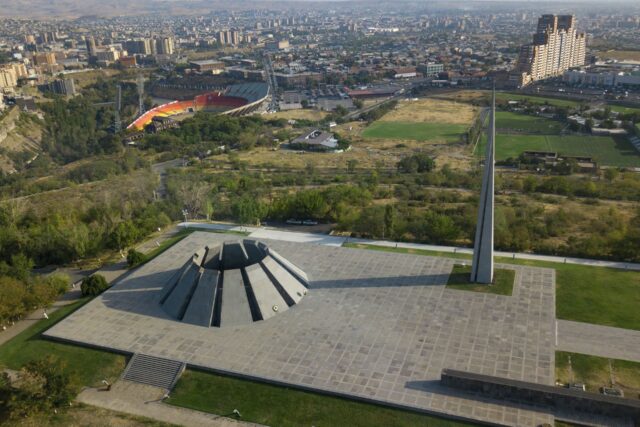
The far larger cause, though, is the 1915 Armenian Genocide under the late Ottoman Empire. In the years around the First World War, the Armenian population of eastern Anatolia was deported and killed on a mass scale, and the survivors fled wherever they could reach: the Middle East, France, the Americas, and the Russian Empire. Whole villages and towns that had been Armenian for centuries emptied out. The people who escaped rebuilt their lives in exile, and their descendants make up much of today’s diaspora. This is why the diaspora is so tightly bound to memory, and why the Tsitsernakaberd Genocide Memorial in Yerevan draws so many visitors with family roots abroad.
Soviet history added another layer. During the Soviet period Armenians moved throughout the USSR for work and study, which is a large part of why Russia today holds one of the biggest Armenian communities anywhere. Economic emigration since independence in 1991 has continued the pattern.
Where are the major Armenian communities?
Exact numbers are debated and should be treated as estimates rather than precise counts, because different countries define and record ethnicity differently. That said, the largest and most established communities are well documented.
- Russia — among the largest Armenian populations in the world, built up over the Soviet period and after, concentrated in Moscow, southern Russia, and other major cities.
- United States — a very large community centred on Southern California, especially Los Angeles and Glendale, which has one of the highest concentrations of Armenians outside Armenia. Fresno in California’s Central Valley was the historic heart of Armenian America in the early twentieth century. There are also long-standing communities in the Boston and New York areas.
- France — a large, deeply rooted community, particularly around Marseille and Paris, formed largely by genocide survivors in the 1920s.
- The Middle East — historically vital communities in Lebanon (Beirut’s Bourj Hammoud district is famously Armenian), Syria (Aleppo was a major centre before the recent war displaced many), and Iran (Tehran and Isfahan’s New Julfa quarter, one of the oldest continuous Armenian communities anywhere).
- Argentina and South America — Buenos Aires holds the largest Armenian community in Latin America, with others in Brazil and Uruguay.
- Georgia — the neighbouring country has a significant Armenian population, including in Tbilisi and the Samtskhe-Javakheti region.
Beyond these, there are meaningful communities in Canada, Australia, and across Western Europe. The point for a traveller is simple: the modern Armenian world is genuinely global, and Yerevan sits at the centre of a web that reaches every inhabited continent.
What does the diaspora do for Armenia?
A great deal. The diaspora is not just an emotional connection; it is a practical pillar of the country. Its role falls into a few clear areas.
Money and investment
Remittances sent home by Armenians working abroad make up a substantial share of the economy, and diaspora-funded charities and foundations have paid for roads, schools, hospitals, and rural development, particularly in the years after independence and after natural disasters. Diaspora investors also help fund tourism ventures, hotels, and the growing tech sector.
Churches, schools, and culture
Wherever Armenians settled, they built churches, and the Armenian Apostolic Church remains one of the strongest threads holding the diaspora together. For many families abroad, the local Armenian church is the first place newcomers go to find community, language classes, and a link back home. This connects directly to Armenia’s identity as the first nation to adopt Christianity as its state religion in 301 AD, with the Mother See at Etchmiadzin serving as the spiritual centre for Armenians worldwide. Diaspora communities also run Armenian-language schools, cultural centres, dance groups, sports clubs, and newspapers to keep the language and traditions alive across generations. Preserving the Western Armenian dialect, spoken by descendants of genocide survivors and now considered endangered, is a particular focus of many of these institutions.
Repatriation and “coming home”
Armenia actively encourages diaspora Armenians to visit, invest, and even return to live. There is a dedicated government body handling diaspora affairs, and organisations exist specifically to bring young diaspora Armenians to the country through volunteering, teaching, and heritage programmes. “Come home” style tourism, where people of Armenian descent visit ancestral villages and reconnect, is a real and growing part of the travel scene.
Famous faces of the diaspora
You almost certainly already know some diaspora Armenians without realising it. A few widely recognised examples:
- Charles Aznavour — the legendary French singer, born to Armenian immigrant parents in Paris, who became one of France’s most beloved artists and a lifelong advocate for Armenia.
- System of a Down — the American rock band whose four members are all of Armenian descent, and who have used their platform to raise awareness of Armenian history.
- The Kardashian family — among the most globally recognised Americans of Armenian descent, which for many people abroad is their first point of contact with the word “Armenian.”
There are countless others in science, business, chess, and the arts. The takeaway is that Armenian culture has an outsized global footprint relative to the country’s small size, and much of that reach comes from the diaspora.
What does the diaspora mean for travellers?
More than you might expect. Here is where it actually touches your trip.
- Hospitality is real and often personal. Armenians are famously welcoming, and many locals have relatives abroad, so travellers are often treated as connections to a wider Armenian world rather than as strangers.
- English is easier to find than you’d guess in Yerevan. A share of the people you meet in cafes, hostels, and tour companies are diaspora Armenians who grew up in the US, France, or the Middle East and have moved back. That makes the capital more internationally minded than its size suggests.
- Heritage travel is a genuine category. If you have Armenian roots, tracing family history, visiting ancestral regions, and connecting with the church is entirely possible, and there are programmes and guides who specialise in exactly this.
- Understanding memory helps you visit respectfully. The genocide is not distant history to Armenians; it is family history for most diaspora families. Approaching sites like Tsitsernakaberd with that awareness makes for a more meaningful and respectful visit.
- The food travels both ways. Dishes you may have eaten at an Armenian restaurant in Los Angeles or Beirut trace straight back to the home country, and eating them where they originated is part of the appeal.
If you want the historical and religious context that underpins all of this, pair this guide with our pieces on the Genocide Memorial and on Armenia as the first Christian nation. Together they explain why a country of roughly 3 million people carries such a large and devoted world behind it.
Sources
- armenia.travel — official tourism portal of Armenia
- Office of the High Commissioner for Diaspora Affairs of the Republic of Armenia — the government body responsible for diaspora relations and repatriation programmes
- Armenian General Benevolent Union (AGBU) — one of the largest Armenian diaspora organisations, active in culture, education, and community programmes worldwide
Last verified: September 2026. Population figures for the diaspora are estimates and vary between sources; treat them as approximate rather than exact counts.
Frequently asked questions
How many Armenians live outside Armenia?
Estimates vary, but well over half of the world’s Armenians live abroad. Against a home population of roughly 3 million, the global Armenian community is commonly estimated at around 7 to 11 million. All such figures are approximate, because countries record ethnicity differently.
Why do so many Armenians live abroad?
Two main reasons. Armenians were a long-established trading people with communities across Europe, the Middle East, and Asia. Far more significant was the 1915 Armenian Genocide under the late Ottoman Empire, which scattered survivors to the Middle East, France, the Americas, and Russia. Soviet-era movement and post-1991 economic emigration added further layers.
Where are the largest Armenian communities?
The biggest and most established communities are in Russia, the United States (especially Los Angeles and Glendale, with Fresno as the historic centre), and France (Marseille and Paris). There are also major historic communities in Lebanon, Syria, and Iran, plus large populations in Argentina, Georgia, Canada, and Australia.
Who are some famous diaspora Armenians?
Widely recognised examples include the French singer Charles Aznavour, the American rock band System of a Down, and the Kardashian family in the United States. Many others work in science, business, sport, and the arts.
How does the diaspora help Armenia today?
The diaspora sends significant remittances, funds charities that build schools, hospitals, and infrastructure, invests in tourism and technology, and supports Armenian churches, schools, and cultural institutions abroad. Armenia also runs programmes to encourage diaspora Armenians to visit, invest, and return.
What does the diaspora mean for a traveller in Armenia?
It makes Yerevan more internationally minded than its size suggests, since many locals have relatives abroad or are returnees who speak English or French. Hospitality is warm and often personal, heritage travel for those with Armenian roots is well supported, and understanding the weight of genocide memory helps you visit historical sites respectfully.
Featured image: Chris06, CC BY-SA 4.0 — via Wikimedia Commons.