Armenia is one of the world’s oldest continuous civilisations. Its roots reach back nearly three thousand years to the kingdom of Urartu; in 301 AD it became the first nation to adopt Christianity as its state religion; and after empires, the 1915 Genocide and seven decades of Soviet rule, it re-emerged as an independent republic in 1991. That long arc is written into almost everything travellers see today.
You do not need a degree in Caucasus studies to enjoy Armenia, but a little history changes how the country reads. A fortress hill in Yerevan, a fourth-century cathedral, a hall full of medieval manuscripts and a hilltop of basalt slabs above the capital all belong to the same story. Here is that story, era by era, with the sites each one left behind.
How old is Armenia? Urartu and the ancient roots
The oldest state on the Armenian Highlands was Urartu, also called the Kingdom of Van, which formed in the 9th century BC around Lake Van (now in eastern Turkey) and is often described as the first unified kingdom in historical Armenia. It was, for a time, the most powerful state in Western Asia before declining in the 6th century BC. Source: Wikipedia, Erebuni Fortress.
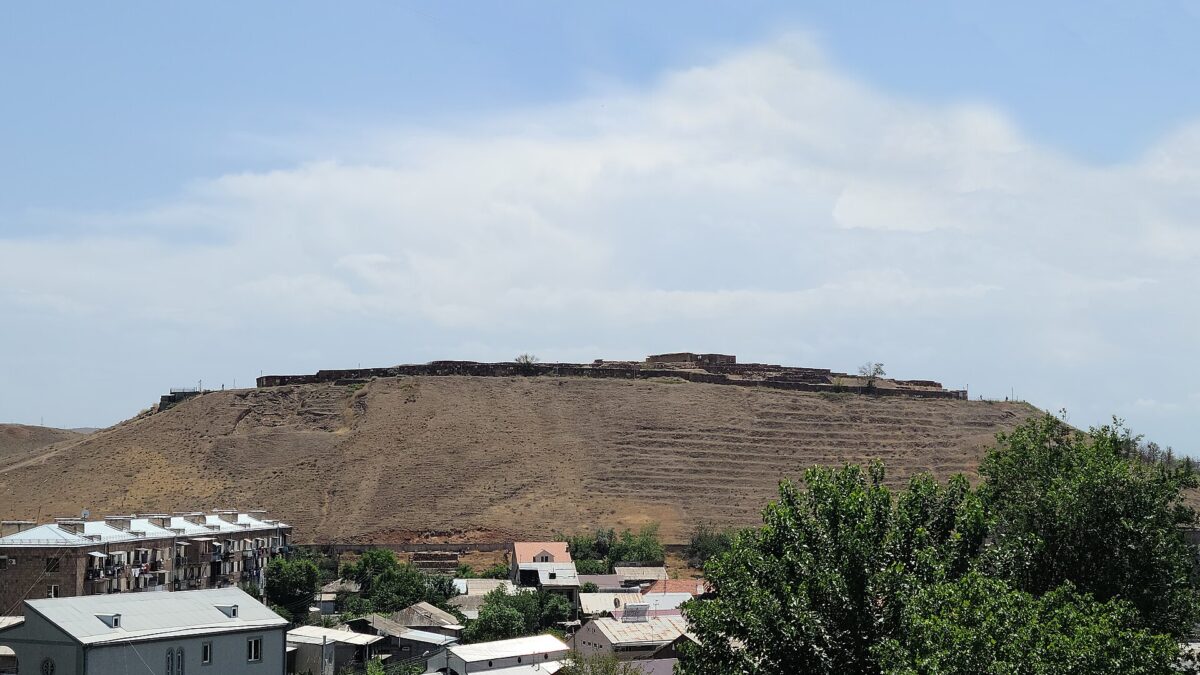
This matters to Yerevan in a very direct way. In 782 BC the Urartian king Argishti I founded the fortress of Erebuni on a hill above the Aras plain, and the modern city dates its own founding to that event. Yerevan is, on that reckoning, older than Rome. The name Yerevan is thought to derive from Erebuni itself. You can still climb the excavated fortress at the Erebuni museum in the south of the city and stand on the walls that give the capital its birth year. Source: Wikipedia; World History Encyclopedia.
Centuries later came Armenia’s ancient high-water mark. Under Tigranes II, “the Great,” who ruled from 95 to 55 BC, the kingdom briefly stretched from the Caspian toward the Mediterranean and became the strongest power in the Roman east, until Rome checked it in 69 BC. It was a short empire, but it fixed Armenia on the map of the classical world. Source: Wikipedia, Tigranes the Great.
When did Armenia become Christian? The year 301 and the golden age
In 301 AD King Tiridates III proclaimed Christianity the state religion of Armenia, which is traditionally counted as the first time any nation did so. The conversion is credited to Saint Gregory the Illuminator, who by tradition had been imprisoned for years in a pit at Khor Virap before healing and baptising the king. Scholars debate the exact year, but 301 is the date Armenians keep. Source: Wikipedia, Christianization of Armenia; World History Encyclopedia.
The physical heir of that moment is Etchmiadzin Cathedral in Vagharshapat, west of Yerevan, built in the early 4th century (traditionally 301 to 303) as the Mother See of the Armenian Apostolic Church. It reopened in September 2024 after a six-year restoration, so guides that still call it closed are out of date. If you read only one of our deeper pieces before visiting, make it Armenia, the first Christian nation.
A century after the conversion came the second pillar of Armenian identity. Around 405 AD the monk and scholar Mesrop Mashtots created the Armenian alphabet, 36 original letters (later expanded), specifically so that scripture and learning could be written in Armenian. Source: Wikipedia, Mesrop Mashtots. That script is still in daily use, and Yerevan’s Matenadaran holds one of the world’s great collections of ancient manuscripts. It is covered in our guide to the Armenian alphabet and language. Together, church and alphabet carried Armenian identity through the centuries when there was no Armenian state.
What were the medieval Armenian kingdoms?
After the classical period Armenia spent long stretches divided between Byzantium and Persia, then under Arab rule. Independence returned in the late 9th century with the Bagratid (Bagratuni) kingdom: Ashot I was recognised as king around 885 AD, and his dynasty made Ani its capital from 961. Ani, near today’s Turkish border, grew into one of the architectural marvels of the medieval world, the “city of a thousand and one churches.” Source: Wikipedia, Bagratid Armenia.
When invasions ended Bagratid Ani in the 11th century, Armenian statehood shifted southwest to the Mediterranean coast. The Armenian Kingdom of Cilicia lasted from 1198 to 1375, a crossroads realm that traded with crusaders and Europe before finally falling. Source: Wikipedia. The monasteries you visit today, Geghard, Haghpat, Sanahin, Noravank, Tatev, mostly date from this medieval flowering of Armenian architecture. Many are on our roundup of the best things to do in Armenia.
Empires and the 1915 Genocide
From the 16th century onward the Armenian Highlands were carved up between the Ottoman and Persian empires, and later the Russian Empire absorbed the eastern, Yerevan side in the 19th century. Millions of Armenians lived as subjects of these powers rather than as citizens of any Armenian state.
That period ended in catastrophe. Beginning on 24 April 1915, the Ottoman government arrested Armenian intellectuals in Constantinople and then deported and massacred its Armenian population; around 1.5 million Armenians are estimated to have died in what is now widely recognised as the Armenian Genocide. Source: Britannica; USHMM Holocaust Encyclopedia. The date, 24 April, is commemorated worldwide each year.
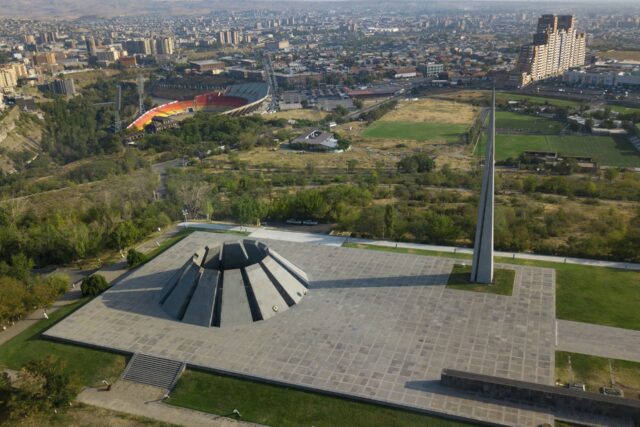
In Yerevan the Genocide is remembered at Tsitsernakaberd, the memorial complex on a hill above the city, built in 1967. Twelve leaning basalt slabs ring an eternal flame, beside a 44-metre spire; an on-site museum tells the history. Entry is free, and it is a solemn place best visited quietly. Source: Wikipedia, Tsitsernakaberd. We cover a respectful visit in our guide to the Armenian Genocide memorial.
Soviet Armenia and independence in 1991
As the Russian Empire collapsed, Armenians declared the First Republic of Armenia in May 1918, a fragile state that survived barely two years amid war and refugees. In late 1920 the Soviet Red Army took control, and Armenia became a Soviet republic, formalised as the Armenian SSR in 1936. Source: Wikipedia, First Republic of Armenia.
Soviet rule lasted seven decades and reshaped the country: Yerevan was rebuilt in pink volcanic tuff to the plans of architect Alexander Tamanian, and much of the city centre you walk today, Republic Square included, is that Soviet-era design. Toward the end came tragedy: the Spitak earthquake of 7 December 1988 killed more than 25,000 people and devastated Gyumri (then Leninakan) and Vanadzor. Source: Wikipedia; MSF.
Armenia declared independence from the Soviet Union on 21 September 1991, still marked as Independence Day. Source: Wikipedia, Independence Day (Armenia). The modern republic, its capital and its culture are the subject of our Yerevan travel guide.
A note on Nagorno-Karabakh
Since independence, the defining conflict has been over Nagorno-Karabakh, a mountainous territory internationally recognised as part of Azerbaijan but long populated and governed by Armenians. War in the early 1990s, renewed fighting in 2020, and an Azerbaijani offensive in September 2023 ended with Azerbaijan taking full control and the territory’s self-declared authorities dissolving. Source: Wikipedia; Britannica. For travellers the practical point is simple: it is not accessible from Armenia and is not an Armenian destination. The Armenia-Azerbaijan border remains sensitive, so check current advisories before travelling near it. Last verified: July 2026.
Armenia at a glance: a traveller’s timeline
| Era | Date | What happened | See it today |
|---|---|---|---|
| Urartu | 9th c. BC; Erebuni 782 BC | Kingdom of Van; Yerevan founded as a fortress | Erebuni fortress, Yerevan |
| Ancient Armenia | 95-55 BC | Tigranes the Great’s short-lived empire | Garni Temple (1st c.) |
| Christianity adopted | 301 AD | First state to adopt Christianity | Etchmiadzin Cathedral |
| The alphabet | c. 405 AD | Mesrop Mashtots creates the Armenian script | Matenadaran, Yerevan |
| Bagratid kingdom | 885-1045 | Independence restored; capital at Ani | Medieval monasteries |
| Cilician Armenia | 1198-1375 | Armenian kingdom on the Mediterranean | Noravank, Tatev |
| Empires | 16th-19th c. | Ottoman, Persian, then Russian rule | Yerevan’s older quarters |
| Genocide | 1915 | ~1.5 million Armenians killed | Tsitsernakaberd memorial |
| First Republic | 1918-1920 | Brief independent statehood | National History Museum |
| Soviet Armenia | 1920-1991 | Armenian SSR; Yerevan rebuilt | Republic Square, Cascade |
| Spitak earthquake | 1988 | 25,000+ killed in the north | Gyumri |
| Independence | 21 Sept 1991 | Modern Republic of Armenia | Yerevan, nationwide |
Why this history shows up on your trip
The through-line is survival. Armenia lost its statehood again and again, yet kept its identity through two things Mashtots and Gregory gave it: a church and an alphabet. That is why the country’s proudest sites are not palaces of conquest but monasteries, manuscripts and memorials. Reading them in order, from Erebuni’s walls to Etchmiadzin to Tsitsernakaberd, turns a set of stops into a single, coherent journey. For more on the culture behind the sites, browse our culture and history section.
Frequently asked questions
How old is Armenia?
As a civilisation, Armenia traces back to the kingdom of Urartu in the 9th century BC, roughly 2,800 years. Yerevan specifically dates its founding to 782 BC, when the Urartian fortress of Erebuni was built, making it older than Rome. Source: Wikipedia.
When did Armenia become Christian?
Traditionally in 301 AD, when King Tiridates III made Christianity the state religion, generally regarded as the first nation to do so. The event is tied to Saint Gregory the Illuminator and to Etchmiadzin Cathedral. Source: Wikipedia.
When did Armenia become independent?
The modern Republic of Armenia declared independence from the Soviet Union on 21 September 1991. An earlier First Republic existed from 1918 to 1920 before Soviet rule. Source: Wikipedia.
What is Armenia known for historically?
For being one of the oldest civilisations, the first Christian nation (301 AD), and the home of a unique alphabet created around 405 AD. It is also remembered for the 1915 Genocide and its long survival under empires and Soviet rule.
Is Nagorno-Karabakh open to visit from Armenia?
No. Following the September 2023 offensive, Azerbaijan took full control of the territory, and it is not accessible from Armenia or an Armenian destination. Check border advisories before travelling to Armenia’s east or south. Last verified: July 2026.
Featured image: Armen Manukov (CC BY-SA 4.0) via Wikimedia Commons