Armenia is called the world’s first Christian nation because it adopted Christianity as its official state religion in 301 AD — earlier than any other country. The conversion is credited to King Tiridates III (Trdat III), who was persuaded by St Gregory the Illuminator. That decision predated Rome’s own turn to Christianity under Constantine by roughly a generation, and its legacy is still visible around Yerevan today.
The traditional date, 301, is the one Armenians observe and the one carved into the national story. Some historians place the conversion a little later — anywhere from the late 3rd century to about 314 — but the point that matters is uncontested: Armenia declared Christianity the religion of the state before the Roman Empire did. This is a Culture & History cornerstone, and it shapes a good deal of what travellers actually see on the ground. Below we cover the events of 301, the two men at the centre of the story, the recently reopened cathedral at the heart of it, and exactly where you can experience this heritage as a visitor.
How did Armenia become the first Christian nation in 301 AD?
In or around 301 AD, King Tiridates III proclaimed Christianity the state religion of the Kingdom of Armenia, making it the first nation to do so. According to Armenian tradition, this followed his conversion at the hands of St Gregory the Illuminator, after years of persecution of Christians gave way to a dramatic reversal at the royal court.
The setting was the ancient capital of Vagharshapat, west of modern Yerevan. Christianity had already reached Armenia through apostolic preaching — the Armenian Church traces its founding to the apostles Bartholomew and Thaddeus in the 1st century, which is why it is called the Armenian Apostolic Church. What changed in 301 was that faith moved from persecuted minority to the official religion of the crown. Pagan temples were pulled down or repurposed, and the machinery of the kingdom was turned toward building churches and appointing clergy.
For context on how early this was: the Roman Emperor Constantine issued the Edict of Milan tolerating Christianity in 313, and the empire only made it the state religion in 380. Armenia’s decision sits ahead of both. You can read the outline of the events in the Christianization of Armenia record and Armenia’s own tourism board account at armenia.travel.
Who were St Gregory the Illuminator and King Tiridates III?
St Gregory the Illuminator was the missionary who converted Armenia and became its first Catholicos (head of the church). King Tiridates III was the Armenian monarch who first imprisoned Gregory, then converted, and made Christianity the state religion. Their reconciliation is the human core of the 301 story.
The traditional account runs like this. Gregory, raised a Christian, entered the service of Tiridates but refused to take part in pagan worship. The king had him thrown into a deep pit at Khor Virap, where — by tradition — he survived for around 13 years, kept alive by a woman who secretly brought him food. Tiridates, meanwhile, is said to have fallen gravely ill. When conventional remedies failed, Gregory was brought up from the pit, and the king’s recovery was attributed to him. Tiridates converted, and the kingdom followed.
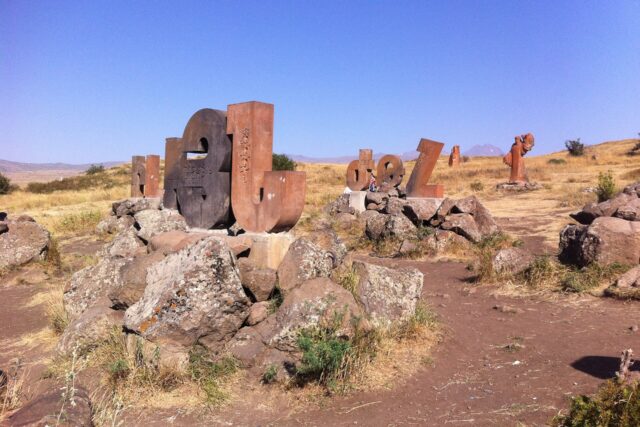
Gregory was consecrated as the first bishop of the Armenians around 314 and organised the new church across the country, a role that established the line of the Catholicos of All Armenians. Whatever one makes of the miraculous elements, the historical outcome is firm: a national church took root under royal sponsorship, and it has been a defining thread of Armenian identity ever since. Later, that same church commissioned Mesrop Mashtots to create a written script for scripture — the origin of the Armenian alphabet around 405 AD.
Sources for this section: the Tiridates III of Armenia entry and the World History Encyclopedia.
What is Etchmiadzin Cathedral, and why does it matter?
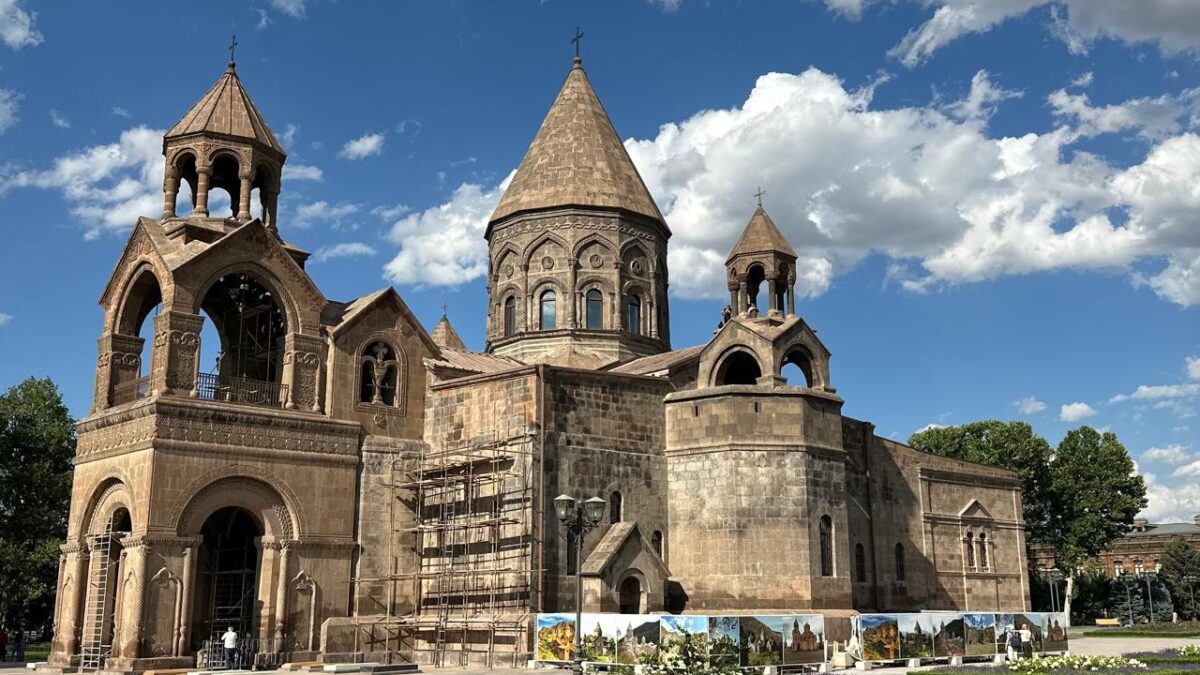
Etchmiadzin Cathedral, in Vagharshapat about 20 km west of Yerevan, is the Mother See of the Armenian Apostolic Church and the seat of the Catholicos of All Armenians. Built in AD 301–303 under St Gregory the Illuminator, it is often described as the oldest state-built cathedral in the world and has been a UNESCO World Heritage Site since 2000.
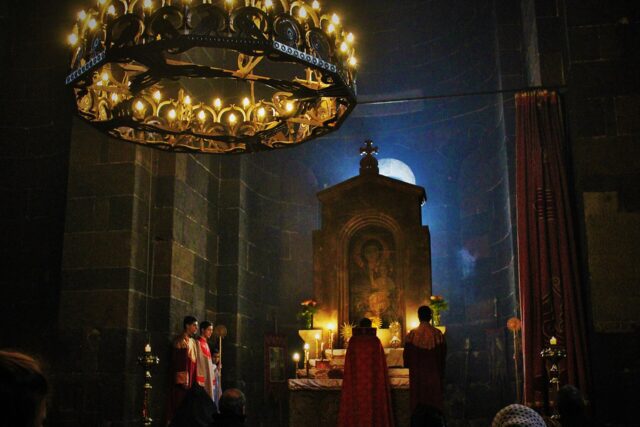
The name Etchmiadzin means “the place where the Only-Begotten descended,” a reference to a vision St Gregory is said to have had marking where the first church should stand. The building has been rebuilt and reinforced many times over seventeen centuries, so what you see mixes early foundations with later stonework, frescoes and a bell tower. It functions today as a working spiritual centre, not a museum — the equivalent, in status, of a Vatican for Armenian Christians worldwide.
The 2024 reopening — why some guidebooks are now wrong
Here is the detail most competing articles still get wrong. The cathedral closed in 2018 for a major structural restoration — foundation, frame, roof and load-bearing walls, the deepest work on the building since the 1620s — and it was re-consecrated and reopened on 29 September 2024. A lot of older travel content, and even some current pages, still tell readers it is “closed for renovation.” It is not. The restoration also cleaned centuries of candle soot from the interior frescoes. If you were put off visiting by an out-of-date warning, that warning has expired. Last verified: July 2026.
Reporting on the reopening: JAMnews and EVN Report.
The complex also holds a Treasury museum whose relics carry enormous weight for believers — among them items venerated as the Holy Lance and a fragment associated with Noah’s Ark. Whether or not those attributions move you, they explain why Etchmiadzin draws pilgrims from the global Armenian diaspora, not just tourists. The seat of the Catholicos has been based here for most of the church’s history — from 303 to 484, and continuously again since 1441 — which is why Armenians the world over look to this one small town in the Ararat plain.
Where can you see this heritage as a traveller?
Three sites west and south of Yerevan tell the whole 301 story between them, and all three make comfortable half-day or day trips from the capital. If you only have time for one, go to Khor Virap for the drama and the Mount Ararat view; if you want the living church, go to Etchmiadzin.
- Etchmiadzin Cathedral (Vagharshapat, ~20 km W) — the Mother See and the reopened centrepiece. Pair it with the nearby churches of St Hripsime and St Gayane, both also part of the UNESCO listing.
- Khor Virap (~35–40 km S) — the monastery over the pit where St Gregory was imprisoned. You can climb down a metal ladder into the pit itself. It also frames the classic view of Mount Ararat, which sits just across the closed border in Turkey.
- Zvartnots (between Yerevan and Etchmiadzin) — the ruins of a spectacular circular 7th-century cathedral built by Catholicos Nerses III, toppled by an earthquake and excavated in the early 1900s. Also UNESCO-listed, and easy to combine with Etchmiadzin as they sit on the same road.
Because Zvartnots and Etchmiadzin lie on the same western route, most travellers do them as one outing; Khor Virap is a separate southern trip, often bundled with Noravank and the Areni wine village. For how to string these together, see our guide to day trips from Yerevan and the wider best monasteries in Armenia. If you are still shaping your itinerary, the best things to do in Armenia roundup places these religious sites alongside everything else worth your days.
What should you know before visiting these sites?
Etchmiadzin, Khor Virap and Zvartnots are all free to enter. These are active religious and heritage sites, so dress modestly — shoulders and knees covered, and it’s courteous for women to carry a scarf for the head inside the cathedral. Photography is generally fine outside; be discreet during services.
| Site | Distance from Yerevan | Entry | Best paired with |
|---|---|---|---|
| Etchmiadzin Cathedral | ~20 km west | Free (Treasury museum separate) | Zvartnots, St Hripsime |
| Zvartnots ruins | ~15 km west | Small fee for the site/museum | Etchmiadzin |
| Khor Virap | ~35–40 km south | Free | Noravank, Areni |
Practical notes, last verified July 2026: opening hours run roughly 8:00–18:00 daily and shift with the season; the Treasury museum at Etchmiadzin keeps shorter hours and may close on Mondays, so confirm on the day. For the best Mount Ararat photo from Khor Virap, arrive early on a clear morning — the peak often hazes over by afternoon, and it is clearest between October and April. Getting to these places is straightforward by organised tour or taxi; public transport works for Etchmiadzin but is awkward for Khor Virap’s return leg. Our Yerevan travel guide covers transport and where to base yourself.
One honest editorial call: if your interest is the history rather than the architecture, Khor Virap rewards you more than photographs suggest, while Zvartnots is best appreciated if you like ruins and can picture the vanished dome — some visitors find it underwhelming without that imagination. For a very different but equally essential strand of Armenian identity, pair this with the Armenian Genocide Memorial in Yerevan. More context across the country’s story sits in our Culture & History section.
Featured image: Armen888 (CC BY-SA 4.0) via Wikimedia Commons