Armenia’s best monasteries are Tatev, reached by the world’s longest reversible cable car; Geghard, a UNESCO rock-cut complex east of Yerevan; Khor Virap, framed by Mount Ararat; Noravank, set against a red-cliff gorge; and Etchmiadzin Cathedral, seat of the world’s oldest state church and re-consecrated in 2024. Nearly all charge no entry fee.
Armenia was the first nation to adopt Christianity as its state religion, in 301 AD, and its monasteries are the physical record of that history. They are also, for most travellers, the single strongest reason to leave Yerevan. What follows is a research-led rundown of the ones worth your time: the setting, why each matters, what you pay, and exactly how to get there. Prices and hours carry a Last verified: July 2026 stamp because they move — always reconfirm the volatile ones at the official source.
One clarification first, because generic guides get it wrong: Garni is a Greco-Roman temple, not a monastery. It is the only standing colonnaded temple in the former USSR, it is usually paired with Geghard on the same day trip, and it charges 1,500 AMD (~$4) to enter — but it belongs in a different category. We cover it in our day trips from Yerevan guide rather than here.
Which monasteries should you prioritise?
If you only have a few days, our editorial call is straightforward. Do Geghard (paired with Garni) as an easy half-day, and Khor Virap for the Ararat view. Add Noravank and Sevanavank if you have a car or a tour. Tatev is the showpiece but the furthest — treat it as a commitment, not a casual add-on. Etchmiadzin is quick, close to the city, and newly reopened, which makes it the freshest thing on this list.
Tatev Monastery and the Wings of Tatev cable car
Tatev is a 9th-century monastery perched above the Vorotan gorge in the far south, and the reason most people make the trip is the Wings of Tatev — recorded as the world’s longest reversible aerial tramway at 5.7 km, running roughly 11–12 minutes each way between Halidzor and the monastery. The ride over the canyon is the experience; the monastery at the end is a serious, atmospheric complex in its own right.
Ticket prices are the one thing sources disagree on, so we publish a range and send you to the source: a round trip is roughly 6,500–9,000 AMD (~$18–25) for an adult. Confirm the current fare on the official page, tatever.am, before you travel. Hours shift by season (Oct–Apr 10:00–18:00; May 10:00–19:00; Jun–Aug 9:00–20:00; Sep 10:00–19:00), and the cable car is closed Mondays except in peak summer — reconfirm that too.
The catch is distance: Tatev sits about 250 km / 4+ hours south of Yerevan. There is no direct marshrutka. The realistic options are a long organised day tour, or a marshrutka to Goris (from Kilikia Central Bus Station, ~2,500–3,500 AMD, 4–6 hours, roughly twice daily) and then a taxi from Goris to Halidzor (~2,500 AMD). Honest advice: public transport for a same-day return is impractical. Book a tour, or overnight in Goris and take your time. Last verified: July 2026.
One point on safety, because it worries some readers: the Tatev area itself is a normal, popular destination and well within the safe tourist zone. The sensitivity in Syunik is confined to the far-southeast highway near the closed Armenia–Azerbaijan border, not the monastery or the standard Goris–Tatev route. Advisories are worth a quick recheck the week you travel, but Tatev is not the concern.
Geghard Monastery: the rock-cut UNESCO site
Geghard is the one to see if you see only one. A UNESCO World Heritage site about 40 km east of Yerevan, part of it is literally carved out of the mountainside — chambers, columns and khachkars hewn directly from the rock, with remarkable acoustics inside. Entry is free, and it is open roughly 8:00–20:00.
Getting there is easy and cheap if you combine it with Garni, which lies about 10 km away. A marshrutka from the Gai statue / Raykom (Mercury) stop runs 300–600 AMD and takes around an hour, but many stop at Garni village, about 4 km short of Geghard — you finish the last leg by taxi. That awkward final stretch is exactly why most people do Garni, the Symphony of Stones basalt columns, and Geghard together as one 5–8 hour trip by tour or car. Last verified: July 2026.
Khor Virap: the monastery beneath Mount Ararat
Khor Virap earns its place through its backdrop. The monastery itself is modest, but it stands on the plain about 35–40 km south of Yerevan directly in front of Mount Ararat — the mountain that anchors Armenian identity, now about 20 km away across the border in Turkey. Entry is free.
Here is the timing that nobody tells first-timers plainly: the Ararat view is not guaranteed. Go early morning and, ideally, between October and April, when the peak is clearest; through summer the mountain hazes over and you can stand there seeing nothing. For transport, a marshrutka toward Ararat costs around 500 AMD but leaves you roughly a 1.5 km walk from the site, with limited and awkward return departures — which is why a tour or taxi is the common choice. If the view matters to you, plan the trip around clear weather and an early start. Our best time to visit Armenia guide breaks the seasons down further. Last verified: July 2026.
Noravank: the red-cliff gorge monastery
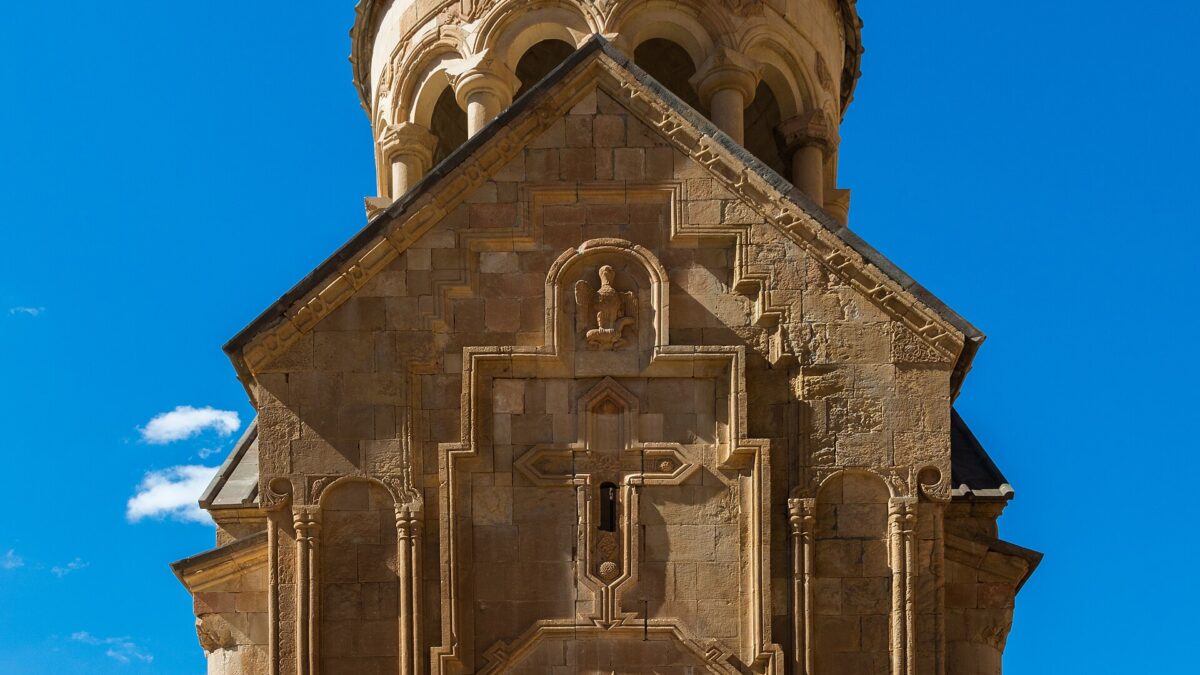
Noravank is a 13th-century monastery in Vayots Dzor, about 120 km southeast of Yerevan, and its setting is the draw — a complex of ochre stone set against sheer red cliffs at the end of a narrow gorge. Its best-known church is a two-storey design with a narrow external stone stair climbing the facade. Entry is free.
Noravank pairs naturally with the Areni wine village nearby (home to Areni-1, the world’s oldest known winery) and is often bundled with Khor Virap into a single southern day trip. There is no clean public-transport route to the monastery door, so a car or an organised tour is the practical way in. Last verified: July 2026.
Sevanavank: the monastery on Lake Sevan
Sevanavank is a 9th-century monastery on a peninsula jutting into Lake Sevan, about 65 km northeast of Yerevan. It was once an island; the Soviet-era drop in the lake’s level joined it to the shore. A short flight of steps takes you up to the churches, and the reward is the view over the high-altitude lake (around 1,900 m). Entry is free.
It is one of the more accessible sites on this list. A marshrutka from the Gai / Northern station to Sevan runs roughly 800–1,500 AMD and takes 45 minutes to 1.5 hours, with departures about hourly; the monastery is a short taxi from Sevan town. Sevanavank pairs well with Dilijan, and if you are here in July or August the lake is warm enough (~20–22°C) for a swim. Last verified: July 2026.
Haghartsin and Goshavank: monasteries in the Dilijan forest
Dilijan, in Dilijan National Park, is Armenia’s forested north, and it hides two fine monasteries in the trees. Haghartsin is a restored 13th-century complex set among wooded hills, and Goshavank sits a short distance away — the two connect via a walkable landscape, with a roughly 7 km trail linking Parz Lake to Goshavank for anyone who wants to hike between forest, lake and monastery.
Reach Dilijan by marshrutka from the Gai / Northern station, roughly 1,200–1,700 AMD, 1.5–2 hours, running every 60–90 minutes. From the town you will want a taxi or a tour for the monasteries themselves. Last verified: July 2026.
Haghpat and Sanahin: the UNESCO pair in Debed Canyon
In the northern Lori region, the Debed Canyon holds Haghpat and Sanahin, a pair of medieval monasteries inscribed together on the UNESCO World Heritage list. They are among the country’s most important surviving examples of medieval Armenian monastic architecture, sitting a few kilometres apart above the canyon. They see fewer tour buses than the sites closer to Yerevan, which is part of the appeal.
They lie off the northern route toward Vanadzor (marshrutka from Gai / Northern, ~1,500–2,000 AMD, 2–2.5 hours), and are best reached with a car or a dedicated northern tour rather than on a casual day trip. Last verified: July 2026.
Etchmiadzin Cathedral: the mother church, reopened in 2024
Etchmiadzin, in Vagharshapat about 20 km west of Yerevan, is the Mother See of the Armenian Apostolic Church and the spiritual centre of the nation. Built in AD 301–303, tied directly to Armenia becoming the first country to adopt Christianity as its state religion in 301 AD, it is often described as the oldest state-built cathedral in the world and is UNESCO-listed.
Here is the detail competitor guides keep getting wrong: many still say it is “closed for renovation.” It is not. After a six-year restoration, the cathedral reopened and was re-consecrated on 29 September 2024. Entry is free, and it is open daily, roughly 8:00–18:00 by season; the Treasury museum keeps shorter hours and may close Mondays. Modest dress applies. It is close, quick and current — a strong pairing with our culture and history coverage of Armenia’s Christian roots. Last verified: July 2026.
Monastery etiquette: how to visit respectfully
These are not museums. They are active places of worship, many of them still in daily use, and visitors are welcome on that basis. A few simple rules keep you on the right side of it:
- Dress modestly. Cover shoulders and knees. Women often cover their heads inside; many churches keep scarves by the door if you need one.
- Keep quiet. Lower your voice, silence your phone, and step aside if a service or a prayer is under way.
- Ask before photographing people — especially clergy and anyone praying. Some interiors restrict photography or flash.
- Move gently. Do not climb on khachkars or altars, and follow any signage or a caretaker’s direction without argument.
None of this is onerous, and Armenians are warm about sharing these sites. Treating them as living churches rather than photo stops is simply the price of entry — and it is free everywhere except the Tatev cable car.
Planning your monastery route
A practical way to think about it: the eastern cluster (Geghard) and the Ararat-plain sites (Khor Virap, extendable to Noravank) each make a comfortable day from the capital, while Sevanavank and Dilijan cover the north and Tatev demands a long day or an overnight in the south. For a fuller loop, see our best things to do in Armenia roundup and use our Yerevan travel guide to base yourself before heading out. Reconfirm any price or opening hour at the official source before you go — Armenia’s fares and seasonal schedules genuinely change.
Featured image: Diego Delso (CC BY-SA 4.0) via Wikimedia Commons