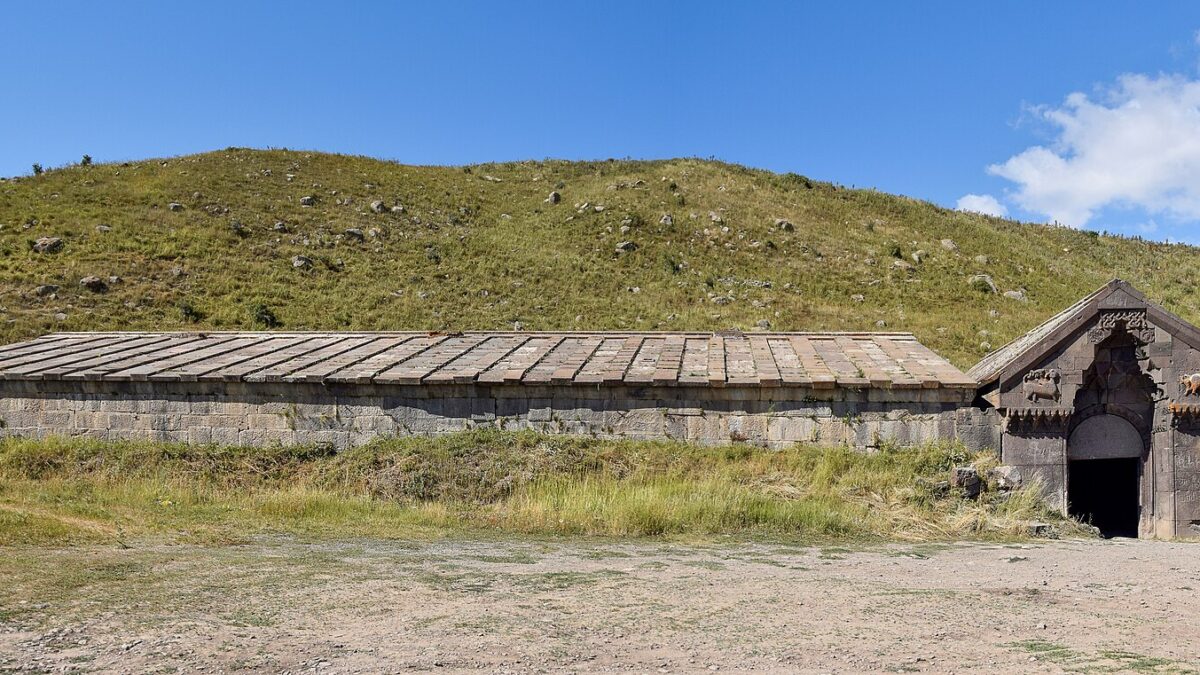
The Selim Caravanserai, also called Orbelian’s Caravanserai, is a stone inn built in 1332 to shelter merchant caravans crossing the mountains between Vayots Dzor and Lake Sevan. It sits near the top of the Vardenyats (Selim) Pass at roughly 2,400 metres, and it is the best-preserved medieval caravanserai in Armenia — a low, dark basalt hall that once housed traders, camels, mules and horses on a branch of the Silk Road.
If you are driving Armenia’s north–south interior route, it is one of the few places where you can walk straight into an intact piece of medieval trade infrastructure, free of charge, with almost nothing between you and the 14th century except the wind at the pass. Here is what it is, how to get there, and how to fit it into a wider Vayots Dzor or Lake Sevan trip.
What is the Selim Caravanserai?
A caravanserai was a roadside inn where trade caravans stopped to rest, water their animals and shelter overnight. The Selim Caravanserai is the surviving example that best keeps its original form. An inscription dates its construction to 1332 and credits Prince Chesar Orbelian, a member of the Orbelian noble house that governed the Syunik and Vayots Dzor region under Mongol-era rule. That is why you will see it labelled two ways — “Selim” after the pass it guards, and “Orbelian’s” after the family who paid for it.
Its job was practical. The pass linked the Vayots Dzor valley in the south with the Gegharkunik basin and Lake Sevan to the north, part of the older Dvin–Partav trade corridor that fed into the wider Silk Road network. Crossing a 2,400-metre mountain pass with loaded animals was slow and dangerous, especially as weather turned, so a solid stone refuge at the top was worth building well. Nearly seven centuries later, it is still standing.
The timing matters to the story. The 14th century was the tail end of the era when Mongol authority kept the long east–west caravan routes across the region relatively secure and profitable. Building a caravanserai here was both a public service and a statement of the Orbelian family’s standing along a route they controlled. That commercial world faded within a couple of centuries as trade patterns shifted, which is part of why so few of these inns survive elsewhere — they lost their purpose and were left to collapse. The Selim building endured, was repaired in the 20th century, and is why you can walk into it today.
Why it is worth the detour
Armenia has hundreds of monasteries, and after a few days many travellers feel church-fatigue. The caravanserai is a different kind of monument — secular, functional, and genuinely rare. Very few medieval caravanserais survive intact anywhere in the South Caucasus, and this one asks nothing of you: no ticket booth, no crowds, no restoration scaffolding. The reward is atmosphere rather than decoration, so manage expectations. It is a dark, bare hall in a spectacular setting, not a museum with displays.
What is it like inside?
The building is a single long hall built from rough basalt, partly set into the slope so it holds heat and resists the wind. Step through the entrance and the temperature drops and the light falls away fast — bring a phone torch. The interior is divided into aisles by stone piers, with a raised central nave and lower side bays. The design was deliberate: animals were tethered and fed in the side aisles while traders slept and stored goods in the drier central space. Small openings in the roof let in thin shafts of daylight and let smoke escape.
The stonework near the entrance carries carved inscriptions in Armenian and Persian, a reminder that this was a multilingual trade route, not a purely Armenian religious site. Give your eyes a minute to adjust and the scale becomes clear — this was built to hold a whole caravan, not a handful of people. There are no ropes, no glass cases and no labels, so you experience the space as merchants would have: enter from the cold, feel the hall close around you, and imagine it full of tethered animals and stacked goods.
How long to spend there
Honestly, 20 to 40 minutes covers it: time to walk the hall, read the inscriptions, and take in the pass from outside. The setting is half the point. Plan the stop around the drive rather than the building, and treat the surrounding views as part of the visit.
Where is the Vardenyats (Selim) Pass?
The caravanserai stands just below the summit of the Vardenyats Pass, historically known as the Selim Pass, in the Vayots Dzor province of south-eastern Armenia. The road climbs in tight switchbacks to around 2,400 metres, which is why the views are the other reason to come. On a clear day you look out over folded, treeless highland ridges that turn gold in autumn.
The pass links two very different trip regions. To the south lie the Vayots Dzor highlights — Noravank monastery in its red-cliff gorge and the wine village of Areni. To the north the road descends toward Martuni and the southern shore of Lake Sevan. This position is what makes the caravanserai easy to slot into a bigger itinerary rather than a standalone destination.
How do you get to the Selim Caravanserai?
Realistically, you need a car or an organised tour. There is no public bus that stops at the pass, and the site is high on a mountain road well away from any town. Your practical options:
- Self-drive: the most flexible choice. Economy car rental in Armenia runs roughly USD 25–40 per day, with a sedan around USD 35–50; budget another USD 8–15 per day for collision cover. The pass road is paved but steep and winding, so allow extra time and drive cautiously, especially if livestock are on the road.
- Private driver or day tour: many Yerevan-based drivers and tour operators fold the caravanserai into a Vayots Dzor day (often paired with Noravank and Areni). This is the low-stress option if you would rather not tackle mountain switchbacks yourself.
- As a through-stop: if you are driving between southern Armenia and Lake Sevan on the interior route, the caravanserai is directly on your path — no detour at all.
How far is it from Yerevan?
The pass is roughly a 2 to 2.5 hour drive south-east of Yerevan, depending on your route and how long you linger in the Areni–Noravank area on the way. Because it is a mountain-road stop rather than a town, there are no facilities at the site itself, so fuel up and buy water and snacks in Yeghegnadzor or Areni before you climb.
When is the best time to visit?
Late spring through autumn is the safe window, and this is the single most important planning point: the pass can be closed by snow in winter. At 2,400 metres, the Vardenyats Pass gets heavy snow, and the road may be shut or impassable from roughly late autumn into spring. If you are travelling between November and April, do not assume you can drive the pass — check conditions locally first, and have the alternative in mind.
There is a low-altitude bypass: the Fontan tunnel route lets traffic cross between Vayots Dzor and the Sevan basin when the pass is snowbound, but it does not pass the caravanserai. In practice that means the caravanserai is a warm-season stop. September and early October are ideal — dry, clear, and with the highland turning gold, matching Armenia’s best travel window overall.
Is there an entry fee?
The caravanserai is an open historic monument rather than a ticketed attraction, and it is typically free to enter or very low cost, with no formal booth at the pass. Because small-site arrangements can change, confirm current details on the official Armenia tourism portal before you go rather than relying on a fixed figure here.
What to combine it with
The caravanserai works best as one stop on a fuller day rather than a target in itself. Two natural pairings:
- Southern Vayots Dzor day (most popular): combine it with Noravank, the 13th-century monastery famous for its dramatic red-cliff gorge and two-storey church with an external stone stair, and Areni, the wine village home to the Areni-1 cave — the site of the world’s oldest known winery, dated to around 6,100 years, and the oldest known leather shoe. Tastings at village wineries typically cost a few thousand dram.
- Sevan crossing: if you are heading north, continue down to Lake Sevan and the 9th-century Sevanavank monastery on its peninsula, roughly an hour further on, making the caravanserai the scenic high point of the drive between the two regions.
Practical tips before you go
- Bring a light — the hall is genuinely dark inside.
- Dress warmer than the valley: at 2,400 metres it is windy and cooler than Yerevan even in summer.
- No shops, cafes or toilets at the pass — stock up in Areni or Yeghegnadzor.
- Fill the fuel tank before the climb; stations are sparse on mountain roads.
- Winter travellers: verify the pass is open before committing to the route.
Last verified: September 2026.
Sources
- armenia.travel — official national tourism portal (site status, access, opening details)
Frequently asked questions
What is the Selim Caravanserai?
It is a stone medieval inn built in 1332 by Prince Chesar Orbelian on the Vardenyats (Selim) mountain pass in Vayots Dzor. Caravans on a Silk Road branch between Vayots Dzor and Lake Sevan sheltered their traders and animals in its long basalt hall. It is Armenia’s best-preserved caravanserai.
How do you get to the Selim Caravanserai?
You realistically need a car or a tour — there is no bus to the pass. It sits about 2 to 2.5 hours south-east of Yerevan by road, high on the Vardenyats Pass. Many Vayots Dzor day tours combine it with Noravank and Areni.
Is the Selim Caravanserai open in winter?
Often not. The Vardenyats Pass sits at around 2,400 metres and can be closed by snow from roughly late autumn into spring. Travel between November and April with caution and check road conditions locally first; the caravanserai is really a warm-season stop.
How much does it cost to enter?
The caravanserai is an open historic monument, typically free or very low cost, with no formal ticket booth at the pass. Because arrangements for small sites can change, confirm current details on the official armenia.travel portal before your trip.
What can you combine with a visit?
The most popular pairing is a southern Vayots Dzor day with Noravank monastery and the wine village of Areni, both south of the pass. Heading north, you can continue down to Lake Sevan and Sevanavank monastery, roughly an hour further on.
How long should you spend at the caravanserai?
About 20 to 40 minutes is enough to walk the hall, read the Armenian and Persian inscriptions and take in the pass. It is a bare, atmospheric stone hall rather than a museum, so the mountain setting is a big part of the visit.
Featured image: Photographer: Mosbatho, CC BY 4.0 — via Wikimedia Commons.