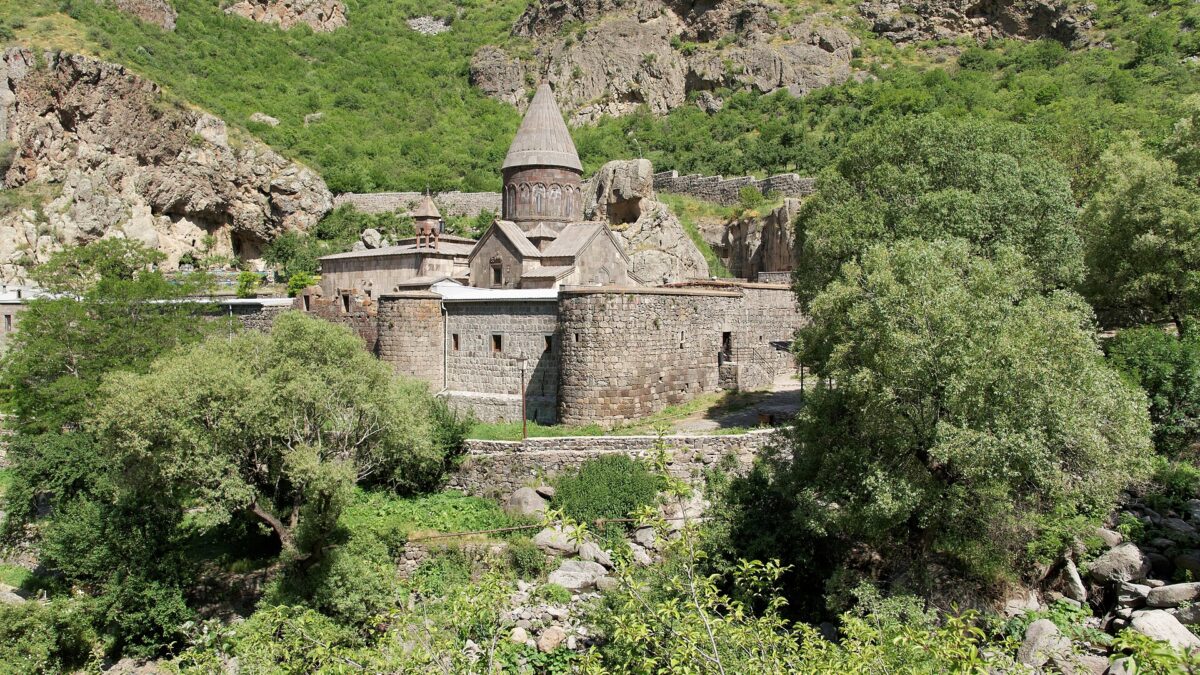
Geghard Monastery is a medieval Armenian Apostolic monastery in the Kotayk province, about 40 km east of Yerevan, partly carved directly out of the cliff at the head of the Azat river gorge. It is a UNESCO World Heritage Site and entry is free, with the grounds open roughly 08:00 to 20:00. Nearly everyone visits it on a half-day trip from Yerevan combined with the Garni temple and the Symphony of Stones basalt columns, roughly 10 km down the same valley.
What is Geghard Monastery?
Geghard (Armenian: Geghardavank, “the Monastery of the Spear”) is a complex of churches and tombs, some free-standing and some cut entirely into the surrounding rock. The main chapel, Katoghike, was completed in 1215 under the Zakarian princes, but the site is far older: tradition traces it to a spring-fed cave sanctuary founded in the 4th century, when Armenia had recently become the world’s first state to adopt Christianity. The name comes from a relic once kept here, the lance said to have pierced Christ at the crucifixion, now held in the treasury at Etchmiadzin.
UNESCO inscribed the site in 2000 under the title “Monastery of Geghard and the Upper Azat Valley,” citing both the rock-cut architecture and its dramatic gorge setting. That combination, working stone churches hollowed out of a living cliff, is the reason it belongs on a first-time Armenia itinerary rather than being an also-ran monastery.
What to see inside
The appeal of Geghard is what you cannot see from the car park. Behind the main church, several chambers are excavated straight into the mountain, so the “walls” are the cliff itself.
- The rock-cut churches (gavits and chapels): Walk through the main church into the adjoining rooms carved from the rock. One chamber is built around the natural spring that made this a holy place long before the stone churches went up; visitors still touch the running water.
- The acoustics: The carved chambers have a long, resonant echo. If you time your visit for one of the informal a cappella performances that sometimes take place inside, the sharakan (Armenian sacred chant) fills the stone room in a way no built church reproduces. Even without singers, clap once and you will hear why.
- Khachkars: The site is covered in khachkars, the intricately carved Armenian cross-stones, cut both into free-standing slabs and directly into the cliff faces around the complex. Look up the gorge walls above the buildings, not just at eye level.
- The upper chambers and reliefs: A stair leads to an upper rock-cut room with carved animal reliefs and family crests of the Proshyan princes who expanded the monastery in the 13th century.
Give yourself 45 minutes to an hour on the grounds. It is compact, but the interiors reward slow looking, and the crowd thins noticeably once the mid-morning tour buses move on.
How do you get to Geghard from Yerevan?
Geghard sits about 40 km east of Yerevan and takes roughly an hour to reach by road. There is no direct public bus to the monastery gate, which is the single most common trip-planning mistake, so choose your method deliberately.
| Option | Approx cost | Notes |
|---|---|---|
| Marshrutka (minibus) toward Garni | ~300–600 AMD (~$1–1.60) | Departs from the informal stop near the Gai statue / Mercury (Raykom) market in eastern Yerevan. Many services terminate in Garni village, about 4 km short of Geghard, leaving you to arrange a taxi for the last leg. |
| Taxi from Garni to Geghard | a few thousand AMD round trip | Drivers wait in Garni for exactly this gap; agree the fare, including wait time, before setting off. |
| Taxi / app car from Yerevan | varies (use GG or Yandex Go) | Book through an app rather than street-hailing so the fare is fixed in advance. Hiring a driver for the whole Garni–Geghard loop is common and often good value split between a few people. |
| Organised day tour | ~$25–50 per person | The simplest option; typically bundles Garni, Symphony of Stones and Geghard, and removes the last-4-km problem entirely. |
Our honest recommendation for most travellers: unless you are on a strict backpacker budget and enjoy the logistics puzzle, a shared taxi or a small-group day tour is worth it here. The marshrutka saves real money but drops you short of the actual monastery, and the return timing from Garni village back to Yerevan can be awkward in the afternoon.
Combining Geghard with Garni and the Symphony of Stones
Garni and Geghard are about 10 km apart in the same river valley, and almost no one visits one without the other. The efficient order is Garni first, then walk or drive down into the gorge for the Symphony of Stones, then finish at Geghard further up the valley.
- Garni Temple: A 1st-century Greco-Roman colonnaded temple, the only standing Greco-Roman building of its kind in the former Soviet space. Entry is about 1,500 AMD (~$4). Summer hours run roughly 10:00 to 21:00, shortening to about 10:00 to 17:00 in winter.
- Symphony of Stones: A wall of towering hexagonal basalt columns in the Garni gorge, formed by cooling lava. It is a free natural formation reached by the road down into the gorge below the temple; some visitors walk, others drive.
- Geghard: Free entry, open roughly 08:00 to 20:00, and the natural finale further up the valley.
Budget five to eight hours for the whole loop from Yerevan, including travel. It fits comfortably into a single morning-to-afternoon outing and is the classic day trip from the capital.
A short history you can carry with you
Knowing a little of the timeline makes the stones read differently. The earliest sanctuary here grew around a mountain spring and a cave, and the site was long known as Ayrivank, the “Monastery of the Cave.” That early complex was destroyed by Arab raids in the 9th century. What stands today is largely the work of the 12th and 13th centuries: the Zakarian princes acquired the site and finished the main church, Katoghike, in 1215, and the powerful Proshyan family then funded the rock-cut chambers, the carved tombs, and the reliefs bearing their emblems. The monastery took its present name from the lance relic, and for centuries it drew pilgrims specifically to venerate it. Reading the walls in that order, cave shrine, medieval churches, princely tombs, turns a quick photo stop into something you actually understand.
Common mistakes to avoid
- Assuming a bus goes to the gate. The most frequent error is expecting public transport to reach Geghard itself. Marshrutkas serve Garni village, roughly 4 km short, so budget for a taxi or tour for the final climb.
- Doing them in the wrong order. Visiting Geghard first and Garni second wastes backtracking. Garni, then the Symphony of Stones in the gorge below it, then Geghard at the head of the valley is the natural flow.
- Arriving at the tour-bus peak. The carved chambers are small, and mid-morning can feel packed. Early or late is calmer, and the light in the gorge is better too.
- Underdressing for the interior. Even on a hot Yerevan day, the rock-cut rooms stay cool and dim. A layer and grippy shoes make the visit more comfortable.
When is the best time to visit?
Late April to June and September to October are the best windows for Armenia generally, and they suit Geghard well: mild temperatures and, in autumn, golden light in the gorge. September is often singled out as the single best month, dry and clear with autumn colour. Summer is fine but hot, and August afternoons can bring storms. Winter visits are atmospheric, with the possibility of snow on the cliffs, but bring warm layers because the rock-cut interiors stay cold.
For the day itself, aim to arrive early or after the mid-morning tour-bus wave. Geghard is a genuinely active pilgrimage site as well as a tourist attraction, and it is quieter and more moving with fewer people in the carved chambers.
Etiquette and what to bring
Geghard is a working monastery, so dress and behave as you would in any active church.
- Cover shoulders and knees. Women are usually expected to cover their heads inside; scarves are often available at the entrance, but bringing your own is smarter.
- Keep your voice down inside the chambers, especially if a service or a chant performance is underway.
- Ask before photographing people at prayer, and check for any signs restricting flash or photography in specific chapels.
- Wear shoes with grip. The stone floors are worn smooth and can be slippery, and the site involves steps and uneven rock.
- Carry cash in Armenian dram. Entry is free, but the last-leg taxi, snacks, and vendors selling gata (sweet bread) and dried fruit at the gate are cash-based.
Is Geghard worth it?
Yes, and it is one of the few Armenian monasteries that is genuinely unlike anywhere else, because so much of it is carved rather than built. Paired with Garni’s Roman columns and the basalt Symphony of Stones, it makes the strongest single day trip you can do from Yerevan without an overnight. If you only have time for one monastery outside the capital and want architecture plus scenery in one short trip, this is the one to pick.
Last verified: September 2026. Entry fees, hours and transport fares in Armenia change; reconfirm prices and opening times with official sources before you travel.
Sources
- UNESCO World Heritage Centre — Monastery of Geghard and the Upper Azat Valley
- armenia.travel — official tourism portal of Armenia
Frequently asked questions
Is Geghard Monastery free to enter?
Yes. Entry to Geghard Monastery is free. You only pay for transport to reach it, and separately for Garni Temple (about 1,500 AMD) if you combine the two, which most visitors do.
What are Geghard Monastery's opening hours?
The grounds are generally open from roughly 08:00 to 20:00. As a working monastery, access can vary around services and by season, so treat these as approximate and reconfirm locally before travelling. Last verified: September 2026.
How far is Geghard from Yerevan and how long does it take?
Geghard is about 40 km east of Yerevan and takes roughly an hour by road. There is no direct public bus to the monastery gate, so plan to use a taxi, an app car, or an organised tour for at least the final stretch.
Can you visit Garni and Geghard on the same trip?
Yes, and almost everyone does. They are about 10 km apart in the same valley. The usual order is Garni Temple, then the Symphony of Stones basalt columns in the gorge, then Geghard, allowing five to eight hours for the whole loop from Yerevan.
Is there a dress code at Geghard?
Yes. As an active monastery, cover shoulders and knees, and women are usually expected to cover their heads inside. Scarves are sometimes available at the entrance, but bringing your own is more reliable.
What is special about Geghard compared with other Armenian monasteries?
Much of Geghard is carved directly into the cliff rather than built, including rock-hewn chapels, a spring-fed chamber, and khachkars cut into the stone. The carved interiors also have striking acoustics, which is why sacred chant performances are sometimes held inside.
Featured image: Vyacheslav Argenberg, CC BY 4.0 — via Wikimedia Commons.