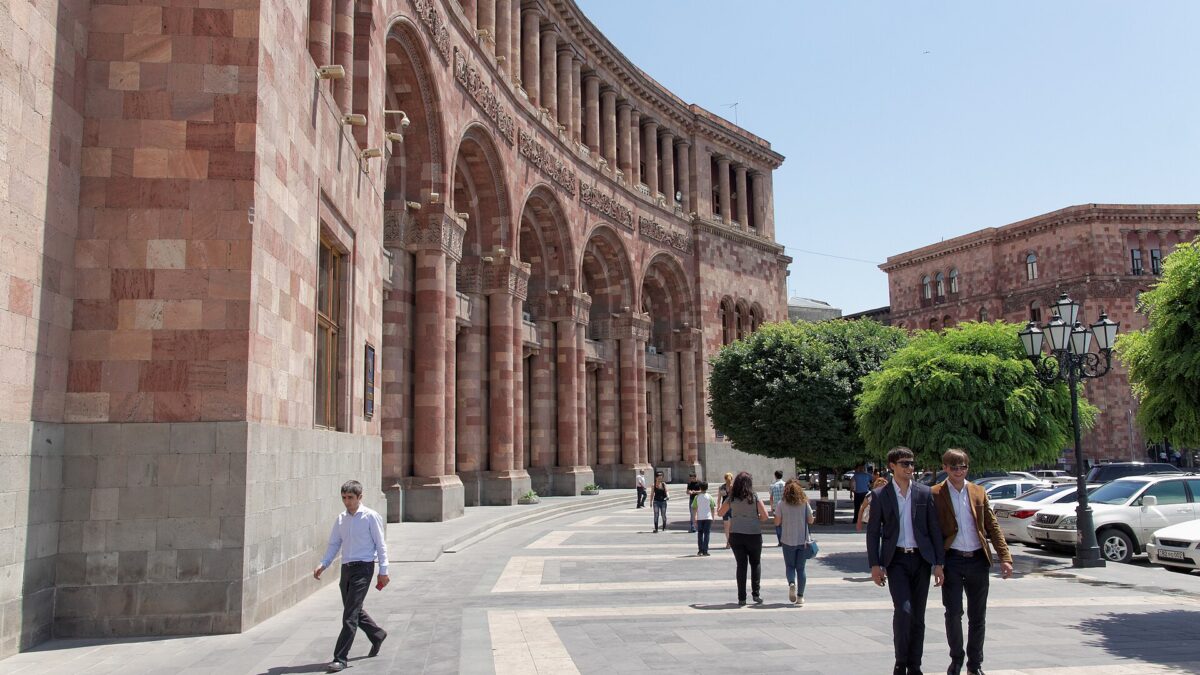
Republic Square is the ceremonial heart of Yerevan, a grand oval-and-rectangular plaza ringed by neoclassical government buildings clad in Armenia’s signature pink and apricot volcanic tuff. It was laid out as the centrepiece of architect Alexander Tamanyan’s early-Soviet master plan for the capital, and it holds the History Museum of Armenia and the National Gallery on its eastern side plus a large ornamental pool that hosts a musical singing-fountain show on summer evenings. Entry to the square is free, it sits at the exact centre of the city, and it is walkable to almost every other central sight.
What is Republic Square?
Republic Square (Hanrapetutyan Hraparak in Armenian) is Yerevan’s main civic space and the point from which the modern city radiates. It was conceived by Alexander Tamanyan, the architect behind Yerevan’s 1920s master plan, as a monumental government forum. The buildings around it were faced in tuff, the porous volcanic stone quarried across Armenia that gives Yerevan its warm pink, rose and apricot tones and earned it the nickname “the pink city”.
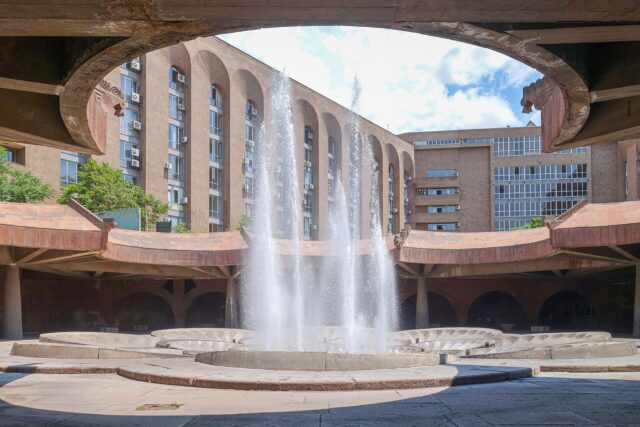
The square is not a single shape but two joined spaces: a broad trapezoid framed by public buildings, and a rounded section built around the fountain pool. Government House, with its clock tower, anchors the composition. The overall effect is deliberately theatrical, meant to be read as the dignified face of the capital, and the tuff cladding ties every facade into one colour family rather than a mix of materials.
Who designed it, and why does it look the way it does?
Alexander Tamanyan drew up the plan in the 1920s and 1930s. His idea was a ring of buildings in a shared architectural language, using Armenian decorative motifs carved into the neoclassical stonework, so the square would feel distinctly Armenian rather than a generic Soviet plaza. The consistent use of local tuff is the reason the whole square glows a soft pink at sunset and looks warmest in late-afternoon light. If you have already read our Yerevan travel guide, this is the set-piece that best explains why the city is described as rose-coloured.
What can you see on the square?
The dominant landmark is Government House. On the eastern side stands a single large building that houses two of the country’s most important collections: the History Museum of Armenia and the National Gallery of Armenia, stacked in the same monumental structure. These are ticketed institutions and worth budgeting a couple of hours for if you want the country’s archaeology and fine art in one stop.
Around the rest of the square are further public and former government buildings in the same tuff-clad style, along with a major hotel and, in the warmer months, the fountain pool that becomes the stage for the evening show. The square itself is open and pedestrian-friendly around the edges, though it carries traffic, so take normal care crossing to the central island.
| On or beside the square | What it is | Notes |
|---|---|---|
| Government House | Seat of government, with clock tower | The square’s architectural anchor; exterior only |
| History Museum of Armenia | National archaeology and history collection | Ticketed; eastern side of the square |
| National Gallery of Armenia | Armenia’s main fine-art museum | Ticketed; shares the same building |
| The fountain pool | Ornamental pool and singing-fountain stage | Free; evening show runs in the warm season |
What are the singing fountains, and when do they run?
The square’s best-known attraction is its musical fountain display. After dark in the warm months, the large ornamental pool comes alive with choreographed jets of water that rise, sway and change colour in time with music, from classical pieces to pop, drawing a nightly crowd who sit on the surrounding steps and low walls to watch. It is free, and it is the single best reason to come back to the square at night rather than only passing through by day.
The season runs roughly from late spring through early autumn, and the show takes place in the evening once it is dark, typically with several sets over a couple of hours. Exact start times and the season’s opening and closing dates shift year to year and are not published on a fixed permanent schedule, so we would not quote a precise showtime here. Check locally the day you plan to go, ask at your hotel, or consult the official tourism portal. Arrive a little before full darkness to get a spot on the steps facing Government House, which is the classic viewpoint.
What nobody tells you about the fountain show
Two practical points. First, the show is weather- and season-dependent; on a cool or wet evening outside the main season it may simply not run, so treat it as a bonus rather than a guaranteed fixture if you are visiting in the shoulder months. Second, the crowd builds as the evening goes on, so the earliest sets after dusk are the calmest for photos, while later ones have the fullest atmosphere. Either way, the pink tuff facades lit up behind the water are the shot most visitors remember.
The square as a gathering place
Beyond the fountains, Republic Square is where Yerevan gathers. It is the natural venue for national celebrations, open-air concerts and public events, and it is the spot the city dresses up for holidays, most visibly around the New Year, when a large festive display goes up in the centre. For a traveller this means two things: on an ordinary evening you will find families, couples and street performers around the pool, giving the square a relaxed social buzz; and on a major public date you may find it closed to normal foot traffic or packed for an event, so it is worth checking whether anything is scheduled if you have a specific evening in mind.
This civic role is part of why the square feels grander than its size suggests. Tamanyan designed it to function as the country’s front room, and it still does that job, which is a large part of its appeal over a purely decorative plaza.
A note on the museums
If you only have time for one interior stop on the square, choose based on your interest. The History Museum of Armenia runs from prehistory and the Bronze Age through medieval and modern Armenia, and it is the better pick for understanding the country you are travelling through. The National Gallery, in the same building, is the stronger choice if you want painting and fine art, including Armenian masters. Opening hours and closing days vary by season and both are ticketed, so confirm current times before you build them into a tight schedule.
When is the best time to visit the square?
The square is worth seeing twice: once by day for the architecture and museums, once after dark for the fountains and the floodlit buildings. For the daytime visit, late afternoon gives the warmest colour on the tuff. For the fountains, come on a clear summer or early-autumn evening. Armenia’s most comfortable travel months are broadly late April to June and September to October, with September often the pick, so a September evening tends to combine mild weather with the fountain show still running, though always confirm the season locally.
Because entry is free and the square is always open, it also works as a simple orientation stop on your first evening in Yerevan before you plan day trips. It costs nothing to walk through and get your bearings.
How does it connect to the rest of central Yerevan?
Republic Square’s biggest practical advantage is its position: almost everything central is within a short, flat walk. From the square you can stroll straight up Northern Avenue, the pedestrian boulevard of shops and cafes, toward the Opera House and on to the Cascade complex, the giant limestone stairway and sculpture garden. The Matenadaran, Armenia’s museum and repository of ancient manuscripts, sits at the top end of that same axis, and the Vernissage open-air market is a few minutes’ walk in the other direction. Because so much clusters here, we would base a first-time visitor within walking distance of the square rather than out in the suburbs.
The square is also on the city’s small metro system and is served by frequent public transport, and taxi apps will drop you here cheaply, so you rarely need to plan hard to reach it.
A suggested half-day on foot
- Start at Republic Square in the late afternoon for the architecture and, if time allows, the History Museum or National Gallery.
- Walk up Northern Avenue to the Opera House, pausing at the cafes.
- Continue to the Cascade for the sculpture garden and the city view from the top.
- Detour to the Matenadaran if manuscripts interest you, or to Vernissage on a weekend for crafts.
- Return to Republic Square after dark for the singing-fountain show.
Practical tips
- Cost: the square and the fountain show are free; the History Museum and National Gallery charge admission.
- Time needed: 20 minutes to walk through; half a day if you add a museum and return for the fountains.
- Photography: late afternoon for the pink tuff, after dark for the floodlit facades and illuminated water.
- Crossing: the central island carries traffic around it; use the crossings and take normal care.
- Fountain season: roughly late spring to early autumn, evenings only, exact times confirmed locally.
Last verified: September 2026.
Sources
- armenia.travel — official Armenia tourism portal (Yerevan sights, seasons and events)
Frequently asked questions
Is Republic Square free to visit?
Yes. The square itself and the evening singing-fountain show are free and open to the public. The History Museum of Armenia and the National Gallery of Armenia, which share a building on the eastern side of the square, charge separate admission.
When does the singing fountain show run in Republic Square?
The musical fountain display runs on evenings during the warm season, roughly late spring through early autumn, starting after dark. Exact start times and the season’s dates change year to year and are not fixed, so confirm locally on the day, through your hotel or the official tourism portal, rather than relying on a set schedule.
Who designed Republic Square?
It was conceived by the architect Alexander Tamanyan as part of his early 20th-century master plan for Yerevan. The surrounding buildings were faced in local pink and apricot volcanic tuff, which gives the square and much of the city its warm rose colour.
What is on Republic Square?
Government House with its clock tower anchors the square, and a single large building on the eastern side holds both the History Museum of Armenia and the National Gallery of Armenia. A large ornamental pool in the rounded section of the square becomes the stage for the summer singing fountains.
What is near Republic Square?
It is central and walkable. Northern Avenue leads from the square toward the Opera House and the Cascade complex, the Matenadaran manuscript museum sits along the same axis, and the Vernissage open-air market is a few minutes away on foot.
What is the best time to visit Republic Square?
See it twice: in late afternoon for the warm light on the tuff facades and the museums, and again after dark for the floodlit buildings and the fountain show. A clear evening in summer or early autumn, when Armenia’s weather is mildest, is ideal.
Featured image: Vyacheslav Argenberg, CC BY 4.0 — via Wikimedia Commons.