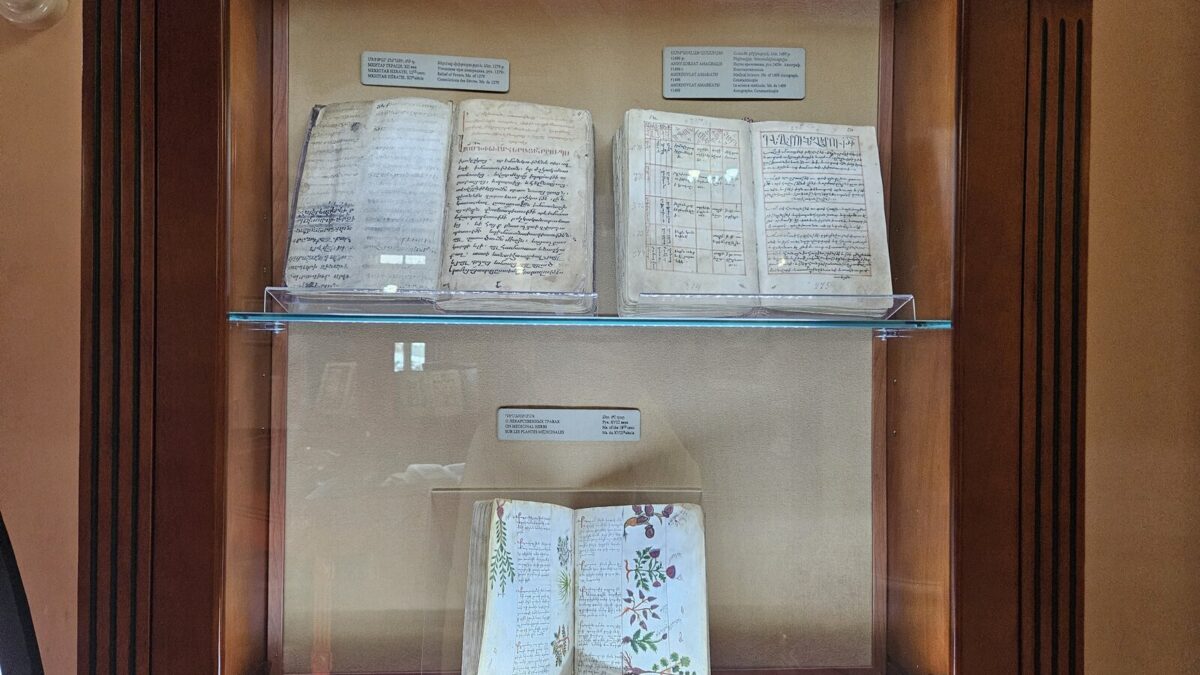
The Matenadaran is Yerevan’s museum and research centre for ancient manuscripts, officially the Mesrop Mashtots Institute of Ancient Manuscripts. It safeguards one of the world’s largest collections of Armenian handwritten books, roughly 17,000 or more manuscripts plus tens of thousands of archival documents, according to the institute (matenadaran.am). For anyone interested in the Armenian alphabet, illuminated Gospels, or the history of the written word, it is worth visiting, and the exhibition hall can be seen in about an hour to ninety minutes.
What is the Matenadaran?
“Matenadaran” is an old Armenian word meaning a repository of manuscripts. The modern institute sits at the top of Mashtots Avenue in central Yerevan, its grey basalt facade closing off the long boulevard that carries the same name. It is two things at once: a public museum with a permanent exhibition, and a working scholarly institute where manuscripts are studied, restored, and digitised.
The collection traces back to the manuscript holdings of Etchmiadzin, the seat of the Armenian Apostolic Church, which were nationalised in the Soviet era and moved to the purpose-built building that opened in 1959. Today it functions under Armenia’s government as a national research centre. The manuscripts are not only Armenian: the holdings include works in Arabic, Persian, Greek, Latin, Syriac, and other languages, reflecting Armenia’s position on the trade and cultural routes between East and West.
Is the Matenadaran worth visiting?
Yes, with a caveat about expectations. This is not a sprawling, interactive museum. It is a fairly compact, dignified exhibition of books, fragments, maps, and miniatures behind glass. If old paper and parchment leave you cold, an hour here may be enough. But if you have any curiosity about how a small nation kept its language and faith alive on the page through centuries of empire and invasion, the Matenadaran is one of the most meaningful stops in Yerevan, and arguably more important to Armenian identity than any single church.
Our honest editorial take: pair it with the story rather than treating it as a box to tick. A short read about Mesrop Mashtots and the Armenian alphabet before you go turns a room of manuscripts into something you actually understand. Read our companion piece on the Armenian alphabet and language first, and the exhibits click into place.
The statue of Mesrop Mashtots
Before you even reach the door, you meet the man behind the building. A large stone statue of Mesrop Mashtots sits on the terrace in front of the Matenadaran, shown teaching a pupil, with the letters of the alphabet he devised carved into the wall behind. Mashtots created the Armenian script around AD 405, a 36-letter system (later expanded to 39) designed specifically to fit the sounds of the Armenian language and to allow scripture and learning to be recorded in Armenian rather than Greek or Syriac.
The placement is deliberate. The alphabet made the manuscripts possible; the manuscripts preserved the alphabet. Standing at the foot of the statue, looking down the length of Mashtots Avenue toward the city, is one of the quieter but more resonant photo spots in Yerevan.
What you actually see inside
The permanent exhibition rotates individual items for conservation reasons, so the exact objects on display can change. That said, several highlights are near-constant fixtures, and the institute publicises them on matenadaran.am:
- Illuminated Gospels and miniatures. The heart of the collection is its medieval Armenian miniature painting, with jewel-toned Gospel books whose gold leaf and pigment have survived for centuries. Look for the work of named masters such as Toros Roslin, the finest of the 13th-century illuminators.
- The largest manuscript. The museum highlights the Homilies of Mush (Msho Charentir), a huge 13th-century volume that reportedly weighs around 28 kg. There is a famous survival story attached to it: it was carried to safety in two halves during the upheavals of the early 20th century.
- The smallest manuscript. At the other extreme, a tiny church calendar, described by the institute as weighing only a few grams, is usually displayed alongside its giant counterpart, a neat illustration of the collection’s range.
- Scientific and medical texts. Beyond scripture, there are manuscripts on medicine, astronomy, geography, philosophy, cookery, and law, evidence that this was a working intellectual tradition, not only a religious one.
- First printed Armenian books and maps. Early printing and cartography material shows the transition from the handwritten book to the printed page.
English labelling is present but can be brief, which is the main reason many visitors take a guided tour.
Tickets, hours, and guided tours
Treat all prices and times below as approximate, and confirm them on the official site (matenadaran.am) before you go, as they change and are not published in the fact bases we rely on for fixed figures. General museum entry in Yerevan typically runs about 1,000 to 2,500 AMD (roughly USD 3 to 7 at about 370 to 385 AMD to the dollar in 2026), and the Matenadaran’s standard adult ticket sits within that band, in the region of 1,500 to 2,000 AMD. Students and children usually pay less.
Guided tours in English (and other languages) are offered for an additional fee, and given the sparse labelling, we think they are the single best upgrade here, especially if you have not read up beforehand. Photography rules vary by hall and over time, so check the current policy at the ticket desk rather than assuming.
| Detail | Approximate (confirm on matenadaran.am) |
|---|---|
| Standard adult ticket | ~1,500-2,000 AMD (~USD 4-5) |
| Guided tour | Extra fee, book at the desk or in advance |
| Time needed | ~1 to 1.5 hours for the exhibition |
| Location | Top of Mashtots Avenue, central Yerevan |
One practical warning: opening days can catch people out. Many Yerevan museums close one day a week (often Monday), so verify the current schedule on the official site before making a special trip.
How to get there and what to combine it with
The Matenadaran anchors the northern end of Mashtots Avenue, so the easiest approach is simply to walk up the avenue from the centre. That walk is part of the appeal. On the way you can stop at the covered market and browse the shops, and the route links naturally to Yerevan’s other headline sights.
The smartest half-day plan is to combine the Matenadaran with the Cascade complex, which is a short walk east. Do the manuscripts first while your attention is fresh, then climb the Cascade’s giant stone staircase for city views and the open-air sculpture garden. Add Republic Square and you have a full, walkable day in the capital without needing a taxi. If you would rather not walk uphill, GG and Yandex Go rides within central Yerevan generally cost about 500 to 2,000 AMD; use the app rather than hailing on the street.
For a themed day around Armenian identity, the Matenadaran also pairs thematically with a trip to Etchmiadzin, whose manuscript holdings seeded this collection, though those two are on opposite sides of the city and better split across a morning and afternoon.
What nobody tells you
Two things. First, the building itself is worth a slow look, not just its contents: it is a strong example of mid-century Armenian architecture in carved basalt, and the entrance hall with its mosaic sets the tone before you reach a single manuscript. Second, the Matenadaran runs a research wing and, at times, temporary exhibitions and events that are not on the standard tourist radar; if you have a specific scholarly interest, the institute’s site lists what is currently on. For a general visitor, though, the permanent exhibition is the reason to come, and it does not take long to appreciate why UNESCO’s Memory of the World register includes material held here.
If your time in Yerevan is tight and you are choosing between sights, we would rank the Matenadaran among the essential three or four indoor stops in the city, alongside the History Museum on Republic Square. See our roundup of the best things to do in Armenia to slot it into a wider plan.
Best time to visit and practical tips
A few things make the visit smoother:
- Go earlier in the day. The exhibition halls are calmest in the morning, before the mid-day tour groups arrive, and the light on the terrace and Mashtots statue is better for photos then too.
- Check the closed day first. Because the museum is also a research institute, hours and weekly closures follow the official calendar rather than typical tourist-attraction patterns. Confirm on matenadaran.am so you do not arrive on a closed day.
- Dress is casual, but it is a serious place. Unlike an active church there is no strict dress code, yet the mood inside is quiet and studious. Keep voices down near the display cases.
- Budget for the tour, not just the ticket. The entry fee is modest, but the value here is context. If a guide is not available, at least read one exhibit’s story in depth rather than skimming everything.
- Allow a little extra for the terrace. The view back down Mashtots Avenue, the carved alphabet wall, and the statue are worth ten unhurried minutes before or after you go inside.
One detail that surprises first-time visitors: the manuscripts you see are the survivors of a much larger lost body of work. Centuries of invasion, fire, and displacement destroyed or scattered countless Armenian books, and part of what the Matenadaran commemorates is that loss. The conservation labs, digitisation programme, and the survival stories attached to individual volumes are all part of an ongoing effort to keep what remains readable for the next generation. Seen that way, a fairly small exhibition carries an outsized weight.
Last verified: September 2026. Prices, hours, and closed days are approximate and change; confirm current details on the official site before visiting.
Sources
- Mesrop Mashtots Institute of Ancient Manuscripts (Matenadaran) official site
- armenia.travel, official tourism portal of Armenia
Frequently asked questions
What does "Matenadaran" mean?
It is an old Armenian word meaning a repository or storehouse of manuscripts. The Yerevan institution’s full name is the Mesrop Mashtots Institute of Ancient Manuscripts, named after the creator of the Armenian alphabet.
How many manuscripts does the Matenadaran hold?
The institute reports a collection of roughly 17,000 or more manuscripts, along with tens of thousands of archival documents and fragments. Only a selection is on public display at any one time, since items are rotated for conservation. Check matenadaran.am for current figures.
How much does a Matenadaran ticket cost?
Treat prices as approximate and confirm on matenadaran.am. General Yerevan museum entry runs about 1,000 to 2,500 AMD, and the Matenadaran’s standard adult ticket sits in the region of 1,500 to 2,000 AMD (roughly USD 4 to 5 in 2026). Students and children usually pay less, and guided tours cost extra. Last verified: September 2026.
How long should I spend at the Matenadaran?
Most visitors find about one to one and a half hours enough for the permanent exhibition. Allow more if you take a guided tour, which we recommend because the English labelling is limited.
Where is the Matenadaran and how do I get there?
It stands at the top of Mashtots Avenue in central Yerevan. The nicest approach is to walk up the avenue from the centre; a GG or Yandex Go taxi within the city usually costs about 500 to 2,000 AMD. It combines well with the Cascade complex, a short walk away.
Is the Matenadaran worth visiting?
Yes, if you have any interest in history, language, or medieval art. It holds Armenia’s most important manuscripts, including illuminated Gospels and the famous largest and smallest manuscripts. It is less compelling if old books do not interest you, but it is central to understanding Armenian identity.
Featured image: Furkan Akkurt, CC BY-SA 4.0 — via Wikimedia Commons.


