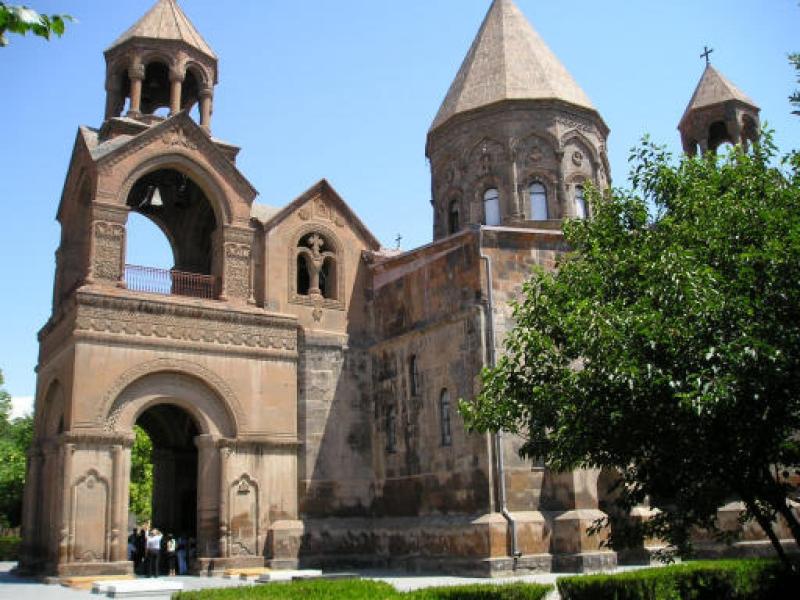
Etchmiadzin Cathedral is the mother church of the Armenian Apostolic Church and the seat of the Catholicos of All Armenians, in the town of Vagharshapat about 20 km west of Yerevan. It is one of the oldest cathedrals in the world, its founding traditionally dated to AD 301–303 when Armenia became the first nation to adopt Christianity as its state religion. After a roughly six-year restoration, the cathedral was re-consecrated and reopened to worshippers and visitors on 29 September 2024 — a detail many older travel guides still get wrong.
If you have read elsewhere that Etchmiadzin is “closed for renovation,” that information is out of date. The main church is open again, and a visit here now works exactly the way it did before the scaffolding went up: free to enter, easy to reach on a half-day trip from the capital, and best combined with the other UNESCO-listed churches around Vagharshapat. Here is what you actually need to know before you go.
What is Etchmiadzin Cathedral?
Etchmiadzin is the spiritual centre of the worldwide Armenian Apostolic Church — the equivalent, in status, of what the Vatican is for Roman Catholics. The full name of the complex is the Mother See of Holy Etchmiadzin, and it is the permanent residence of the Catholicos, the church’s supreme head. The name Etchmiadzin means, roughly, “the place where the Only-Begotten descended,” a reference to a vision in which Christ is said to have shown Gregory the Illuminator where to build the church.
The cathedral is usually described as the first cathedral built in ancient Armenia and one of the oldest in the world. Its origins are tied directly to the year 301, when King Tiridates III made Christianity the official religion of the Armenian kingdom — the earliest such adoption by any state. Along with the nearby churches of Saint Hripsime, Saint Gayane, and the ruins of Zvartnots, the cathedral was inscribed on the UNESCO World Heritage List in 2000. The town itself is officially called Vagharshapat, though many Armenians and signposts still use the name Etchmiadzin for the town as well as the church.
What was restored, and why does the 2024 reopening matter?
The cathedral closed to the public in 2018 for the most extensive restoration in its modern history. The work focused on stabilising and conserving the ancient structure — the dome, walls, and interior — along with the frescoes and stonework that had suffered from age, moisture, and earlier interventions. During those years the resident congregation moved services to the neighbouring Church of Saints Hripsime and other churches on the grounds.
The re-consecration ceremony on 29 September 2024 marked the formal return of worship to the main cathedral. For visitors, this is the single most useful piece of up-to-date information about Vagharshapat: the building at the heart of the complex is open again. It is worth checking the Mother See’s own announcements close to your travel date, because access to specific chapels or the interior can still be limited around major church feasts and ceremonies.
What is there to see inside and on the grounds?
The cathedral interior is comparatively restrained by the standards of grand European cathedrals — the pull here is age and religious significance rather than gilded excess. Expect carved stone, restored frescoes, and the quiet weight of a building that has been a place of worship for more than seventeen centuries. The wider walled compound also holds the residence of the Catholicos, an open-air altar, khachkars (Armenian carved cross-stones), and monastery buildings, so leave time to walk the grounds rather than only stepping inside the church.
The Treasury Museum and its relics
The most important things to see are kept in the Treasury (the museum within the complex), and this is where the cathedral’s famous relics are held. Chief among them is the Holy Lance, known as the Geghard — the spear that, by Armenian tradition, pierced the side of Christ, and which gives the better-known Geghard Monastery its name. The collection also traditionally includes a fragment of wood venerated as a relic of Noah’s Ark, along with reliquaries, manuscripts, vestments, and liturgical objects gathered over centuries.
The Treasury Museum keeps shorter and more variable hours than the church itself and may be closed on Mondays, so if the relics are the reason you are making the trip, treat the museum — not just the cathedral — as the fixture your visit is planned around, and confirm its opening times before you set out.
How much does it cost to visit?
Entry to Etchmiadzin Cathedral itself is free, as it is at most active Armenian churches. The Treasury Museum charges a separate, modest admission fee to see the relics and collection. We are deliberately not quoting an exact museum price here: small-site fees in Armenia change without much notice, and an out-of-date number is worse than none. Carry a little Armenian dram in cash for the museum ticket and for any candles or donations, since not every counter takes cards.
What are the opening hours?
The cathedral is generally open daily from around 8:00 to 18:00, with hours shifting a little by season. As an active church it also holds regular services; the main Sunday Divine Liturgy is the most atmospheric time to experience the place as a living cathedral rather than a monument, though it is also the busiest. If you specifically want to look around calmly and photograph the interior, a weekday morning is the better bet. The Treasury Museum, again, operates on its own shorter schedule and is the part most likely to be closed when you arrive unprepared.
How do you get to Etchmiadzin from Yerevan?
Vagharshapat is only about 20 km west of central Yerevan, so getting there is quick and cheap. You have three realistic options:
- Marshrutka (minibus) or bus: Regular minibuses run to Vagharshapat/Etchmiadzin from the Yerevan area near the Sasuntsi Davit railway station district. The ride takes roughly 30–45 minutes and costs only a few hundred dram, paid to the driver in cash. This is the budget choice; minibuses tend to leave when reasonably full rather than on a fixed timetable.
- Taxi or ride-hailing app: Using the GG or Yandex Go apps, a one-way car from central Yerevan is inexpensive and far faster than the minibus. Booking through the app avoids the tourist mark-up you get from street-hailed taxis, and you see the fare before you confirm.
- Organised day tour: Many Yerevan operators bundle Etchmiadzin with Zvartnots and sometimes Hripsime and Gayane, which solves the transport logistics between sites in one go.
What else is worth seeing nearby?
The smart way to plan this trip is to treat Vagharshapat as a small cluster of sites rather than a single stop. Within a short drive you can pair the cathedral with:
- Zvartnots Cathedral ruins — the striking 7th-century circular cathedral, now a ruin, that shares the UNESCO listing and sits roughly between Yerevan and Vagharshapat, making it a natural add-on to or from the city.
- Saint Hripsime Church — a beautifully proportioned 7th-century church, one of the finest examples of early Armenian architecture, on the edge of the town.
- Saint Gayane Church — another elegant 7th-century church a short distance from the cathedral, completing the historic ensemble.
All four sites together make a comfortable half-day trip. If you set out mid-morning from Yerevan, you can see the cluster and be back in the capital for a late lunch.
What should you wear, and how should you behave?
Etchmiadzin is a functioning cathedral and the holiest site in Armenian Christianity, so dress modestly: shoulders and knees covered for everyone, and it is respectful for women to carry a scarf to cover the head inside, as many local worshippers do. Keep your voice low, especially if a service is under way, and check for signs before photographing inside — the grounds are generally fine, but flash and photography can be restricted in certain chapels or during ceremonies. This is a place people come to pray, not only to sightsee, and a little care goes a long way.
Is it worth visiting?
Yes — and more so now than at any point in the last several years, because the main cathedral is open again after its long restoration. Architecturally it will not overwhelm anyone who has just come from a European cathedral tour; the value is in what it represents. Standing in the mother church of the world’s oldest state Christian church, in the country that adopted the faith first, is the kind of context that makes the rest of an Armenia trip make sense. Combined with Zvartnots and the two 7th-century churches, a Vagharshapat morning is one of the best-value half-days you can plan from Yerevan.
Sources
- The Mother See of Holy Etchmiadzin (Armenian Apostolic Church official site)
- armenia.travel — official tourism portal of Armenia
- UNESCO World Heritage List — Cathedral and Churches of Echmiatsin and the Archaeological Site of Zvartnots
Last verified: September 2026. Opening hours, museum admission fees, and access around church feasts can change — confirm current details with the Mother See or armenia.travel before you travel.
Frequently asked questions
Is Etchmiadzin Cathedral open in 2026?
Yes. The main cathedral reopened and was re-consecrated on 29 September 2024 after a roughly six-year restoration, so guides describing it as ‘closed for renovation’ are out of date. It is generally open daily from around 8:00 to 18:00, with seasonal variation, and hosts regular services.
How far is Etchmiadzin from Yerevan and how do I get there?
Vagharshapat, where the cathedral stands, is about 20 km west of central Yerevan. A marshrutka (minibus) or bus takes roughly 30 to 45 minutes for a few hundred dram, or you can take an inexpensive GG or Yandex Go taxi. Many day tours combine it with the Zvartnots ruins.
How much does it cost to visit Etchmiadzin Cathedral?
Entry to the cathedral itself is free, as at most active Armenian churches. The Treasury Museum inside the complex charges a separate modest admission fee to see the relics. Carry some Armenian dram in cash, as small counters may not take cards.
What relics are kept at Etchmiadzin?
The Treasury Museum holds the Holy Lance, or Geghard, the spear that by Armenian tradition pierced the side of Christ, along with a fragment of wood venerated as a relic of Noah’s Ark, plus reliquaries, manuscripts and liturgical objects. The museum keeps shorter, variable hours and may close on Mondays.
What should I wear to Etchmiadzin Cathedral?
Dress modestly, with shoulders and knees covered. Women often carry a scarf to cover the head inside, following local custom. Keep quiet during services and check signage before photographing indoors, as it may be restricted in some chapels or during ceremonies.
What can I combine with a visit to Etchmiadzin?
Pair it with the nearby UNESCO-listed sites: the 7th-century Zvartnots Cathedral ruins between Yerevan and Vagharshapat, and the elegant 7th-century churches of Saint Hripsime and Saint Gayane in the town. Together they make a comfortable half-day trip from Yerevan.
Featured image: Author of the photo is Heretiq, Public domain — via Wikimedia Commons.