Makenyats Vank (Մաքենյաց վանք, also written Makenots or Makenis Monastery) is a walled 9th-century monastery on a spur above the Makenis river, about 5 km south of Lake Sevan’s south-eastern shore and roughly 15 km from the town of Vardenis in Gegharkunik province. The main church of Surb Astvatsatsin was built by Grigor Supan II, the Syunik prince who also built Kotavank, and the site was one of the most important monastic schools of early medieval Armenia. It is far less visited than Sevanavank, sits at 2,187 m, and rewards anyone willing to leave the lake road for an hour. Go for the dark-stone church, the galloping-horse lintel and the khachkar-strewn cemetery, not for facilities, because there are none.
Foundation and the Supan princes
The monastery is older than its church. Written sources mention a community at Makenots from the 7th century, and the 13th-century historian Stepanos Orbelian, bishop of Syunik, describes its abbot Soghomon (Solomon) Makenatsi compiling a Tonakan — a feast calendar with readings — around 701. A 2012 article by Norayr Poghosyan in the Etchmiadzin journal, which works through what the Mekhitarist scholar Ghevond Alishan collected on the site, gives the clearest sequence: a first destruction in the early 8th century, a rebuild in 788 by Ter Soghomon (the same man who briefly became Catholicos Soghomon I Garnetsi in 791–792), then a second burning by the forces of the Persian rebel Babak, dated in Armenian chronicles to the late 820s. Before that raid the monks split up: half went with their abbot to Zresk monastery in Shirak, the rest to a monastery in Caucasian Albania (Artsakh).
The honest caveat: Orbelian’s chronology is muddled, and Alishan already said so. Orbelian lumps the 727–734 campaigns of the Arab governor Marwan together with Babak, who was active from 816 and could not have burned anything in 728, yet popular pages repeat “728, Babak, 15,000 killed” as one event. Treat the 15,000 as a chronicler’s number, not a census.
The rebuild that produced today’s church came in the second half of the 9th century under Grigor Supan II, prince of Syunik and lord of Gegharkunik (his mother Mariam, a Bagratuni, was the patron behind Sevanavank). According to Orbelian, Supan built Kotavank first, then the domed Surb Astvatsatsin at Makenots, walled the complex “with rocks” and endowed it lavishly. His foundation inscription on the east wall was already half-gone in Orbelian’s day and has now vanished, but Orbelian copied it. It lists a village, fishing rights, cash from Kotk, Deghdzanaget and Ani, five shops in Ani and seven vineyards in Yerevan. The round date of 851 you will see in English sources is not in the Armenian scholarship I read, which says simply “late 9th century”; Grigor Supan II’s activity is usually placed between about 859 and the early 900s.
Later history is thinner. In 1170 Catholicos Nerses Shnorhali sent to Makenyats for its monastic rule when he reformed church discipline, which tells you how much prestige the place still carried. It stayed independent of the Syunik metropolitan see until 1513, when it recognised Tatev, and is recorded as ceasing to function in 1878 (American University of Armenia monument database).
The monastic school
This is the part that makes Makenyats more than another ruined church. Orbelian writes that Stepanos Syunetsi — the 8th-century philosopher, translator and later bishop of Syunik — left Dvin after his studies and came to the “angel-filled” community at Makenots to study under Soghomon. A few years later Vahan Goghtnatsi, the prince of Goghtn who was executed as a Christian in 737, stopped at Makenots on his way to confess his faith before the caliph. Both links come from Orbelian via Alishan and the Christian Armenia encyclopaedia (2002); they are tradition recorded five centuries after the fact, but they are the tradition.
Better documented is the 9th-century generation. A monk named Stepanos of Makenots witnesses an 844 Tatev property deed, and his pupil was Mashtots Yeghvardetsi — the hermit who founded Sevanavank in 874 and ended his life as Catholicos Mashtots I. So the school on this hillside trained the man behind the most-visited monastery on Lake Sevan. Hovhannes Draskhanakertsi, the historian-catholicos, is also listed among alumni on Armenian monument sites. The scriptorium kept going: the Matenadaran holds a Gospel copied at Makenis in 1496 (per Armenpress), and the monastery’s relic, a cross said to hold wood of the True Cross brought from Edessa in the 11th century, is named in several sources.
What’s on site
The Armenian state inventory treats Makenyats as a complex of 37 components (the figure is quoted by Armenpress and the AUA database). Most are wall fragments, cell foundations and gravestones. The things you will actually look at:
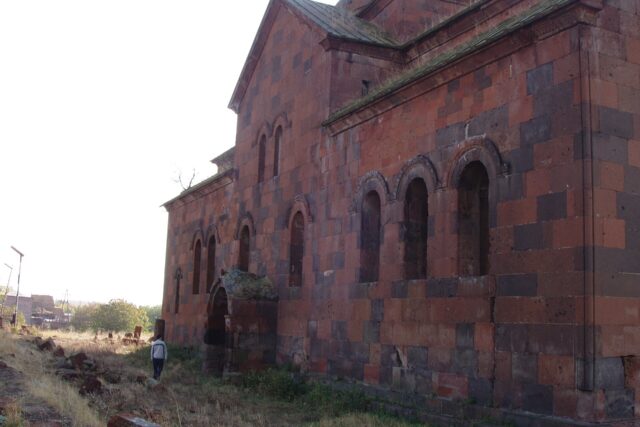
- Surb Astvatsatsin church — rectangular outside, cross-shaped inside, with three semicircular apses and a rectangular western arm, two-storey corner chambers, and a conical dome on a drum pierced by four windows. The masonry is dark brown rough tuff with dressed stone only at the corners and openings, which is why the building looks older and grimmer than it is. Paired triangular niches mark the east facade. A belfry rotunda was added in a later repair.
- The horse lintel — on the inner face of the main (south) portal is a high-relief saddled horse at full gallop. This is not a modern tourist claim: Alishan’s 19th-century compilation already notes that “on the inner face of this door a steed in flight is masterfully carved” and that local researchers praised it. Nobody has a secure explanation for it; a princely-donor emblem is the usual guess.
- Gavit — a later entrance hall on the west side. Alishan gave its size as 20 by 8 cubits; today mostly foundation walls survive.
- Smaller churches — a single-nave vaulted chapel south-east of the main church that predates it (7th century by most accounts), plus two small 9th–10th-century churches set against the outside of the enclosure wall, decorated with rosettes and interlace arches.
- Enclosure and service buildings — a high wall with its gate at the north-west, the ruins of cells, a refectory, stables and a stone water channel inside.
- Khachkars and graves — cross-stones from the 9th to the 17th century stand in the yard and are built into the walls; the cemetery wraps the west end of the church. Look for a block carved with Daniel in the lions’ den reused low in the south-east corner. If you want the vocabulary for reading them, see our guide to khachkars.
Two things I could not confirm. Tour sites mention “a cave nearby”; no Armenian scholarly or monument-register source describes one, so it is either a minor rock shelter in the gorge or a copy-paste. Claims of surviving frescoes are likewise unsupported by anything I read.
Condition: half-ruined in 1862 (Archbishop Mesrop Smbatyants) and again in the 1910s (Yervand Lalayan). A Soviet restoration in the 1980s rebuilt the dome and floor; donors paid for wall repairs in the 2010s and a 60-kg bell in 2014; the access road was improved in 2020–2021 (all per Armenpress). So “untouched” is an overstatement, but it is nothing like the rebuild at Sevanavank.
Getting there
Makenyats is a detour from the south-shore road, which is itself a detour. Budget half a day from Yerevan.
| Leg | Distance | Time (car) | Notes |
|---|---|---|---|
| Yerevan → Martuni | ~125 km | ~2 h | M4 to Sevan, then the south shore; or the M10 over the Selim pass if you come from Yeghegnadzor |
| Martuni → Makenis turn-off | ~35 km | 40 min | Good asphalt along the lake |
| Turn-off → monastery | ~6 km | 15 min | Village road, improved 2020–21; fine in a normal car when dry |
| Vardenis → Makenis | ~15 km | 25 min | Direction of approach if you came by marshrutka |
By car is the sensible answer; see our notes on renting and driving in Armenia. The monastery is on the western edge of Makenis village beside the river, so drive through the village and ask — everyone knows “vank”.
By public transport, take a Yerevan–Vardenis minibus (no. 311/312, about 1,500 AMD, 3–3.5 hours; t-armenia.com lists Kilikia bus station while Rome2rio says the Northern bus station, so confirm the day before) or the more frequent Martuni service, then a taxi for the last 15 km from Vardenis. Expect around 3,000–5,000 AMD one way and arrange the pick-up before you let the driver go, because there is no taxi rank in Makenis.
The south-shore loop: Kotavank, Vanevan and Makenyats
Grigor Supan II’s buildings make a natural one-day circuit of three monasteries nobody else is visiting:
- Kotavank (Nerkin Getashen, 10 km south-west of Martuni, 1,940 m) — Supan’s first church and family mausoleum, late 9th century, restored by 2015. Same rectangular-outside, three-apse-inside plan as Makenyats, which lets you compare the two side by side.
- Vanevan (Artsvanist, east of Martuni) — founded in 903 by Supan’s relatives the Bagratunis, small, restored, in a gorge by the river.
- Makenyats — the roughest and most atmospheric of the three, and the one with the real intellectual history.
Drive the loop west to east so you end at Makenyats in afternoon light on the south portal. Return to Yerevan via Sevan town (about 3 hours from Makenis) or continue over the Selim pass to Yeghegnadzor if you are heading for Syunik. For how these rank nationally, see the best monasteries in Armenia.
When to go
At 2,187 m the site is snowbound or muddy from November to April and the village road can be a mess in the thaw. June to early October is the window; September is clearest. Mornings are cold at this altitude even in summer — bring a layer. The lake road is busy with beach traffic in July–August but the monastery will still be empty.
Practical notes
- Hours and entry: no gate, no ticket, no official hours that I could find. The church is sometimes locked; if so, ask in the village for the keyholder. A bell was installed in 2014 and occasional services are held, so you may meet a priest.
- Time on site: 45–60 minutes covers the church, the outer chapels and the cemetery.
- Food and fuel: none at the monastery. Vardenis has shops, cafes and petrol; Martuni has more.
- Footwear: the yard is uneven, gravestones are loose and the slope to the river is steep.
- Border note: Vardenis district borders Azerbaijan. Makenis is well inside Armenia with no restriction on visiting, but check the situation before driving on past Vardenis toward Sotk.
- Respect: this is a working cemetery as well as a monument. Do not climb on khachkars for photos.
Last verified: October 2026.
Worth it?
Yes, if you are already on the south shore or crossing the Selim pass, and especially if you care about where Armenian learning happened rather than just how churches look. Makenyats trained the founder of Sevanavank, supplied Nerses Shnorhali with his monastic rule and kept a scriptorium going into the 1490s; it has a rare figurative relief and a cemetery that reads like a thousand-year timeline. No, if your interest is architecture alone — the church is squat and rough, and Kotavank is the tidier version of the same plan.
Frequently asked questions
How far is Makenyats Vank from Lake Sevan and from Yerevan?
The monastery is about 5 km south of the lake’s south-eastern shore, 15 km from Vardenis and roughly 165 km (2.5-3 hours) by road from Yerevan via Sevan and Martuni.
Who built Makenyats Monastery?
A community existed from the 7th century, but the surviving Surb Astvatsatsin church was built in the second half of the 9th century by Grigor Supan II, prince of Syunik, after an earlier monastery was burned in Babak’s raids. The 851 date given on some English pages is not in the Armenian sources.
Can I get to Makenyats Vank without a car?
Yes, but slowly. Take a Yerevan-Vardenis minibus (about 1,500 AMD, 3-3.5 hours) and a taxi for the last 15 km; arrange the return ride before the driver leaves, as there are no taxis in Makenis village.
Is there an entry fee or opening hours?
No fee and no official hours; it is an open monument with a cemetery. The church may be locked, in which case ask in the village for the key.
Featured image: Armen Manukov, CC BY 3.0 — via Wikimedia Commons.