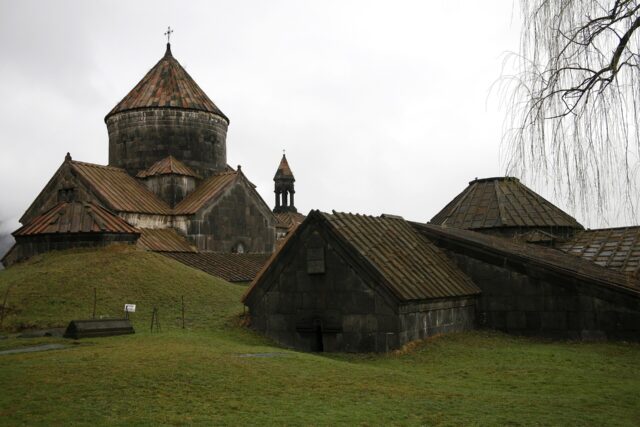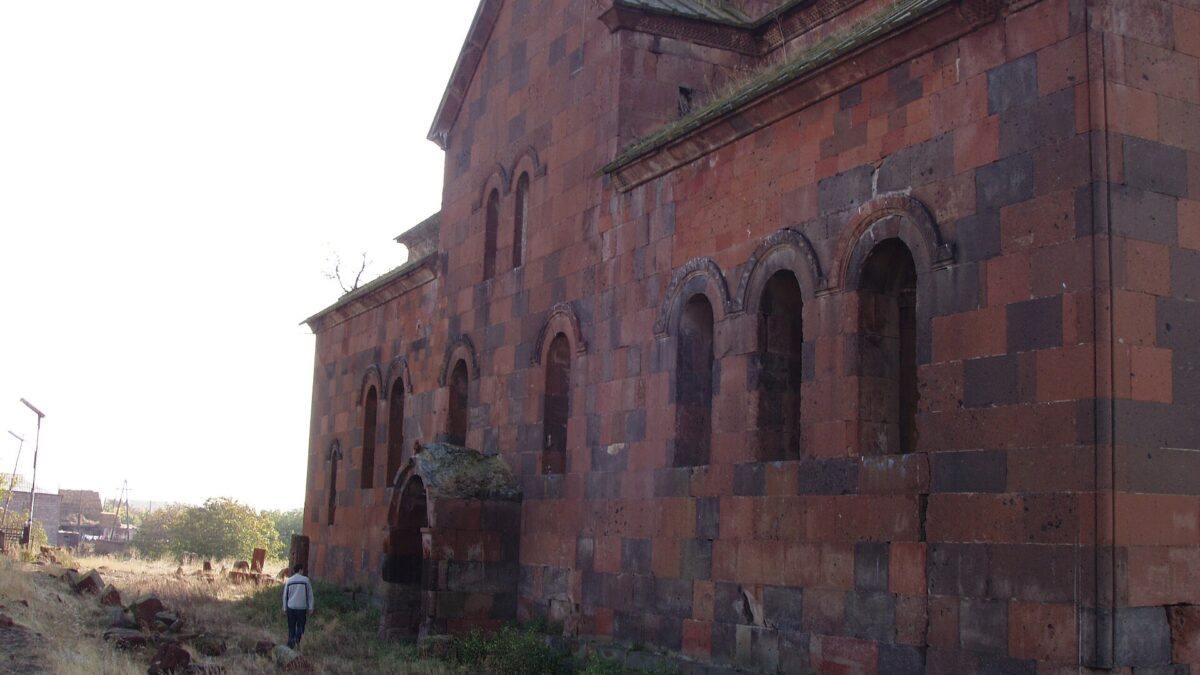
Aruch is a village about 55 km north-west of Yerevan, just off the M1 Yerevan–Gyumri highway, with two things most visitors drive straight past: the 7th-century Cathedral of Surb Grigor (the Katoghike), the largest domed hall church of early medieval Armenia at roughly 17 by 35 metres, and a 13th-century Silk Road caravanserai almost on the roadside. The cathedral lost its dome centuries ago, which is what makes the place: a 1,360-year-old stone hall open to the sky, with a 7-metre painted Christ in the apse that is among the oldest wall paintings in the country. Next to it are the excavated foundations of the palace of Grigor Mamikonian, the prince who ran Armenia for the Arab caliphate in the 660s. No ticket, no crowds, one hour on the way to Gyumri.
Who built it and why
The builder was Grigor I Mamikonian, presiding prince (ishkhan) of Armenia from about 661/662 until his death in 685. He had been held hostage in Damascus since 654/655; in 661, when Mu’awiya needed loyal provinces in his war with Ali, the Armenian princes and Catholicos Nerses III asked for Grigor’s release, and Mu’awiya sent him home as presiding prince. The historian Ghevond records “great peace” during his years, and the Encyclopaedia Iranica entry on the Mamikonians cites the “vast palace and adjoining domed basilica” at Aruch as the physical evidence of the family’s mid-7th-century wealth.
Aruch is what an Armenian prince built when he was, briefly, the safest man in the country: cathedral and residence side by side on the old winter camp of the royal army. The dedication inscription names Grigor and his wife Heghine (Heline, Helen). The AUA Armenia Hidden Gems project gives founded 662, consecrated 666 by Catholicos Anastas Akoretsi; scholars from Marr and Strzygowski to Der Nersessian spread the completion anywhere within 661–682. “The 660s” is the safe answer. Grigor died in 685 fighting a Khazar raid, and the peace ended with him. For how a Christian principality operated under the early caliphate, see our short history of Armenia.
The cathedral: architecture, the lost dome, the frescoes
A domed hall at maximum scale
Seventh-century Armenian architects were working out how to put a dome over one long hall instead of a cross-in-square plan, and Aruch is the biggest result. The hall measures about 16.95 by 34.6 metres (Armenian heritage listings; some round it to 17), the largest of the early medieval domed hall churches in the AUA project’s words. Two pairs of massive wall piers carry wide arches that once held the drum and dome over the centre of the nave. Three doors (west, south, north) and unusually wide windows on every side, framed by carved arches, keep the interior bright. Armenian sources also claim it as the first dated use in Armenia of pendentives rather than squinches under a dome. Outside, it stands on a stepped platform in plain, clean tuff with almost none of Zvartnots’ carving: architecture by volume, not ornament.
When did the dome fall?
The honest answer: nobody publishes a date. The usual explanation is earthquakes plus the building’s use as a fortress in the 16th–17th centuries. The 4 June 1679 earthquake, which wrecked Garni, Geghard, Hovhannavank and most of Yerevan’s churches, is often assumed to be the culprit, but the monument lists for that quake do not name Aruch, so treat 1679 as plausible, not proven. What is documented is the repair history: a 15th-century restoration, excavations 1947–53, structural reinforcement 1949–59 (AUA’s dates; other summaries say 1946–48), work in 1973, and digs in 2006 and 2013. The walls and apse are stabilised originals, not a rebuild, and nobody has tried to put the dome back.
The frescoes
This is the reason to go inside rather than photograph the outside. The apse half-dome carries a standing Christ about 7 metres tall holding a scroll, with a text from John (“He that hath my commandments and keepeth them…”) beside him. Below, mostly flaked away, were the twelve apostles; five figures and part of a sixth survive on the north side, above a band of acanthus, roses, grapes and pomegranates. The name Stepanos is painted in large uncials beneath, read by most Armenian art historians as the painter’s signature, which makes him one of very few named artists of the period.
Scholars disagree on the subject: the AUA page and Matevosyan’s survey of Armenian frescoes call it the Traditio Legis (Christ handing the Law to the apostles); several Armenian popular sources call it the Ascension. The dating is less contested. Lidia Durnovo and Sirarpie Der Nersessian used Aruch, with Lmbatavank and Talin, to prove that 5th–7th-century Armenian churches were painted at all, and a 2016 paper in the St Petersburg journal Actual Problems of Theory and History of Art counts about thirty such 7th-century churches, placing Aruch with those influenced by the eastern Byzantine provinces. You are looking at a painting from the same decade as the building, in its original position, with no glass, barrier or lighting. Give your eyes a minute.
The palace ruins
Immediately south and south-east of the cathedral are low walls and column bases: Grigor Mamikonian’s palace, excavated in 1947 and again in 1950–52 (some sources give 1948–51). The digs found a large rectangular columned hall with side chambers and galleries, compared to the Catholicos’s palace at Dvin, plus a second building; the Armenian tourism board mentions a tufa throne among the finds. About 60 metres south-east is a 5th-century three-aisle basilica, older than the cathedral, later converted to secular use and walled in as a small fortress in the 12th–13th centuries.
Since 2022 an Armenian–Italian mission (the Academy of Sciences’ Institute of Archaeology and Ethnography with ISMEO in Rome) has been re-digging. Their reports in the journal Aramazd describe a fortified area with several phases, from Grigor’s enclosure to a smaller 11th-century fort, and note that the 1950s digs ignored the later layers. Expect trenches and new signage; for now the ruins are unfenced and unlabelled.
The caravanserai: Silk Road context, layout, how to find it
Aruch sat on the medieval road between Dvin, the old capital near Artashat, and Ani, the Bagratid capital now just across the Turkish border. In the late 12th–13th centuries the Zakarid princes, ruling here under Georgian overlordship, built a chain of Seljuk-style caravanserais to pull trade towards Ani; the art historian Antony Eastmond places Aruch in that network with Talin and Chrplu. An Aramazd paper on the route treats the caravanserais, bridges and the fortresses at Aruch and Dashtadem as one coordinated infrastructure programme, confirmed by inscriptions and coin finds.
What survives is one wing of a three-nave hall, roughly 450 square metres of basalt, heavily restored in 1960. The plan is the standard one: a single entrance on the south side wide enough for loaded animals, a central aisle for the pack animals and cargo, and side aisles for merchants and their servants, all under arches springing from squat piers. Unlike the Selim (Orbelian) caravanserai on the Vardenyats pass, it has no carved portal, inscription slab or upper rooms; it is a working shed, which is why it is interesting. It stands on open ground right beside the M1, about 2 km north of the cathedral (my estimate from the published coordinates, 40.304°N 44.077°E against 40.289°N 44.083°E for the church), so driving from Yerevan you reach it before the village turn-off. No gate, no fee.
Getting there
From Yerevan
Take the M1 towards Ashtarak and Gyumri: about 55 km, 27 km past Ashtarak, 50–60 minutes. Watch for the caravanserai beside the highway, then the signed turn for the village; the cathedral is on 1st Street, two minutes in, with parking beside it. With a hire car this is the easiest Aragatsotn stop there is; our car rental and driving guide covers the M1.
From Gyumri
Same road, so it is the natural break southbound: Mastara, Talin and Dashtadem first, then Aruch (Talin is 24 km north-west of Aruch). Our Gyumri travel guide covers the city end.
Without a car: Yerevan–Gyumri marshrutkas drop you at the Aruch junction on request, but the return is luck; a two-hour taxi from Ashtarak is the practical option.
The Aragatsotn mini-route: Aruch, Talin, Mastara, Dashtadem
Four early medieval sites sit within 35 km of each other on the M1 and make the best half-day of early Armenian architecture outside Echmiadzin. Northbound from Yerevan:
| Stop | Approx. km from Yerevan | What it is | Time |
|---|---|---|---|
| Aruch caravanserai | 53 | 13th-c. Zakarid caravanserai beside the highway | 15 min |
| Aruch cathedral + palace | 55 | 660s domed hall, 7th-c. frescoes, excavated palace | 45–60 min |
| Dashtadem fortress | 73 | 9th–10th-c. core, later half-round towers, carved gateway; 6 km south of Talin | 30 min |
| Talin cathedral | 79 | Late-7th-c. cathedral of the Kamsarakan princes; dome and walls lost in the 1840 and 1931 earthquakes | 30 min |
| Mastara, St Hovhannes | 90 | Centrally planned 7th-c. church (core dated 5th-c. by the tourism board), huge polygonal drum, just off the road | 20 min |
Kilometre figures are rounded road distances from the sources cited. Allow about 3.5 hours including driving and you still reach Gyumri for a late lunch. Short on time? Mastara and Aruch: opposite answers to the same 7th-century problem of how to dome a big space.
When to go
Aruch is at 1,220 m on the southern slope of Aragats: cooler than Yerevan and exposed. April–June and September–October are best. July–August is fine inside, but the ruins and caravanserai have no shade. In winter the M1 stays open but the village lane can be icy and the frescoes are hard to see on a dark afternoon. Go in the morning: with the roof gone, morning sun reaches the east-facing apse.
Practical notes
- Hours and entry. Open ground, no ticket office, as at most village monuments in Armenia. The cathedral is a functioning church and may be locked at odd hours; ask in the village, and confirm locally rather than trusting any listed hours.
- Dress and photos. A working Armenian Apostolic church: shoulders and knees covered. Photography is fine; use a wide lens and high ISO for the frescoes. No café; Ashtarak and Talin have restaurants.
- Names. Aruch, Aruj, Arutch, Armenian Արուճ. The village was Talish until the Soviet period, so older books and Russian maps use that. The cathedral is Surb Grigor, Katoghike, Aruchavank or “the Aruch temple” depending on the sign.
Worth the stop?
Yes. If you care about early Christian architecture, Aruch is a first-rank building: the largest of its type, precisely dated, with a named painter’s work still on the wall. If you don’t, it is still a huge roofless stone hall in a wheat field with a Silk Road inn down the road, free, and done in an hour. The honest caveat: no interpretation on site, the palace is a puzzle of low walls, and the frescoes are faint; you need to know what you are looking at, which is what this page is for. Among the big-name monasteries it would be a top-ten site; as a roadside stop on the way to Gyumri it is close to unbeatable.
Last verified: October 2026. Site conditions, especially the ongoing Armenian–Italian excavations, change; check locally.
Frequently asked questions
How far is Aruch from Yerevan and how long does the visit take?
About 55 km north-west on the M1 Yerevan–Gyumri highway, roughly an hour’s drive. The caravanserai is right beside the road and the cathedral is two minutes into the village; allow an hour for both plus the palace ruins.
Is there an entry fee or fixed opening hours at Aruch?
No fee. The cathedral, palace ruins and caravanserai are open-ground village monuments. The church itself can be locked at times, so confirm locally; there is no official timetable to rely on.
How old are the frescoes in Aruch cathedral?
They date from the 660s, the same decade as the building, and are among the oldest surviving wall paintings in Armenia. The apse shows a 7-metre Christ with a scroll and the remains of the twelve apostles; the name of the painter, Stepanos, is painted below.
When did the dome of Aruch cathedral collapse?
No source gives a firm date. The damage is attributed to earthquakes and to the building’s use as a fortress in the 16th–17th centuries; the 1679 earthquake is often blamed but Aruch is not named in the lists of monuments destroyed that year. The walls were reinforced in the 1940s–50s and the dome has never been rebuilt.
Featured image: Tamara Areshian from London, UK, CC BY 2.0 — via Wikimedia Commons.