The Debed Canyon is a deep river gorge in Lori province, northern Armenia, best known for Sanahin and Haghpat, two 10th-century monasteries listed together as a UNESCO World Heritage Site. Both sit on high ledges above the town of Alaverdi, on the main road between Yerevan and Tbilisi. They are among the finest medieval buildings anywhere in the Caucasus.
If you are driving or riding a marshrutka between Armenia and Georgia, the canyon is directly on your route. That single fact shapes almost every practical decision below, so we will keep coming back to it. Here is what the two monasteries actually are, what else is worth stopping for, and the honest logistics of reaching a place that public transport reaches only awkwardly.
Where is the Debed Canyon?
The Debed Canyon runs through Lori, Armenia’s northernmost province, following the Debed river as it cuts toward the Georgian border. The gorge is roughly 175 km north of Yerevan and about 60 km north of Vanadzor, the regional capital. The main town inside the canyon is Alaverdi, an old copper-mining settlement that sits at the bottom of the gorge at around 700 metres, with forested walls rising several hundred metres on either side.
What makes the canyon matter for travellers is its position. The M6 highway and the Yerevan–Tbilisi railway both thread through it, and the Bagratashen–Sadakhlo border crossing into Georgia lies at its northern end. In practice, the Debed Canyon is the last stretch of Armenia you pass through before Georgia, or the first if you are arriving from Tbilisi. That is why we treat it less as a standalone destination and more as the best possible reason to break the journey between the two capitals. For the wider region, see our destinations hub.
What are Haghpat and Sanahin?
Haghpat and Sanahin are two medieval Armenian monasteries, founded in the 10th century and expanded over the following three hundred years. Both were major centres of learning as well as worship, with scriptoria where monks copied and illuminated manuscripts, schools of theology and science, and libraries. UNESCO describes them as representing the highest flowering of Armenian religious architecture, and they were inscribed on the World Heritage List for exactly that reason.
The two stand only about 10 km apart, on opposite plateaus above Alaverdi, and their rivalry is part of the story. Sanahin (the name is usually read as “older than that one”) was founded around the mid-10th century; Haghpat followed, traditionally dated to about 976 and linked to Queen Khosrovanuysh, wife of the Bagratid king Ashot III. Over time both grew into dense clusters of churches, chapels, bell towers, book-repositories and covered galleries, rather than single buildings.
On the UNESCO listing: Haghpat was inscribed first, in 1996, as one of Armenia’s earliest World Heritage entries. The site was then extended in 2000 to include Sanahin, and renamed the “Monasteries of Haghpat and Sanahin.” You will see some sources say both were listed in 1996; the more precise version is Haghpat 1996, Sanahin added by extension in 2000. (Source: UNESCO World Heritage Centre.) Last verified: July 2026.
Haghpat Monastery
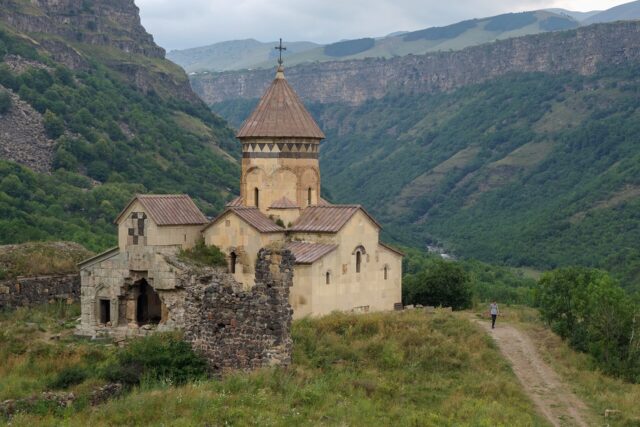
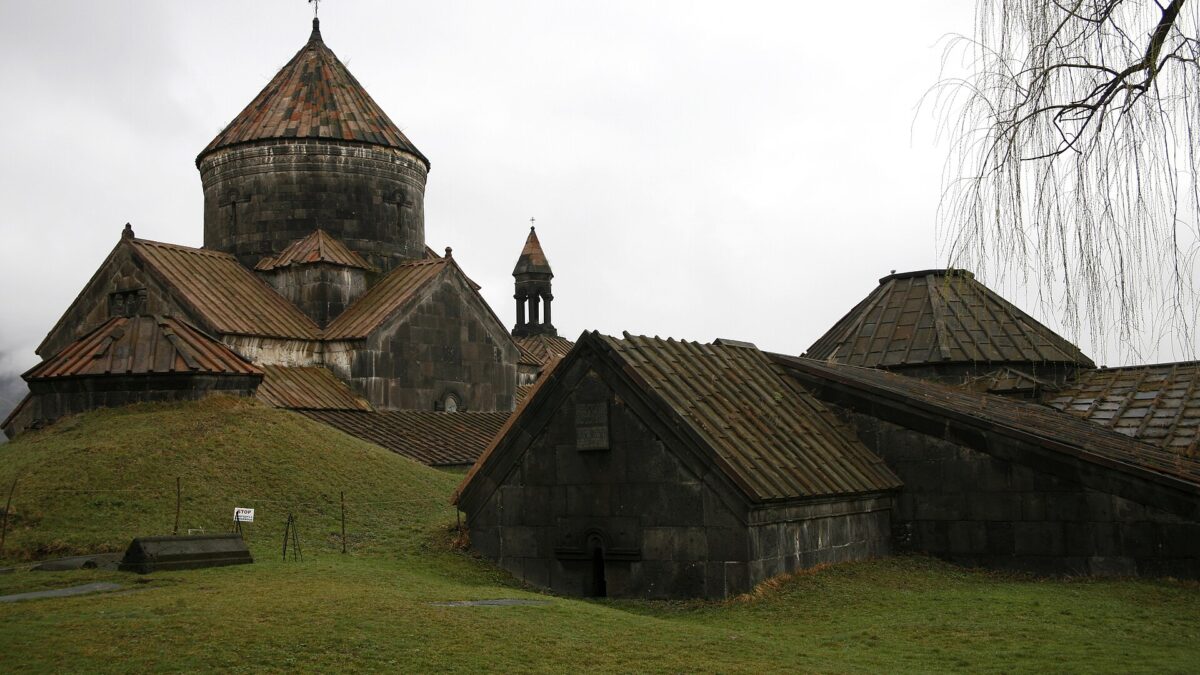
Haghpat is the larger and, for most visitors, the more photogenic of the pair. Its buildings cluster around the church of Surb Nshan (the Holy Cross), completed in the late 10th century, with a free-standing three-storey bell tower, a domed book repository, and a gavit (an assembly hall attached to the west of the church) added later. The complex sits above the village of the same name, with the gorge dropping away behind it, and the stonework carries the carved khachkars (cross-stones) and reliefs that Armenian masons were known for.
Haghpat kept working as a monastery for centuries and survived earthquakes and raids that flattened lesser sites. Entry is free, as at almost every Armenian monastery. Allow an hour to walk the complex without rushing.
Sanahin Monastery
Sanahin sits directly above Alaverdi, on the western rim of the inner gorge, and is easier to reach on foot or by the town’s cable car (more on that below). Its layout is denser and more scholarly in feel: two main churches joined by an academy building, a scriptorium, a library with niches cut for manuscripts, and a covered gallery of arches. This was one of medieval Armenia’s most important schools, and the surviving academy hall is a rare physical record of how teaching space was built.
Because Sanahin and Haghpat are so close and so complementary, our call is simple: do not choose between them. Seeing one and skipping the other is the most common mistake here, and it saves you maybe forty minutes for a real loss. If you have half a day in the canyon, both fit comfortably. For where these two rank against the country’s other great complexes, see our guide to the best monasteries in Armenia.
What else is worth seeing in the Debed Canyon?
The two UNESCO sites anchor the canyon, but Lori is unusually dense with medieval churches, and a few reward the detour if you have a car.
- Odzun church — a large domed basilica in the village of Odzun, on the plateau west of the gorge, generally dated to around the 6th century and built from pink felsite stone. It is one of the oldest churches in the region and stands on an open terrace with long views. (Source: Odzun Church, Wikipedia.)
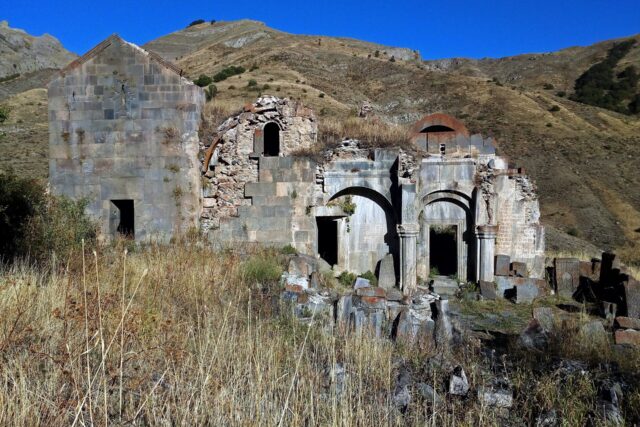
- Kobayr — a partly ruined 12th-century monastery (founded around 1171) clinging to the side of the gorge near Tumanyan station. It is reached by a short uphill walk and is known for fragments of Byzantine-style frescoes, unusual in Armenia. (Source: Kobayr monastery, Wikipedia.)
- Alaverdi cable car — a Soviet-era gondola built in 1976 that climbs from the floor of Alaverdi up to the Sanahin plateau. It was originally timed to the copper mine’s work shifts and still runs on an irregular, informal schedule, so treat it as a quick local ride if it happens to be operating rather than a fixed part of your plan.
Alaverdi itself is not pretty in the conventional sense — the chimney of its old copper smelter is visible from most of the centre, and the town is working and industrial. We think that honesty is part of the appeal: this is a real place, not a restored showpiece, and the contrast with the monasteries on the ledges above is exactly what makes the canyon memorable.
How do you get to the Debed Canyon monasteries?
The short answer: a car (your own or a hired driver) makes this easy, and public transport makes it slow. The canyon sits on the Yerevan–Tbilisi corridor, so the smartest way to see it is as a planned stop on that journey rather than a round-trip day tour from Yerevan.
From Yerevan the monasteries are roughly 3.5–4 hours’ drive one way, which makes a same-day return long and rushed. A better base is Vanadzor, about 90 minutes south, which has the region’s widest choice of hotels and taxis; from there a full-day taxi covering both monasteries runs on the order of 100 AMD per kilometre, so a typical loop lands in the low tens of dollars. Alaverdi is closer still but has fewer places to stay. There is no train or bus to the monasteries themselves — the railway follows the gorge floor, while the sites sit on the plateaus above.
| Approach | Rough time / cost | Our take |
|---|---|---|
| As a stop en route Yerevan–Tbilisi | Adds ~2–3 hrs to the drive | Best option; the canyon is on the road anyway |
| Day trip from Yerevan | ~7–8 hrs round trip | Doable by car/tour, long and tiring |
| Based in Vanadzor | Full-day taxi, low tens of USD | Comfortable; best regional accommodation |
| Marshrutka + local transfers | Several connections via Alaverdi | Cheap but slow; only for flexible travellers |
Fares and taxi rates are approximate and shift with fuel prices and season — treat them as ballpark. Last verified: July 2026. For the wider mechanics of moving around the country, see how to get around Armenia, and for the border crossing specifically, our guide to the Yerevan to Tbilisi route.
When to go, and how to fit it in
Late spring through early summer and again in September–October are the best windows: the gorge is green or turning gold, and the roads are clear. Winter brings snow and ice to the plateau roads, which can make the approach to Odzun or Kobayr awkward without the right vehicle. The monasteries have no entry fee and no fixed closing time in the way a museum would, though visiting in daylight is obviously wise.
Our honest recommendation stands: build the Debed Canyon into an Armenia–Georgia trip rather than treating it as a separate expedition. Spend a night in Vanadzor or Alaverdi, see Sanahin and Haghpat properly in the morning, add Odzun or Kobayr if you have the car and the appetite, then continue north to the Bagratashen border and on to Tbilisi. Travellers heading the other way can do the same in reverse. If you are also weighing up Gyumri as a northern base, our Gyumri travel guide covers the country’s second city, a couple of hours west.
Lori rarely tops a first-time Armenia list, and that is part of why it holds up. Two of the country’s greatest monuments sit almost empty on their ledges, on a road you are likely to travel anyway. Skipping them to save a couple of hours is the one call we would argue against.
Featured image: Saro Hovhannisyan (CC BY-SA 4.0) via Wikimedia Commons