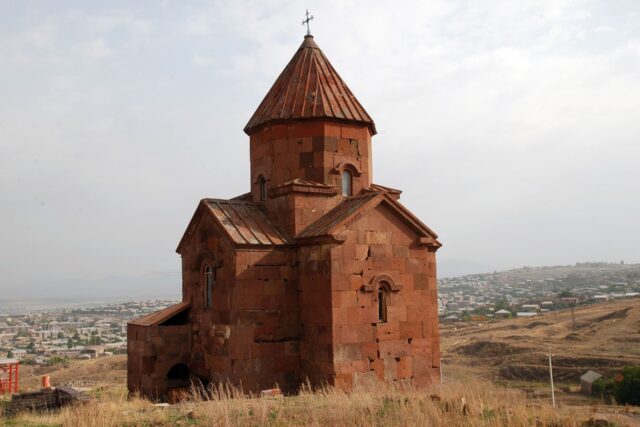
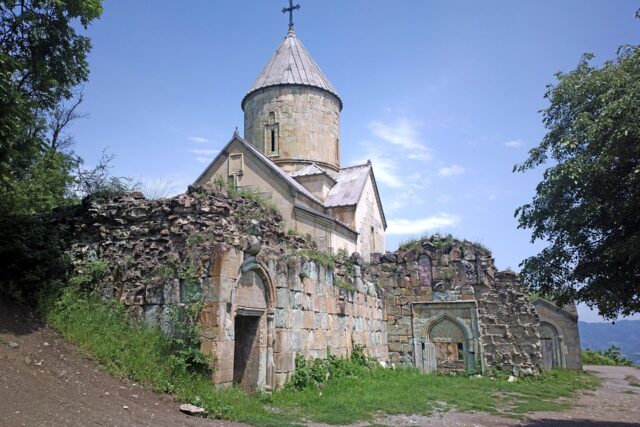
Hnevank (Հնևանք, “Old Monastery”) is a 7th–13th-century monastic complex on a spur above the Dzoraget river, in the canyon east of Kurtan village in Lori province. It is one of the few Armenian monasteries where the key building inscriptions are in Georgian: the main church was renovated by Smbat Orbeli in 1154 (1144 in the Armenian Soviet Encyclopedia), and the site followed the Chalcedonian (Georgian-rite) confession through the 12th–13th centuries. The collapsed dome was rebuilt in 2006, which is why the main church now looks “new” from a distance. Count on 2.5–3 hours from Vanadzor door to door, a rough final descent, and almost no other visitors.
History: from the 7th century to the Orbelis and Zakarids
The main church is dated to the 7th century on stylistic grounds, built of yellowish felsite, a cross-domed plan that is rectangular outside and three-apsed inside with a rectangular western arm (Armenian Soviet Encyclopedia, vol. 6, 1980, entry by M. Hasratyan). Nothing survives in writing about the founding; the name is usually read as “Hin vank” (old monastery), though the Lori tour operator Tirar notes a second reading, “Greek monastery”, which would point to the Chalcedonian period rather than the founding.
The documented chapter starts in 1123, when the Georgian king David the Builder took Lori-Tashir and handed it to his amirspasalar (commander-in-chief) Ivane Orbeli. Ivane’s son Smbat held the same office from 1128, and a Georgian inscription on the drum of the main church records that he renovated it; Armenian Wikipedia and the Lori tourism site tsayg.am give 1154, the Soviet Encyclopedia gives 1144. Treat the decade as uncertain, the patron as not. The Orbelis were Georgian-court nobles, and the monastery worked under the Georgian (Chalcedonian) rite in the 12th–13th centuries. A second Georgian inscription over the gavit entrance dates that building to 1186–1206, i.e. the early Zakarid period, when Lori passed to the Zakarian (Mkhargrdzeli) brothers who served Queen Tamar.
That puts Hnevank in the same small group as Akhtala, Kobayr and Khuchap: Lori monasteries where Armenian builders worked for patrons who were in communion with the Georgian church rather than the Armenian Apostolic Church. One visible consequence, pointed out by several Armenian sources (e.g. janarmenia.com): there are no khachkars at Hnevank. Cross-stones are an Apostolic habit, and their complete absence here is read as a sign the site stayed Chalcedonian until late.
What is on site
The Soviet Encyclopedia and the Lori tourism office (travellori.am) both describe three churches, a gavit, living quarters and service buildings. In practice:
- Main church (7th c., renovated 12th c.). The showpiece. Inside, the transition to the dome is carried on two tiers of squinches (trompes); outside, the drum is octagonal, with blind arches and pilasters on each face. The Georgian renovation inscription runs around the drum/cornice. The walls are plain felsite with almost no carving, which is normal for the 7th century and makes the squinch dome the thing to look at.
- Gavit (1186–1206). West of the main church. Only parts survive: a few column bases and lower walls, plus the dated inscription over the doorway.
- Southern church (early 13th c.). A domed-hall church with a semicircular apse, attached on the south side. It is the best-preserved original fabric on site, and its arched entrance has an acanthus-leaf frame (Armenian Wikipedia, citing the 2012 Armenian epigraphic corpus).
- Northern church. A single-nave vaulted chapel on the north side of the gavit, reduced to the apse and two courses of wall.
- Two-storey building ~50 m east. Probably the monks’ residence (visitdebedcanyon.com). Plus traces of enclosure walls and outbuildings in the grass.
The 2006 reconstruction and the argument about it
By the late Soviet period the main church’s dome had collapsed. Restoration work began in 2006 (travellori.am), the dome was rebuilt in full, and on 25 November 2006 the cross was consecrated and mounted on it (reported in the Armenian church monthly Echmiadzin, 2006, cited by Armenian Wikipedia). English Wikipedia attributes the programme to the Armenian government; I could not find a primary document naming the funder or the architect.
Two things are true at once. The rebuild saved the squinches and the inscribed drum from further weathering and gave the church back its silhouette. It also produced a dome and drum crown in clean new stone that read as 21st-century from a hundred metres away, and the amount of original fabric in the upper structure is small. Heritage practice since the 1964 Venice Charter prefers anastylosis (re-assembling fallen original pieces) over reconstruction in new material, and Hnevank is clearly the latter. The honest caveat: I was briefed that Armenian press criticised the work as over-reconstruction, but I could not locate those articles, so I would not repeat the claim as fact. What you can do is judge for yourself: the southern church next door is largely untouched 13th-century masonry, and the contrast with the main church is instructive.
The Dzoraget canyon
The Dzoraget (“gorge-river”) rises in the Bazum range and runs east past Stepanavan and Lori Berd before joining the Pambak at Dzoragyugh to form the Debed. Around Kurtan the canyon is 200 m-plus deep, with basalt cliffs on top and dense scrub and riverside woodland below. Hnevank sits on a hill inside the gorge near where the Gargar stream comes in, roughly 980–1,000 m above sea level; Kurtan on the plateau above is at 1,260 m. The Twin Fortresses section of the Transcaucasian Trail (Tsater to Kurtan, 11 km, 4.5 h, rated hard by HIKEArmenia) passes the monastery, along with two small cliff-top fortresses locals call Kir and Akhper (sister and brother), a rock-cut chapel and herders’ caves. The river is swimmable in summer at a shaded flat used for picnics and camping, and the Dzoraget is the only Armenian river with a commercial rafting stretch (put-in near Stepanavan). More on the trail network in our best hikes in Armenia guide.
Getting there
From Yerevan via Vanadzor
Yerevan to Vanadzor is about 117 km on the M-4, 2 hours. From Vanadzor take the M-3 north over the Pushkin pass (there is a tunnel under the pass, so this road is open year-round) and turn east toward Gyulagarak and Kurtan; Vanadzor to Hnevank is about 33 km by road (visitdebedcanyon.com). The turn for Kurtan is well signed in Armenian and Latin. Kurtan itself is an asphalt village. The last stretch from the village down to the monastery is a dirt track dropping about 250 m into the canyon: fine for a Duster or any SUV in dry weather, painful for a low sedan, and a mudbath after rain. Several visitors on Komoot and visitdebedcanyon.com describe the road as “challenging”; if you are in a hire car, see our notes on driving and car hire in Armenia before committing. The alternative is to park at the canyon edge and walk down, 30–40 minutes each way on the track.
From Stepanavan
Stepanavan to Kurtan is roughly 20–25 km southeast via Gyulagarak (the Lori office quotes a longer 40 km figure, which likely counts a different approach). Allow 45 minutes to the village, plus the descent.
From Alaverdi / the Debed
There is no good through-road. Drivers from Alaverdi go back down the M-6 toward Vanadzor and then up the M-3, about 2 hours. Hikers have the better option: a marked trail climbs the Dzoraget gorge from Dzoragyugh (on the M-6, where the Dzoraget meets the Pambak) to Hnevank and on up to Kurtan or Arevatsag. Pair it with the Debed canyon monasteries if you are basing yourself in Alaverdi or Dsegh.
Public transport
Marshrutkas run Yerevan–Stepanavan and Vanadzor–Stepanavan, with only village-schedule services to Kurtan. Without a car, a half-day taxi from Vanadzor is the realistic option.
A Lori day: Hnevank, Lori Berd and the Dendropark
| Time | Stop | Notes |
|---|---|---|
| 08:00 | Leave Vanadzor | M-3 over the Pushkin pass |
| 09:00–11:00 | Hnevank | Descent, site, climb back; longer if you walk the track |
| 11:30–12:30 | Stepanavan Dendropark | Near Gyulagarak, on the way back to the M-3; 35 ha, founded 1931 by the Polish forester Edmund Leonowicz, free entry, roughly 10:00–19:00 in season |
| 13:00 | Lunch in Stepanavan | Khorovats places on the main street |
| 14:00–15:30 | Lori Berd | 4–5 km northeast of town on the Dzoraget–Miskhana promontory; 11th-century capital of Tashir-Dzoraget founded by David Anhoghin (1005–1020s), 200 m wall, two bathhouses, a 14th-century bridge in the gorge below |
| 16:00 | Back to Vanadzor or on to Yerevan | Yerevan is 136 km from Stepanavan, ~2.5 h |
Do Hnevank first: the canyon track is easiest when it has had the morning to dry, and the light on the east-facing drum is better before noon.
When to go
April to November is the sane window (visitdebedcanyon.com). May–June has the wildflower meadow the TCT crews describe around the ruins and a full, loud river. July–August is hot on the plateau but fine in the gorge, and the river is swimmable. October is the best light. In winter the Pushkin tunnel keeps the M-3 open but the Kurtan descent turns to ice and mud; walk it, do not drive it.
Practical notes
- No entry fee, no gate, no guardian, no toilets. The nearest shop is in Kurtan.
- Phone signal is patchy below the canyon rim. Download offline maps; the trail is marked but the dirt roads fork.
- Dress code: nobody checks, but this is a consecrated church since 2006, so behave as you would at any Armenian monastery.
- Kurtan has its own 6th-century St Astvatsatsin basilica with a two-storey belfry and the foundations of Gtevank (travellori.am); both are 10 minutes’ detour.
- Camping is tolerated at the riverside flat; carry out everything.
Verdict
Hnevank is not Haghpat. It is a small site with one important building, a rebuilt dome that will annoy purists, and a road that will annoy everyone else. Go for three reasons: the 7th-century squinch dome, the Georgian inscriptions that make it a rare physical record of the Orbeli and Zakarid era in Lori, and the canyon, which is the best thing about it. As a half-day out of Vanadzor paired with Lori Berd it is worth the effort; as a dedicated trip from Yerevan it is not, unless you are hiking the Dzoraget.
Last verified: October 2026.
Frequently asked questions
Is Hnevank a Georgian or an Armenian monastery?
Architecturally Armenian (7th-century felsite cross-domed church), but the building inscriptions are in Georgian because its 12th–13th-century patrons, the Orbelis and then the Zakarids, served the Georgian crown and the monastery followed the Chalcedonian rite. It is best described as an Armenian Chalcedonian monastery, like Akhtala and Kobayr.
Can I reach Hnevank in a normal car?
To Kurtan village, yes, on asphalt. The final dirt track into the Dzoraget canyon drops about 250 m and is rough; an SUV in dry weather is fine, a low sedan is not. Otherwise park at the rim and walk 30–40 minutes down.
How long does a visit take?
About an hour on site, plus the descent and climb. From Vanadzor allow a half day; combined with Lori Berd and the Dendropark it is a full day.
Was the dome original or rebuilt?
Rebuilt. The dome had collapsed and was reconstructed in new stone in 2006, with the cross consecrated on 25 November 2006. The squinches and the inscribed drum below it are original.
Featured image: Armenak Margarian, CC BY-SA 4.0 — via Wikimedia Commons.