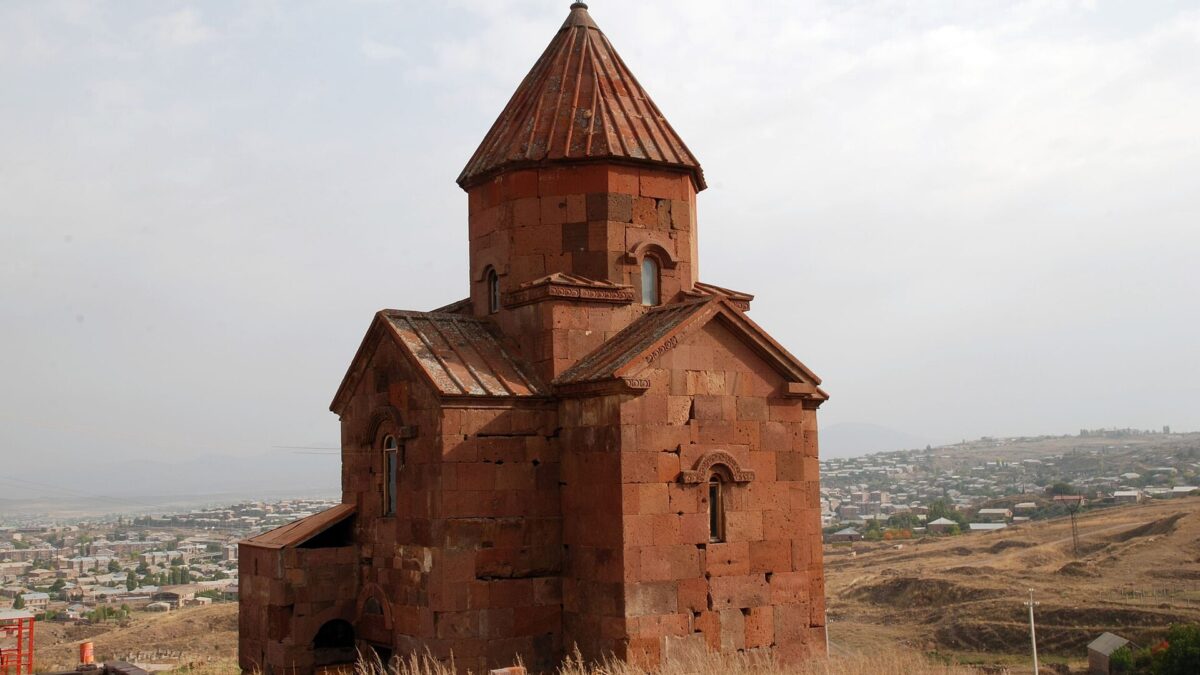
Lmbatavank is a tiny domed church on a hill 1.5–2 km south-west of Artik, in Shirak province, and it holds some of the oldest wall paintings still standing in Armenia: a Theophany in the apse that most scholars date to the late 6th or 7th century. The building is small enough to walk around in two minutes. The painting, cleaned and consolidated by an Italian-based team between 2013 and 2017, is why you make the 20-minute detour from Gyumri. The honest caveat: the church is often locked, and the frescoes are fragments, not a glowing Byzantine interior.
Why Lmbatavank matters: the frescoes
Armenia built hundreds of churches in the 7th century, but almost none of their painted interiors survive. The standard list of early wall paintings is short: Mren, Aruch, Talin, Lmbat, and a handful of fragments elsewhere. The Fresno State “Arts of Armenia” resource puts Lmbat’s paintings in the late 6th or early 7th century; the AUA Armenia Hidden Gems project and the 2024 paper in the Journal of Architectural and Engineering Research (NUACA) both treat the apse Theophany as the key surviving early composition, citing the standard references by Nicole Thierry and Paolo Cuneo.
That makes this one-room church a primary document for how Armenians painted Christ before the Arab period. Mastara and Talin on the same Aragats slopes are grander buildings, but Lmbat is where the paint survived.
The church: plan, dome, inscriptions
Surb Stepanos (St Stephen) is a cruciform, central-domed church with a single apse. The east arm is semicircular inside; the north, south and west arms are rectangular. The dome sits on an octagonal drum with a conical cap, and the transition from the square to the drum is made with squinches rather than pendentives. The AUA monument file flags one unusual detail: the north and south cross-arms are roofed with small domical vaults instead of the usual barrel vaults, a solution it calls unique in Armenian architecture. The stone is the local Artik tuff, pink and yellow-red, laid in large dressed blocks.
Dating is contested within a narrow band. Toros Toramanyan placed it in the 7th century, and that is what most sources repeat. The AUA file lists four Armenian scholars (Grigoryan, Hasratyan, Mnatsakanyan, Ghazaryan) who argue for the 6th century, ranging from mid-century to the last quarter. Either way it predates almost everything else you will see in Shirak.
The walls carry 24 catalogued inscriptions, mostly 10th–13th century. One records a couple, Barsegh and Sarawta, rebuilding the dome; another, from the 11th century, names the town below as “Hartk,” the medieval name of Artik. A Ter Barsegh, son of Vahram Pahlavuni, is recorded buying the monastery back “from the lawless,” restoring its water rights and gifting it the village of Tsitsk (armeniadiscovery.com, drawing on the inscription corpus). Dated entries include 1181 and 1251.
The frescoes: what survives and what they show
The main composition is in the conch of the apse: a Theophany based on Ezekiel’s vision. Christ sits enthroned on a rainbow arc, on a throne picked out with pearls, surrounded by the symbols of the heavenly powers against a background described as flaming (armeniadiscovery.com; Armenpress). Flanking it are two mounted saints with cross-topped staffs riding toward the centre: St George (Surb Gevorg) on one side, and a second horseman usually identified as St Sargis or St Theodore. The AUA file also lists an Ascension and “Christ in Glory” with apostles in the upper sanctuary, and notes that the painters mixed metal particles into the pigments so the surfaces catch light.
Not everything is 7th century. Eurasia.travel’s summary of the Armenian literature reports 12th–13th-century fresco fragments with donor inscriptions from the villages of Tsitsk and Sarnakhbyur, so the interior was repainted in places during the monastery’s medieval prime.
Before 2013 the paintings were, in the Armenian Wikipedia’s phrase, “barely visible.” The restoration was unusual: Christine Lamoureux, a Belgian wall-painting conservator based in Italy, and Ara Zaryan, an Italian-Armenian restoration architect, largely paid for it themselves. Armenpress reported the first stage (the eastern part of the Ezekiel fresco) finished in October 2013; the Armenian Mirror-Spectator describes the main campaign running 2014 through 2017, limited to cleaning, consolidation and minimal infill, with every intervention photographed. Two findings matter for visitors: the cleaning turned up previously unread inscriptions, and it showed the interior had once been fully plastered, which undercuts the old assumption that 7th-century Armenian churches were bare stone inside.
The lost complex and the mausoleum
What you see is the survivor, not the whole. Clearing work around the church in 1953–1955 (AUA dates the archaeological trench to 1954) exposed the apse and west portal of a second building on the south side of the west arm, together with khachkars, the foundations of a large mausoleum, and gravestones of the 9th–10th-century type. En.wikipedia additionally mentions a 1960 clearance that found a Bronze Age cemetery under the forecourt; I could not confirm that in an Armenian source, so take it as plausible rather than settled. A 1989 repair campaign identified further 12th–13th-century rebuilding. The east side of the terrace still has medieval tomb slabs, several inscribed for monks.
Names and legends
Locals have called it Karmir Vank, the Red Monastery, for the tuff, and Hrashagorts Vank, the Miracle-working Monastery, for its reputation. The miracle stories are the ones people in Artik will tell you first. In the most repeated version, an Ottoman pasha ignored warnings that the hill was protected, laid siege, and found his legs paralysed (or withered), after which his soldiers fled. A second version has Turkish gunners firing twice at the church, missing, and then having the cannon blow up in their own position before the commander called it off. A third, gentler one concerns a thief who carried off the church door and could not get it off his back until he returned it. Legends, reported as such.
The pilgrimage day
St Stephen the Protomartyr’s feast falls in late December, when this hill is under snow. Since about 2015 the Mother See of Holy Etchmiadzin has sent a relic of St Stephen to Lmbatavank for a Divine Liturgy on the first Saturday of October instead; Armenpress covered the 7 October 2017 service as “the third year” of the arrangement, quoting the church’s abbot, Fr Levon Hovhannisyan, that the move was made so more people could attend. Pilgrims come from the Shirak and Artik dioceses and beyond, many from Gyumri. It is the one day you can be confident the church is open and full. Avoid it if you want the paintings to yourself; come if you want to see what the Armenian Apostolic Church looks like as living practice in a village, this is a good place. Confirm the date with the Shirak Diocese or the Artik parish before travelling, since the schedule is a custom rather than a fixed calendar feast.
Getting there
| From | Route | Time |
|---|---|---|
| Gyumri | H-17 south via Pemzashen, ~22 km to Artik | 25–30 min by car |
| Yerevan | M-1 toward Gyumri, turn at Maralik or go via Talin–Mastara; roughly 100–115 km depending on route | 2–2.5 h by car |
| Artik centre | Hill south-west of town, 1.5–2 km | 30–40 min on foot, 10 min by car |
Artik sits at about 1,860 m on the north-west foot of Aragats; the church is marked at 1,827 m on a hill in the Lmbat quarter at the town’s south-western edge, with the open-cast tuff and pumice quarries that fed Soviet Artik spread out below. Marshrutkas run from Gyumri’s bus station to Artik through the day; from Yerevan, take a Gyumri marshrutka (from near Sasuntsi Davit metro) and change. With your own car, use the coordinates 40.6081, 43.9575 and follow the dirt track up from the last houses; the final stretch is steep and rutted, fine for any car in dry weather and worth walking after rain. The driving guide covers Shirak roads.
Keys: the church is usually locked outside services. Ask at the Surb Marine (Astvatsatsin) church in Artik centre, or at the houses nearest the track, for the keyholder. Confirm locally; there is no published rota, and some visitors report finding it open.
Pair it with
- Artik’s own churches. Surb Marine (also called Astvatsatsin), in the town centre, is a 5th-century foundation attributed to the Kamsarakan princes, with a 7th-century St Gevorg church next to it. Both are ruined, free, and put Lmbat in context as the hilltop monastery of an early-Christian town.
- Pemzashen, 5 km north on the Gyumri road: a 7th-century church next to the footings of a 5th-century basilica, built from the same tuff and carved with the same shield-and-cross motif as Lmbat.
- Harichavank, 10 km east of Artik: a 7th-century core with a magnificent 13th-century Zakarid gavit, and a proper working monastery with a resident keyholder.
- Marmashen, 10 km north-west of Gyumri: the finest 10th–11th-century ensemble in the province, in a river gorge.
- Gyumri itself, 22 km away, with the best 19th-century streetscape in Armenia and the region’s hotels and restaurants; see the Gyumri guide.
All of these fit one long day from Gyumri; our monastery ranking shows where Lmbat sits among them.
When to go
May to October. The hill is exposed, and Shirak winters are the coldest in the country; the track is impassable or icy from December into March. Morning light through the east window helps you read the apse; late afternoon lights the pink exterior. The first Saturday of October is the pilgrimage, with the crowds that implies.
Practical notes
- Allow 45 minutes on site. No fee, no facilities, no shade; Artik has shops and cafes.
- Bring a torch (headlamp) for the apse; the interior is dim and the paintings are above eye level.
- No flash, and do not touch the walls. The consolidation work is recent and the pigments are fragile.
Last verified: October 2026.
Verdict
Lmbatavank is a 30-minute stop that outweighs its size. Go for the 7th-century Theophany, stay for the view over the tuff quarries and the Shirak plain, and build it into a Gyumri-based loop with Harichavank and Marmashen rather than treating it as a destination on its own. Without the key you still get one of the best-preserved small 7th-century exteriors in the province; with it, you get paint from the first great century of Armenian stone churches, which very few places can offer.
Frequently asked questions
How old are the Lmbatavank frescoes?
The apse Theophany (Christ enthroned, after Ezekiel’s vision) is dated by most scholars to the late 6th or 7th century, the same generation as the paintings at Mren and Aruch. Some fragments inside are later, 12th–13th century, with donor inscriptions.
Is Lmbatavank open to visitors?
The hill and exterior are open at all times and free. The church itself is usually locked outside services; ask for the keyholder at Surb Marine church in Artik or at the houses nearest the track, and confirm locally. It is reliably open on the pilgrimage day, the first Saturday of October.
How do I get to Lmbatavank from Gyumri?
Drive or take a marshrutka 22 km south to Artik (25–30 minutes), then follow the dirt track to the hill 1.5–2 km south-west of the town centre. On foot from Artik it is a 30–40 minute uphill walk.
Why is it called Karmir Vank?
Karmir Vank means Red Monastery and refers to the pink-red Artik tuff it is built from. It is also called Hrashagorts Vank, the Miracle-working Monastery, after local legends about Ottoman soldiers failing to take or destroy the church.
Featured image: Bertramz, CC BY-SA 3.0 — via Wikimedia Commons.