Mastara’s St John church (Surb Hovhannes) is a squat, heavy, early-medieval building in the middle of a village on the Yerevan–Gyumri highway, roughly 55 km from the capital. It matters because of what is not inside it: no pillars. A dome about 11 m across rests on four apses and a stack of corner squinches, which makes Mastara the earliest surviving Armenian church to hold up a dome that way, and the model for a whole family of later buildings. The church was fortified in the 18th century, used as a farm storehouse for most of the Soviet period, and in 2017 gave up fragments of wall painting nobody knew existed. Thirty minutes is enough, and you are driving past it anyway.
Why Mastara matters
Early Armenian domed churches solve the same problem in one of two ways. Either the dome sits on four free-standing piers inside the building (the Echmiadzin and Bagharan type), or the building is small enough that the walls alone can carry it. Mastara does neither. The plan is a square prayer hall with four apses opening off its sides: a tetraconch on a square base, which the Fundamental Armenology survey of 4th–7th-century architecture calls, simply, “the Mastara type”. Four large squinches bridge the corners of the square, a second tier of eight smaller squinches sits above them, and on that rises the drum and dome. The Armenian Church’s own Mother See video on the building titles it “the first Armenian church without columns”, and that is the fairest one-line summary.
The scale is the other point. The dome diameter is usually quoted at 11.2 m (a figure from tourism sources, not one I found in an academic text, so treat it as approximate). For a 5th–7th-century village church that is a wide span with no interior support, and it is why the interior reads as one volume rather than a nave with aisles. Fresno State’s Armenian Studies Program notes the drum is sixteen-sided on the outside and the dome itself is built in twelve panels, an unusual arrangement in Armenian architecture; other descriptions (hushardzan.am, the AUA Hidden Gems survey) call the drum octagonal, which is how it reads from the ground.
The plan was copied. The hushardzan.am page and several guides list the Great Church of Artik, St Astvatsatsin of Voskepar, St Grigor at Harichavank and the Holy Apostles church in Kars as buildings that follow the Mastara scheme. Zvartnots, a few decades later, is the ambitious cousin; Mastara is the plain one that worked out the structural trick first.
The dating argument: 5th century or 7th?
Both dates appear in print, and the disagreement is genuine.
The case for the 7th century. Three inscriptions survive on the church. One, on the south and west walls, says the church was built by the monk Grigoras (Grigor) in the time of Bishop Teodoros Gnuni, and that bishop is recorded as attending a council at Dvin in the 640s. Fresno State’s page and the Service for the Protection of the Historical Environment (hushardzan.am) both report the inscription. The AUA Hidden Gems project goes further and puts initial construction in the 620s–630s with a revision in the 640s.
The case for the 5th century. Hushardzan.am points out that the decoration (equal-armed crosses on the lintels, line-carved cherubs, a cross relief flanked by a pair of birds, high-relief doves on the arch) is characteristic of 5th-century work, and that the original masonry is large reddish-purple blocks while the 7th-century work is in orange-yellow stone. On that reading Grigoras rebuilt or enlarged an existing church rather than founding one. Fresno State’s summary is similar: 7th-century, incorporating an older church.
Why the inscription doesn’t settle it. The Armenian verb in the inscription, shinel, is used in medieval texts for both “to build” and “to rebuild”. The honest position is that the building you see is substantially 7th-century, standing on, and reusing parts of, something earlier. A second inscription records a repair of the south entrance in 891 by Sargis, son of the priest Artavazd, so the church was already being patched within 250 years.
The name and the relic legend
The tradition, reported by hushardzan.am, the AUA survey and the Diocese’s own material, is that Gregory the Illuminator brought relics of John the Baptist back from Caesarea in Cappadocia and buried a portion of them here. The name is then explained as mas (“part” or “relic”) plus tara (“I took” or “I carried off”): “I took the part”. A second version collected by the AUA team has the villagers receiving the saint’s hand and building the church to house it. There is no relic on display, but the story explains the dedication to St John and fits the wider pattern of relic-founded churches described in our piece on Armenia’s conversion.
What you’ll see
Exterior
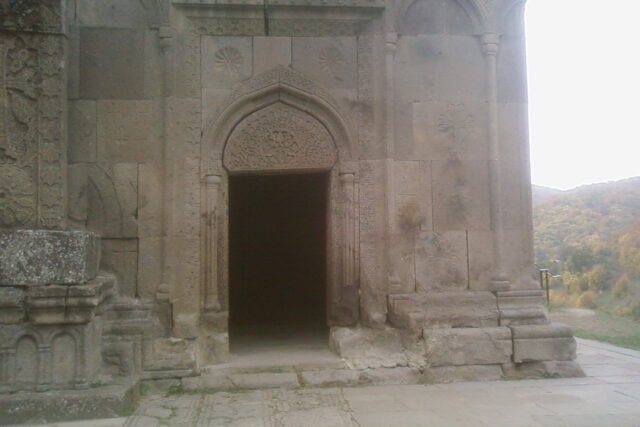
From the road the church is a block of dark tuff with a tall polygonal drum and a conical roof, standing in a fenced yard in the middle of the village at about 1,745 m elevation. The four apses show as polygonal projections (pentagonal on the outside, horseshoe-shaped within), and the two-tone masonry is obvious once you know to look: the big purplish blocks low down are the older work, the yellower stone above is the 7th-century rebuild. Look at the lintels and the arch over the entrance for the cherub carvings and the dove reliefs. Two or three steps lead up to the door; there is no ramp.
Interior
The whole argument for visiting is the moment you step in. There is one room, square, with the four apses opening off it and nothing between you and the dome. Stand in the centre and look up at how the corners are turned: large squinch, then a row of smaller squinches, then the drum with its eight windows. The light is good at midday because those windows are high and evenly spaced. The altar apse is on the east, flanked by two small rectangular chambers.
The wall paintings
Until the 2010s the interior was assumed to be bare. A Belgian conservator, Christine Lamoureux, and the architect-restorer Ara Zaryan examined the church between 2013 and 2017 as part of a wider study of early Christian Armenian murals, and found that under the thick sand plaster applied in 1889 the entire inner surface had once been painted. The fragments they cleaned and consolidated in 2017, in the south-west corner and the south apse, include parts of saints’ figures, one of them probably a mounted St George, and a painted inscription reading “Archangel Gabriel” (Armenian Mirror-Spectator, May 2020, reviewing their 2019 book published by Tigran Metz). The fragments are small and faded; do not expect a painted church. You will hunt for them with a torch.
The 18th-century walls
In the 18th century the church was enclosed by a defensive wall and used as a refuge, which is why older descriptions call it a fortress. In 1889 the village priest had the wall pulled down, repaired the south entrance, built a wooden gallery inside and plastered the interior, the plastering that hid the murals for 130 years. Almost nothing of the enclosure survives above ground today.
The storehouse years and the restoration
In 1935 the church was closed under Soviet anti-religious policy and turned into the collective farm’s storehouse; the AUA survey says it held grain. It was returned to the church and reopened for worship in 1993 (one source says 1992). The grain use probably preserved the plaster, and so the murals, since nobody touched the walls for sixty years. The structural restoration of the drum and roof dates from the post-Soviet period and the fresco conservation from 2017, and it is now the parish church of Mastara.
Getting there
| From | Distance / time | How |
|---|---|---|
| Yerevan | About 55 km on the M1, 1 h by car | Any Gyumri-bound marshrutka from the Kilikia bus station passes the village; ask for Mastara |
| Gyumri | About 65 km, 1 h | Yerevan-bound marshrutka, same deal |
| Talin | About 10 km | Taxi, 5 minutes |
The church is a few hundred metres off the highway in the village centre and is signposted. Marshrutkas between Yerevan and Gyumri run roughly hourly in the morning, take about two hours end to end and cost in the region of 1,500–2,000 AMD; the driver will drop you at the Mastara turn, and you flag down the next one to continue. If you are doing the Talin–Dashtadem–Mastara cluster, a hire car or a taxi hired by the day from Yerevan (budget 25,000–35,000 AMD) is the sensible choice.
Hours and entry: it is a working village church and there is no ticket. In my experience of Aragatsotn village churches it is open through the day, and if the door is locked, someone nearby has the key. I could not verify fixed hours for Mastara, so build in slack.
When to go, and the light
At 1,745 m the village is cold and often snowed in from December to March; the highway stays open but photographs are grey. May–June gives green fields and clear views of Aragats to the east. For the exterior, late afternoon light from the west picks out the two colours of stone; for the interior, aim for 11:00–14:00 when the drum windows throw light on the squinches. Bring a torch for the mural fragments.
Pair it with
- Talin (10 km back towards Yerevan): the ruined 7th-century cathedral built for the Kamsarakan princes and the small St Astvatsatsin church beside it. Half an hour.
- Dashtadem fortress (about 6 km south of Talin): a 10th-century castle expanded under the Seljuks and the Persians, restored in the 2010s, with a keep you can climb. Forty minutes.
- Aruch (on the M1, 30 km back towards Yerevan): a huge 7th-century single-hall cathedral with fresco remains in the apse, plus a caravanserai ruin by the road.
- Garnahovit (north of Talin, rough road): a 7th-century church on a plan close to Mastara’s.
All four plus Mastara make a long but comfortable day from Yerevan; see our day-trip overview for how it compares with the other options. If you are heading on to Gyumri, do Aruch, Talin and Mastara in that order and you arrive by mid-afternoon.
Worth the stop?
Yes, if you are on that road anyway. Mastara is not a photogenic monastery in a gorge; it is a plain, important building that rewards ten minutes of looking up, and worth the 15-minute detour for anyone curious how Armenian architects got from basilicas to Zvartnots. The honest caveat is that it is a village church, not a site: no café, no guide, no signage inside. With Talin and Dashtadem it is one of the best half-days in western Armenia; alone, a good 30 minutes.
Last verified: October 2026.
Frequently asked questions
Is Mastara church 5th century or 7th century?
Both dates appear in reputable sources. An inscription says the monk Grigoras built it under Bishop Teodoros Gnuni, who is recorded in the 640s, but the Armenian verb used can mean ‘rebuild’, and the carved decoration and the lower reddish-purple masonry look 5th-century. The usual compromise is a 7th-century building reusing an earlier church.
Why is Mastara called the first Armenian church without pillars?
Its dome, about 11 m across, rests on four apses and two tiers of corner squinches rather than on interior piers, so the whole interior is one open square. It is the earliest surviving Armenian church built this way and gave its name to the ‘Mastara type’ plan copied at Artik, Voskepar and Harichavank.
How do I get to Mastara from Yerevan without a car?
Take any Gyumri-bound marshrutka from Kilikia bus station and ask to be dropped at Mastara, about 55 km and an hour away. The church is a short walk into the village. To continue, flag down the next marshrutka on the highway. A day taxi is easier if you also want Talin and Dashtadem.
Are there frescoes inside Mastara church?
Fragments only. Conservators Ara Zaryan and Christine Lamoureux found in 2013–2017 that the whole interior had once been painted; they cleaned and stabilised pieces in the south-west corner and south apse in 2017, including a probable mounted St George and a painted ‘Archangel Gabriel’ inscription. Bring a torch.
Featured image: Travis K. Witt, CC BY-SA 4.0 — via Wikimedia Commons.