Amberd is a ruined medieval fortress and church complex on the southern slopes of Mount Aragats, sitting at roughly 2,300 metres (about 7,500 ft) above sea level in Armenia’s Aragatsotn province. The stronghold dates from the 7th to 11th centuries, and its name has long been read as “fortress in the clouds.” You reach it by car or tour from Yerevan in about 1.5 hours, and the mountain road is seasonal.
Amberd is one of those sites that rewards a little planning and punishes none. The walls are half-collapsed, there are no ticket queues to speak of, and on a clear day the setting does most of the work. Below we cover the history, the church beside it, how to actually get up there, and what else fits into the same day. Prices and access details carry a Last verified: July 2026 stamp because mountain conditions and small entry fees change.
What is Amberd fortress?
Amberd (Armenian: Ամբերդ) is a fortified castle and church complex built into a rocky spur where the Arkashen and Amberd rivers meet, on the flanks of Mount Aragats. The castle and some of its wall sections were first raised in the 7th century as a holding of the noble Kamsarakan family, then reached their peak in the 10th and 11th centuries under the powerful Pahlavuni dynasty (Wikipedia).
The name has long carried the sense of a stronghold set among the clouds, a nod to its altitude and the mist that rolls across the slope. It was a serious military position in its day, guarded by natural gorges on two sides and heavy stone walls on the approach. Control of Amberd meant control of one of the routes toward the Ararat plain, which is why successive powers wanted it. That defensive strength did not save it forever: Seljuk forces took it late in the 11th century, and Mongol armies captured and largely destroyed the site in the 13th century (Advantour). What survives today is a substantial ruin rather than a restored castle, which is part of the appeal.
The fortress and Vahramashen church
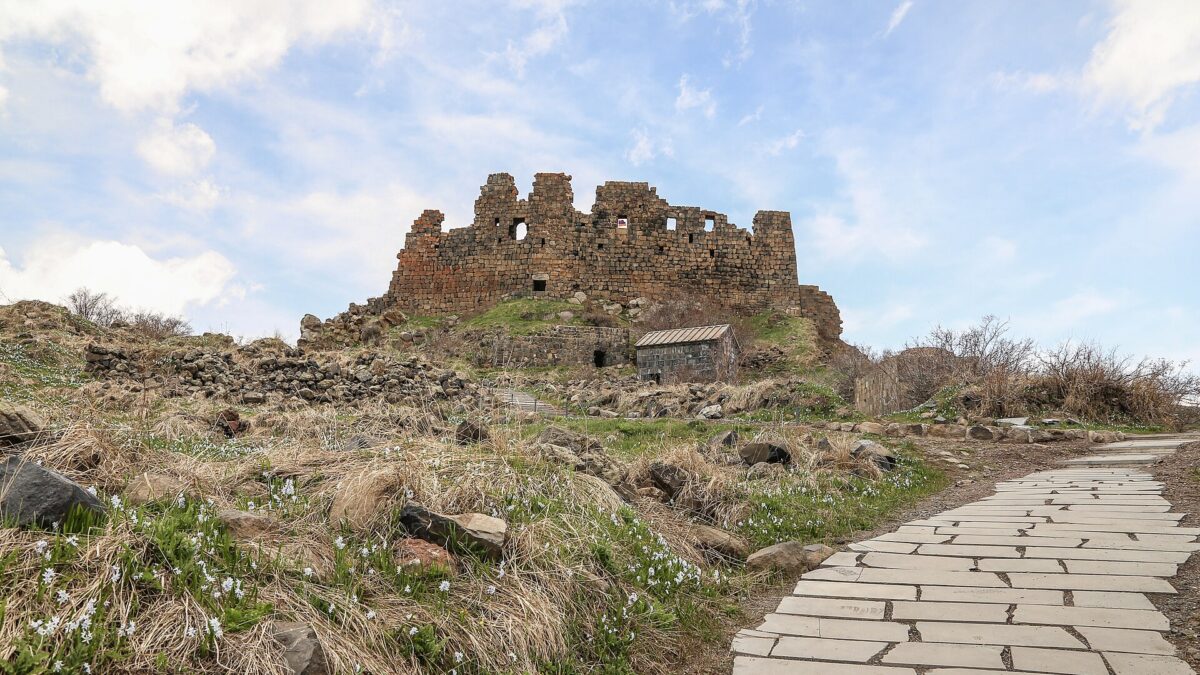
Two structures anchor the site. The fortress itself is a spread of stone walls, a keep, cisterns and the remains of a bathhouse and secret water passages that once let defenders survive a siege. It is a ruin you can walk through and around rather than a museum with rooms and railings.
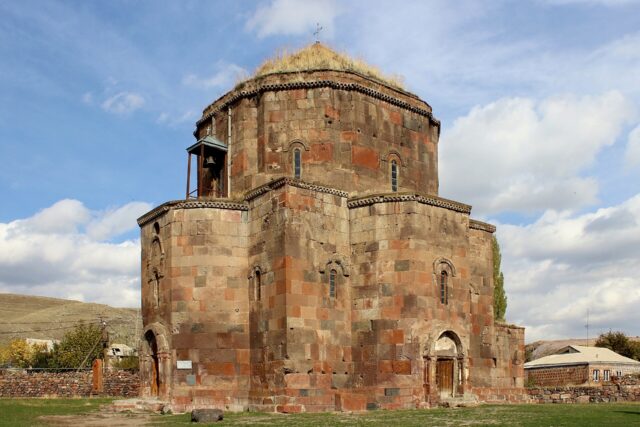
Standing apart from the walls is the Vahramashen Church, also called Surb Astvatsatsin (Holy Mother of God). It was built for Prince Vahram Pahlavuni, and an inscription on the north portal dates its completion to 1026 (Wikipedia). The church has a compact cruciform plan under a central dome, with carved detail on the exterior that has weathered nearly a thousand years of mountain winters. It is small, intact enough to enter, and photographs far better than the fortress walls because it still reads as a single building rather than a scatter of stone. The tuff masonry glows a warm reddish-grey in low light, which is part of why late-afternoon visits are worth timing for.
Give yourself time for both. Many visitors head straight for the church, snap it against the mountain, and leave without picking through the fortress ruins on the promontory below, which is where the older stonework and the drop into the gorge actually are.
The setting on Mount Aragats
The location is the reason to come. Amberd clings to the southern shoulder of Mount Aragats, the highest massif in Armenia, whose northern summit reaches 4,090 m (Wikipedia). The fortress itself sits far lower, around 2,300 m, on a wedge of land between two river gorges. Look one way and you have alpine meadow climbing toward the peaks; look the other and the land falls away toward the Ararat plain.
At this altitude the air is noticeably cooler and thinner than in Yerevan, and weather turns fast. Cloud can swallow the church in minutes and then clear just as quickly. If you like landscape and quiet ruins over polished tourist sites, this is a strong pick. If you want an accessible, kid-friendly monastery with a café and paved paths, temper expectations: the ground is uneven and the drama comes at the price of a bumpy road and mountain exposure.
How do you get to Amberd from Yerevan?
Amberd lies about 52 km (roughly 32 miles) northwest of Yerevan, near Byurakan village, and the drive takes around 1.5 hours because the final stretch is a slow, winding mountain road (Absolute Armenia). The usual route runs toward Ashtarak, up to Byurakan, then follows signs onto the Aragats road to the fortress.
Your realistic options:
- Rented car: the most flexible choice. Main roads are fine; the last climb is narrow and best driven in daylight. Budget roughly USD 25-40/day for an economy car (Last verified: July 2026).
- Organised day tour: the easiest route, since guides know the road and usually pair Amberd with other Aragatsotn sights. Group day tours in Armenia run roughly USD 25-50 per person.
- Hired taxi / GG or Yandex Go car for the day: workable if you agree a round-trip price up front, because you will not find a return ride waiting at the fortress.
The honest catch: there is no useful public transport to the fortress itself. Marshrutkas serve Byurakan village, but that still leaves a long uphill gap to Amberd with no onward minibus, so day-trippers without a car almost always take a tour or a private car. If you are weighing your transport choices for the wider trip, our guide on how to get around Armenia lays out marshrutkas, taxi apps and car rental in detail, and Amberd fits naturally into a broader run of day trips from Yerevan.
When is Amberd open and accessible?
The site has no gates to lock in the usual sense, so “open” is really a question of the road. The Aragats road is a warm-season route: snow can close or make the upper approach dangerous, and it is generally described as accessible from around May to as late as December, with winter access unreliable (Absolute Armenia).
Practical timing:
- Best window: late spring through autumn. Meadows are green in June, and September brings dry, clear air, matching Armenia’s best all-round travel months (see the best time to visit Armenia).
- Shoulder season (April, late October-November): possible but check first. An early or late snowfall can shut the climb with little warning.
- Winter: assume the fortress is effectively off-limits unless a tour operator confirms current conditions.
| Item | Detail (approx., verify locally) |
|---|---|
| Elevation | ~2,300 m (7,500 ft) |
| Distance from Yerevan | ~52 km / ~1.5 hr drive |
| Best months | May-October (September ideal) |
| Winter road | Often snow-closed; confirm first |
| Entry | Widely reported free at the ruins; some operators list a small fee (~700 AMD residents / ~1,500 AMD visitors) – confirm on site |
On the fee: sources disagree. Several treat the fortress as free to walk, while at least one operator lists a small ticket of roughly 700 AMD for residents and 1,500 AMD for visitors (Absolute Armenia). Carry a little cash in Armenian dram either way. Last verified: July 2026.
What can you combine with Amberd?
Amberd works best as one stop on an Aragatsotn loop rather than a solo errand, because the drive is longer than the time you will spend at the ruins. The sights that pair naturally with it:
- Byurakan Astrophysical Observatory – a Soviet-era research observatory on the same road up from Byurakan village, and the obvious combine given you pass it.
- Saghmosavank – a 13th-century monastery perched over the Kasagh River gorge, an easy add on the way to or from Amberd.
- Lake Kari – a small alpine lake higher up Mount Aragats, and the launch point for summit hikes when the road is open; strong for anyone interested in hiking in Armenia.
Slot Amberd into a half or full day and it earns its place; treat it as a standalone two-hour hop and the road-to-ruin ratio feels lopsided. For where it ranks against the country’s headline sights, see our roundup of the best things to do in Armenia, or browse more of the region under destinations.
Our take: Amberd is underrated by day-trippers who default to Garni and Geghard. If you have already done the eastern classics and want a wilder, quieter, higher stop with genuine history attached, this is the one to add, weather and road permitting.
Featured image: Saro Hovhannisyan (CC BY-SA 4.0) via Wikimedia Commons