A khachkar is a carved Armenian cross-stone, a memorial stele bearing a cross that rests on a sun or wheel-of-eternity disc and is framed by dense, lace-like carving. UNESCO inscribed the craft of making them as Intangible Cultural Heritage in 2010. The most famous stand at Noratus cemetery near Lake Sevan and at Goshavank monastery.
If you travel through Armenia for more than a day or two, you will start seeing them everywhere: propped against church walls, planted in graveyards, set into monastery courtyards, sold in miniature at every souvenir stall. The khachkar is arguably the single most Armenian object there is. Here is what they are, what the carvings mean, and where to see the ones worth planning a stop around.
What is a khachkar?
A khachkar (Armenian khach, “cross”, plus kar, “stone”) is an upright memorial slab carved with a cross as its centrepiece. It is a defining form of medieval Christian Armenian art. The cross usually sits above a rosette or solar disc, and the rest of the stone is filled with interlaced bands, vine scrolls, grapes, pomegranates and geometric knotwork, occasionally with saints or animals worked into the border. Most were carved from local volcanic tuff or basalt, the same stones that build Armenia’s churches.
Crucially, no two are identical. Among the tens of thousands that survive, each carries its own pattern, which is part of why the tradition is treated as a living art rather than a repeated template (UNESCO). They were raised for many reasons: to mark a grave, to commemorate a military victory or the founding of a church, to ask protection, or simply as an act of faith. Once blessed and anointed, a khachkar was believed to hold holy power.
What do khachkars symbolise?
The core image reads as Christian faith rising out of eternity. The cross stands for Christ and salvation; beneath it, the sun-disc or “wheel of eternity” carries an older, pre-Christian sense of endlessness and light (UNESCO). The living, sprouting branches at the foot of many crosses turn the whole stone into a tree of life. Grapes and pomegranates, both loaded Armenian symbols of abundance and the church, thread through the borders.
Read that way, a khachkar is less a gravestone than a compact statement of belief: eternity below, the cross above, and life growing around it. That layering of Christian and older Armenian imagery is one reason khachkars sit so close to national identity, alongside the country’s history as the first nation to adopt Christianity as a state religion and its own unique alphabet.
When did khachkars first appear?
Free-standing cross-stones emerged in the 9th century during a period of Armenian cultural revival. The oldest firmly dated khachkar, carved in 879 CE, was raised for Queen Katranide, wife of King Ashot I (Wikipedia). The art peaked between the 12th and 14th centuries, when master carvers pushed the stone into astonishing fineness, then declined after the Mongol invasions before a strong 16th-17th century revival. Roughly 40,000 or more historic khachkars are thought to survive today, though estimates vary.
Are khachkars UNESCO heritage?
Yes. In 2010, UNESCO added “Armenian cross-stones art. Symbolism and craftsmanship of Khachkars” to its Representative List of the Intangible Cultural Heritage of Humanity, at the committee session held that November in Nairobi, Kenya (UNESCO). Note the wording carefully: the listing protects the craft and knowledge of making khachkars, the living tradition passed from master to apprentice, not a specific monument. That distinction matters, because Armenia’s single greatest field of khachkars was outside its borders and did not survive.
The medieval Armenian cemetery at Julfa (Nakhichevan), which held around 10,000 khachkars in the 17th century, was systematically destroyed by Azerbaijan between the late 1990s and 2005 (Wikipedia). Its loss is why the field you can still visit at Noratus now carries the title of the largest surviving khachkar cemetery.
Where can you see khachkars in Armenia?
The short answer: almost any old church or monastery has a few, but a handful of places are worth building a route around. The standout is Noratus, easily paired with a Lake Sevan day trip.
Noratus cemetery (the big one)
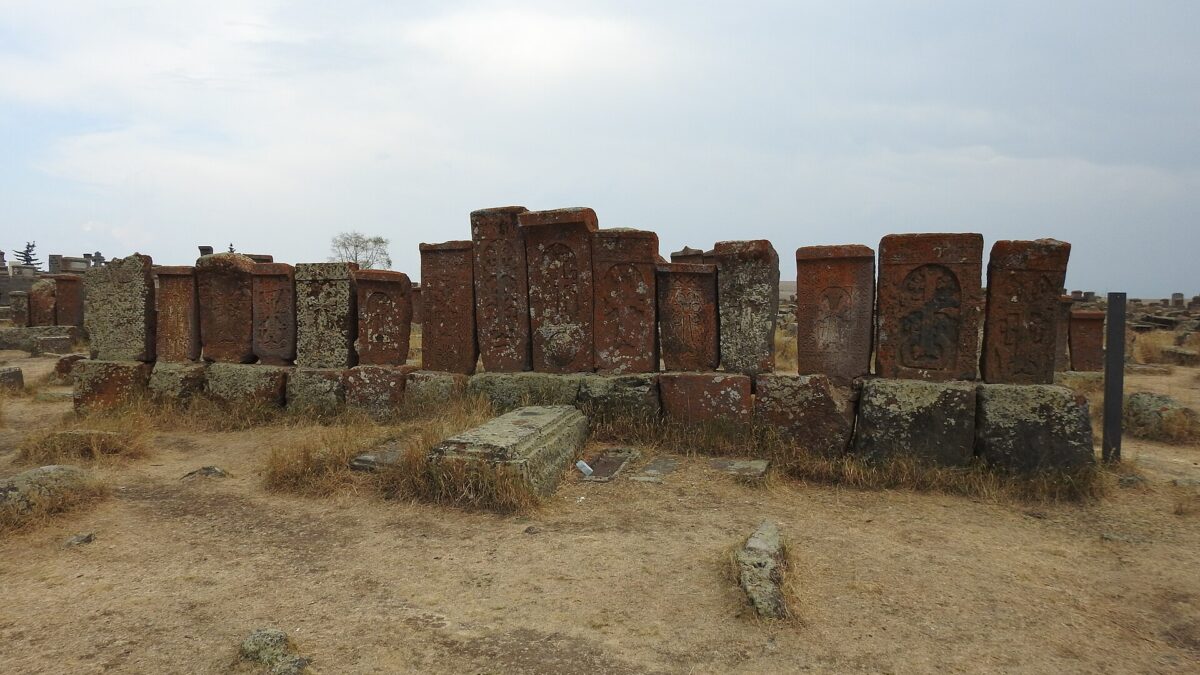
Noratus (also spelled Noraduz) is a medieval cemetery near Gavar on the western side of Lake Sevan, about 90 km north of Yerevan. It spreads across roughly seven hectares and holds close to a thousand khachkars, the oldest dating to the late 10th century (Wikipedia). It is the largest surviving field of khachkars anywhere. Walking the rows, you see the whole arc of the craft, from weathered early stones to the denser 16th-17th century work of local masters such as Kiram Kazmogh. Entry is free and the site is open-air, so there are no fixed hours. Give it 45 minutes to an hour. Last verified: July 2026.
Goshavank monastery (the finest single stone)
If Noratus is about quantity, Goshavank in the northern Tavush region is about the single most celebrated khachkar in the country. Carved by the master Poghos in 1291, it is nicknamed Aseghnagorts, “needle-carved”, because the openwork is so fine the stone reads like lace rather than rock (armenia.travel). It stands near the church of St. Grigor Lusavorich; a companion khachkar by the same master is now held at the History Museum of Armenia in Yerevan.
Other reliable places to see them
- Geghard and Haghpat monasteries, both with notable dated khachkars (1213 and 1273) worked into their walls and courtyards.
- Sevanavank, on the Sevan peninsula, has khachkars set around its 9th-century churches.
- Yerevan, where the History Museum on Republic Square displays important carved stones indoors, out of the weather.
- Almost any working monastery on our monasteries route will have several against its outer walls.
| Site | Why go | Region / access |
|---|---|---|
| Noratus cemetery | Largest surviving khachkar field, ~1,000 stones | Lake Sevan (~90 km N of Yerevan) |
| Goshavank | Poghos’s “needle-carved” 1291 khachkar | Tavush, near Dilijan |
| Geghard | Rock-cut UNESCO monastery, dated khachkars | ~40 km E of Yerevan |
| Sevanavank | Khachkars by lakeside 9th-c. churches | Sevan peninsula |
| History Museum of Armenia | Poghos’s second khachkar, indoors | Central Yerevan |
Our honest call: if you only have time for one, make it Noratus. The scale, the setting above the lake, and the free open-air access make it the most rewarding, and it slots neatly into a Sevan day. Goshavank is the better single object but a longer detour north. Both can be reached on a broader Armenia itinerary.
How are khachkars made?
A khachkar begins as a single slab of local stone, usually the soft volcanic tuff that hardens on exposure to air, which is why carvers could cut such fine detail. Working with chisel, die, sharp pointed tools and hammer, the master roughs out the cross and central disc, then progressively deepens the interlace and vegetal patterns around them (UNESCO). The surface is finished by grinding with fine sand, and flaws are filled with clay or lime before any painting.
The knowledge itself is what UNESCO singled out. It passes down through families and through apprenticeships, with masters teaching the established patterns while encouraging each carver’s own hand, which is exactly why regional styles diverge and no two stones repeat. The craft is still practised, so the khachkars you see are not only relics; carvers are adding new ones today.
Why khachkars matter to Armenian identity
Few symbols do as much cultural work. Khachkars mark Armenian ground literally, standing over graves and at church doors, and figuratively, appearing on stamps, in diaspora churches worldwide, and as the go-to national emblem in stone. Their fate is bound up with Armenian history too, from the medieval golden age of carving to the destruction at Julfa. For a traveller, learning to read one, cross above, eternity below, life growing around, turns a roadside slab into one of the clearest windows onto how Armenia sees itself. To go deeper into that story, our Culture & History guides connect the stones to the churches and the faith behind them.
Featured image: Khoren Arabadjian (CC BY-SA 4.0) via Wikimedia Commons