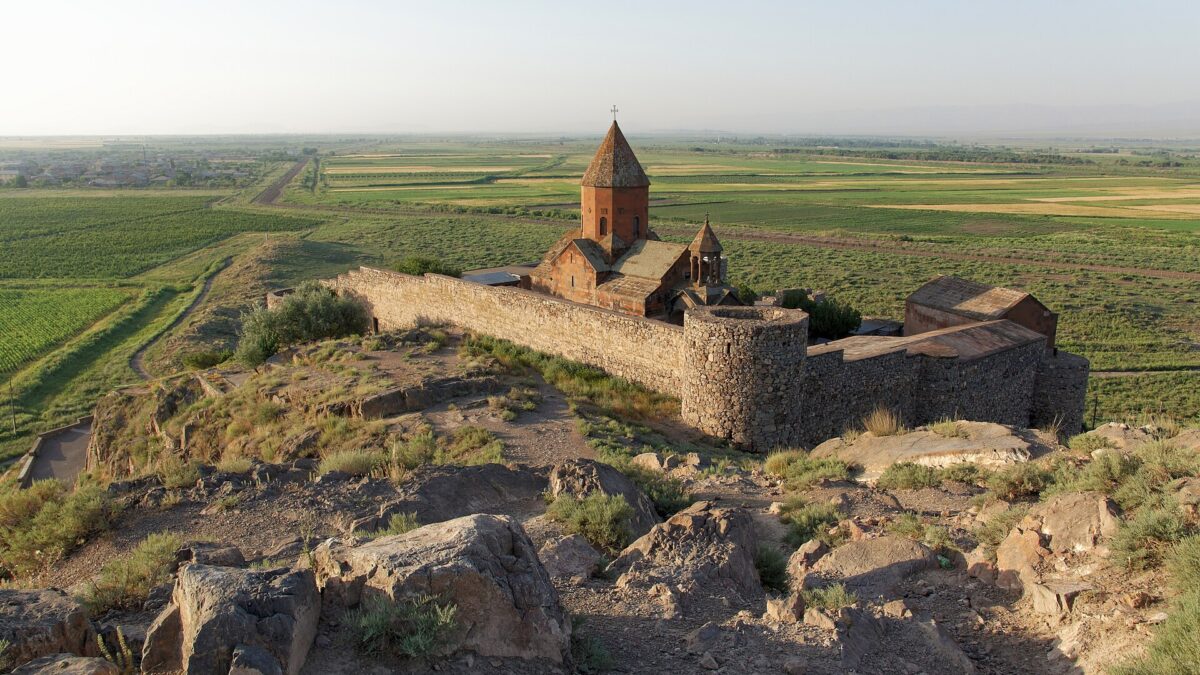
Khor Virap is a working Armenian Apostolic monastery on the Ararat plain, roughly 40 km south of Yerevan (about a 45–50 minute drive), pressed right up against the closed Armenia–Turkey border. It is the country’s most famous vantage point for Mount Ararat, whose snow-capped double summit rises directly behind the church walls. Its name literally means “deep dungeon,” and the site is built over the pit where, according to Armenian tradition, Gregory the Illuminator was imprisoned for around 13 years before he converted King Trdat III and Armenia adopted Christianity as its state religion in 301 AD. Entry is free, and you can still climb down a ladder into that pit today.
This guide covers how to reach Khor Virap without a car, when to go for the clearest Ararat view and why, what descending into the pit is actually like, and how to pair it with Noravank and Areni or Echmiadzin for a full day out. Facts here are cross-checked against the official tourism board; time-sensitive details carry a verification date at the end.
Why Khor Virap matters
Two things pull travelers here, and they reinforce each other. The first is history. The pit beneath the site is tied to the story that turned Armenia into the world’s first officially Christian nation. Gregory the Illuminator, who had refused to take part in a pagan rite, was thrown into this dungeon on the orders of King Trdat III and, by tradition, survived roughly 13 years there. After the king fell gravely ill, Gregory was released, healed him, and baptized him — the moment Armenia usually dates to 301 AD. The monastery you see now grew up around that spot over later centuries, with the main Surb Astvatsatsin (Holy Mother of God) church dating from the 17th century.
The second draw is the view. Khor Virap sits on flat farmland almost at the base of Mount Ararat. The mountain lies about 20 km away and is today inside Turkey, but from the monastery’s low hill it looks close enough to touch. The image of the small church and its walls with the enormous mountain behind is one of the most reproduced scenes in the whole South Caucasus — and unlike many famous photos, it genuinely looks like that in person when the weather cooperates.
A note on Ararat and the border
Mount Ararat is the national symbol of Armenia and appears on its coat of arms, yet the peak itself has been within Turkey’s borders since the 1920s. The land frontier between the two countries is closed. Khor Virap sits very near that border, but it is a normal, well-visited tourist site on the standard Yerevan day-trip circuit — this is not one of the sensitive eastern zones near the Armenia–Azerbaijan border that travel advisories flag. You will often see the border fence and watchtowers from the hill; treat photography around obvious military installations with common sense.
How do you get to Khor Virap from Yerevan?
There is no single direct tourist marshrutka that drops you at the monastery gate, and this is the part most first-timers underestimate. You have three realistic options.
- Organized day tour — the simplest choice, and the most common. Group tours from Yerevan typically bundle Khor Virap with Noravank and Areni (see below); expect roughly the standard Armenian day-tour range of about USD 25–50 per person. This removes the transport headache entirely and is what most visitors end up doing.
- Taxi or ride-hailing app — book through GG or Yandex Go rather than hailing on the street, where tourists are routinely overcharged. A one-way ride is cheap by international standards, but you’ll want to agree a wait-and-return arrangement, because getting a car back from the monastery is difficult.
- Public marshrutka (the budget route) — minibuses heading toward the town of Ararat leave from around the Sasuntsi Davit area and cost only about 500 AMD, but they drop you on the main road, leaving roughly a 1.5 km walk to the monastery. Departures are limited and the return timing is awkward, so budget travelers frequently arrive by marshrutka and then take a taxi back. If you go this way, confirm departure points and times locally, as station information in Yerevan changes and sources disagree.
Our honest take: unless you are committed to doing it cheaply, the combined day tour or a booked GG/Yandex car with a wait is worth it. Khor Virap alone doesn’t fill a day, and the return-transport problem sours more independent visits than anything else.
When is the best time to see Mount Ararat?
Early morning, and ideally in the cooler half of the year. Ararat is often shrouded in haze, and the atmosphere over the plain is clearest first thing in the day before the heat builds. The peak also shows most reliably from around October through April, when the air is crisper; summer frequently hazes the mountain over entirely, so a midday July visit can leave you staring at a milky sky where the mountain should be.
The practical lesson: if the Ararat shot is your main reason for coming, plan an early start and check the forecast. Many tours leave Yerevan late morning, which can mean arriving after the best light and clarity have gone. There is no way to guarantee a clear peak on any given day — Ararat makes its own weather — but stacking the odds with an early, cool-season visit is the single most useful thing you can do.
Can you go down into the pit?
Yes. Inside the Surb Gevorg chapel on the site, a narrow opening leads down a near-vertical metal ladder into the small underground chamber traditionally identified as Gregory the Illuminator’s prison. The descent is roughly 6 metres down a tight shaft, and the pit at the bottom is cramped and dimly lit.
A few honest warnings. The ladder is steep and the rungs can be slick; it is genuinely not suitable for anyone with limited mobility, a fear of enclosed spaces, or small children who can’t manage a vertical climb. There is often a short queue, since only a few people fit at once and everyone comes back up the same ladder. Bring a phone light, and don’t wear a skirt or anything that makes a vertical ladder awkward. Going down is optional — plenty of visitors skip it and simply enjoy the churches and the view — but for many people the descent into the actual dungeon is the emotional core of the visit.
How much time do you need, and what does it cost?
Entry to Khor Virap is free, as it is at most Armenian monasteries. Budget around 45 minutes to an hour on site: time to walk the walls for the Ararat view, look inside the main church, and (if you choose) queue for and climb into the pit. As a working monastery and active place of worship, modest dress is expected — cover shoulders and knees, and women may want a scarf. There are usually vendors selling doves near the entrance, released for luck or blessings; whether you take part is up to you.
What to combine with Khor Virap
Because the monastery itself is a short visit, it is almost always paired with somewhere else. Two combinations dominate.
Khor Virap + Noravank + Areni (the southern loop)
This is the classic full-day route, and the one most group tours follow. After Khor Virap you continue southeast into Vayots Dzor to Noravank, a 13th-century monastery set in a dramatic red-cliff gorge, famous for its two-storey church with a narrow external stone stair up its face. On the way you pass Areni, the wine village where the Areni-1 cave holds what is recognized as the world’s oldest known winery, at roughly 6,100 years old (the same cave produced a 5,500-year-old leather shoe). Several wineries offer tastings; prices vary but are typically a few thousand AMD. If you’re here in early October, the Areni Wine Festival is worth timing for.
Khor Virap + Echmiadzin
A gentler alternative that leans into the religious-history theme. Echmiadzin Cathedral in Vagharshapat, about 20 km west of Yerevan, is the Mother See of the Armenian Apostolic Church and central to the same 301 AD conversion story that gives Khor Virap its meaning. Worth flagging: the cathedral reopened and was re-consecrated on 29 September 2024 after a multi-year restoration, so any guide claiming it is “closed for renovation” is out of date. Pairing the two makes a coherent day around Armenia’s Christian origins, though they sit on opposite sides of Yerevan, so this works best with a car or tour rather than public transport.
Practical tips before you go
- Start early for the clearest Ararat and to beat tour-bus arrivals.
- Sort your return transport first if going independently — the way back is the hard part.
- Dress modestly; bring a scarf and shoes you can climb a ladder in.
- Carry some cash (AMD) for a taxi, doves, or a tasting stop — the countryside runs on cash.
- Check the weather for Ararat visibility; a hazy day means the mountain may simply not appear.
Last verified: September 2026. Time-sensitive details such as transport fares, tour prices, and departure points can change — reconfirm locally before you travel.
Sources
- Armenia Travel — official tourism board (armenia.travel)
- UK FCDO — Armenia travel advice
- US State Department — Armenia travel advisory
Frequently asked questions
Is Khor Virap free to enter?
Yes. Like most Armenian monasteries, entry to Khor Virap is free. There is no ticket for the site or for descending into the pit, though donations and dove-sellers are common, and a tasting or transport will cost extra if you add them.
How far is Khor Virap from Yerevan?
It is roughly 40 km south of Yerevan on the Ararat plain, about a 45–50 minute drive. Because there is no direct tourist marshrutka to the gate, most visitors arrive on an organized tour or by a booked GG/Yandex taxi.
Can you actually climb into the pit where Gregory the Illuminator was imprisoned?
Yes. A steep metal ladder, roughly 6 metres deep, leads down into the small underground chamber inside the Surb Gevorg chapel. It is tight and dimly lit, so it isn’t suitable for anyone with mobility issues, claustrophobia, or very young children.
When is the best time to photograph Mount Ararat from Khor Virap?
Early morning gives the clearest air before haze builds, and the cooler months of roughly October to April show the peak most reliably. Summer often hazes the mountain over completely, so a midday July visit can miss it entirely.
Is Khor Virap safe to visit given it's near the border?
Yes. Khor Virap sits near the closed Armenia–Turkey border but is a standard, well-visited tourist site on the main day-trip circuit. It is not one of the sensitive eastern zones near the Armenia–Azerbaijan border that travel advisories flag. Check current advice before you travel.
What should I combine with Khor Virap?
The most popular pairing is a southern loop with Noravank monastery and the wine village of Areni. Alternatively, combine it with Echmiadzin Cathedral for a day themed around Armenia’s adoption of Christianity in 301 AD.
Featured image: Vyacheslav Argenberg, CC BY 4.0 — via Wikimedia Commons.