Haghartsin is a 10th-to-13th-century Armenian monastery set deep in the forested hills of Tavush province, about 18 km east of Dilijan (a 25-30 minute drive). It is free to enter, sits inside Dilijan National Park, and is one of the few medieval monastic complexes in Armenia to have been fully restored in recent years. There is no direct bus, so most visitors reach it by taking a marshrutka to Dilijan and then a short taxi ride up the side valley.
What sets Haghartsin apart from Armenia’s better-known monasteries is its setting. Instead of a dramatic gorge or a cliff edge, you get a clearing wrapped in beech and hornbeam forest, with the churches appearing gradually as the road climbs. It photographs beautifully in autumn and stays cool in summer, which makes it a comfortable trip when Yerevan is baking. Below is a practical, research-led rundown of what to see, how to get there, and how to fit it into a wider Tavush day.
What is Haghartsin Monastery?
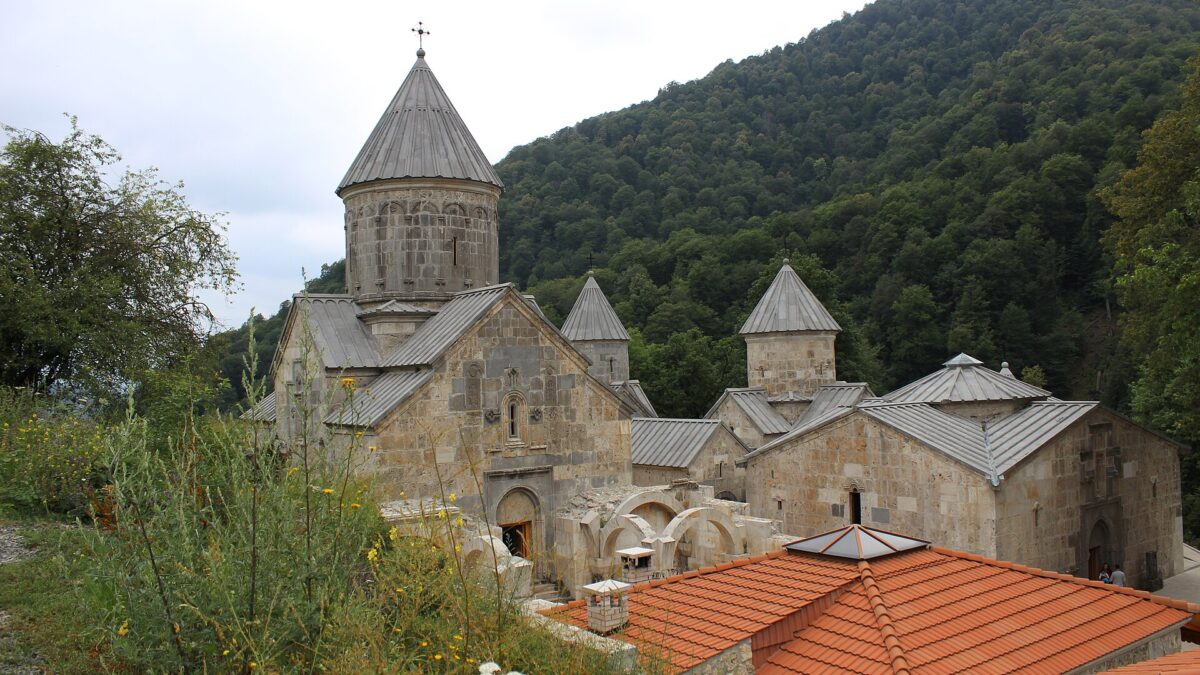
Haghartsin is a complex of three churches, a refectory, and several smaller structures, built across three centuries. The oldest fabric dates to around the 10th century, and the main building phase ran through the 12th and 13th centuries under the patronage of the Bagratuni and later the Zakarid nobility. The name is usually explained as referring to eagles seen over the site, and an eagle carved into the exterior of one church is often pointed out as a nod to that story.
The three churches are:
- Surb Astvatsatsin (Holy Mother of God) – the largest and most prominent church, completed in the early 13th century, with a tall drum and conical dome typical of the period.
- Surb Grigor (St. Gregory) – the oldest of the three, the modest church around which the complex first grew.
- Surb Stepanos (St. Stephen) – a smaller church added to the group.
The building most visitors remember, though, is the refectory (dining hall). It is a long, aisled hall roofed by two pairs of intersecting stone arches that meet in a lattice overhead – an unusual and genuinely impressive piece of medieval engineering. It was where the monastic community ate together, and standing under those crossing arches gives a clearer sense of daily monastic life than the churches alone do.
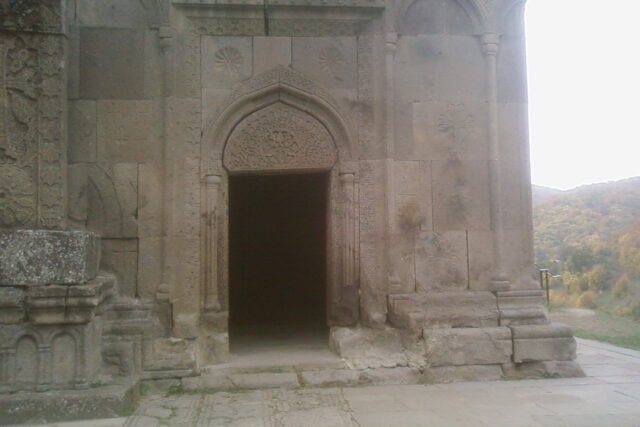
Scattered around the grounds you will also find khachkars (carved cross-stones), the ruins of a chapel and other outbuildings, and the carved sundial and eagle relief on the church walls. Look up at the drums and around the doorways for the fine ornamental stone carving the site is known for. One much-photographed detail is a relief on the Surb Astvatsatsin facade showing two figures holding a model of the church – a medieval depiction of the donors, the kind of carving that rewards a slow walk around the exterior rather than a quick photo of the dome.
The forest setting and Dilijan National Park
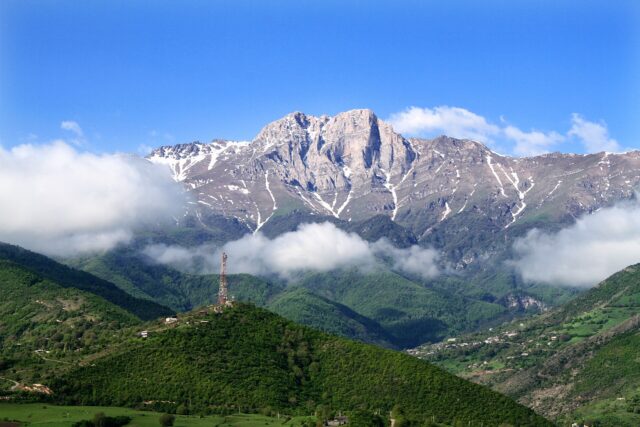
Haghartsin sits inside Dilijan National Park, one of the most heavily wooded parts of Armenia and the reason the wider area earns its “Armenian Switzerland” nickname. The monastery is not perched on a summit or a cliff; it occupies a green clearing surrounded by dense beech and oak forest, with a stream running nearby. That matters for planning: the tree cover keeps the site noticeably cooler and shadier than open monasteries like Khor Virap, and it is what makes the autumn visit so rewarding, as the whole bowl around the churches turns gold and copper. It also means views are intimate rather than panoramic – you come here for the architecture and the woodland calm, not for a big sweeping vista.
The restoration – why it looks so intact
Haghartsin was extensively restored in the early 2010s, a project funded by Sheikh Sultan bin Muhammad Al-Qasimi, the ruler of Sharjah in the UAE, after he visited Armenia. That is the reason the complex looks far more complete than many other Armenian monasteries, where you often see partial ruins. It divides opinion: some travellers love that you can see the buildings roughly as they would have stood, while others feel the reconstruction lost some of the weathered, atmospheric quality that ruins carry. Either way, it is worth knowing the stonework you see is a mix of original medieval fabric and modern restoration, not one untouched 13th-century survival.
How do you get to Haghartsin from Yerevan?
There is no bus that goes directly to the monastery. The practical route is Yerevan to Dilijan by marshrutka, then a taxi for the final leg up the valley. Plan on a full day if you are travelling by public transport.
- Yerevan to Dilijan (marshrutka): minibuses leave from the Gai / Northern bus station in the northeast of Yerevan, roughly every 60-90 minutes. The ride is about 1.5-2 hours and costs approximately 1,200-1,700 AMD (around USD 3-5). Pay the driver in cash; these vans often leave when full, so allow buffer time.
- Dilijan to Haghartsin (taxi): from Dilijan it is about 18 km east and then up a forest side road. A taxi is the simplest option; agree the fare (and, ideally, a wait-and-return) before you set off, since there is little passing traffic at the monastery for the trip back. Bring cash.
- Car: if you have a rental, the drive from Yerevan is roughly 2-2.5 hours via the Dilijan tunnel. The access road to the monastery is paved and manageable. This is by far the most flexible way to combine Haghartsin with other Tavush sights in one day.
- Day tour: plenty of Yerevan operators run Dilijan-area day trips that bundle Haghartsin with Goshavank, Lake Sevan or Parz Lake. This removes the taxi-arranging hassle and is often the least stressful option for a first visit.
For a fuller breakdown of stations, fares and taxi apps, see our guide on getting around Armenia and our day trips from Yerevan roundup.
Entry fee and opening times
Entry to Haghartsin is free, as it is an active Armenian Apostolic church rather than a ticketed museum. There are no fixed turnstile hours in the way a museum has; the grounds are open through daylight hours, and daytime visits are the norm. As it is a working place of worship, dress modestly – covered shoulders and knees – and keep noise down, especially if a service is under way. Facilities on site are minimal, so bring water and use Dilijan for food and restrooms. Prices and access details can change, so treat cafe or taxi costs as approximate and confirm locally.
When is the best time to visit?
The two shoulder windows – late April to June, and September to October – are the sweet spot, and September is arguably the single best month: dry weather, comfortable temperatures, and the first turn of autumn colour in the surrounding forest. October pushes the foliage further, which is spectacular here given how wooded the site is.
Summer (July-August) is still pleasant because the forest and altitude keep Haghartsin cooler than the capital, though afternoon storms are possible and it is the busiest stretch. Spring brings green hillsides and wildflowers. Winter visits are possible but the access road can be snowy and slippery, so check conditions before driving. Whatever the season, mornings tend to be quieter and light the churches well.
What to combine with Haghartsin
Haghartsin works best as part of a Dilijan-and-Tavush day rather than a standalone stop. Strong pairings include:
- Goshavank Monastery – another 12th-13th-century complex about a 30-40 minute drive away near Gosh village, famous for its intricately carved khachkars. The two monasteries are the classic Tavush double-header.
- Parz Lake (Lich) – a small forest lake in the national park, good for a walk, a rowboat or a relaxed lunch. There is a marked hiking route of roughly 7 km linking Parz Lake and Goshavank for those who want to walk between sights.
- Dilijan old town (Sharambeyan Street) – a restored lane of traditional craft workshops and cafes, and the natural base for the day. See our full Dilijan travel guide for where to eat and stay.
- Lake Sevan – on the way back toward Yerevan, making a broad northern loop feasible in a long day with a car.
If your trip is more monastery-focused, Tavush pairs naturally with the UNESCO-listed churches further north; see our Debed Canyon, Sanahin and Haghpat guide, and our overview of the best monasteries in Armenia to decide which cluster suits your itinerary.
Tips and what nobody tells you
- Arrange your return before you leave Dilijan. Taxis do not idle at the monastery, and mobile signal in the valley can be patchy. Booking a wait-and-return saves a long, awkward wait.
- Do not skip the refectory. Many visitors photograph the churches and leave; the crossing-arch dining hall is the architectural highlight and takes two minutes to walk to.
- Manage the restoration expectation. If you have seen photos expecting mossy ruins, know that the site was rebuilt in the 2010s and looks crisp and complete.
- Combine, do not isolate. A round trip from Yerevan just for Haghartsin is a lot of driving for one site – fold in Goshavank and Dilijan to make the day worthwhile.
- Go early or late. Tour groups tend to arrive mid-morning to midday; you get the clearing largely to yourself outside those hours.
Last verified: September 2026. Fares, taxi costs and opening arrangements are approximate and can change; confirm current details locally before you travel.
Sources
- Armenia Travel (armenia.travel) – official national tourism portal (Dilijan, Tavush and monastery information)
- UK FCDO Armenia travel advice – safety and regional guidance
Frequently asked questions
How much does it cost to visit Haghartsin Monastery?
Entry is free. Haghartsin is an active Armenian Apostolic church, not a ticketed museum, so there is no admission charge. Your only real costs are getting there – the marshrutka from Yerevan to Dilijan (roughly 1,200-1,700 AMD) and a taxi for the final leg from Dilijan (agree the fare in advance). Prices are approximate; last verified September 2026.
How do you get to Haghartsin without a car?
Take a marshrutka from Yerevan’s Gai/Northern bus station to Dilijan (about 1.5-2 hours), then hire a taxi in Dilijan for the roughly 18 km trip up to the monastery. There is no direct bus to Haghartsin itself, so arrange a wait-and-return with the taxi driver since there is little passing traffic for the way back.
How far is Haghartsin from Dilijan?
It is about 18 km east of Dilijan, up a forested side valley, which is roughly a 25-30 minute drive on a paved road.
What is the best time of year to visit Haghartsin?
Late April to June and September to October are ideal, with September often the best single month for dry weather and early autumn colour. Because the site sits in forest at altitude, it stays cooler than Yerevan in summer. Winter visits are possible but the access road can be snowy.
What should I combine with a visit to Haghartsin?
Pair it with Goshavank Monastery (about 30-40 minutes away), Parz Lake, and Dilijan’s restored old town on Sharambeyan Street. With a car you can add Lake Sevan on the way back to Yerevan for a full northern day.
Is Haghartsin an original medieval monastery or a reconstruction?
Both. The complex was built between the 10th and 13th centuries, but it underwent a major restoration in the early 2010s funded by the ruler of Sharjah. That is why it looks far more intact than many Armenian monasteries – what you see is a mix of original medieval stonework and modern reconstruction.
Featured image: Beko, CC BY-SA 4.0 — via Wikimedia Commons.