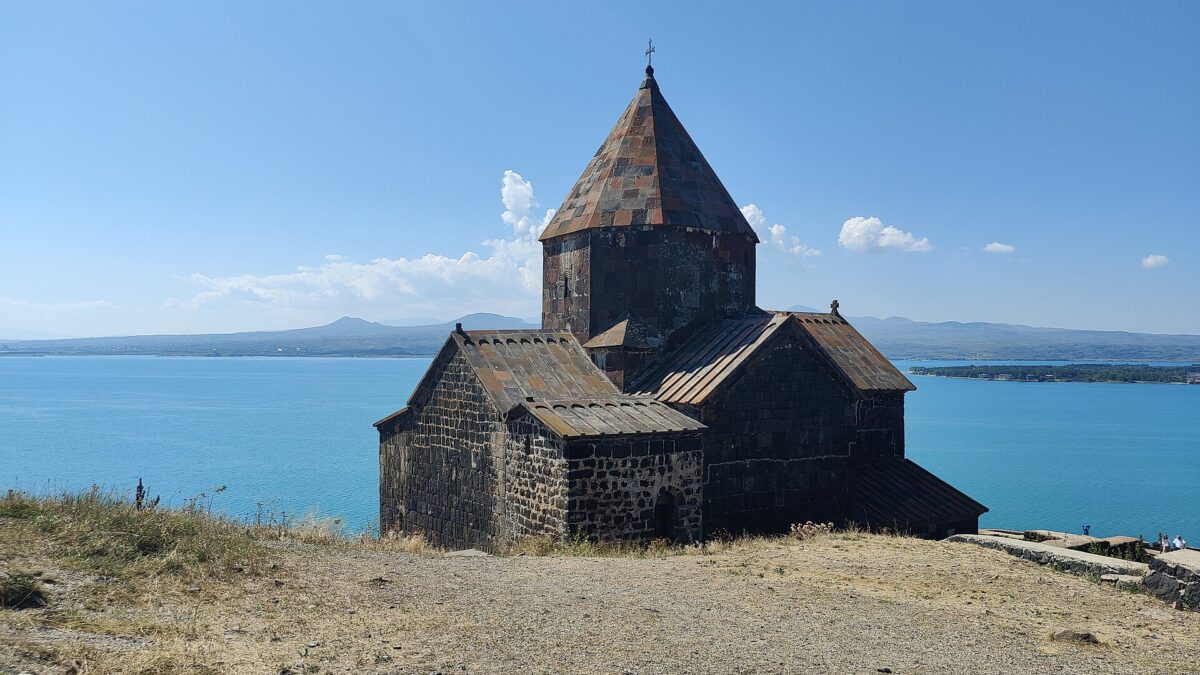
Sevanavank is a 9th-century Armenian Apostolic monastery perched on a rocky peninsula on the northwest shore of Lake Sevan, about 65 km and roughly an hour northeast of Yerevan. Two small churches, Surb Astvatsatsin and Surb Arakelots, sit at the top of a steep climb of around 200 steps, with wide views over the lake at 1,900 m altitude. Entry to the grounds is free, and most travellers reach it by marshrutka to Sevan town plus a short taxi, or on a Lake Sevan day trip.
It is one of Armenia’s most photographed monasteries, and for once the popularity is deserved: the setting does most of the work. But there is more to know than the postcard suggests, including a few things that catch first-time visitors out. This guide covers what Sevanavank actually is, how to get there without wasting a day, when to go, and what to pair it with.
What is Sevanavank?
Sevanavank is a monastic complex founded in 874 AD by Princess Mariam, daughter of the Bagratid king Ashot I. For most of its history it stood on an actual island, cut off from the mainland and reachable only by boat, which is partly why monks chose it: isolation suited the ascetic life. That changed in the Soviet era. A large-scale drawdown of Lake Sevan for irrigation and hydropower dropped the water level by around 20 metres over the mid-20th century, and the island became the peninsula you walk onto today.
The name simply combines the lake, Sevan, with vank, the Armenian word for monastery. What survives at the top are two compact churches built from dark tuff stone, plus the footings of older structures and a scatter of carved khachkars (Armenian cross-stones). It is a working religious site, not a museum, so treat it as one.
The two churches
Both surviving churches date to the monastery’s founding period in the late 9th century and share the same austere, cross-in-square plan typical of the era:
- Surb Astvatsatsin (Holy Mother of God) — the smaller of the two, still used for services.
- Surb Arakelots (Holy Apostles) — a little larger, with a dim, candle-lit interior. Look for the fragments of carved detailing around the entrance and the khachkars set into and around the walls.
Neither is large or ornate inside; the appeal is the age, the stonework, and where they stand rather than any grand interior. Give yourself 30 to 45 minutes on the peninsula itself and you will have seen it properly.
How do you get to Sevanavank from Yerevan?
Lake Sevan sits about 65 km northeast of Yerevan, and the drive takes roughly an hour to 90 minutes depending on traffic leaving the city. You have three realistic options.
- Marshrutka (minibus): Departures for Sevan town leave from Yerevan’s Gai / Northern bus station in the northeast of the city, roughly hourly. Expect a fare of around 800–1,500 AMD (about $2–4) and a ride of 45 minutes to 1.5 hours. Marshrutkas typically drop you in Sevan town, not at the monastery, so you will need a short taxi (a few thousand AMD) or a 30–40 minute walk up to the peninsula from there.
- Taxi or ride-hailing app: Use the GG or Yandex Go app rather than street-hailing. A one-way trip from Yerevan is far more than a marshrutka but splits well between a few people, and it takes you to the base of the steps directly. Agree on waiting time if you want the same driver back.
- Organised day tour: Day trips from Yerevan run roughly $25–50 per person and usually bundle Sevanavank with Dilijan or other stops, which solves the transport-and-return problem in one booking. This is the least stressful option if you don’t want to juggle minibuses.
One honest caveat: Yerevan’s bus stations are a recurring source of confusion, and which station serves which route is not always consistent. Gai / Northern is the most-cited departure point for Sevan, Dilijan and the northeast, but confirm locally the day before, as schedules and platforms shift.
| Option | Approx. cost from Yerevan | Time | Drops you where? |
|---|---|---|---|
| Marshrutka to Sevan town | ~800–1,500 AMD (~$2–4) each way | 45 min–1.5 hr | Sevan town; short taxi or walk to the peninsula |
| GG / Yandex Go taxi | Higher; splits well between 3–4 people | ~1–1.5 hr | Base of the steps directly |
| Organised day tour | ~$25–50 per person | Full day | Base of the steps; usually with other stops |
Prices are approximate and volatile. If you are travelling as a pair or a group and want the trip done in half a day, a shared app taxi to the base and back often works out simpler than the minibus, since the marshrutka leaves you in town with the climb still ahead.
The stairs
From the car park and cafes at the base of the peninsula, a stone staircase climbs to the churches. It is commonly counted at a little over 200 steps. They are not technical, but at 1,900 m the thin air makes the climb feel longer than the number suggests, so take it slowly if you have just arrived from lower ground. There is no lift and no alternative gentle path to the top, so this is the one part of the visit that requires reasonable mobility. Wear proper shoes; the steps can be slick after rain or early-morning dew.
When is the best time to visit?
Sevanavank is open year-round and free, so timing is about weather and crowds rather than tickets.
- For the best light and fewest people: arrive early in the morning or in the late afternoon. Midday in July and August brings the heaviest domestic and tour-bus traffic, since this is when Armenians themselves head to the lake.
- For swimming and beach time: realistically only July and August, when the surface water warms to roughly 20–22°C. Even then, this is a high-altitude lake and it stays brisk. Beaches operate seasonally, roughly June to August.
- For clear, comfortable sightseeing: late spring (May–June) and early autumn (September) are ideal. September in particular is Armenia’s standout travel month, dry and golden, and the lake is quieter than in high summer.
- Winter: the monastery stays open and the snow-framed churches are striking, but it is genuinely cold up here, often at or below freezing, and windy on the exposed peninsula. Dress for it.
Whatever the season, bring a layer. Sevan is noticeably cooler and windier than Yerevan even on a hot day, precisely because of the altitude and the open water.
The views
The reason to climb is the panorama. From the terrace beside the churches you look out over the largest lake in the Caucasus, a vast sheet of blue that stretches to the horizon and the mountains beyond. On a clear day the color of the water shifts from turquoise near the shore to deep navy further out. It is the single best vantage point on the northwest shore, and the churches in the foreground with the lake behind are the shot almost everyone comes for. Sunrise and the hour before sunset give the warmest light and the calmest water.
What to combine with Sevanavank
Sevanavank on its own is a half-day at most. It rewards being folded into a fuller Lake Sevan or northern itinerary:
- Lake Sevan beaches: the northwest shore near Sevan town has the most developed seasonal beaches, handy if you are visiting in summer and want a swim after the climb.
- Hayravank Monastery: a smaller, quieter 9th–12th century church on the western shore, a short drive south. Far fewer visitors than Sevanavank.
- Noratus: the largest surviving field of medieval khachkars in Armenia, on the western side of the lake. If the cross-stones at Sevanavank intrigue you, this is where to see hundreds of them together.
- Dilijan: the forested resort town often called “Armenian Switzerland” is an easy add-on to the northeast, with Parz Lake and Haghartsin Monastery nearby. Many day tours pair Sevan and Dilijan.
A common and sensible plan is Sevanavank first thing (before the crowds), then continue to Dilijan, or loop down the western shore via Hayravank and Noratus if monasteries and khachkars are your priority over forests.
Is Sevanavank worth it? An honest take
Yes, with a caveat about expectations. If you arrive expecting a vast, richly decorated monastery, the two little churches will feel modest. What makes Sevanavank special is the whole ensemble: the climb, the wind, the dark stone, and that enormous lake opening up beneath you. It works best as a scenic, atmospheric stop rather than a deep architectural study, and it is far better early or late than at midday, when tour buses and summer crowds thin out the magic. Travellers who treat it as a 40-minute photo stop tend to leave underwhelmed; those who linger over the views, walk down to the shore, and pair it with Dilijan or Noratus get a genuinely memorable day out of it.
What to wear and monastery etiquette
These are active churches. Standard Armenian Apostolic etiquette applies:
- Dress modestly: shoulders and knees covered. Women often cover their heads inside the churches, though it is not strictly enforced for tourists; a light scarf is worth carrying.
- Keep your voice down inside, especially if a service or prayer is underway.
- Ask before photographing people, and check for any signs restricting photography inside the churches.
- Wear sturdy, non-slip shoes for the steps, and bring sun protection and a windproof layer for the exposed top.
There are cafes and souvenir stalls at the base of the peninsula, and public facilities near the car park, but carry some cash in dram, as the countryside is far more cash-reliant than central Yerevan.
Last verified: September 2026. Prices and transport details are approximate and change; reconfirm fares and schedules locally before you travel.
Sources
- armenia.travel — official Armenia tourism portal (destinations, Lake Sevan)
Frequently asked questions
How much does it cost to visit Sevanavank?
Entry to the monastery grounds and churches is free. Your only real costs are getting there (a marshrutka from Yerevan is roughly 800–1,500 AMD each way, plus a short taxi from Sevan town) and optional extras like a beach or cafe. Day tours from Yerevan run roughly $25–50 per person.
How many steps are there at Sevanavank?
The stone staircase up to the two churches is commonly counted at a little over 200 steps. It is not technical, but at 1,900 m altitude the thin air makes it feel harder, so pace yourself and wear non-slip shoes.
Is Sevanavank on an island?
It was originally built on an island in the 9th century. During the Soviet era, Lake Sevan’s water level was lowered by around 20 metres for irrigation and power, and the island became the peninsula you can now walk onto directly.
Can you swim at Lake Sevan near Sevanavank?
Realistically only in July and August, when the surface water warms to around 20–22°C. It is a high-altitude lake, so it stays cool even in summer. Beaches on the northwest shore operate seasonally, roughly June to August.
How long do you need at Sevanavank?
The peninsula itself is a 30–45 minute visit once you have climbed the steps. As a trip from Yerevan it is a half-day, so most people combine it with Dilijan, or with Hayravank and the Noratus khachkar field on the western shore, to fill a full day.
What are the two churches at Sevanavank called?
Surb Astvatsatsin (Holy Mother of God), the smaller one, and Surb Arakelots (Holy Apostles), the slightly larger one. Both date to the monastery’s founding in 874 AD and are built from dark tuff stone.
Featured image: Anastasiya Lvova, CC BY-SA 4.0 — via Wikimedia Commons.