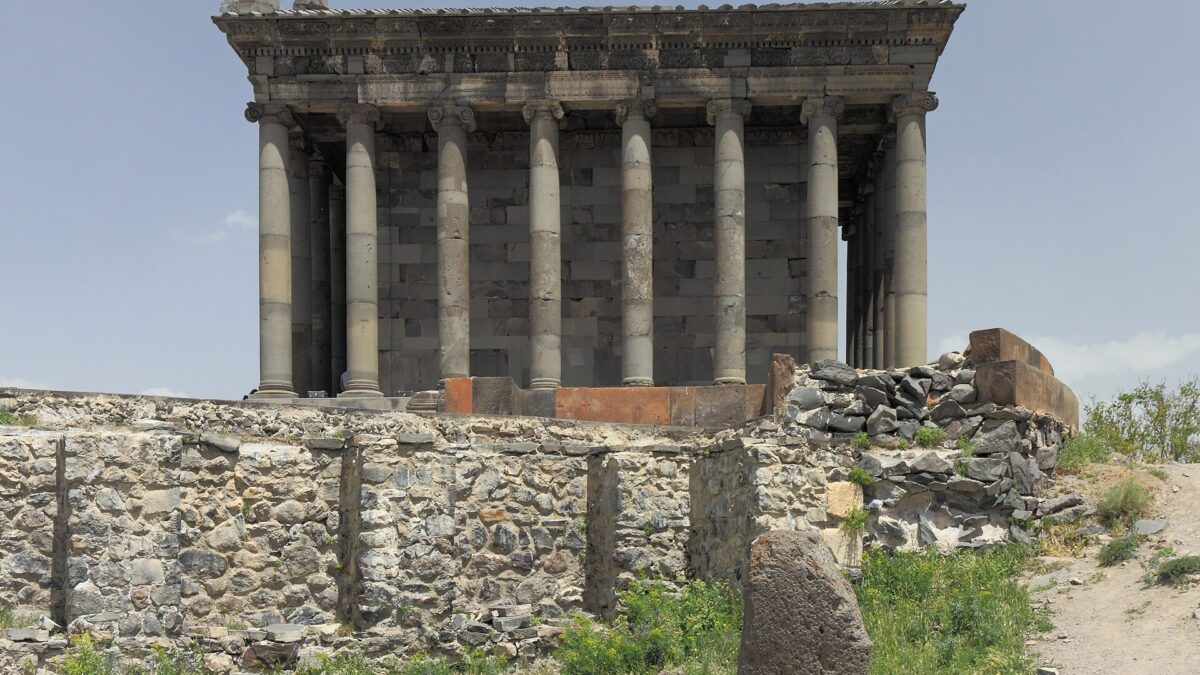
The Temple of Garni is a first-century AD Greco-Roman colonnaded temple in Kotayk Province, roughly 30–40 km east of Yerevan — the only standing building of its kind left in Armenia and, in fact, in the whole former Soviet Union. It was raised in the Ionic order and, on the evidence most scholars favour, dedicated to the Armenian sun god Mihr. The temple stood for around sixteen centuries until a 1679 earthquake brought it down, and it was reassembled from its own fallen stones in the 1970s. Entry is roughly 1,500 AMD (about USD 4), and the temple sits inside a larger royal-residence site that includes a Roman-style bathhouse with a Greek-inscribed mosaic, all perched on a headland above the Azat gorge.
What exactly is the Temple of Garni?
Garni is a pagan temple — a rectangular colonnaded shrine in the classical Mediterranean tradition, not a church. That single fact is what makes it unusual in a country whose famous stone monuments are almost all medieval Christian monasteries. Armenia adopted Christianity as its state religion in 301 AD, and over the following centuries most pre-Christian temples were dismantled or converted. Garni is the one classical temple that survived, which is why it is routinely described as the only standing Greco-Roman colonnaded structure in Armenia and across the ex-USSR.
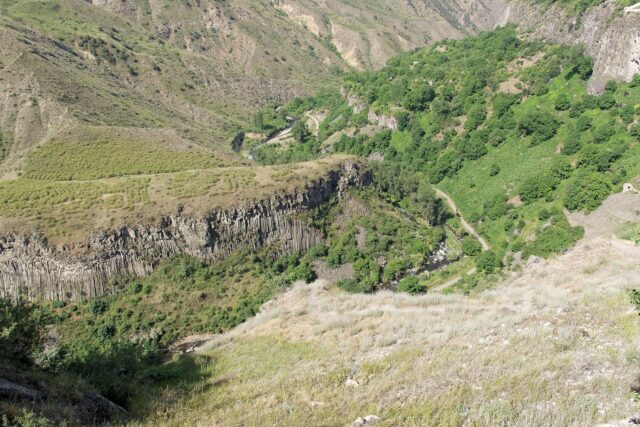
The temple crowns a triangular promontory that juts out over the Azat River gorge, the tip of a fortified site that goes back far earlier than the temple itself. Garni was a royal stronghold and later a summer residence of the Armenian kings, so the temple you photograph today was once one building inside a much larger walled compound of palace halls, a bathhouse and defensive works.
Who was it built for?
The building is usually dated to the first century AD and linked to King Trdat I. Its dedication is not settled beyond doubt, but the reading most historians accept is that it honoured Mihr (Mithra), the Armenian sun deity. If you see the temple described flatly as “the Temple of Mihr,” treat that as the leading interpretation rather than a proven inscription — the honest phrasing is “most likely dedicated to the sun god.”
The architecture: Ionic columns on a basalt platform
Garni follows the classical peripteral plan — a rectangular cella (the inner room) ringed by a colonnade, reached by a steep flight of nine tall steps. The columns are Ionic, topped with the scrolled volute capitals of the Greek order, and the whole structure is cut from local grey basalt rather than the marble you would see in Greece or Italy. That dark volcanic stone, and the mountain-gorge setting, are what give Garni its distinctly Armenian character despite the imported Hellenistic form.
Look closely and you will see the carving on the friezes, the acanthus and geometric detail, and the sheer size of the steps — they were built for a temple podium, not for comfortable walking, so take them slowly. The building is compact; the appeal is in the proportions, the columns against the sky and the drop into the gorge behind, not in a vast interior.
The 1679 earthquake and the 1970s reconstruction
The temple survived the arrival of Christianity — possibly because it was repurposed as a royal summer house rather than demolished — and remained standing until a major earthquake in 1679 collapsed it, scattering its blocks down the slope. For nearly three centuries it lay in ruins.
What you visit now is a reconstruction carried out in the 1970s using the method archaeologists call anastylosis: the original fallen stones were catalogued, fitted back into their proper places, and only the missing pieces filled in with new material. That is why some blocks look weathered and ancient while others are visibly newer — the difference is deliberate and honest, marking what is original versus what was added to hold the structure up. It also means Garni is genuinely the ancient temple re-erected, not a modern replica built from scratch.
Beyond the temple: the rest of the Garni site
Most day-trippers photograph the temple and leave, which is a mistake. The promontory holds several other things worth ten more minutes each.
- The Roman bathhouse. To one side of the temple are the remains of a bath complex built on the Roman model, with a hypocaust (under-floor heating) system. Its highlight is a floor mosaic bearing a Greek inscription — a rare survival that underlines just how far classical culture reached into ancient Armenia. It is usually protected under cover, so look for the sheltered section rather than expecting it in the open.
- The royal residence ruins. Scattered around the temple are the foundations of the summer palace and reception halls of the Armenian kings, plus stretches of the old fortress wall that defended the headland.
- The gorge itself. The site sits high above the Azat River, and the views down the canyon are half the reason to come. The famous hexagonal basalt columns known as the Symphony of Stones are down in that gorge, a short distance below.
How do you get to Garni from Yerevan?
Garni village lies roughly 30–40 km east of Yerevan, about a 45-minute drive. You have three realistic options.
- Marshrutka (minibus): the cheapest route, roughly 300–600 AMD, taking about 45–60 minutes. Buses for Garni leave from an informal stop near the Gai statue / Mercury (Raykom) market area in eastern Yerevan — it is a street stop, not a proper terminal, so ask locally to confirm the current spot. The minibus drops you in Garni village; the temple is a short walk from there.
- Taxi via app: book through GG or Yandex Go rather than hailing on the street. A one-way ride is far more than the bus but saves the hassle, and many visitors negotiate a driver to wait and continue to Geghard.
- Organised day tour: the most common choice, typically around USD 25–50 per person, which bundles Garni, the Symphony of Stones and Geghard into one 5–8 hour loop and removes all the transport guesswork.
A practical note if you rely on buses: some minibuses headed toward Geghard actually stop in Garni village and go no further, leaving you to arrange the last few kilometres to the monastery by taxi. If Geghard is on your list, a taxi or tour is genuinely easier than stitching together public transport.
Tickets, opening hours and what to budget
Entry to the temple grounds is approximately 1,500 AMD for adults (about USD 4). Treat that as a guide rather than a locked-in figure — museum and monument fees drift, so confirm on arrival. Opening hours are roughly 10:00–21:00 in summer and 10:00–17:00 in winter; the long summer evenings are a real advantage here.
That last point is the tip most guides skip: go late in the day. The morning tour buses cluster around Garni, and the temple faces beautifully into the low afternoon and early-evening light. Arriving after about 4pm in summer means fewer crowds, softer photographs and cooler air on the exposed platform.
Rough costs at a glance
| Item | Approx. cost | Notes |
|---|---|---|
| Garni temple entry (adult) | ~1,500 AMD (~USD 4) | Confirm on site; fees change |
| Symphony of Stones | Free | Natural formation in the gorge below |
| Geghard Monastery | Free | UNESCO-listed, ~10 km on |
| Marshrutka from Yerevan | ~300–600 AMD | From the Gai statue / Raykom stop |
| Full-day tour (all three sites) | ~USD 25–50 pp | Easiest way to see the whole loop |
When is the best time to visit?
The shoulder seasons — late April to June and September to October — are the sweet spot, and September is arguably the single best month in Armenia: dry, warm but not scorching, with the first autumn colour in the gorge. Summer works too, but August afternoons get hot on the shadeless temple platform and can bring storms; carry water and sun cover. Winter visits are perfectly possible with the shorter 10:00–17:00 hours, and a dusting of snow on the basalt is striking, but the gorge trail down to the Symphony of Stones can be slippery.
Combining Garni with the Symphony of Stones and Geghard
Garni is almost never visited alone, and it shouldn’t be — it anchors the classic eastern day trip out of Yerevan. The efficient order is Garni first, then down into the gorge for the Symphony of Stones, then on to Geghard Monastery about 10 km further up the valley. The three form a natural half-day to full-day loop, and both the columns and Geghard are free to enter, so the temple ticket is essentially your only admission cost for the whole route.
The contrast is the point: Garni is Hellenistic and pagan, the Symphony of Stones is raw geology, and Geghard is a medieval church partly carved straight into the cliff. Seeing them back to back in a single afternoon is one of the best-value cultural outings anywhere near Yerevan. For how this trip fits alongside other easy escapes from the capital, see our guide to day trips from Yerevan.
Last verified: September 2026. Entry fees, opening hours and transport fares in Armenia change; reconfirm the current figures locally or on the official source before you travel.
Sources
- Armenia Travel (armenia.travel) — official national tourism portal (Garni, Kotayk attractions, opening seasons).
Frequently asked questions
What is the Temple of Garni famous for?
Garni is the only standing Greco-Roman colonnaded temple in Armenia and the former Soviet Union. Built in the first century AD in the Ionic order and most likely dedicated to the sun god Mihr, it is the one classical pagan temple to survive in a country of medieval Christian monasteries.
How far is Garni from Yerevan and how do I get there?
Garni is roughly 30–40 km east of Yerevan, about a 45-minute drive. You can take a marshrutka (around 300–600 AMD) from the Gai statue / Raykom market stop, book a GG or Yandex Go taxi, or join a day tour (about USD 25–50) that also covers the Symphony of Stones and Geghard.
How much does it cost to enter Garni Temple?
Entry is approximately 1,500 AMD (about USD 4) for adults. Prices can change, so confirm the current fee on arrival. The nearby Symphony of Stones and Geghard Monastery are both free to enter.
Is Garni Temple original or a reconstruction?
Both. The temple stood from the first century AD until a 1679 earthquake collapsed it, and it was rebuilt in the 1970s using anastylosis — its original fallen stones were re-erected in place, with only missing pieces filled in with new material. That is why some blocks look ancient and others newer.
What else is there to see at the Garni site?
Besides the temple, the promontory holds a Roman-style bathhouse with a mosaic floor carrying a Greek inscription, the ruins of a royal summer palace and fortress walls, and sweeping views over the Azat gorge — where the Symphony of Stones basalt columns are found below.
When is the best time to visit Garni?
Late April to June and September to October are ideal, with September often the best month for dry, mild weather and early autumn colour. Whatever the season, arriving late in the afternoon avoids the morning tour-bus crowds and catches the temple in warm light.
Featured image: Marcin Konsek, CC BY-SA 4.0 — via Wikimedia Commons.