The Wings of Tatev is the world’s longest reversible aerial tramway, a 5.7 km cable car that glides over the Vorotan gorge to reach the 9th-century Tatev Monastery in southern Armenia. The ride takes about 11–12 minutes each way, and a round-trip ticket costs roughly 6,500–9,000 AMD (around $18–25). It runs daily except most Mondays outside peak summer.
What is the Wings of Tatev cable car?
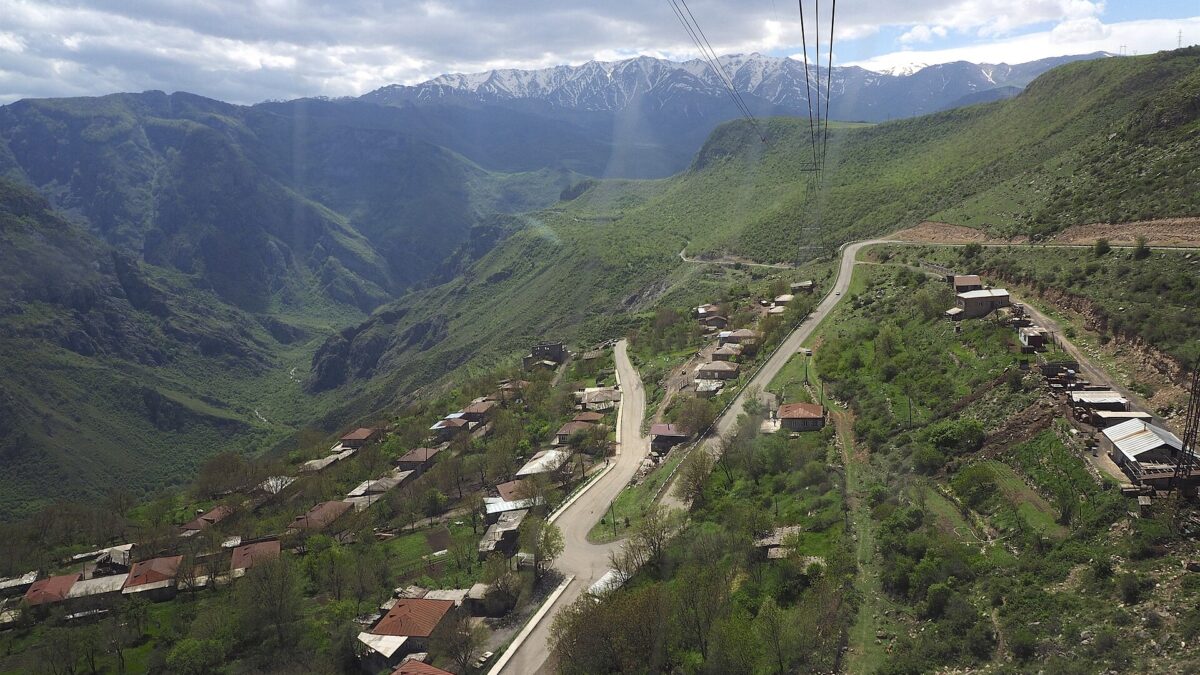
The Wings of Tatev (“Tatever” in Armenian) opened in 2010 and still holds the Guinness record for the longest non-stop double-track reversible cable car in the world. Two cabins run on the same line, counterbalancing each other: as one climbs, the other descends. The span is 5.7 km between the village of Halidzor and the plateau beside Tatev Monastery, crossing the deep Vorotan River gorge on the way.
At its highest the line hangs around 320 metres above the canyon floor, and the whole crossing takes roughly 11 to 12 minutes each way. Cabins hold up to about 25 passengers and leave frequently—typically every 15–20 minutes when demand is steady. The reason to take it is not just novelty: the gorge is genuinely dramatic, and the alternative is a slow, switchbacking road that adds the better part of an hour. For most visitors, the cable car is the experience, and the monastery is the reward at the far end.
How much does the Wings of Tatev cost, and when is it open?
Expect roughly 6,500–9,000 AMD (about $18–25) for an adult round trip, with one-way and child tickets priced lower. Published figures vary between sources and change seasonally, so treat the table below as a guide and confirm the exact fare on the operator’s own booking page before you travel.
| Ticket | Approx. price (AMD) | Approx. (USD) |
|---|---|---|
| Adult round trip | ~6,500–9,000 | ~$18–25 |
| Adult one way | ~6,500 | ~$18 |
| Child round trip | ~5,500 | ~$15 |
| Child one way | ~4,000 | ~$11 |
You can buy on-site or book online in advance through the official site, tatever.am—worth doing on summer weekends when tour groups fill the cabins. Last verified: July 2026. (Ignore any listing showing 800/1,500 AMD; that figure circulates online and is an error.)
Opening hours shift with the season. The published schedule is:
| Season | Hours |
|---|---|
| October–April | 10:00–18:00 |
| May | 10:00–19:00 |
| June–August | 09:00–20:00 |
| September | 10:00–19:00 |
The line is usually closed on Mondays outside peak summer and can shut for maintenance in November, so a Monday visit in spring or autumn is the classic way to arrive at a locked ticket office. Reconfirm the day and hours on tatever.am close to your trip, especially in the shoulder months.
How do you get to Tatev from Yerevan or Goris?
Tatev sits about 250 km south of Yerevan, a drive of at least four hours each way on the M2 through Vayots Dzor and over mountain passes. That distance shapes every decision about how to visit.
A day trip from Yerevan is possible but punishing. Leaving around 5:30–6:00am gets you to Halidzor by late morning, buys two or three hours at the top, and lands you back in the capital near 8–9pm—ten to fifteen hours, most of it in a vehicle. If you only have one shot and don’t mind a long day, an organised tour (roughly $25–50 per person) handles the logistics and is far less tiring than driving yourself.
The calmer option is to base in Goris overnight. Goris lies about 15 km from the Halidzor cable-car station, roughly 1,500–2,500 AMD by local taxi, and a night there (around 15,000–25,000 AMD for a room) lets you ride the first cabins before the tour crowds and still see the Devil’s Bridge and the cave village of Khndzoresk. Public transport works for reaching Goris—marshrutkas run from Yerevan’s Kilikia central station for about 2,500–3,500 AMD over 4–6 hours—but there is no direct minibus to Halidzor, so you finish the last leg by taxi. For the full breakdown of minibuses, shared taxis, and car hire, see our guide to how to get around Armenia, and pair Tatev with nearby stops in our Goris and Khndzoresk guide.
What makes Tatev Monastery worth the trip?
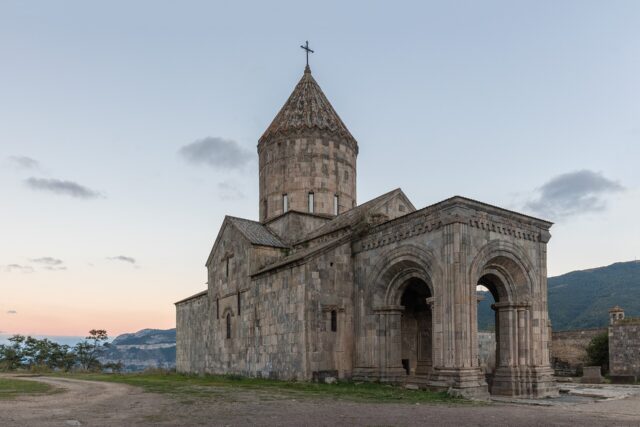
Tatev Monastery was founded in the 9th century on the site of an older pagan sanctuary, and by the medieval period it had grown into one of the most important religious and intellectual centres in Armenia. Perched on a basalt spur above the Vorotan gorge, the complex is a fortress-monastery as much as a church, and its history of surviving wars, raids, and earthquakes is written into the thick walls.
Three features stand out beyond the churches of Sts. Paul and Peter and St. Gregory the Illuminator:
- The medieval university. In the 14th and 15th centuries Tatev housed one of the leading universities of medieval Armenia, drawing scholars to study theology, philosophy, the sciences, and the copying and illumination of manuscripts. Its scriptorium produced work that shaped Armenian religious thought for generations.
- The Gavazan, or swinging pillar. This eight-metre octagonal stone column, raised in the 10th century, is hinged at its base and sways when the ground moves—an early seismic warning device that reportedly trembled when horsemen approached or an earthquake was coming. It is one of the genuinely unusual pieces of engineering you will see in an Armenian monastery.
- The 17th-century oil mill. Restored and open to visitors, the mill once pressed linseed, sesame, and hemp oil. Tellingly, it sat just outside the monastery walls so villagers could buy oil without disturbing the monks.
Entry to the monastery grounds is free; it is an active religious site, so modest dress is expected. Give yourself at least an hour to walk the complex properly—the views back across the gorge from the ramparts are the ones people remember. For how Tatev compares with the country’s other great foundations, see our roundup of the best monasteries in Armenia.
Should you take the cable car one way?
Here is the tip most operators won’t volunteer: you don’t have to ride the cable car both directions. A footpath links Halidzor and the monastery through the gorge, past the ruined Old Halidzor fortress and the natural travertine “Devil’s Bridge,” and it takes roughly 1.5 to 2 hours on foot. Buying a one-way cable-car ticket and walking the other leg turns a 12-minute novelty into a proper half-day in one of Armenia’s finest canyons.
Two honest caveats. First, the trail involves real elevation change and loose ground in places, so it suits reasonably fit walkers in decent shoes, not flip-flops. Second, if you’re driving, there is also a back road to Tatev village for vehicle access—useful when the cable car is closed, but a slow, rough alternative rather than a scenic one. Our advice for most people: cable car up for the arrival, and either walk down if you have the time and legs, or ride back and save the energy for Khndzoresk. Either way, aim to be on an early cabin—the light is better and the cabins are emptier before the tour buses arrive around midday.
Is Tatev worth visiting?
Yes—with one condition: build the time in properly. Tatev is the highlight of southern Armenia, and the combination of a record-breaking cable car and a 1,100-year-old fortress-monastery over a canyon is the kind of pairing the country does better than almost anywhere. What lets people down is the logistics, not the place. Squeezed into a rushed day trip from Yerevan, it becomes eight hours of driving for two hours on site, and the memory that lingers is the minibus, not the monastery.
Treat it as an overnight from Goris, or as the anchor of a southern loop, and it earns its place near the top of any trip. Autumn is especially good, when the gorge turns gold and the crowds thin—see our notes on the best time to visit Armenia before you fix dates. For where Tatev ranks against the rest of the country’s headline experiences, our guide to the best things to do in Armenia puts it in context.
Prices, hours, and closed days are point-in-time and change seasonally. Confirm the current fare and schedule on tatever.am before you travel. Last verified: July 2026.
Featured image: Clay Gilliland (CC BY-SA 2.0) via Wikimedia Commons