The duduk is a double-reed woodwind carved from apricot wood, widely regarded as Armenia’s national instrument. Its warm, soft, faintly mournful tone has carried far beyond the country, into Hollywood scores and world stages. UNESCO inscribed “Duduk and its music” on the Representative List of the Intangible Cultural Heritage of Humanity in 2008, following an earlier proclamation in 2005.
If you spend any time in Armenia, you will hear it: drifting from a restaurant corner in Yerevan, layered under a documentary about Mount Ararat, or played solo at a memorial. This guide covers what the duduk actually is, how it is made and why it sounds the way it does, the UNESCO listing and the players who made it famous, the composer Komitas who saved Armenian folk music, the other instruments that share the stage with it, and where travellers can realistically hear it live.
What is the duduk?
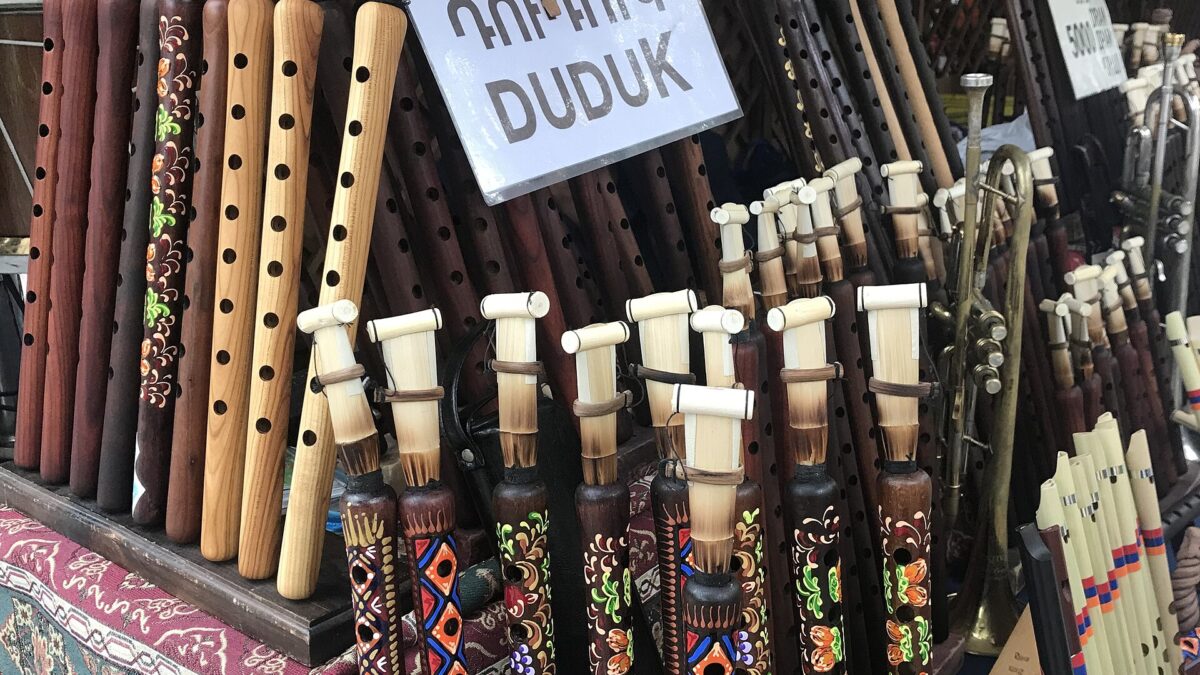
The duduk (Armenian: tsiranapogh, roughly “apricot pipe”) is a cylindrical double-reed wind instrument with a large flattened reed, closer in family to the oboe than the flute. UNESCO describes its timbre as “warm, soft, slightly nasal.” It comes in several sizes, commonly from about 28 to 40 centimetres, with longer instruments favoured for slow, lyrical melodies.
Two facts set it apart from most woodwinds. First, the body is made almost exclusively from apricot wood, the fruit tree so tied to Armenian identity that the national colour orange on the flag is often read as apricot. Second, it is traditionally played in pairs: one musician carries the melody while a second holds a continuous drone underneath, sustained through circular breathing so the sound never stops. That constant floor of tone is a large part of why the duduk feels so grounded and grave.
Armenians frequently call it their most expressive instrument, one associated with weddings and funerals alike. It is genuinely old, with roots historians trace back thousands of years, though the modern concert form is more recent.
Last verified: July 2026 (UNESCO ICH element 00092).
Why does the duduk sound so haunting, and how is it made?
The character of the sound comes from the reed as much as the wood. The double reed is cut broad and flat from a cane that grows near the Arax (Araks) River, then tied and shaped so it vibrates slowly and richly. Paired with the dense, resonant apricot wood, the result is a low, breathy voice pitched close to the human singing range, which is exactly why listeners describe it as sounding almost like a person mourning or praying.
Making a good duduk is craft work. Apricot wood is chosen because it is hard, oily and acoustically warm; the timber is aged, bored, and drilled with finger holes, then matched to a hand-made reed with an adjustable bridge or cap that lets the player tune the pitch and the “cry” of the tone. A cheaper instrument made from other woods will play, but it will not carry the same depth, which is worth knowing if you are tempted to buy one as a souvenir. A serious apricot-wood duduk from a Yerevan workshop costs considerably more than the painted tourist versions sold near Republic Square.
Is the duduk UNESCO heritage, and who made it world-famous?
Yes. “Duduk and its music” was proclaimed by UNESCO in 2005 and formally inscribed on the Representative List of the Intangible Cultural Heritage of Humanity in 2008. The listing recognises not just the instrument but the whole living tradition of playing and passing it on. It sits alongside Armenia’s other UNESCO intangible entries such as lavash bread-making and khachkar carving.
The name most responsible for the duduk’s global fame is Djivan (Jivan) Gasparyan, born in 1928 near Yerevan and taught by his father from the age of six. Gasparyan took the duduk from a shepherd’s and village instrument onto the international concert stage, taught at the Komitas Conservatory in Yerevan, and collaborated with Western musicians. His playing appears in major film soundtracks including The Last Temptation of Christ and Hans Zimmer’s score for Gladiator (2000). He died in 2021. Because of that film work, millions of people have heard a duduk without ever knowing its name.
| Instrument | Type | Material / note | Typical use |
|---|---|---|---|
| Duduk | Double-reed woodwind | Apricot wood; soft, low tone | Ballads, laments, film scores |
| Zurna | Double-reed woodwind | Apricot wood; loud, piercing | Outdoor dances, celebrations |
| Blul | End-blown flute | Apricot wood; shepherd’s flute | Solo folk melodies |
| Kamancha | Bowed string (spike fiddle) | Round body, membrane face | Lyrical, poetic music |
| Kanun | Plucked zither | Table-like body, many strings | Delicate, ornamented melody |
| Dhol | Double-headed drum | Goat/calf skin, played with sticks | Rhythm for dance and processions |
Who was Komitas, and why does he matter to Armenian music?
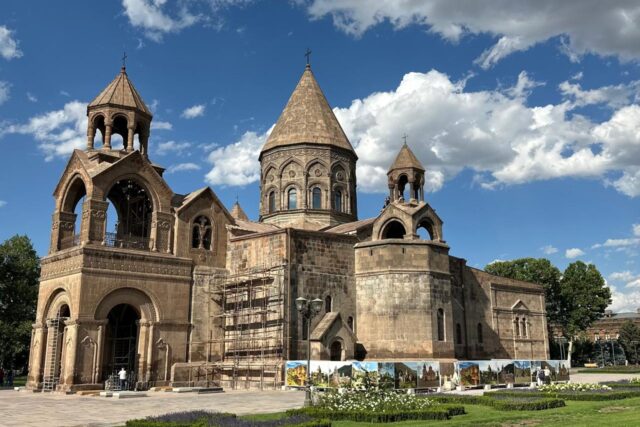
You cannot understand Armenian folk music without Komitas. Born Soghomon Soghomonian in 1869 in the Ottoman Empire, orphaned young, he was educated at Etchmiadzin, ordained as a vardapet (celibate priest) in 1895, and later studied music in Berlin. He is considered the founder of the Armenian national school of music.
His life’s work was fieldwork. Komitas travelled through villages collecting and transcribing thousands of folk songs and dances, saving an oral tradition that was disappearing. He also rediscovered and systematised Armenian medieval sacred music, and became the first non-European member of the International Music Society. Much of what a duduk player performs today survives because Komitas wrote it down.
His story is also a tragedy tied to the wider Armenian one: Komitas was among the Armenian intellectuals arrested in Constantinople in 1915, at the start of the Armenian Genocide. He survived deportation but never recovered psychologically, spending his final years in institutions and dying in Paris in 1935. His remains were later reburied in Yerevan. The Komitas Museum-Institute and the Komitas State Conservatory in the capital both carry his name, and the leafy Komitas Pantheon is where many of Armenia’s cultural figures are buried. For the historical background, see our guide to Armenia as the first Christian nation, since so much of this music grew out of the church.
What other instruments play alongside the duduk?
The duduk rarely works alone in traditional settings. Its natural partners are the dhol, a double-headed drum thousands of years old that historically carried signals across mountain valleys, and for louder outdoor music the zurna, another apricot-wood double-reed but shrill and powerful where the duduk is soft. The zurna-and-dhol pairing is the sound of a village celebration; the duduk is the sound of the quiet moments.
Among strings, the kamancha is a bowed spike fiddle with a small round body and a membrane face, used for lyrical, poetic pieces, while the kanun is a large plucked zither, laid flat, capable of fast, ornamented runs. The blul, an end-blown shepherd’s flute also cut from apricot wood, rounds out the wind family. Together these instruments define Armenian folk and dance music, an art form as distinctive as the country’s unique alphabet or its carved khachkar cross-stones.
Where can you hear live duduk in Yerevan?
Yerevan is the easiest place in the country to hear a duduk played well, though a little planning helps because there is no single dedicated “duduk hall.” Realistic options:
- Concert venues: the Yerevan Opera House (Opera and Ballet Theatre on Mashtots Avenue) and other city concert halls programme traditional and duduk-featuring concerts through the season. Check current listings before you go rather than assuming a performance on any given night.
- Restaurants with live music: several traditional restaurants in the centre feature live Armenian music, sometimes including duduk, over dinner. It is atmospheric, but the music is a backdrop to a meal, not a formal recital, so treat the schedule as informal and confirm when you book.
- Cultural experiences and tours: small-group duduk sessions with a professional musician are sold in Yerevan, where you hear the history, a live performance, and sometimes try the instrument yourself. These are the most reliable way to guarantee you actually hear one.
- The Komitas Museum-Institute: primarily a museum about the man and his work rather than a nightly concert venue, but a strong stop for context, and it occasionally hosts events.
Our honest take: do not leave a live duduk to chance on your last evening. If hearing one matters to you, book a dedicated music experience or a confirmed concert early in your trip, and treat any restaurant performance as a bonus. Pair it with the wider capital in our Yerevan travel guide, and slot it into a broader plan using our roundup of the best things to do in Armenia.
Live-performance schedules change constantly. Last verified: July 2026 — confirm venue listings locally before you go.
The short version
The duduk is Armenia’s apricot-wood double-reed, a UNESCO-listed tradition, and the emotional voice of Armenian music. It was preserved for the modern world by Komitas and carried onto the global stage by Djivan Gasparyan. Hear it live if you can; it explains a lot about the country that words do not.
Featured image: Benoit Prieur (CC0) via Wikimedia Commons
Sources: For the official picture, consult UNESCO’s listing for the duduk. Last verified: July 2026.