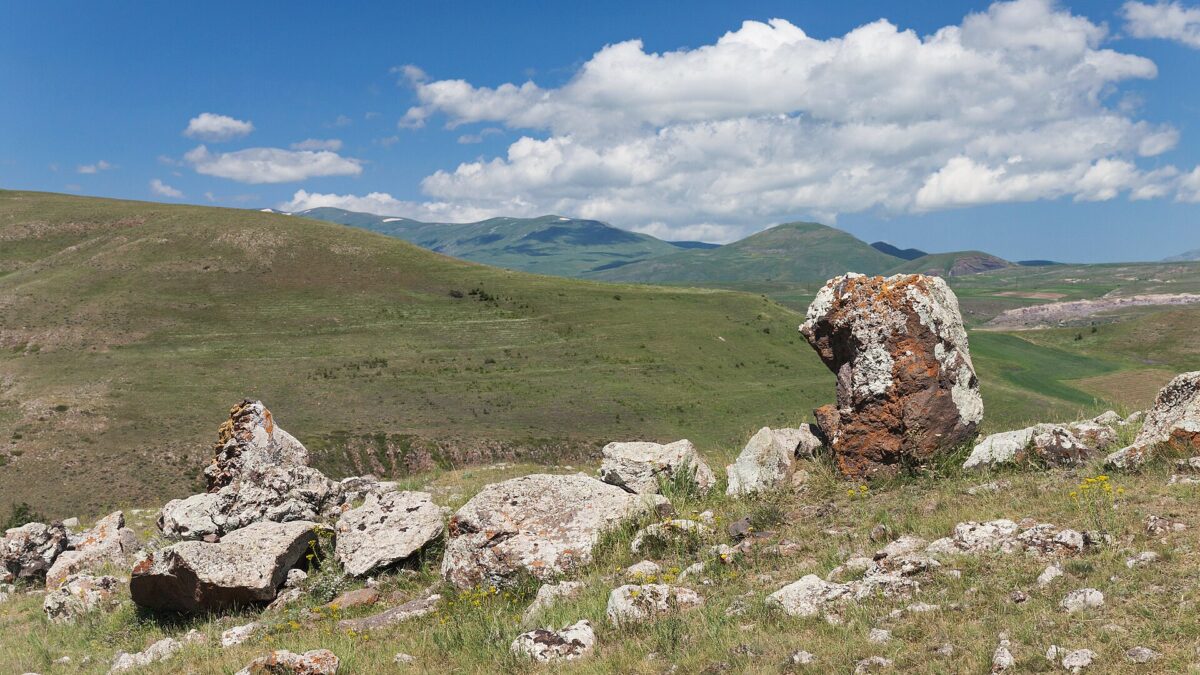
Zorats Karer, also spelled Carahunge or Karahunj, is a prehistoric field of standing basalt stones on a windswept plateau just outside the town of Sisian, in Armenia’s southern Syunik province. Several dozen of its roughly 200 stones are pierced with smooth round holes, and that detail, plus the ring-like layout, is why it picked up the nickname the “Armenian Stonehenge.” Sisian itself is a quiet highland town about 220 km (roughly 3.5 hours) south of Yerevan, sitting a short detour off the main road that carries most travellers on toward Goris and the Tatev cable car.
It is a genuinely rewarding stop if you are already heading south, but it is not a place most people build a trip around. This guide covers what the site actually is, how to reach it via Sisian, what else is worth your time nearby, and how to fold it into the classic southern Armenia route without wasting a day.
What is Zorats Karer (Karahunj)?
Zorats Karer is a megalithic site: a cluster of upright basalt monoliths arranged across a hilltop, dated broadly to the Bronze and Iron Ages. The stones range from knee-height to well over two metres, and the whole complex spreads across several hundred metres, with a denser central grouping and long “arms” of stones trailing off to the north and south.
The name is worth untangling because it causes confusion. “Zorats Karer” (often translated as “warriors’ stones” or “stones of power”) is the older Armenian name. “Karahunj” or “Carahunge” is a more modern coinage that leans on the resemblance to Stonehenge. You will see all three spellings on signs, maps and tour listings, and they all point to the same field of stones. Archaeologists generally treat it as a burial ground and ritual site rather than a single-purpose monument, and graves have been documented among the stones.
The “oldest observatory” claim — handle with care
Here is the part that gets oversold everywhere online. A popular theory holds that Zorats Karer was an ancient astronomical observatory, with the holes bored through certain stones acting as sightlines to the sun, moon and specific stars. This interpretation was pushed hardest in the early 2000s by an Armenian radiophysicist whose study proposed the site was many thousands of years old and predated Stonehenge as a working observatory.
That claim is contested, not established. Mainstream archaeologists are sceptical of both the very early dates and the observatory function. The counter-arguments are practical: the holes may have been used to lash stones together, to tether animals, or to sight over shorter distances, and some may not be as old as the astronomical theory assumes. Formal archaeological survey work at the site has generally described it as a prehistoric necropolis and settlement rather than a confirmed observatory. So enjoy the “Armenian Stonehenge” framing for what it is, a good story with a real kernel of mystery, but treat “the world’s oldest observatory” as a popular, debated hypothesis rather than a proven fact. That honesty is, frankly, more interesting than the marketing version.
Practical basics: hours, entry and what to expect
Zorats Karer is an open-air site with no gate, no fixed ticket booth and no set opening hours, so it is effectively free and accessible in daylight whenever you turn up. There is no real visitor infrastructure on the plateau itself, which is part of the appeal and also the catch: bring water, wear proper shoes for uneven ground, and be ready for wind, because the exposed hilltop can be cold and blustery even when Sisian below is calm.
- Entry: free, open site, no ticket office.
- Time needed: 45 minutes to an hour and a half to walk the full field slowly.
- Facilities: minimal to none on site — no cafe, limited shade. Stock up in Sisian.
- Best light: early morning or late afternoon, both for photography and to have the stones largely to yourself.
How to get to Sisian and Zorats Karer
Sisian is the launch point. The site sits a few kilometres from the town, just off the main highway, and the town is where you will find guesthouses, food and a driver if you need one.
By marshrutka or shared taxi
Long-distance minibuses (marshrutkas) and shared taxis toward Sisian, Goris and Kapan leave from Kilikia Central Bus Station in Yerevan, near Sasuntsi Davit metro. Departures are limited, often only a couple of useful services a day, and they tend to leave when full rather than on a strict clock, so confirm times locally the day before. Public transport drops you in Sisian town, not at the stones — from there it is a short taxi ride or a longer walk out to the plateau. Because of that last-leg gap and the thin schedule, most independent travellers either hire a taxi in Sisian for the round trip or visit with a car.
By car
Driving is the easiest way to do this, and it is why so many people fold Sisian into a southern road trip. The turn-off to Zorats Karer is signposted from the main road, and there is space to pull over near the stones. A rental car also unlocks Shaki waterfall and Vorotnavank, which are awkward to reach without your own wheels. For the state of the roads and rental costs, our guide on how to get around Armenia has the details.
By day tour
Some southern Armenia tours from Yerevan bundle Zorats Karer with Tatev, but be realistic about the distance: at 220 km each way, a single-day return that also tries to cover Tatev is a very long day in a vehicle. An overnight in Sisian or Goris makes the whole thing far more pleasant.
What else is near Sisian?
Sisian punches above its weight for a small town, and the two big draws pair naturally with Zorats Karer.
Shaki waterfall
A short drive from Sisian, Shaki is one of the more photogenic waterfalls in southern Armenia, dropping in a broad curtain over a rock face in a green gorge. It is a quick, easy stop rather than a hike. One honest caveat: the flow is affected by a nearby hydroelectric diversion, so the volume of water varies and can drop noticeably at times — it is at its fullest in spring and early summer when snowmelt is running. If a full sheet of water matters to you, aim for late spring.
Vorotnavank monastery
Perched above the Vorotan river gorge, Vorotnavank is a medieval monastic complex with a dramatic canyon setting and far fewer visitors than the headline monasteries further along the route. It rewards anyone who likes their historic sites quiet and atmospheric, and the drive there is scenic in its own right.
How Sisian fits the southern Armenia route
Think of Sisian as a worthwhile mid-route stop rather than a destination in itself. The classic southern loop runs Yerevan → Areni and Noravank → Goris → Tatev, and Sisian sits neatly on the way, between the Vayots Dzor wine country and Goris.
A sensible rhythm for drivers: break the long southbound drive at Sisian, see Zorats Karer and Shaki, sleep in Sisian or push on to Goris, then give the next morning to the Wings of Tatev cable car — the world’s longest reversible aerial tramway — from Halidzor. Basing yourself in Goris also puts the cave dwellings of Old Khndzoresk within reach, so two nights in the south lets you cover Sisian, Goris, Tatev and Khndzoresk without rushing.
| Stop | Distance from Yerevan (approx) | Why stop |
|---|---|---|
| Areni / Noravank | ~120 km | Red-cliff monastery, wine village |
| Sisian (Zorats Karer, Shaki, Vorotnavank) | ~220 km | Standing stones, waterfall, canyon monastery |
| Goris / Old Khndzoresk | ~250 km | Cave town, southern hub, base for Tatev |
| Tatev (via Halidzor cable car) | ~250+ km | Cliff-top monastery, longest aerial tramway |
When is the best time to visit?
Late April to June and September to October are the sweet spots for southern Armenia, and September is the single best month: dry, clear, with autumn colour creeping into the hills and none of the August heat haze. Sisian sits at altitude, so it runs cooler than Yerevan year-round — pack a layer even in summer, and expect genuine cold and possible snow in winter, when the exposed Zorats Karer plateau is bleak and the drive south can be icy. Spring brings the strongest waterfall flow at Shaki; autumn brings the best light and the most reliable weather for the long drive. For a month-by-month breakdown, see our guide to the best time to visit Armenia.
Is it worth the detour?
Honestly, it depends on how you travel. If you are driving the south and like archaeology, quiet landscapes and a good unresolved mystery, Zorats Karer plus Shaki and Vorotnavank easily justify a half-day and an overnight in Sisian. If you are tight on time and relying on patchy public transport, the effort-to-payoff ratio is less kind, and you might reasonably prioritise Tatev, Noravank and Khor Virap instead. What you should not do is arrive expecting a signposted, Stonehenge-scale monument — the reward here is atmosphere, isolation and the puzzle of the stones, not spectacle.
Last verified: September 2026.
Sources
Frequently asked questions
Is Zorats Karer really the world's oldest observatory?
That is a popular but contested claim, not established fact. A theory promoted in the early 2000s argued the pierced stones functioned as astronomical sightlines predating Stonehenge, but mainstream archaeologists dispute both the very early dates and the observatory function, and generally describe the site as a Bronze/Iron Age burial and ritual ground. Treat it as an interesting hypothesis rather than proven history.
How much does it cost to visit Zorats Karer?
Nothing. Zorats Karer is an open-air site with no gate, no ticket booth and no fixed opening hours, so it is free and accessible during daylight. There is no visitor infrastructure on the plateau, so bring your own water and wear sturdy shoes for the uneven, windy ground.
How do you get to Sisian from Yerevan?
Sisian is about 220 km (roughly 3.5 hours) south of Yerevan. Marshrutkas and shared taxis toward Sisian, Goris and Kapan leave from Kilikia Central Bus Station, but departures are limited and drop you in the town rather than at the stones. Most independent travellers drive or hire a taxi in Sisian for the final few kilometres to the site.
What is the difference between Zorats Karer, Karahunj and Carahunge?
They are all names for the same site. Zorats Karer is the older Armenian name; Karahunj and Carahunge are more modern spellings that play on the resemblance to Stonehenge. Signs, maps and tour listings use the names interchangeably.
Can you combine Sisian with Tatev and Goris?
Yes, and that is the natural way to do it. Sisian sits on the main southern route between Vayots Dzor and Goris, so drivers often see Zorats Karer and Shaki waterfall en route, sleep in Sisian or Goris, and visit the Tatev cable car the next morning. Trying to do all of it as a single day trip from Yerevan makes for an exhausting amount of driving.
When is the best time to visit Sisian and Zorats Karer?
Late April to June and September to October are ideal, with September the standout month for dry, clear weather. Spring gives Shaki waterfall its strongest flow from snowmelt, while autumn offers the best light and driving conditions. Sisian is at altitude, so it is cold and can be snowy in winter.
Featured image: Marcin Konsek, CC BY-SA 4.0 — via Wikimedia Commons.