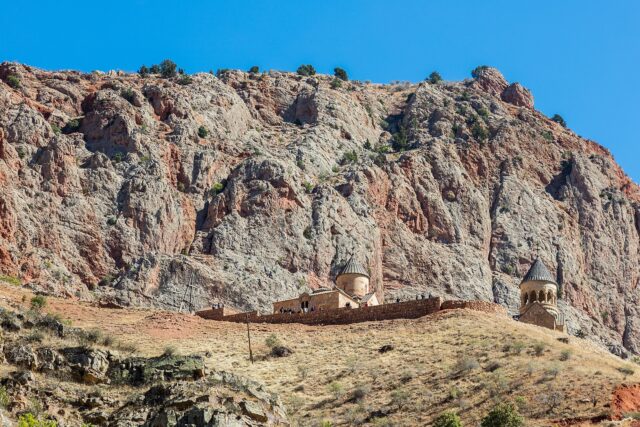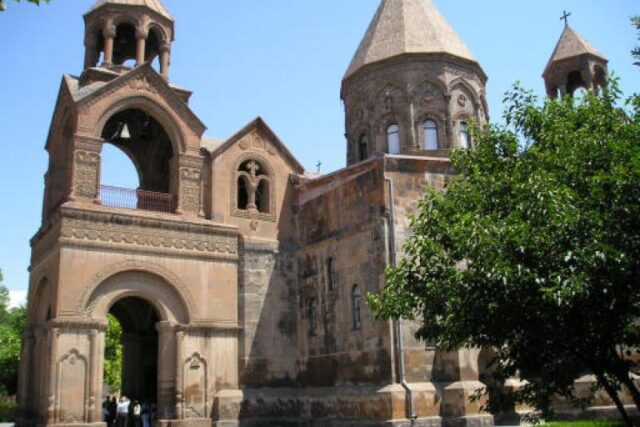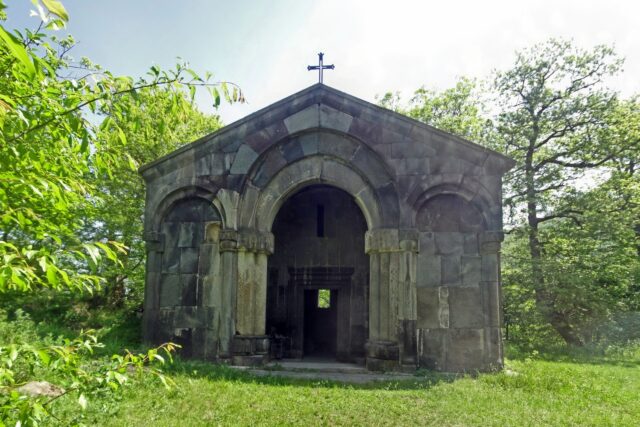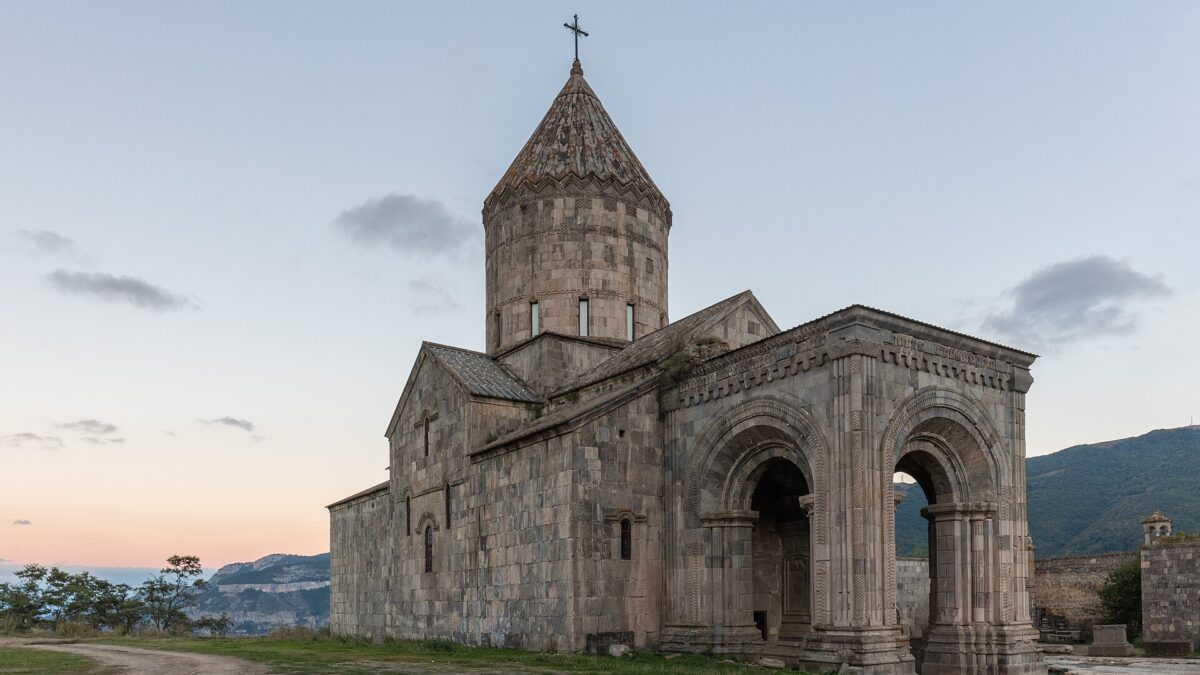
Tatev Monastery is a 9th-century Armenian Apostolic complex perched on a basalt promontory above the Vorotan River gorge in Syunik, Armenia’s far south, roughly 250 km and four-plus hours southeast of Yerevan near the town of Goris. It is famous for two things: it was one of the medieval Armenian world’s great centres of learning, home to the Tatev University in the 14th and 15th centuries, and it survives today as a dramatic, largely intact fortified monastery reached by the “Wings of Tatev” cable car. Entry to the monastery grounds is free.
Most travellers come for the ride and leave without really looking at the buildings. That is a mistake. The cable car is the getting-there; the monastery is the reason to go. This guide covers what Tatev actually is, why it mattered, what to look at when you arrive, and how to fit it into a trip through the south.
What is Tatev Monastery?
Tatev is a walled Apostolic monastery built on a rocky plateau that drops sharply into the Vorotan gorge on three sides. The natural cliff edges did much of the defensive work, and stone fortifications closed off the rest, so the complex functioned as both a religious house and a stronghold. Inside the walls sit churches, a bell tower, monks’ cells, a refectory, and service buildings, arranged around courtyards rather than a single grand structure.
For centuries it was the seat of the bishops of Syunik and one of the most powerful religious and political institutions in the region, at times controlling extensive lands and hundreds of surrounding villages. That wealth and authority is why a relatively remote clifftop ended up with buildings of this scale and ambition.
Why is Tatev historically important?
Tatev’s real claim to fame is intellectual. In the late medieval period it housed the Tatev University (roughly late 14th to 15th century), one of the most significant centres of higher learning and manuscript production in medieval Armenia. Scholars here taught theology, philosophy, sciences, and the arts, and the attached scriptorium copied and illuminated manuscripts that helped carry Armenian learning through a difficult era.
The figure most associated with this golden age is Grigor Tatevatsi, the theologian and teacher whose name is tied to the monastery’s scholarly peak; his tomb is on the site. Understanding this context changes how the place reads. You are not just looking at a pretty church on a cliff. You are standing in what was, for a time, effectively a university campus and a working knowledge factory for a whole culture.
What are the main buildings to see?
Surb Poghos-Petros (Sts Paul and Peter) church
The dominant structure is the church of Surb Poghos-Petros, dedicated to the apostles Paul and Peter and built in the closing years of the 9th century. It is a domed basilica, tall and severe, and it anchors the whole complex. Look for the carved reliefs on the exterior and the traces of frescoes inside; the interior is deliberately austere, which is characteristic of Armenian church architecture, where structural geometry and stone carving do the work that painting and gilding do elsewhere.
The Gavazan swinging pillar
The single most unusual object at Tatev is the Gavazan, an octagonal stone column erected in 904 in one of the courtyards. It is often described as an early oscillating monument or primitive seismograph: the pillar was engineered to sway in response to earth tremors and, by some accounts, the approach of forces, hinged at its base so it could move without toppling. Whether or not every legend about it holds up, it is a genuinely remarkable piece of medieval engineering and one of the few of its kind anywhere. Spend a minute with it rather than walking straight past.
Fortifications, bell tower and living quarters
The defensive walls, gatehouse, and the ranges of monastic cells and workrooms are what make Tatev feel like a fortress-town rather than a lone chapel. Walk the perimeter where you can: the views straight down into the Vorotan gorge from the edge of the plateau are the reason photographers rate this as one of the most striking monastery settings in the Caucasus. There is also an old oil press (the monastery pressed its own oil) among the service buildings, a small reminder that this was a self-sufficient working community, not only a place of prayer.
Not everything you see is original. Tatev suffered badly in a major earthquake in 1931, which brought down the church dome and damaged parts of the complex, and it went through periods of neglect in the Soviet era. Restoration work over the following decades, continuing in the modern era, rebuilt and stabilised much of what stands today. This is worth knowing so you read the site honestly: it is a genuinely ancient monastery that has been repaired, not a flawless survivor frozen since the 10th century.
How do you get to Tatev Monastery?
Tatev sits above the village of the same name on the far side of the Vorotan gorge, and there are two ways across.
- By cable car (the popular way): the “Wings of Tatev” aerial tramway runs from Halidzor on the near rim across the gorge to the monastery, and is billed as the world’s longest reversible aerial tramway at 5.7 km. It takes roughly 11-12 minutes each way and delivers you almost at the monastery gate. For current ticket prices, seasonal opening hours, and the Monday closure situation, see our dedicated Wings of Tatev cable car guide and confirm on the official operator site before you travel, as prices vary.
- By road: you can also drive the winding road down into the gorge, past the Devil’s Bridge, and back up the far side to the monastery. It is slower and twistier than the cable car but free, and it lets you stop at the gorge on the way. A common tactic is to take the cable car one way for the views and drive the other, if your transport allows.
There is no direct public bus to Tatev. Nearly everyone bases themselves in Goris, the nearest town, and covers the last stretch to the Halidzor cable-car station by taxi or on an organised day trip. From Yerevan it is a long haul south (around 250 km, four hours or more each way), so a same-day round trip from the capital makes for a very long day; staying overnight in Goris is the more comfortable choice.
How much time do you need, and what does it cost?
Allow at least an hour to an hour and a half at the monastery itself to see the church, the Gavazan, the fortifications, and the gorge views without rushing; longer if you like to sit and take it in. Entry to the monastery grounds is free, which is normal for Armenian monasteries. Your main cost is getting there, whether that is the cable-car ticket, a taxi from Goris, or a day tour. Because ticket prices and hours change with the season, check the official Wings of Tatev site and armenia.travel close to your trip rather than trusting an old figure online.
What can you combine with a Tatev visit?
Tatev rewards being paired with the rest of southern Syunik rather than treated as a fly-in, fly-out photo stop.
- Devil’s Bridge and the Vorotan gorge: on the road route below the monastery, this natural rock bridge over the river, with travertine formations and warm mineral springs, is an easy add-on.
- Goris and Old Khndzoresk: Goris is your base town, and nearby Khndzoresk is a spectacular abandoned cave settlement reached across a swinging pedestrian bridge. See our Goris and Old Khndzoresk guide.
- Other monasteries: if Tatev has you wanting more clifftop churches, our roundup of the best monasteries in Armenia maps out how the great sites connect, and our day trips from Yerevan guide covers the closer ones.
When is the best time to visit Tatev?
Late spring through early summer and, especially, September into October are the sweet spots: the weather is stable, the gorge is either green or turning gold, and the light is kind for photographs. September is widely regarded as Armenia’s single best travel month. Summer is fine but can be hot and hazy, and the far south sees afternoon storms in high summer. Winter brings snow and a real chance of the cable car being affected by weather, and Syunik’s mountain roads become genuinely difficult, so if you go in the cold months, build in flexibility and check conditions locally.
One practical note on the region: Tatev and the classic Goris-Tatev route are ordinary, popular destinations and are well away from the sensitive stretch of the Armenia-Azerbaijan border in far southeastern Syunik. Travel advisories concern the immediate border zone, not the monastery. As border situations can change, check your government’s current advice the week you travel.
Last verified: September 2026. Prices, opening hours, and border advice change; confirm time-sensitive details before you travel.
Sources
- Wings of Tatev (tatever.am) — official cable-car operator: current ticket prices and seasonal hours.
- armenia.travel — Armenia’s official tourism portal.
Frequently asked questions
Is Tatev Monastery worth visiting?
Yes. Beyond the famous cable-car ride, Tatev is one of Armenia’s most dramatic and historically important monasteries: a 9th-century fortified complex on a cliff above the Vorotan gorge that was a leading medieval university and manuscript centre. The Surb Poghos-Petros church, the swinging Gavazan pillar, and the gorge views make the site itself the highlight, not just the journey.
How old is Tatev Monastery?
The main church, Surb Poghos-Petros (Sts Paul and Peter), dates to the late 9th century, and the site’s famous Gavazan pillar was erected in 904. A monastic presence at Tatev is older still, and the complex grew over the following centuries, reaching its intellectual peak with the Tatev University in the 14th-15th centuries.
What is the Gavazan pillar at Tatev?
The Gavazan is an octagonal stone column raised in 904 in a courtyard of the monastery. It was engineered to sway or oscillate in response to earth tremors and is often described as an early seismic-warning monument, making it one of the most unusual pieces of medieval engineering in Armenia.
Is there an entry fee for Tatev Monastery?
Entry to the monastery grounds is free, as with most Armenian monasteries. Your main cost is getting there, whether by the Wings of Tatev cable car, a taxi from Goris, or an organised day tour. Any on-site museum or the cable-car ticket is separate; check the official operator for current prices before you go.
Can you visit Tatev Monastery without the cable car?
Yes. A winding road descends into the Vorotan gorge, passes the Devil’s Bridge, and climbs to the monastery on the far side, so you can reach Tatev entirely by car. Many visitors take the cable car one way for the views and drive the other. There is no direct public bus, so most people base in Goris and use a taxi or a tour.
How far is Tatev from Yerevan?
Tatev is roughly 250 km southeast of Yerevan in Syunik province, a drive of about four hours or more each way. That makes a same-day return trip very long; staying overnight in Goris, the nearest town, is the more comfortable option and lets you combine Tatev with Khndzoresk and the Vorotan gorge.
Featured image: Diego Delso, CC BY-SA 4.0 — via Wikimedia Commons.