Gyumri is Armenia’s second-largest city, the capital of Shirak province in the northwest, about 126 km from Yerevan at roughly 1,550 m elevation. It is worth visiting for its Kumayri old town, a rare surviving quarter of 19th-century black-and-red tuff houses, and for a local culture famous across Armenia for craftsmanship, art and dry humour. Two to three hours by road or rail from the capital, it works as a long day trip or, better, a relaxed overnight.
How do you get from Yerevan to Gyumri?
You have three realistic options: marshrutka (minibus), a scenic commuter train, or a private taxi. Public transport is cheap and frequent, so most travellers skip the rental car for this route.
- Marshrutka: Minibuses run frequently from Yerevan (Kilikia central bus station, by the railway station) for roughly 1,500–2,000 AMD (about USD 4–5.50), taking 2.5–3 hours. They generally leave when full and you pay the driver in cash.
- Train: South Caucasus Railway runs several services a day. Standard commuter trains cover the 154 km in about 3 hours for roughly 1,000–2,000 AMD (around USD 3–5), while the faster Yerevan–Gyumri express does it in about 2 hours 10 minutes. The line rolls across the open Shirak plateau, and for the price it is one of the better-value rides in the country. Confirm current times on the South Caucasus Railway site or at the station.
- Taxi: A private car via an app or arranged through a hotel runs far more but saves time and lets you stop en route.
Last verified: July 2026. Fares and timetables shift — reconfirm the week you travel. Our honest call: take the train one way for the ride and the marshrutka back, or the reverse. For the wider picture of minibuses, taxi apps and car hire, see our guide on how to get around Armenia.
What is the Kumayri historic district?
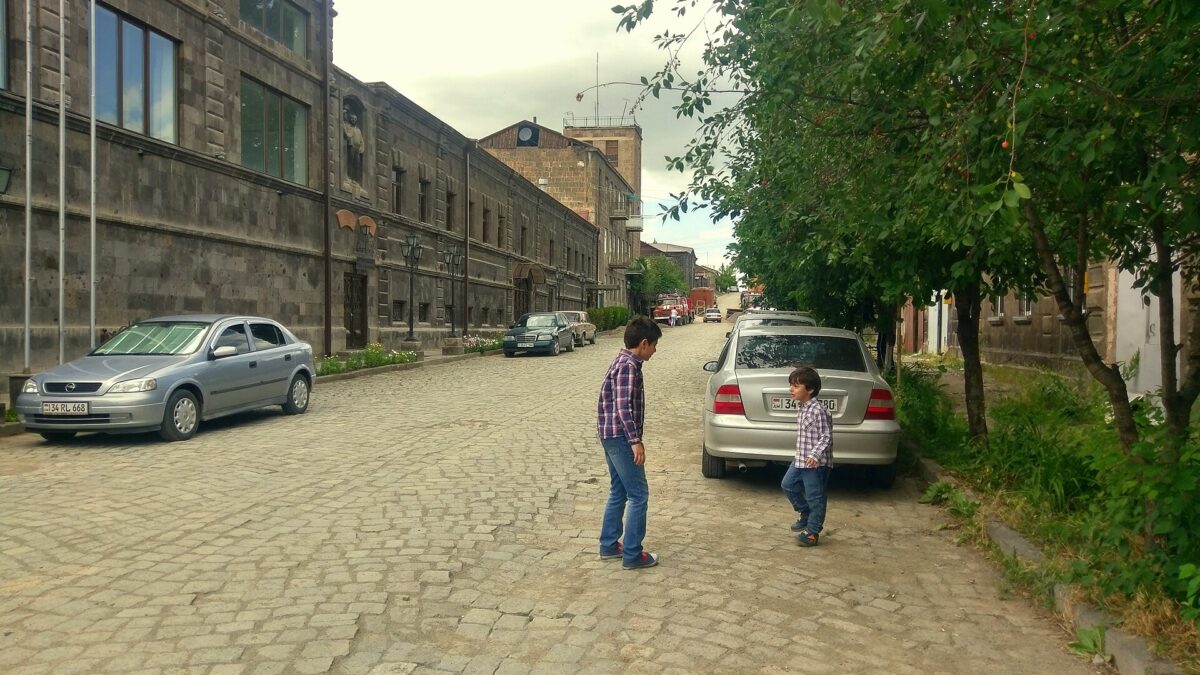
Kumayri is Gyumri’s preserved old town and the single best reason to come. It gathers more than a thousand buildings from the 18th and 19th centuries, built from local black basalt and red-brown tuff, and it is one of the few places in Armenia — and among a handful worldwide — where a genuinely urban, pre-Soviet Armenian townscape survives largely intact, per its architectural-reserve listing.
The pleasure here is unhurried walking. Carved wooden balconies, low stone facades, courtyards and small workshops line streets that never got the Soviet apartment-block treatment that reshaped so much of Yerevan. Give yourself a couple of hours and no fixed plan. This is also where several of the city’s museums sit, so you can drift between architecture and galleries without covering much ground.
A practical note that guidebooks tend to skip: much of what you admire in Kumayri is a mix of original 19th-century stone and careful post-earthquake restoration, and some blocks still show unrepaired damage or vacant lots between the handsome facades. That patchwork is part of the honest texture of the place, not a flaw to look past. The two-tone masonry — dark basalt paired with warm reddish tuff — is the visual signature, and it looks best in low morning or late-afternoon light rather than the flat glare of midday.
Why is Gyumri called Armenia’s capital of humour?
Gyumri has carried several names — Kumayri in antiquity, Alexandropol under the Russian Empire, Leninakan in the Soviet period, and Gyumri again since 1990 — and through all of them it kept a reputation as a city of artisans, poets, musicians and sharp comic wit. Locals are proud of a distinctive Gyumri sense of humour, and the city has produced a long line of Armenian actors, satirists and craftsmen. This matters for a visitor because the culture is not staged for tourism; it shows up in the cafes, the workshops and the way people talk. Combined with lower prices than the capital, it makes Gyumri feel lived-in rather than curated.
What are the best things to do in Gyumri?
Beyond wandering Kumayri, a compact set of sights anchors most visits:
- Vardanants Square: The central plaza, framed by the city hall and two large churches — the Church of the Holy Saviour (Amenaprkich) and the Seven Wounds Church (Surb Astvatsatsin). It is the natural starting point and shows both the 19th-century grandeur and the earthquake scars in one place.
- Black Fortress (Sev Berd): A circular Russian imperial fortress built between 1834 and 1847, sitting on high ground with wide views over the city and plateau. It now serves as a cultural venue and concert space rather than a military site.
- Mother Armenia statue: Erected in 1975, a smaller counterpart to Yerevan’s monument, standing over the city as a symbol of resilience — a fitting one given Gyumri’s history.
- Central Park and the churches: The two churches on and near Vardanants Square repay a closer look. The Church of the Holy Saviour was heavily damaged in 1988 and painstakingly rebuilt using salvaged original stones, so its walls literally embody the city’s recovery. Nearby stands the older Church of the Holy Mother of God (the Seven Wounds).
- Cafes and craft: Gyumri carries a reputation across Armenia for artisans, poets and comedians. The cafe culture is genuine, prices are lower than Yerevan, and the local wit is part of the appeal rather than a marketing line. Shirak is also a strong dairy and bread region, so it is a good place to eat simply and well.
A useful walking plan: start at Vardanants Square, work through the churches and city hall, thread down into the Kumayri streets toward the Dzitoghtsyan Museum, then climb to the Black Fortress or Mother Armenia for the wider view before circling back for coffee. That covers the essentials on foot in a full but unhurried day.
If you are mapping a broader trip, our roundup of the best things to do in Armenia sets Gyumri alongside the monasteries and mountain towns.
What happened in the 1988 Gyumri earthquake?
On 7 December 1988, a magnitude 6.8 earthquake struck northern Soviet Armenia. It levelled about 90 percent of the town of Spitak, which gives the disaster its usual name, and destroyed roughly half of Gyumri — then called Leninakan. Between 25,000 and 50,000 people were killed across the affected region and more than 100,000 were injured, according to contemporary and later accounts.
The scale of the collapse was made worse by poorly built Soviet-era apartment blocks that failed catastrophically, while many older tuff-and-stone houses in Kumayri fared better. The disaster triggered the largest international relief effort since the Second World War, and it was the first time the Soviet Union openly accepted aid from Western nations — a moment often read as an early crack in the Cold War order.
Recovery, though, has been slow and painful. For years afterward thousands of families still lived in temporary shelters known locally as domiks, and the loss of the Soviet economy after 1991 left the city with far less rebuilding money than it needed. Reconstruction stretched across decades, and even now Gyumri’s population sits below its pre-quake level. Understanding this is central to reading the city — the mix of restored elegance, gaps in the streetscape and quiet endurance you see today all trace back to that morning. If you want to grasp the human side of it, the Dzitoghtsyan Museum and the churches on Vardanants Square both carry the story.
Which museums are worth your time in Gyumri?
Gyumri punches above its size on museums, and two stand out:
- Dzitoghtsyan Museum of National Architecture and Urban Life: Housed in a grand 19th-century black-tuff mansion in Kumayri and founded in 1984, it reconstructs the daily urban life of old Gyumri — furnishings, trades, crafts and the townhouse culture that defined the city. It is the best single place to understand why Kumayri matters. Details via the museum’s listing.
- Aslamazyan Sisters Gallery: Established in 1987 and devoted to painters Mariam and Yeranuhi Aslamazyan, it holds the world’s largest collection of their work — hundreds of vivid paintings, prints and ceramics — and is Armenia’s only museum named for and dedicated to female artists, per the gallery’s own site.
Opening hours and entry fees change seasonally and are modest (typically a few hundred to around 1,000–1,500 AMD); confirm on arrival. Last verified: July 2026.
Where does Gyumri fit in an Armenia trip?
Honest editorial call: Gyumri rewards an overnight far more than a rushed day trip. You can technically see the highlights in a long day from Yerevan, but the character of the place — slow mornings in Kumayri cafes, the light on the tuff facades, an unhurried museum or two — is exactly what a day-tripper races past. Stay one night and the city opens up.
It also pairs naturally with the north. Gyumri sits within reach of the monasteries of Lori and the Debed Canyon, so it slots well into a loop rather than an out-and-back. If your time is tight and you would rather sample the classic sights near the capital, our day trips from Yerevan guide covers the shorter options, and the Yerevan travel guide anchors the capital end of any itinerary.
On timing, the plateau is high and winters are genuinely cold, with January averaging well below freezing; late spring through early autumn is far more comfortable for walking the old town. See our best time to visit Armenia guide for the month-by-month picture.
Gyumri at a glance
| Detail | Information |
|---|---|
| Province | Shirak, northwestern Armenia |
| Size | Armenia’s 2nd-largest city (~112,000, 2022 census) |
| Distance from Yerevan | ~126 km (2.5–3 hr by road or rail) |
| Marshrutka fare | ~1,500–2,000 AMD from Kilikia station |
| Train fare | ~1,000–2,000 AMD (South Caucasus Railway) |
| Don’t miss | Kumayri old town, Vardanants Square, Black Fortress |
Costs approximate and volatile. Last verified: July 2026.
Explore more Armenian towns and regions in our destinations section.
Featured image: Preacher lad (CC BY-SA 4.0) via Wikimedia Commons