The Armenian alphabet is a unique 36-letter script created around 405 AD by the monk, scholar and linguist Mesrop Mashtots, giving the Armenian language its own writing system for the first time. Two letters were added in the Middle Ages, bringing the modern total to 38 (39 if you count the ligature և). It is still in everyday use, and it is one of the oldest alphabets on Earth still written the same way its inventor designed it.
For travellers, the alphabet is more than a curiosity on shop signs. It runs through Armenia’s cathedrals, its national museum of manuscripts, and a genuinely striking sculpture park at the foot of Mount Aragats. This guide covers who made the script and why, what makes it linguistically unusual, and the two places where you can actually go and stand in front of it.
Who created the Armenian alphabet, and when?
The Armenian alphabet was created around 405 AD by Mesrop Mashtots (c. 362–440 AD), an Armenian churchman, theologian and linguist, working with the backing of King Vramshapuh and the head of the Armenian Church, Catholicos Sahak Partev. Mashtots designed a set of 36 letters that mapped one-to-one onto the sounds of spoken Armenian.
The motive was practical and religious rather than decorative. Armenia had adopted Christianity as its state religion around 301 AD (a story we cover in how Armenia became the first Christian nation), but scripture still had to be read in Greek or Syriac, languages most Armenians did not understand. Mashtots wanted ordinary people to read the Bible in their own tongue. According to the traditional account recorded by his pupil Koryun, he settled on the final letter forms after study abroad, assisted by a Greek calligrapher named Rufinus. The very first sentence translated into the new script is said to have been a line from the Book of Proverbs. Within a generation, literacy spread and a golden age of Armenian translation and writing began. Mashtots was later canonised as a saint of the Armenian Church. Source: World History Encyclopedia; Wikipedia: Mesrop Mashtots.
What does the Armenian script actually look like?
Armenian is written left to right, like most European scripts, and it is fully alphabetic: each letter stands for a single sound, which is part of why it is considered such a tidy piece of design. The original alphabet had 36 letters, roughly 29 consonants and 7 vowels, covering the phonetics of Classical Armenian (called Grabar).
Two letters were added centuries later, in the medieval period, to handle sounds that came in through borrowed words: Օ (o) and Ֆ (f). That took the count from 36 to 38. A commonly used ligature, և (ew / yev), is sometimes counted as well, which is why you will see the total quoted as 38 or 39 depending on the source. If a guide tells you flatly that there are “39 letters,” it is counting that ligature. Source: Wikipedia: Armenian alphabet.
One point that surprises many visitors: Armenian is not related to Russian, Georgian, Turkish or Persian, despite the neighbourhood. It forms its own independent branch of the Indo-European language family, meaning it has no close living relatives at all. The script is unique to it. Russian is still widely spoken across the country as a second language, and English is common in Yerevan though thinner in the regions, but the letters you see on the street belong to Armenian alone.
There is a neat piece of design trivia worth knowing. The letters were also assigned numerical values, so the same characters that spelled words could count and date things, a system you will still spot carved into old manuscripts and church walls. Scholars have long admired how cleanly the original 36 signs matched the language’s sounds, which is a large part of why the script has survived nearly unchanged for over sixteen centuries.
Why does the alphabet matter so much to Armenians?
It is hard to overstate how central the script is to Armenian identity. Armenia has spent most of its history without a fully independent state, its people scattered across empires and, in the twentieth century, a genocide. Through all of that, the alphabet was a portable homeland. Church, language and letters held a dispersed nation together when borders did not.
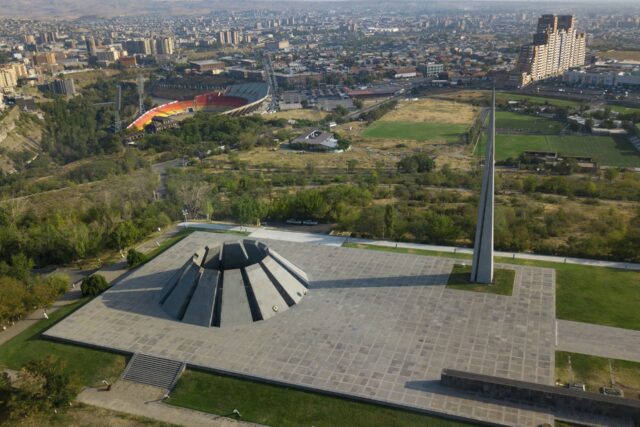
That is why the 1,600th anniversary of the alphabet was marked in 2005 with a national monument (more on that below), and why Mashtots is honoured almost like a founding father. If you visit sites such as the Armenian Genocide Memorial in Yerevan, you start to see why a writing system carries this much emotional weight here. It is worth reading a little of this background before you go; it changes how you see the ornate lettering carved into every old church wall. For more on the country’s cultural threads, browse our Culture & History section.
Where can you see original Armenian manuscripts? The Matenadaran
The single best place to encounter the written word in Armenia is the Matenadaran, formally the Mesrop Mashtots Institute of Ancient Manuscripts, at the top of Mashtots Avenue in Yerevan. The name comes from Armenian words meaning roughly “repository of manuscripts,” and that is exactly what it is: one of the world’s richest collections of hand-written books.
The institute holds on the order of 23,000 manuscripts, fragments and documents, not only in Armenian but also in Greek, Arabic, Persian, Syriac, Latin, Georgian, Hebrew and more. The collection is inscribed on UNESCO’s Memory of the World register. A statue of Mashtots, teaching the alphabet to a pupil, sits on the terrace outside the grey basalt building. Source: UNESCO Memory of the World.
Our honest take: the Matenadaran rewards a guided visit far more than a wander-through. The illuminated pages and tiny pocket-sized bibles are extraordinary, but the labels are sparse, and without context a room of old books can wash over you. Book the guided tour, or at least read up first. It pairs naturally with a walk down Mashtots Avenue into the centre, which we map out in the Yerevan travel guide. Opening hours and ticket prices change, so confirm on the official museum site before you go. Last verified: July 2026.
Where is the Armenian Alphabet Monument?
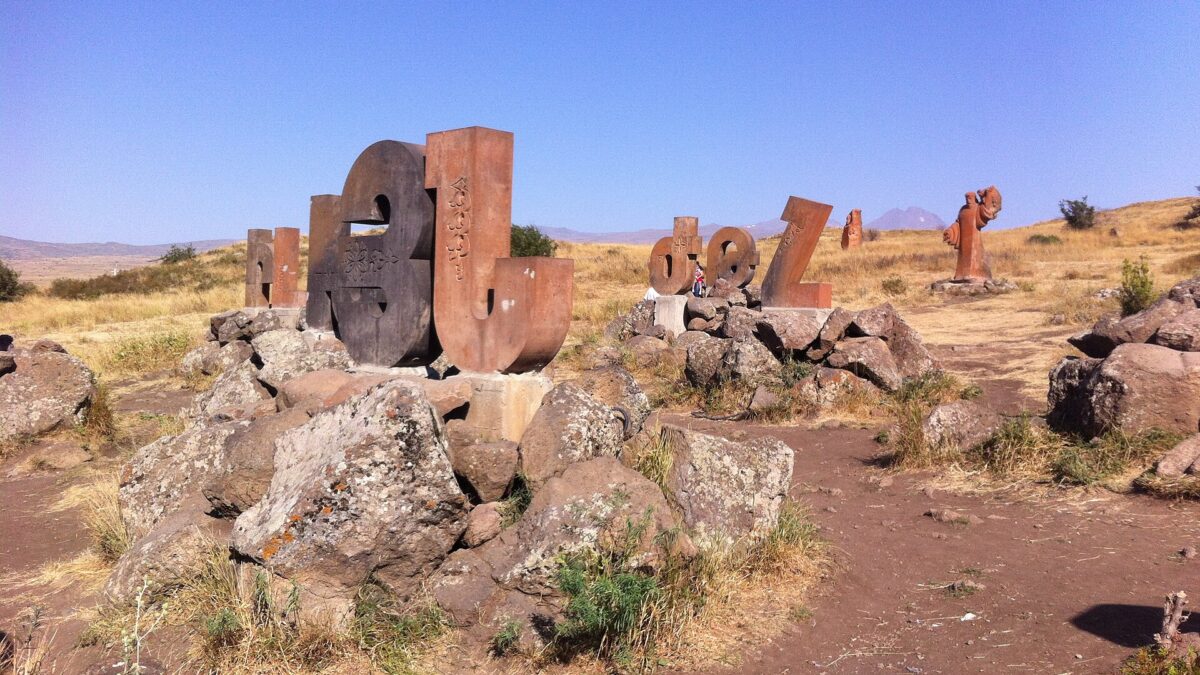
The Armenian Alphabet Monument sits near the village of Artashavan, on the eastern slope of Mount Aragats, roughly an hour’s drive northwest of Yerevan. It is an open-air sculpture park of all 39 letters, each carved as a separate standing block of local tuff stone in shades of pink, orange, grey and black, and decorated with traditional ornament.
The monument was built in 2005 to mark the 1,600th anniversary of the alphabet’s creation, designed by the architect Jim Torosyan. Scattered among the letters are statues of key figures, including Mashtots himself. Many Armenians come to find the first letter of their name and photograph it, which tells you something about how personally the script is felt here. Source: Wikipedia: Armenian alphabet.
Practical honesty: there is no ticket and no visitor centre, so a stop here is quick, maybe 20–30 minutes, and there is little shade or shelter. It works best as one leg of a wider day out on Aragats, combined with the medieval Amberd fortress or a drive up toward Lake Kari, rather than as a destination in its own right. There is no direct public transport that makes sense for a day trip; a hired car or a day tour is the realistic way to reach it. We fold sights like this into the broader best things to do in Armenia. Last verified: July 2026.
A few useful Armenian words for travellers
You do not need to read the script to get around, but a handful of spoken words go a long way, especially outside Yerevan where English thins out. Transliteration into Latin letters varies, so treat these as a phonetic guide (Eastern Armenian, the dialect used in Armenia).
| Armenian (romanised) | Meaning |
|---|---|
| barev / barev dzez | hello / hello (polite) |
| shnorhakalut’yun | thank you |
| khndrem | please / you’re welcome |
| ayo / voch | yes / no |
| inch’kan e? | how much is it? |
| ts’tesut’yun | goodbye |
barev and shnorhakalut’yun alone will earn you a warm response almost anywhere. Source: fact-base compiled from touristik.am and armenia.travel.
The bottom line
The Armenian alphabet is not a museum piece; it is a living 1,600-year-old design that still fills every sign, menu and gravestone in the country. Two experiences bring it alive for a visitor: the manuscripts of the Matenadaran in Yerevan, and the stone letters at the foot of Aragats. Understand where the script came from and why Armenians guard it so fiercely, and a lot of the rest of the country starts to make sense.
Featured image: Edgar Keshishian (CC BY-SA 4.0) via Wikimedia Commons