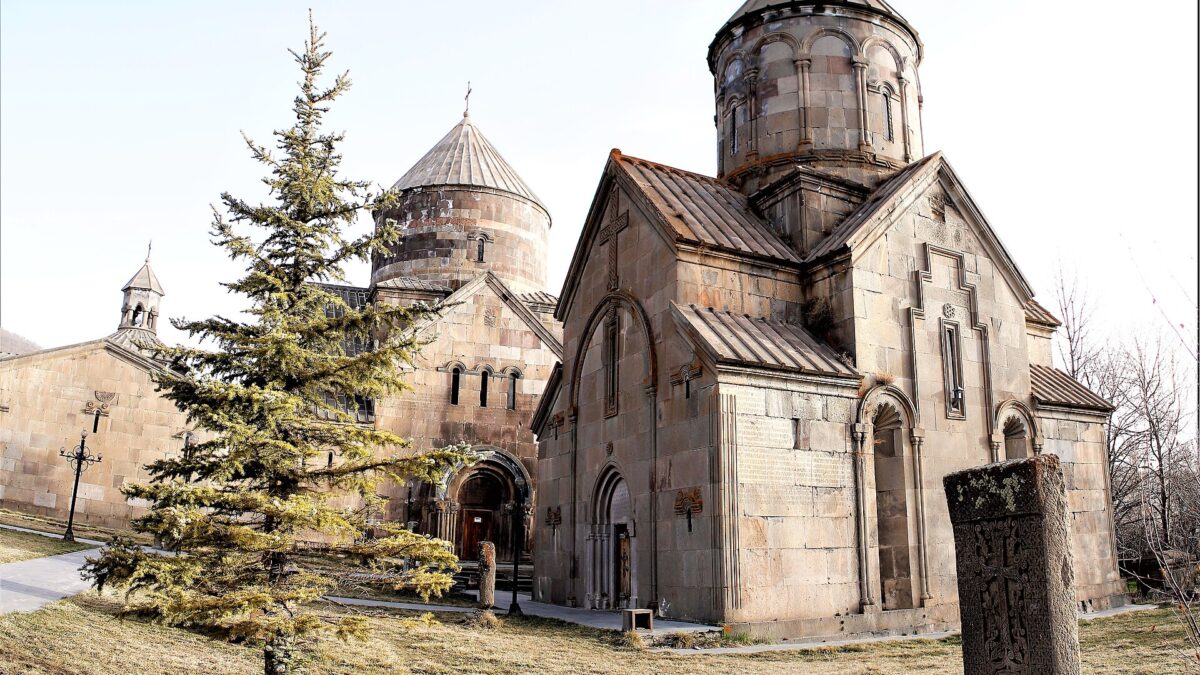
Kecharis is a four-church monastery in the centre of Tsaghkadzor, Armenia’s ski town, 55 km north-east of Yerevan. The Pahlavuni princes built the first churches in the 11th century; the Khaghbakian (Proshian) princes added the cathedral and gavit around 1200. Since 2000 it has been the seat of the Kotayk Diocese, so it is a working church, not a ruin. It takes 45 minutes, sits a short walk below the ropeway, and belongs in any Tsaghkadzor day, winter or summer.
Grigor Magistros and 1033
The oldest building is Surb Grigor (St Gregory the Illuminator). A building inscription on the lintel of its south door names “Grigor Magistros, son of Hasan” as the builder and gives the Armenian year ՆՁԲ, which is 1033. That is the date you will see on the signboard and in most guides.
The honest caveat: Armenian epigraphers have argued over that inscription for 130 years. The same text mentions King Gagik I (d. c. 1020) and Catholicos Sargis I, both dead by 1033, so the 19th-century scholar Ghevond Alishan read the date as 1003. Karen Matevosyan (Etchmiadzin, 2004) agreed and credited the church to a different man, Grigor Apirat; some English sources give 1013. A paper on Kecharis’s donor inscriptions by Gnel Grigoryan and Gohar Khachatryan (Armenian National Academy of Sciences, arar.sci.am) lays out all three positions and calls the sources “contradictory and mutually exclusive.” So: early 11th century, 1003–1033, built by a Pahlavuni- or Apirat-family Grigor. Beyond that, nobody can be certain.
Firmer is the link to Grigor Magistros Pahlavuni (c. 990–1058), the scholar-prince of Bjni, 15 km down the valley. A 1051 document preserved in Rome names him as builder and donor of Surb Grigor, giving books, gold and silver, two villages and a vineyard; the chapel ruin between the churches is traditionally called his tomb. His letters, the subject of a Cambridge Byzantine and Modern Greek Studies article on his “Byzantophilia”, show a man teaching Greek science and poetry to Armenian pupils, which is why Kecharis is always described as a school. In 1044 he traded Bjni to Byzantium for the title magistros; the fortress is a 20-minute drive away (see our Bjni guide).
The four churches, one by one
| Building | Date | Builder | What to look for |
|---|---|---|---|
| Surb Grigor Lusavorich | 1003–1033 (inscription reads 1033) | Grigor Magistros (Pahlavuni or Apirat) | Domed hall, two-storey side chambers flanking the apse; the 1033 lintel inscription on the south door |
| Surb Nshan (Holy Sign) | 11th c., possibly 1051 | Pahlavuni circle; repaired 1223 by Prince Vache Vachutyan | Tiny cross-plan chapel on the north side; the oldest dated donor inscription at Kecharis (1163) is on its north wall |
| Gavit (narthex) | c. 1196–1206, dated inscriptions 1206 and 1213 | Khaghbakian/Proshian patrons | Four-column hall, one of the earliest of its type; sundial outside; 13th-century donor texts cut into the walls |
| Katoghike (Holy Mother of God) | 1203–1214 (inscription 1214) | Prince Vasak Khaghbakian; architect Vetsik | Cross-dome church with two-storey corner chapels; Vasak’s building inscription on the south wall and west portal |
| Surb Harutyun (Resurrection) | 1220 | Unnamed donor “son of Hasan” | Small domed church about 120 m west of the main group, in the cemetery; reconsecrated 2011 |
Start with Surb Grigor, the largest: a domed hall rather than a cross-plan church, with an unusually open interior for the 11th century. The dome is modern; the original fell in the 1827 earthquake. The gavit in front of it is the building to linger in. Its walls are a stone ledger: the Grigoryan–Khachatryan paper counts over forty inscriptions across the complex, most 12th–13th century, recording Yerevan vineyards, villages and silver given in exchange for a set number of liturgies a year. One 1206 text records a donor planting a vineyard at Arinj and gifting it so the monks would pray on St Theodore’s feast. This is how a medieval Armenian monastery was financed, and nowhere shows it more plainly.
Surb Nshan is the small chapel against Surb Grigor’s north side: cross in plan, no columns, room for ten. Katoghike, to the south, is the showpiece. Vasak Khaghbakian, the Proshian prince who fought with the Zakarian brothers to push the Seljuks out of this valley, built it “for the long life” of his overlords Ivane and Shahnshah; his wife Mama added a Yerevan vineyard. The architect, Vetsik, is one of very few medieval Armenian builders known by name. Surb Harutyun is the one visitors miss: walk west through the cemetery for two minutes. It was reconsecrated by the Kotayk Diocese on 9 September 2011.
The khachkars and the cemetery
Around 30 khachkars stand in the complex, most 12th–13th century, a few as late as the 17th. The most important is the memorial stone for Vetsik, put up after the architect died, apparently soon after Katoghike was finished. Sources disagree on where it stands: several put it a few metres south of Katoghike, others place a memorial khachkar on a pedestal east of Surb Grigor. Look for the most finely carved stone with an inscription naming Vetsik. The cemetery running west to Surb Harutyun has rougher, later stones; several abbots are buried under the floor of Surb Harutyun itself. If you want to read the symbolism, our khachkar guide explains the rosettes, interlace and the “winged cross” motif you will see here.
Earthquakes and the 2000–01 restoration
A first repair is recorded in 1248, after the Mongol invasions. The big blow came on 8 October 1827, when the “Tsaghkadzor earthquake” destroyed churches across the valley and as far as Lake Sevan and Tbilisi; Surb Grigor’s dome collapsed. Armenian and Russian sources date the damage to 1827 or 1828; several English-language sources say 1927. We found no primary source for a 1927 event and suspect a transcription error has propagated; 1827 is the better-supported date.
Soviet conservation in 1947–49 re-roofed the churches in stone and built the enclosure wall, but the domes stayed off. Reconstruction of Surb Grigor and Katoghike began around 1990, stalled, and was finished in 1998–2001 with money from Vladimir Harutyunyan, an Austrian-Armenian businessman from Vienna. The complex was reconsecrated on 9 July 2000 and became the cathedral of the Kotayk Diocese, created in 1996. The work is honest to the eye: new stone is paler and sharper-cut, so you can read what is original. Whether rebuilt domes are “right” is a live debate in Armenian heritage circles; here the alternative was two roofless halls, and the result is a church people use.
Kecharis as a school
From the 11th to the late 13th century Kecharis was one of the main centres of learning in central Armenia, with a scriptorium whose manuscripts survive in the Matenadaran. Its best-known teacher was Khachatur Kecharetsi (c. 1260–1331), poet, philosopher and Proshian family member, whose hymns were ranked with those of Grigor Narekatsi and Nerses Shnorhali. He wrote his Lamentation here in 1295. The AUA Hidden Gems entry calls him abbot; other sources say he founded or ran the school. Either way, Kecharis kept teaching into the Mongol period while many monasteries closed, which is the real measure of its importance.
Visiting: hours, services, dress, photography
- Hours. Open in daylight, roughly 09:00–19:00 in summer, until dusk in winter; no ticket, no posted closing time. Entry is free.
- Services. Cathedral of the Kotayk Diocese (office: 6 Olimpiakan Street; +374 223 60629). Sunday Divine Liturgy is mid-morning; Saturday weddings and baptisms may close parts of Surb Grigor for an hour. To attend, arrive before 10:30 on Sunday and stand at the back.
- Dress. Shoulders and knees covered, hats off for men; women need not cover their hair, though many locals do.
- Photography. Allowed inside and out, no flash during services. The gavit’s inscriptions read best in flat light; Katoghike’s west portal is in shadow until late afternoon.
Getting there
From Yerevan by car: 55–60 km, about an hour via the M4 to Hrazdan, then the signed turn to Tsaghkadzor. The monastery is on the main road in the town centre, free parking opposite. Paved all the way; the last climb can be icy in winter.
By marshrutka: no frequent direct service. Minibuses to Hrazdan leave from near Yeritasardakan metro station in Yerevan, about 06:40–21:00, 700 AMD (Absolute Armenia, checked June 2025). Get off at Hrazdan’s Mikroshrjan (microdistrict) stop and take the local minibus (100 AMD) or a taxi (about 1,000 AMD) the final 8 km. A direct Yerevan–Tsaghkadzor bus is listed a few times a day; do not plan around it. A GG or Yandex taxi from central Yerevan is 9,000–11,000 AMD one way, worth it for two or more people.
From Bjni or Hrazdan: Bjni is 15 km south, Hrazdan 8 km; a taxi from Bjni is 2,500–3,500 AMD. Bjni fortress and Kecharis in one morning is the natural pairing, since the same Pahlavuni family built both.
Pair it with
- The ropeway. The lower station is a steep 20-minute walk or a 5-minute taxi uphill from the monastery. Three chairlift sections climb to about 2,800 m on Mount Teghenis; recent reports put a single ascent at roughly 3,000 AMD, rising yearly. It runs daily in season, typically 10:30 to 19:00, with views to Aragats and, on a clear day, Ararat.
- Skiing. Kecharis is the half-day for the non-skier in the group and the one cultural stop on a ski trip. Season runs roughly late December to late March; our skiing guide covers passes and rentals.
- Tsaghkadzor town. The Orbeli brothers’ house-museum and the Soviet-era sanatoria are 10 minutes’ walk; see our Tsaghkadzor guide.
When to go
October is best: the forest turns copper, the ropeway still runs and the crowds have gone. Winter weekends bring skiers, weddings and midday tour buses, but snow on the basalt is the postcard view. May–June is green and quiet; July–August brings Yerevan families, since Tsaghkadzor sits at 1,750–1,850 m and runs 8–10°C cooler than the capital. Avoid 13:00–14:00 on a Saturday unless you want to share the gavit with a bridal party.
Verdict
Kecharis is not Geghard or Haghpat; the carving is plainer and the setting is a town, not a gorge. What it has is legibility: four churches from 1003–1220 side by side, so you watch Armenian architecture move from domed hall to cross-dome to four-column gavit in one glance, with the people who paid for it named on the walls. For a Tsaghkadzor visitor it is the one essential hour. From Yerevan it is a half-day, best bundled with Bjni, and it earns its place on our list of Armenia’s monasteries worth the drive.
Last verified: October 2026. Transport prices and ropeway hours change seasonally; the diocesan office is the authority on service times.
Frequently asked questions
When was Kecharis Monastery founded?
The inscription on Surb Grigor church reads 1033, but Armenian scholars have argued for 1003 or 1013 because the same text names a king and a catholicos who had died before 1033. The safe answer is the early 11th century, under the Pahlavuni princes; the Katoghike and gavit were added by the Khaghbakian (Proshian) princes between about 1196 and 1214.
Is Kecharis an active church?
Yes. Since its reconsecration on 9 July 2000 it has been the cathedral of the Kotayk Diocese of the Armenian Apostolic Church. Sunday liturgy is celebrated, and Saturday weddings are common, so parts of the main church may be briefly closed to visitors.
How much does it cost and how long do you need?
Entry is free and the grounds are open in daylight hours. Allow 30–45 minutes for the main group of churches and another 15 minutes to walk through the cemetery to Surb Harutyun, about 120 m to the west.
Can you combine Kecharis with the Tsaghkadzor ropeway?
Easily. The lower ropeway station is a steep 20-minute walk or a short taxi ride uphill from the monastery. Visit Kecharis first in the morning light, then ride the chairlift sections towards Mount Teghenis; the ropeway generally runs from about 10:30 to 19:00 in season.
Featured image: Beko, CC BY-SA 4.0 — via Wikimedia Commons.