Metsamor is a Bronze and Iron Age settlement mound beside Taronik village in Armavir province, about 35 km west of Yerevan, with a three-floor museum on the site holding more than 27,000 excavated objects, including a basement gold treasury. It is open Tuesday to Sunday, the ticket is in the 700–1,000 AMD range, and you can walk the citadel ridge with its carved “observatory” platforms in under an hour. It pairs naturally with Echmiadzin and Zvartnots, which sit on the same road back to the city. The honest caveat: the grandest claims you will hear about Metsamor (oldest copper smelter, Bronze Age observatory) are interpretations from the 1960s–80s that the current excavators treat with care, so go for what is genuinely there rather than for the superlatives.
Metsamor the place vs. Metsamor the power plant
Two things in Armenia carry the name. The Armenian Nuclear Power Plant is universally called “Metsamor” after the small town built for its workers. The Metsamor Historical-Archaeological Museum-Reserve is a separate place a few kilometres away, next to Taronik village, on a low volcanic rise above the Metsamor river. Taxi drivers and map apps will happily take you to the wrong one. Search for “Metsamor Museum” or “Taronik”, not “Metsamor town”, and if a driver looks puzzled, say “Taronik, tangaran” (museum).
The cooling towers are visible from the ridge, which is a strange but genuinely interesting view: a 5,000-year-old metalworking settlement and a Soviet-era reactor in one frame.
What was here: 5,000 years in one mound
The Polish–Armenian mission and the reserve itself date occupation from the 5th millennium BC (Chalcolithic) through the Middle Ages, with some use of the mound even later. The Warsaw team’s press material via Science in Poland gives the useful shape of the story:
- 4th–2nd millennium BC: a settlement of roughly 10 hectares, which grew into a fortified town with a citadel on the hill.
- 11th–9th century BC (Early Iron Age): the peak. The town spread to something close to 100 hectares, with a central fortress surrounded by cyclopean walls, temple complexes, and industrial quarters. The excavators describe it as one of the most important centres on the Ararat plain in this period, comparable to Samtavro in Georgia or Mingechaur in Azerbaijan.
- 8th century BC: conquest by Urartu under Argishti I. Burnt layers, ash and human remains in the excavated quarters are read by the mission as evidence of a violent takeover. After that the settlement shrank; project director Krzysztof Jakubiak has said in interviews that the Urartian-period town was simpler and less organised than what came before. If you have been to Erebuni in Yerevan, this is the same king who founded it in 782 BC; see our guide to Urartu and Erebuni.
- Antiquity to medieval: the site stayed in use. A 2022 jar burial of the 2nd–3rd century AD was found inside the old urban quarters, published in the journal Aramazd.
Two further claims appear on almost every Armenian page about the site. First, the metallurgy: Soviet-era excavations under Emma Khanzadyan (from 1965) reported smelting furnaces and a large metal-working quarter, and tourism sources call it the “world’s first well-preserved copper smelter”. Metal production is well documented here, but “world’s first” is not a claim the current excavators repeat, and dates offered for the furnaces range wildly across sources. Treat it as “an important early Caucasian metalworking centre”, which is enough. Second, the observatory, which gets its own section below.
The museum: what to see
The museum opened in 1968, three years into Khanzadyan’s excavations, specifically to keep the finds on site rather than shipping them to Yerevan. According to the mission’s museum page, it is now a branch of the state Service for the Protection of Historical Environment and Cultural Museum-Reserves, holds more than 27,000 objects, and is laid out on three levels:
- Ground floor: chronological, from the Early Bronze Age to the medieval period. Pottery dominates, including the painted and black-burnished wares typical of the Ararat plain, plus stone tools and the first metal.
- Upper floor: crafts and cult. This is where the metallurgy displays are, along with ritual objects, the stepped clay altars from the temple quarter, and figurines.
- Basement treasury: the reason to pay for a guide. Gold and silver ornaments, carnelian, amber and paste jewellery from the Late Bronze Age to the Urartian period. The two headline pieces are imports that show how far Metsamor’s trade reached: an agate frog-shaped weight inscribed for the Babylonian king Ulam-Buriash (16th century BC) and a carnelian cylinder seal of the Kassite king Kurigalzu (15th century BC) with Egyptian hieroglyphs.
Three practical notes. Labels are mainly in Armenian with some Russian and English; take the guided tour if one is offered, because the staff know the finds in a way the captions do not convey. Photography rules in the treasury change, so ask. And the newest gold (see below) is not always on the shelves: pieces were shown at the History Museum of Armenia in Yerevan in late 2022, and loans continue.
The ridge: “observatory” and the citadel walk
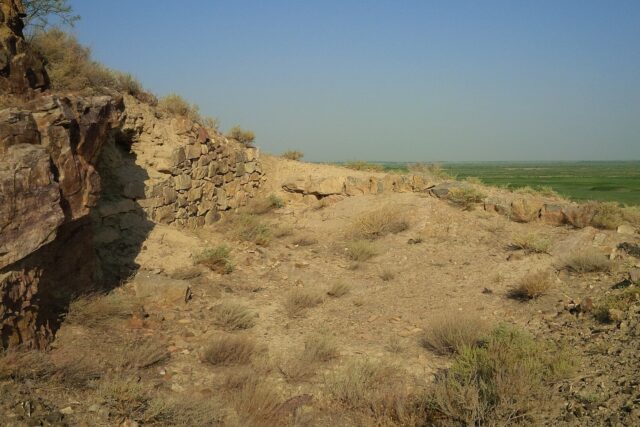
Walk out of the museum and the whole site is open ground. The citadel occupies the main hill, ringed by the lower courses of cyclopean walls (big unmortared blocks) that the Warsaw team says are still standing to a visible height. Excavated house walls, streets and the temple quarter with its stepped altars are visible in the trenches below, though they are backfilled or roped off in places after each season. Pottery sherds are everywhere underfoot; leave them.
On the “Small Hill” to the side is the complex of carved rock platforms discovered in 1966. The astrophysicist Elma Parsamian of Byurakan Observatory studied them with the geologist Koryun Mkrtchyan and published the interpretation in 1969: three well-preserved platforms, one triangular with its apex on a north–south line, another 2.5 m higher aligned with the meridian, and a third with a carved compass-like indicator and seven cut steps. A trapezium with four star symbols on the first platform points, by her calculation, to where Sirius rose at the summer solstice between roughly 2800 and 2600 BC.
That is the attribution. The caveat is that this is one astronomer’s reading, built on a compass azimuth of a roughly cut line and a choice among four candidate stars; it has not been independently tested with modern survey methods, and the Polish–Armenian project does not make the observatory claim part of its own work. What you can say without hedging is that the platforms are real, old, deliberately cut, and oddly compelling to stand on at sunrise. A row of vishap-style standing stones and inscribed stelae has been set up outside the museum building as well.
Allow 45–60 minutes for the ridge. The ground is rough basalt and dust, with no paths, shade or railings; wear proper shoes.
The Polish–Armenian digs and the gold finds
Since October 2013 the site has been excavated jointly by the University of Warsaw (Faculty of Archaeology and the Polish Centre of Mediterranean Archaeology, PCMA) and the Armenian Service for the Protection of Historical Environment, directed by Krzysztof Jakubiak and Ashot Piliposyan. Where Khanzadyan worked the citadel and cemetery, the Poles took on the lower town, which is why the museum keeps gaining material from the urban quarters.
- 2016: sixteen gold objects, including a carnelian-and-gold necklace found in a burnt destruction layer in the settlement. The mission’s view, reported by Science in Poland, is that its owner lost it during the Urartian conquest.
- 2021–22: work shifted to the necropolis, where around 100 graves have now been examined; nearly all were looted in antiquity. Tomb 23, dug in autumn 2022, was not. A stone-lined cist held a man and a woman in their thirties on a wooden burial bed, three necklaces of more than 100 gold and carnelian beads, gold pendants, a dozen pots and a faience flask imported from the Syrian–Mesopotamian borderland, dated 1300–1200 BC (HeritageDaily). Some reports also mention amber beads. Why the two died together is unknown.
- Autumn seasons continue each September–October, so a visit in those weeks may let you see trenches open and the team at work. Do not walk into an active trench.
Beyond the gold, the project’s more academic results, such as the sealed pithos with food remains and the spatial study of the Iron Age street grid, are what will eventually rewrite the Soviet-era picture of the site.
Getting there
| Option | How | Approx. cost / time |
|---|---|---|
| Taxi from Yerevan | Yandex Go or GG; put “Metsamor Museum, Taronik” as the destination, not Metsamor town | 45–60 min; roughly 4,000–6,000 AMD one way, return by app or ask the driver to wait |
| Bus + taxi | Bus 203 from Kilikia Central Bus Station to Echmiadzin (about 250 AMD, 30–35 min), then a taxi from Echmiadzin to Taronik | 10–15 min taxi; agree a price with return and wait time |
| Self-drive | M5 west, use the Echmiadzin bypass, turn left (south) for Taronik about 4 km past the town; through the village centre, right, then an unpaved lane south to the museum | 40–50 min from central Yerevan; free parking by the museum |
There is no direct public transport to Taronik from Yerevan; the bus-plus-taxi route via Echmiadzin is the realistic budget option. If you are driving yourself, see our car-rental and driving guide; the final 500 m is an earth road that is fine in a normal car in dry weather.
Pair it with
- Echmiadzin Cathedral: 10 minutes away, the headquarters of the Armenian Church. Do Metsamor first in the morning light, then the cathedral complex and lunch in Vagharshapat.
- Zvartnots: the 7th-century ruined cathedral is on the M5 back toward Yerevan, 15 minutes from Taronik. Its own museum is small; Metsamor’s is the better of the two.
- Sardarapat: the 1918 battle memorial and the Ethnography Museum of Armenia are about 15 km west, past Armavir town. Together the four sites make a full, varied day; see our day trips from Yerevan.
Hours, tickets, facilities
| Item | Detail |
|---|---|
| Address | Metsamor Historical-Archaeological Museum-Reserve, Taronik village, Armavir province (40.139 N, 44.185 E) |
| Hours | Monday closed. Mission site lists Tue–Sat 10:30–17:00, Sun 10:30–15:00; Armenia’s official tourism site lists Tue–Sun 10:00–18:00. Arrive by 15:00 to be safe. |
| Ticket | 700 AMD per the mission’s museum page; the reserve service announced a unified 1,000 AMD adult ticket in 2019 with concessions for students and pensioners. Expect 1,000 AMD; guided tours cost extra. |
| Facilities | Toilets at the museum, no café. Bring water; the nearest shops are in Taronik and Echmiadzin. |
| Time needed | 1.5–2 hours for museum plus ridge |
Confirm hours and prices before you go; the published figures disagree and the reserve’s own website is intermittently unreachable from abroad. Last verified: October 2026.
When to go
April–May and late September–October are best: the Ararat plain is green or golden, the light is low enough for the carvings to read, and the autumn dig season may be running. July and August on the exposed ridge regularly pass 35 °C with no shade; if you must come in summer, be there at 10:30 opening. Winter is fine for the museum, but the ridge can be muddy and the lane to the site turns to slop after rain.
Verdict
Metsamor is the best Bronze Age site you can reach from Yerevan without a long drive, and the treasury alone justifies the 1,000 AMD. Go in with the right expectations: this is an excavation with a working museum, not a reconstructed park, and the headline myths are weaker than the real archaeology. If you have a half-day on the Echmiadzin side of the city, add it.
Frequently asked questions
Is the Metsamor museum the same place as the Metsamor nuclear plant?
No. The power plant is next to Metsamor town; the archaeological reserve and museum are beside Taronik village a few kilometres away. Navigate to ‘Metsamor Museum, Taronik’ to avoid being taken to the wrong one.
How much is the Metsamor museum ticket and when is it open?
Sources disagree: the Polish mission’s page lists 700 AMD and Tue–Sat 10:30–17:00, Sun 10:30–15:00, while the state reserve service announced a unified 1,000 AMD ticket in 2019. Monday is closed everywhere. Budget 1,000 AMD, arrive before 15:00, and confirm on the day.
Can you walk on the actual archaeological site?
Yes. The citadel hill with its cyclopean walls, the excavated quarters and the carved ‘observatory’ platforms are open ground next to the museum. Allow 45–60 minutes, wear sturdy shoes, and stay out of any open trenches during the autumn dig season.
How do I get to Metsamor from Yerevan without a car?
Take bus 203 from Kilikia Central Bus Station to Echmiadzin (about 250 AMD, 30–35 minutes) and a short taxi to Taronik from there, or book a taxi app ride direct from Yerevan for roughly 4,000–6,000 AMD each way. There is no direct bus to Taronik.
Featured image: sedrakGr, CC BY 3.0 — via Wikimedia Commons.