The Yerevan Metro is one line, ten stations, 13.4 km, and for a visitor it does exactly three useful things: it links Republic Square, the Cascade/university quarter and the parliament district in under ten minutes, it drops you at the railway station, and it is the cheapest tour of late-Soviet Armenian architecture in the city. A ride costs 150 AMD (about $0.40), paid by contactless bank card, a 500-AMD transport card or the Telcell app; cash and the old tokens are gone. Trains run roughly 07:00 to midnight every 4.5 to 12 minutes depending on the hour. The honest caveat: it does not go to the airport, the Genocide Memorial, the Cascade’s top or most hotels, so treat it as a short north–south spine rather than a network.
Why ride it, and why it is so small
Soviet planning rules reserved metros for cities of a million people. Yerevan crossed that line in the 1970s and got a system scaled for a city that was expected to keep growing; then the 1988 earthquake, the Karabakh war and the 1990s energy crisis froze construction. The result is a single line, now officially the Karen Demirchyan Yerevan Metro after the Soviet-era Armenian leader who pushed it through. The irony is that the 1990s were its busiest years: with buses idle for lack of fuel, the metro carried up to 350,000 people a day. By 2023 it was down to about 81,000 a day, or 29.6 million a year, per figures cited on the Armenian and Russian Wikipedia pages from municipal data.
For a visitor that is a feature: end to end takes about 25 minutes, and the map is a straight line with one short branch.
History in 200 words
Construction ran through the 1970s and the first section opened on 7 March 1981 with four stations: Barekamutyun (then Druzhba), Marshal Baghramyan (then Saralanj), Yeritasardakan and Sasuntsi Davit. Republic Square, then Lenin Square, followed in December 1981; its architect Jim Torosyan won the Armenian State Prize for it in 1983. Gortsaranayin opened in 1983, Shengavit at the turn of 1985/86, Garegin Nzhdeh Square (then Spandaryan Square) at New Year 1986/87, and Zoravar Andranik (then Hoktemberyan) in December 1989. Four stations shed their Soviet names between 1991 and 1992.
Then the money stopped. The only post-independence addition is Charbakh, opened on 26 December 1996 on a short single-track branch from Shengavit, built cheaply and deliberately plain. Since then: master plans for 32 stations on three lines, and a decade of announcements about an eleventh station at Ajapnyak, covered below. Rolling stock is still the Soviet 81-717/714 family, rebuilt car by car in the Shengavit depot.
Fares, hours and how to pay (October 2026)
Yerevan introduced a unified ticket for metro, bus and trolleybus on 1 February 2025 and raised the single fare from 100 to 150 AMD, which triggered a brief passenger boycott that City Hall rode out (ARKA, Feb 2025).
- Single ride: 150 AMD. Tap a contactless Visa, Mastercard or ArCa bank card on the turnstile reader. Armenian banks are all accepted except VTB; Amex and Mir are not (yerevan.am, July 2025). One card pays for one person, and the same card cannot be used again for 30 minutes, so a couple needs two cards.
- Transport card: 500 AMD, which includes one ride, then top up at Telcell terminals, metro ticket windows or transport.yerevan.am. Sold at metro station terminals and the information centres on Republic Square and France Square (yerevan.am, July 2025).
- Telcell Wallet app generates a QR code for the turnstile; only worth it with a local SIM.
- Passes: a 90-minute transfer ticket around 300 AMD, a day pass 900 AMD, a month 9,000 AMD, a year 90,000 AMD (JAMnews, Aug 2025, quoting City Hall). These load onto a transport card, not a bank card.
- Paper QR tickets were withdrawn on 1 August 2025 because they printed unreadably (yerevan.am). Any guide telling you to buy one is out of date.
- Fines: 10,000 AMD for no ticket, 3,000 AMD for an unvalidated one; inspectors with handheld readers started in August 2025 (JAMnews).
Hours: the operator’s site yermetro.am gives 07:00 to 24:00 daily. Weekday headways are 4.5 to 7 minutes in the morning peak, 7.5 minutes midday, 5 minutes from 17:30 to 19:00, then stretching to 11 minutes after 22:00. Weekends are 8.5 minutes most of the day and 12 minutes in the last two hours. The Charbakh branch is a separate single-car shuttle from Shengavit with its own, sparser timetable. Confirm first and last trains at the station. For how the dram and ATMs work, see our money guide.
Station by station
North to south. Where Armenian and Russian sources disagree on a date by a few weeks, we say so.
| Station | Opened | Architecture | What is nearby |
|---|---|---|---|
| Barekamutyun (“Friendship”, ex-Druzhba) | 7 Mar 1981 | Northern terminus. 100-m hall faced in red Armavir tuff and Aghveran marble, granite floors from Pambak and Khujand, bas-relief by Ghukas Chubaryan. Future junction for the Ajapnyak extension. | Komitas Avenue shopping, Arabkir district, buses to Ashtarak and the north. |
| Marshal Baghramyan (ex-Saralanj) | 7 Mar 1981 | Monumental early-1980s style by Spartak Kntekhtsyan, Albert Zurabyan and Ilya Manucharyan; marble, granite, bas-reliefs of the marshal. | National Assembly, Presidential residence, Academy of Sciences, Lovers’ Park, American University. |
| Yeritasardakan (“Youth”) | 7 Mar 1981 | The famous one: a long inclined concrete tube of an entrance pavilion with a slot skylight running down its spine, by Stepan Kyurkchyan. Light-grey marble hall, ventilation hidden behind metal mesh on the columns, “Youth” relief by Ruzan Kyurkchyan. | Yerevan State University, the Cascade (10 min walk), Opera, Isahakyan and Abovyan streets. |
| Hanrapetutyan Hraparak / Republic Square (ex-Lenin Square) | 26 Dec 1981 | Jim Torosyan’s State Prize station: deep pylons that taper sharply so that from the centre of the hall they read as arches. Escalators overhauled 2024–25 (260 million AMD, yerevan.am). | Republic Square, History Museum, Vernissage market, GUM market, most central hotels. |
| Zoravar Andranik (ex-Hoktemberyan) | Dec 1989 | Last Soviet-era station, by Romeo Julhakyan and Suren Burkhajyan. Escalator replacement tendered at 504 million AMD in 2025. | St Gregory the Illuminator Cathedral, Rossiya Mall, Tigran Mets Avenue. |
| Sasuntsi Davit (David of Sassoun) | 7 Mar 1981 | Surface station built into the railway station complex by Baghdasar Arzumanyan, Sergey Nersisyan and Rafael Israelyan; relief by Artashes Hovsepyan. | Yerevan railway station (Tbilisi and Gyumri trains), Yervand Kochar’s equestrian David of Sassoun statue. |
| Gortsaranayin (“Factory”) | 11 Jul 1983 | Open-sided surface station, grey marble with daylight slots between wall and roof, “Song of Labour” relief by Levon Vardanyan. Escalators fully replaced 2024–25 (204 million AMD). | Southern industrial belt. Nothing for visitors. |
| Shengavit | Dec 1985 / Feb 1986 (sources differ) | Severe industrial style, grey granite, eight stainless-steel columns, white marble with black borders. Junction: change here for the Charbakh shuttle. | Shengavit district; nothing for visitors beyond the junction itself. |
| Garegin Nzhdeh Square (ex-Spandaryan Square) | 31 Dec 1986 / 1 Jan 1987 | Deep column station, white marble arches between dark-brown granite columns, by Levon Gevorgyan. | Southern terminus of the main line; local markets, buses toward Ararat province. |
| Charbakh | 26 Dec 1996 | Only post-independence station and the cheapest ever built: orange tuff, white concrete roof on cylindrical steel columns, by Valter Mnatsakanyan. Served by single-car shuttles. | Residential Charbakh; the planned future ring to Ajapnyak would start here. |
Republic Square, Yeritasardakan and Marshal Baghramyan between them cover the centre; our where-to-stay guide explains those neighbourhoods.
The three stations worth going down for the architecture
Republic Square
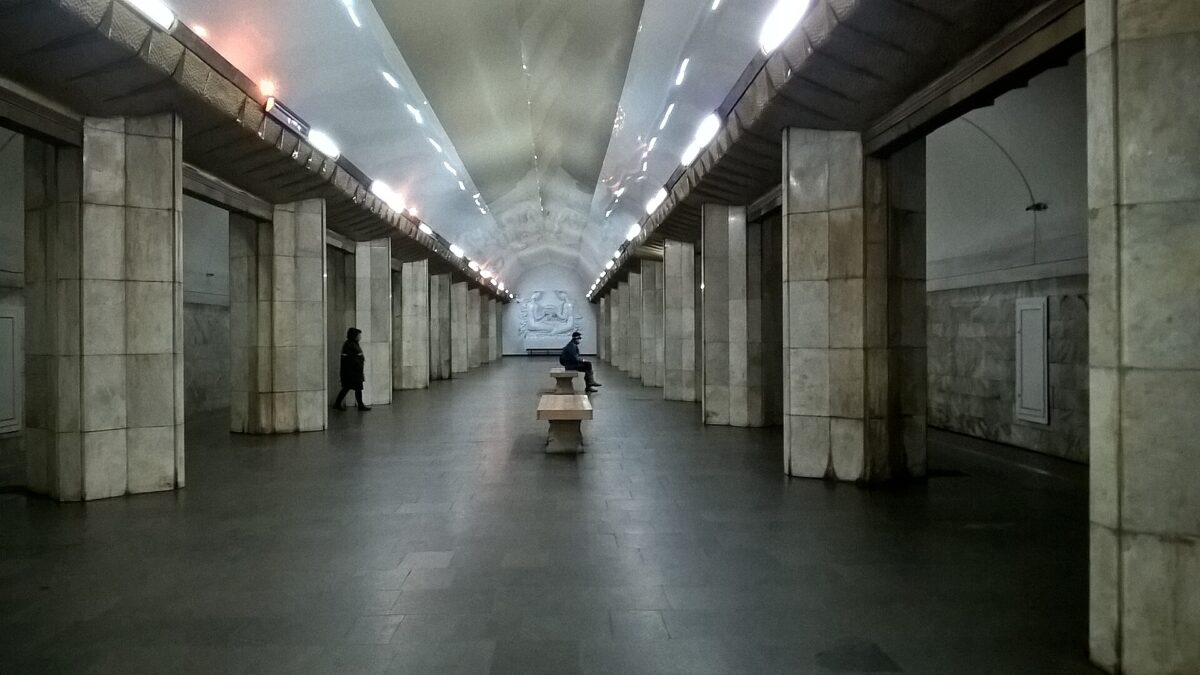
Stand mid-platform and look along the hall. Torosyan’s pylons are wide at the base and taper upward, so each pair frames the next like an arcade even though this is structurally a pylon station, not a column one. It was praised as unlike anything else in the Soviet metro system, and the 1983 State Prize was for exactly this trick. Then go up to the square; our Republic Square guide covers what is above ground.
Yeritasardakan
The attraction is the entrance, not the platform: a raking concrete tube climbing out of the pavement on Isahakyan Street, lit by a glazed slot along its spine. It is on every list of Soviet modernism in Yerevan and photographs best in late afternoon. Inside, the ventilation grilles were turned into vertical decoration on the columns rather than hidden. From here the Cascade is a ten-minute walk uphill.
Barekamutyun
The materials are the point: red Armavir tuff walls against pale granite floors, with the Chubaryan relief at the centre. It is also the station that changes most if Ajapnyak is built, since the extension leaves from here. Honourable mention to Charbakh, whose orange tuff and bare steel on a 1996 budget say more about the 1990s than any museum caption.
Etiquette, escalators, photography
- Stand right, walk left on the escalators. Republic Square, Gortsaranayin and Sasuntsi Davit have had theirs overhauled or replaced since 2024; Zoravar Andranik is next (yerevan.am, March 2025). Hold the rail.
- Give up seats to the elderly and to women with children before being asked.
- Carriages are Soviet 81-717/714 stock: loud in tunnels, mostly without air-conditioning, doors that close hard. Summer afternoons are hot.
- Photography: we found no published rule on yermetro.am or yerevan.am. Some stations still carry a crossed-out-camera pictogram; staff sometimes object to tripods and obvious cameras, while phone snaps go unremarked. Be discreet, avoid staff and the police post, stop if asked. That is practice, not policy.
- Announcements are Armenian only; wall signs are Armenian and Latin, and counting stops works.
The extension question
Ajapnyak, a dense district on the west bank of the Hrazdan gorge, has been promised a station since City Hall revived the project in 2018. The engineering is the problem: the line must leave Barekamutyun and bridge the gorge, and the estimate has climbed from about $50 million in 2022 to around $287 million (CivilNet, 2025). Where it stood in October 2026:
- June 2025: the state expert examination approved the engineering design; Mayor Tigran Avinyan called it the city’s top infrastructure priority (Armenpress, 9 June 2025).
- October 2025: the 2026 state budget set aside 5.5 billion AMD for the metro, of which 2 billion for the new station (Armenpress, 31 Oct 2025). In December 2025 part of the allocated money was redirected to buy 45 trolleybuses (PanARMENIAN, June 2026).
- March 2026: a parallel programme to buy 48 new metro cars and rebuild the depot, costed at around 60 billion AMD, went to the government’s Public Investment Committee (Armenpress, 2 Mar 2026).
- 10 June 2026: Prime Minister Pashinyan said he wanted construction to “finally begin” and asked City Hall to tender for technical supervision first, then set a timetable, pick a contractor and fix financing (PanARMENIAN).
- 3 September 2026: Armenia confirmed it was discussing Russian participation in building the station, and described Ajapnyak as the first of at least four new stations on a route through Academic City to Charbakh, forming a ring (Armenpress).
So: designed, approved, partly funded, no contractor, no shovel. Do not plan a trip around it; if it starts, expect years of works around Barekamutyun.
Metro vs marshrutka vs taxi
For a visitor the honest ranking is app taxi, then metro, then bus. Yandex Go and GG are cheap by European standards and go door to door. The metro wins on two corridors: Barekamutyun or Marshal Baghramyan to Republic Square in rush hour, when Baghramyan Avenue is jammed, and anything to the railway station, where it delivers you inside the building. Buses and marshrutkas take the same 150-AMD card, cover far more of the city and are the only public option for the airport, the Genocide Memorial and Erebuni. The wider picture is in how to get around Armenia.
Verdict
Ride it once for the three good stations and the price; use it as transport only along its north–south spine. Buy a 500-AMD transport card at Republic Square if you are staying more than two days or travelling as a pair; otherwise tap a bank card. Ajapnyak is closer than ever and still not a thing you can ride.
Last verified: October 2026. Fares, hours and the extension timeline change; confirm at the station or on yermetro.am before relying on them.
Frequently asked questions
How much does the Yerevan Metro cost in 2026?
A single ride is 150 AMD, roughly $0.40, under the unified city fare introduced on 1 February 2025. Tap a contactless Visa, Mastercard or ArCa card on the turnstile, use a 500-AMD transport card (first ride included), or scan a QR code from the Telcell app. Cash, tokens and paper QR tickets are no longer accepted.
What are the Yerevan Metro opening hours?
The operator lists 07:00 to 24:00 daily. Weekday trains run every 4.5 to 7.5 minutes until about 21:00 and every 11 minutes late at night; weekends are every 8.5 to 12 minutes. The Charbakh branch is a separate single-car shuttle with longer gaps. Confirm last-train times at the station.
Does the Yerevan Metro go to the airport or the Genocide Memorial?
No. The single line runs north-south through the centre between Barekamutyun and Garegin Nzhdeh Square, with a short branch to Charbakh. Zvartnots airport, Tsitsernakaberd and the top of the Cascade all need a bus or taxi.
Is the Ajapnyak metro station being built?
Not yet, as of October 2026. The design passed state examination in June 2025, 2 billion AMD was budgeted for 2026, and in June 2026 the prime minister called for construction to begin and for a supervision tender. No contractor had been named and no construction had started.
Featured image: David1010, Attribution — via Wikimedia Commons.