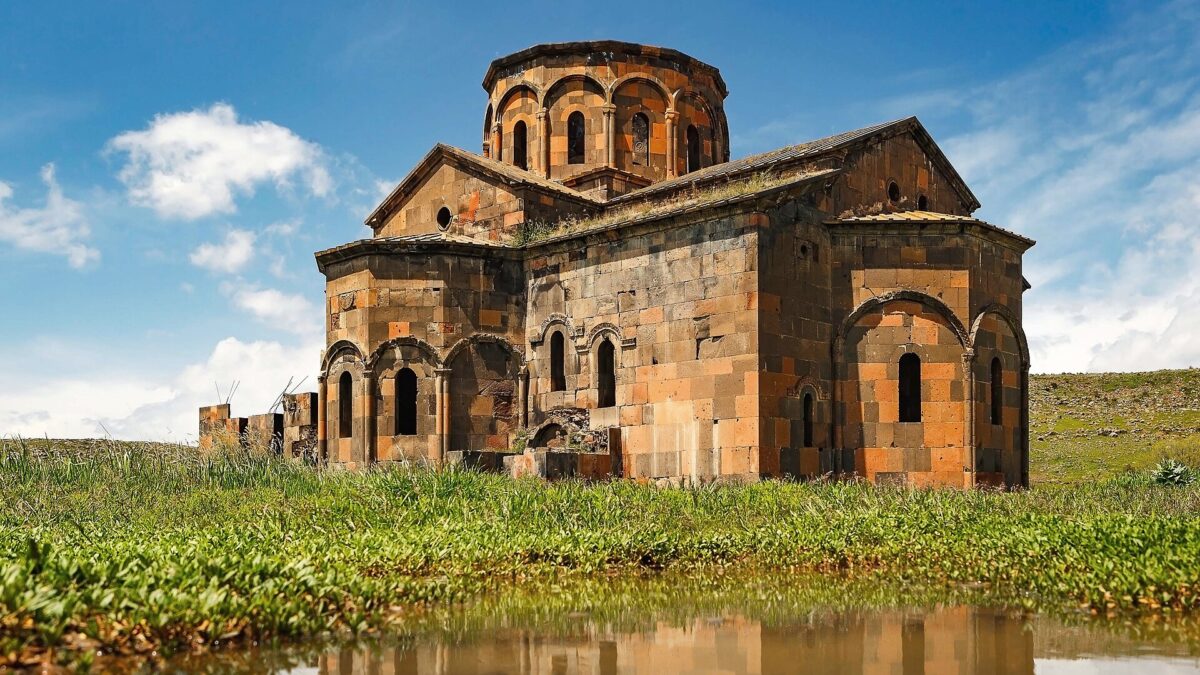
Talin Cathedral (Katoghike) is a 7th-century domed basilica on the northern edge of Talin, a small town of about 3,900 people on the Yerevan–Gyumri highway in Aragatsotn province, 68 km from the capital. It was one of the biggest churches of early medieval Armenia and is now a stabilised ruin: the dome and south-west corner fell in earthquakes between 1840 and 1931. The reason to come is what the shell still holds: fragments of wall paintings from the 600s, among the oldest church frescoes in the country, plus a tiny, nearly intact 7th-century church 200 m away with an inscription naming the prince who paid for it. Both sit in a working cemetery full of medieval khachkars, and nobody charges you to walk in.
Who built it: the Kamsarakans and 7th-century Armenia
The 600s were a strange, productive century for Armenian building. Persian rule collapsed, Byzantium and the Arab Caliphate fought over the country, and the princely houses played both sides while putting up domed churches on a scale not seen again for 300 years. Talin was the work of the Kamsarakans, lords of Shirak and Arsharunik, whose fortresses included Ani and Bagaran. The family was consistently pro-Byzantine, which is why their leading member Nerseh carries Byzantine court titles in his inscriptions; historians generally identify him with the Nerseh Kamsarakan whom Emperor Justinian II installed as presiding prince of Armenia in 689–691.
The cathedral carries no foundation inscription, so its date rests on style and one indirect clue. The American University of Armenia’s heritage survey (armeniahiddengems.aua.am) reports a black-ink note on the plaster of one fresco saying the painting was done on the initiative of a churchwarden named Movses in 642–646, which would put construction around mid-century. The Courtauld Institute’s “Crossing Frontiers” catalogue instead places it in the second half of the 7th century on architectural grounds. The honest range is 640s–690s. The earliest dated text on the building is a generation later: an inscription on the south-east facade recording that a monk named Ughtatur and his brother Tuti brought water to Talin in Armenian year 232, i.e. 783–784. Later donation inscriptions by the Bagratunis, who took over after the Kamsarakans faded in the late 700s, are also cut into the walls.
The cathedral: plan, the lost dome, what survives
Talin is filed as a “domed basilica”, but the plan is odder than the label. From the west you enter a three-aisled, barrel-vaulted nave. East of the crossing the building turns into a trefoil: three apses to the east, north and south, semicircular inside and five-sided outside. The dome stood almost at the centre on four free-standing piers, with a twelve-sided drum above. The AUA survey counts five entrances, some with porches in the style of Zvartnots, the great round cathedral built in the same decades near Echmiadzin. Look for the same vocabulary here: vine scrolls, acanthus, pomegranates, a carved bear. The facing is cut tuff in alternating red and black blocks per the Courtauld catalogue; in flat midday light the reds read orange-pink, but the two-tone banding is the thing to look for.
The earthquakes
The sources disagree on which earthquakes did the damage:
- The AUA survey: 1840 and 1926 destroyed the dome and south-west section.
- The Courtauld catalogue: damage in 1840, 1919 and 1931.
- Armenia’s official tourism board (armenia.travel): 1840 and 1931.
Everyone agrees on 1840, the great Ararat earthquake; 1926 is plausible too, since the Leninakan (Gyumri) earthquake of 22 October 1926 reached intensity IX only 50 km north. Soviet engineers stabilised the ruin in 1947, and a campaign in the early 1970s (1970–74 or 1972–76 depending on the source) rebuilt the lower drum and arches, which is why it reads as a coherent shell rather than a heap. That work also uncovered the foundations of a separate single-nave basilica beside the cathedral (the low walls in the grass), and in 2001 an underground tomb under its floor.
The frescoes
Go straight to the east apse. Early Armenian churches were painted inside far more often than today’s bare stone suggests, but almost none survived; Talin is one of three or four places (with Aruch and Lmbat) with 7th-century painting in situ. The best-preserved piece, in the semi-dome, is a “Christ in Majesty” with an unusual twist: instead of Christ on the throne, the painter showed an empty cushioned throne with an open Gospel on it. Around the apse are the remains of a row of apostles, and on the lower walls fragments of scenes from the life of Christ, notably the Entry into Jerusalem; the AUA survey also records an Ascension. Colours have faded to ochre, red and grey-blue; binoculars or a zoom lens help. Also look down: the floor is laid in concentric rings ending in a pit under where the dome was, an arrangement the AUA survey flags as unusual.
The small Surb Astvatsatsin church
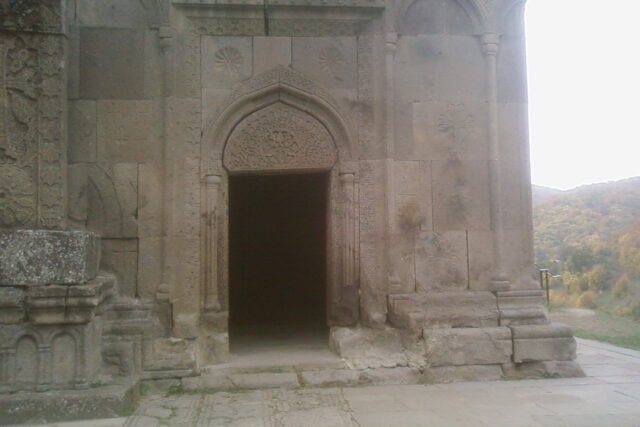
Walk 200 m south-east from the cathedral, towards the cemetery entrance, and you reach a church you could almost put your arms around. St Astvatsatsin (Holy Mother of God), also called the Kamsarakan church, is cross-shaped and centrally planned, with an octagonal drum pierced by four small windows under an umbrella roof. Unlike its big neighbour it is essentially complete. The AUA survey dates it to the last quarter of the 7th century, consistent with Nerseh’s prominence in the 680s.
The inscription is the point. In translation: “I Nerseh the patrician proconsul, lord of Shirak and Asharunik, built this church in the name of the Holy Mother of God for her intercession for me and my wife Shushan and Hrapat my son.” Named, with family, in Byzantine court titles: that is rare for the period, and it is the main reason scholars are confident about the Kamsarakan attribution for the whole site.
Khachkars, cemetery, caravanserai
Both churches stand in Talin’s old cemetery, in use since the early Middle Ages and still taking burials. Between the modern headstones are dozens of medieval markers: khachkars (cross-stones) of the 12th–17th centuries, horizontal slab graves and some earlier stelae. None are labelled. North of the cathedral the ground rises to Julhak Blur (“Weaver’s Hill”), where the AUA survey notes scattered ruins of a pre-Christian fortress.
The caravanserai is a separate stop, 2–3 km south of the centre on the Dashtadem road. It is 13th-century, from when the Zakarid princes rebuilt the Dvin–Ani trade road and lined it with inns; Aruch’s caravanserai is a sibling. The plan was two three-aisled halls with a square courtyard between them ringed by arched trading rooms and corner towers (armenia.travel; armeniadiscovery.com). It is badly ruined: you can trace the walls and the springers of the vault arches, not much more. Ten minutes is enough.
Getting there
Talin is on the M1, the main Yerevan–Gyumri highway, 68 km north-west of Yerevan by road and roughly 55 km south of Gyumri. The cathedral is on the north edge of town: follow the main street north until it ends at the cemetery, where there is unpaved space to park. No fee.
| Option | Time | Notes |
|---|---|---|
| Own car / rental from Yerevan | 1 h 10–1 h 20 | Dual carriageway to Ashtarak, then good two-lane road. Lets you chain Aruch, Mastara and Dashtadem. |
| Marshrutka from Kilikia Central Bus Station, Yerevan | About 1 h 40 (Transport for Armenia) | Direct minibuses; Gyumri-bound services also pass through. Budget up to ~1,000 AMD; last return mid-afternoon, confirm at the station. |
| From Gyumri | About 1 h | Yerevan-bound marshrutkas drop you on the highway at Talin; 15-minute walk to the cathedral. |
| Taxi / GG from Yerevan | 1 h 15 | Roughly 12,000–18,000 AMD one way; agree a waiting fee. |
To see more than the cathedral, drive: the satellite sites are spread over 25 km and public transport between them is effectively nonexistent. See our car rental and driving guide.
The Aragatsotn mini-route: Aruch, Talin, Mastara, Dashtadem
Every site below is on or within 10 km of the M1. Outbound from Yerevan:
| Stop | What it is | Time on site |
|---|---|---|
| 1. Aruch (Aruchavank), ~45 km from Yerevan, just off the M1 | The largest “domed hall” church of early Armenia, built 662–666 for Prince Grigor Mamikonian and his wife Heghine per its inscriptions. Dome collapsed, 7th-century apse frescoes, excavated palace with a stone throne, 13th-century caravanserai across the road. | 45 min |
| 2. Talin, ~23 km further | Cathedral, St Astvatsatsin, cemetery, then the caravanserai on the way south. | 1 h 15 |
| 3. Dashtadem fortress, ~7 km south of Talin | One of Armenia’s largest fortresses: a 10th-century core, later semicircular towers, a Kufic inscription of 1174 naming the Shaddadid ruler of Ani, and an octagonal outer wall. Heavily restored inside; outer walls original. | 45 min |
| 4. Mastara, ~10 km north-west of Talin on the M1 | St Hovhannes, a four-apse (tetraconch) church with one of the widest early domes in Armenia. Dated 5th or 7th century depending on whom you read; the link to Bishop Theodoros Gnuni, at the Council of Dvin in 648, is the usual argument for the 600s. | 30 min |
Round trip from Yerevan is about 190 km, 3 to 3.5 hours of driving; leave by 9 and you are back by 5. Heading on to Gyumri, keep going north from Mastara, 45 minutes away. For how these rank against the famous monasteries, see our monasteries overview.
When to go, and the light
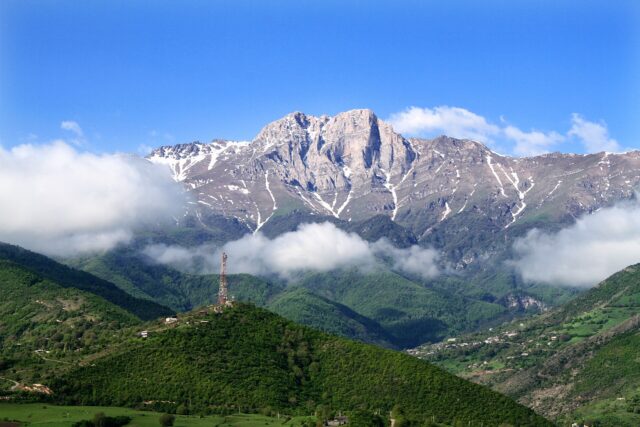
The cathedral stands at about 1,600 m on open steppe with Mount Aragats filling the eastern sky, and there is no shade. May–June and September–early October are comfortable; July and August are hot and glary by late morning; winter brings wind and snow on the Gyumri road. For the stone, come late: the tuff goes flat at noon and glows after 5 pm. For the frescoes, come late morning, when the east apse gets its best indirect light through the open roof.
Practical notes
- Open-air, no gates, ticket, staff or hours. Confirm locally if anything has changed.
- It is an active cemetery: keep off recent graves, keep quiet if a burial is in progress, don’t climb the medieval slabs.
- No toilets; the cafes on the main street are the option.
- Fencing comes and goes inside the cathedral as restoration stops and starts; the frescoes are visible from the crossing even when the apse is barred.
- Closed shoes: loose stone, nettles and long grass between the graves. No interpretation panels; download a map first.
- Allow 75 minutes for cathedral, small church and cemetery; add 15 for the caravanserai.
Last verified: October 2026.
Worth the stop?
Yes, with a condition. If your interest in Armenian churches is casual, Talin will look like a big ruin in a graveyard; give the hour to Aruch instead. If you care about early medieval architecture, or about seeing paintings from the 600s in the building they were made for, Talin is one of the three or four most important sites in the country and absurdly under-visited. The honest caveat is that it takes some imagination. Hold the plan in your head, find the empty throne with the open book in the apse, and the place opens up.
Frequently asked questions
Is there an entrance fee or opening hours for Talin Cathedral?
No. The cathedral, the small St Astvatsatsin church and the medieval cemetery are an open-air site with no gates, tickets or staff, accessible at any time. The caravanserai south of town is likewise unfenced. If a restoration campaign is under way parts of the cathedral interior may be fenced off; confirm locally.
When was Talin Cathedral built and when did the dome fall?
It was built in the 7th century by the Kamsarakan princes; sources place it between the 640s (a fresco inscription dated 642–646) and the second half of the century. The dome and south-west corner collapsed in earthquakes: all sources agree on 1840, and then variously name 1919, 1926 or 1931 for the later damage. The drum was partly rebuilt in the 1970s.
How do I get from Yerevan to Talin without a car?
Direct marshrutkas (minibuses) leave Yerevan’s Kilikia Central Bus Station for Talin, taking about 1 hour 40 minutes; Gyumri-bound services also pass through Talin on the M1. The cathedral is a 15-minute walk north from the highway through the town. Check return times at the station, since the last minibus back leaves mid-afternoon.
Can I combine Talin with other sites in one day?
Yes. Aruch (7th-century domed hall with frescoes), Talin, Dashtadem fortress and Mastara’s tetraconch church all lie on or within 10 km of the Yerevan–Gyumri highway and make a 190 km round-trip day from Yerevan with a car, roughly 3.5 hours of driving. It also works as a scenic route to Gyumri.
Featured image: Haykhove, CC BY-SA 4.0 — via Wikimedia Commons.