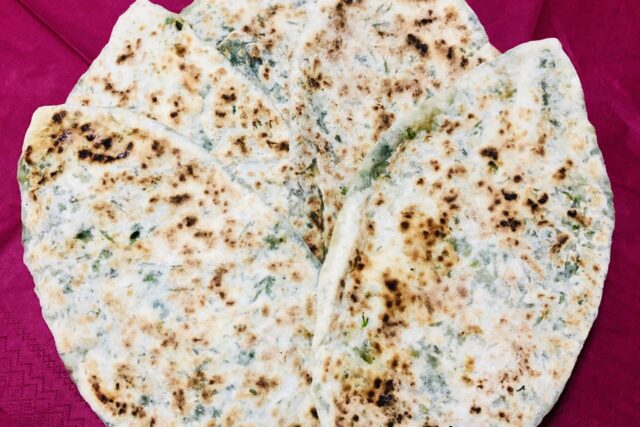
Armenian gata (also spelled kata or gyata) is a sweet enriched bread that sits somewhere between a pastry and a cake. Most versions are a round, golden disc of soft dough wrapped around a crumbly sweet centre called khoriz — flour toasted with butter and sugar — and the top is often scored or stamped into a pattern before baking. You will run into it most memorably as a warm, homemade slab sold by women at the roadside stalls outside monasteries like Geghard.
If you only try one Armenian sweet on a trip, gata is the one you are most likely to be handed without asking. It turns up in bakeries, at family tables, and beside coffee across the country, and it changes shape and name from region to region. Here is what it actually is, how the varieties differ, and where to buy the good stuff.
What is gata, exactly?
Gata is a baked sweet made from an enriched wheat dough — flour, butter, sugar, and usually egg, milk, or yoghurt — that is far less sweet than a Western cake but richer than a plain loaf. What makes it distinctly gata is the khoriz: a filling of flour cooked down with butter and sugar until it turns into a sandy, buttery crumb. That filling is spread inside the dough, which is then folded, rolled, and baked until deep gold.
Not every gata is filled. Some are made as a plain enriched bread with the sweetness worked into the dough itself, and the decorated top does the talking. That variability is the point — gata is a category, not a single fixed recipe, which is why two Armenians can describe it quite differently and both be right.
It also helps to know what gata is not. Despite sometimes being translated as “sweet cake”, it is not a light, sugary sponge. The texture is closer to a dense, tender bread or a thick shortbread, and the sweetness is restrained by dessert standards. If you arrive expecting frosting and fluff you may be underwhelmed; approach it as a rich, buttery bread and it makes far more sense. The spelling wanders too — kata and gyata are the same thing, transliterated different ways — so don’t be thrown when a menu or a stall sign uses a version you haven’t seen.
The khoriz filling
Khoriz is the heart of a filled gata. In its simplest form it is flour, butter, and sugar rubbed and toasted together into a crumbly, almost shortbread-like mixture. Bakers vary it: some add vanilla, some fold in ground walnuts, and richer holiday versions lean heavier on butter. When a gata is cut, a good khoriz shows as a distinct sweet, slightly grainy layer running through the soft bread around it.
The decorated top
Part of gata’s identity is visual. Before baking, the top is brushed with egg for shine and then marked — scored with a fork or knife into a lattice or radial pattern, or pressed with a carved wooden stamp. In some households and villages the patterns carry meaning, and a large festive gata can be a small piece of edible folk art. If you photograph one thing at a monastery stall, make it the stamped top.
What are the regional varieties of gata?
Gata is not one recipe but a family of them, and the differences are regional. The names, shapes, and fillings shift as you move around the country, so what a baker in one town calls gata can look quite unlike another’s.
- Filled disc gata — the version most travellers meet: a round, thick disc of dough with a sweet khoriz centre and a scored or stamped top. This is the classic monastery-stall style.
- Karabakh-style gata — associated with the Armenian communities of that region, often made thinner and layered, folded so the sweet filling runs in ribbons through flaky dough rather than sitting as one central pocket.
- Ararat-plain / valley styles — some areas favour a simpler, less heavily filled gata that reads more as a lightly sweet enriched bread, relying on the dough and the decorated crust rather than a thick khoriz core.
- Nut gata — versions where ground walnuts are worked into the khoriz for extra richness and texture, common in home baking and around holidays.
Treat these as broad families rather than strict rules. Recipes are passed down at home, so the “correct” gata is usually whichever one someone’s grandmother made. If a stall or bakery has more than one type on show, ask which is filled and which is plainer, and buy a piece of each — they are cheap enough to compare.
Where can you buy gata fresh?
The most rewarding place to buy gata is at the informal stalls run by local women outside popular monasteries, above all at Geghard, the UNESCO-listed rock-cut monastery east of Yerevan. Vendors set up along the approach and in the parking area, selling large rounds of gata baked that morning, often still warm. You will find similar sellers around Garni, the nearby Greco-Roman temple, and at roadside pull-offs along the route between the two.
Geghard and Garni sit about 10 km apart, roughly 40 km east of Yerevan, and are almost always visited together on the same trip — which makes gata an easy thing to fold into that day out. See our Garni Temple and Geghard Monastery guide for how to combine them, and our day trips from Yerevan guide for getting there by marshrutka or taxi.
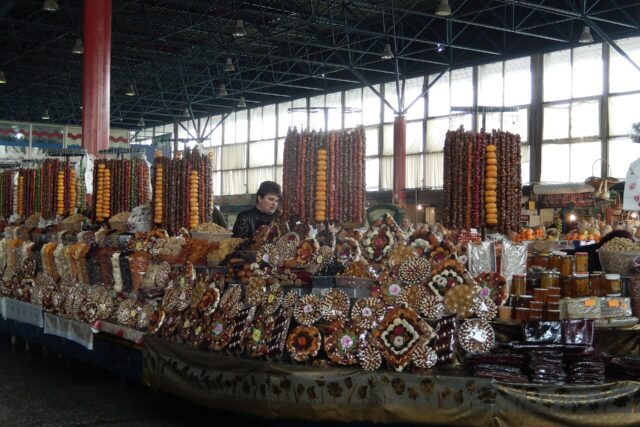
Beyond the monastery stalls, gata is sold at bakeries and grocery shops across the country and stacked high at market stalls, so you do not need a monastery to find it. But the stall gata has an appeal the shrink-wrapped supermarket version does not: it is handmade, sold by the person who baked it, and often warm.
A note on money: prices at informal stalls are set by the seller, vary by size, and are usually paid in cash, so carry small Armenian dram notes and expect no fixed menu. We do not quote a set price here because there isn’t one — it depends on the size of the round you buy.
How is gata eaten?
Gata is an everyday sweet, most often eaten with a hot drink rather than as a plated dessert. The natural pairing is Armenian coffee — thick, unfiltered, served in a small cup — or a cup of tea. Its mild sweetness and dense crumb are built for dunking and for a slow mid-morning or afternoon break, which is exactly how the monastery stalls intend it: buy a piece, break it, share it.
Because it keeps well for a few days, gata also travels. A wrapped round is a practical thing to buy at Geghard and carry back to Yerevan, and it is a common host gift when visiting someone’s home. If you want to place it among Armenia’s other sweets, our Armenian desserts and sweets guide covers churchkhela, sweet sujukh, and the rest, and gata gets its short mention in the broader Armenian food guide alongside the savoury classics.
The New Year coin custom
Gata carries meaning beyond the everyday. It appears at celebrations and holidays, and in some Armenian homes a coin is baked into a festive gata at New Year — whoever gets the slice with the coin is promised good luck for the year ahead. It is a household tradition rather than a universal rule, so you are far more likely to meet it at a family table than in a shop, but it is part of why gata is a celebratory bread and not just a snack.
This ties gata to the wider role of bread in Armenian culture, where the tonir-baked flatbread lavash was added to UNESCO’s list of intangible cultural heritage. Gata is the sweet cousin in that same bread tradition — dough treated as something worth decorating, sharing, and marking occasions with.
A few honest tips
- Buy it warm if you can. Gata is at its best fresh from the oven; the monastery-stall version has the edge over anything wrapped in plastic precisely because it is baked that day.
- Ask filled vs plain. If you want the classic sweet-centre experience, confirm the piece has khoriz — some rounds are the plainer enriched-bread style.
- Bring small cash. Stalls are cash-only with no set price list, so small dram notes make the transaction painless.
- Pair it, don’t rush it. Gata is a coffee-break bread, not a rich dessert. Eat it the way locals do — with a hot drink and no hurry.
Gata is one of those foods that tells you something about a place. It is unfussy, generous, handmade, and everywhere — the kind of thing sold by a woman outside a 13th-century monastery who baked it that morning. That is worth more than any polished patisserie box, and it costs the price of a coffee.
Last verified: September 2026.
Sources
- Armenia Travel (armenia.travel) — official national tourism portal, Armenian cuisine and Geghard/Garni destination information.
Frequently asked questions
What is Armenian gata?
Gata (also called kata or gyata) is a sweet enriched bread, usually a round golden disc of soft dough wrapped around a crumbly sweet filling called khoriz, made from flour toasted with butter and sugar. The top is typically scored or stamped into a pattern before baking. Some versions are plainer, with the sweetness in the dough rather than a filling.
What is khoriz?
Khoriz is the sweet filling at the heart of a filled gata. It is flour cooked with butter and sugar until it becomes a sandy, buttery crumb, sometimes with added vanilla or ground walnuts. When you cut a gata, the khoriz shows as a distinct sweet, slightly grainy layer inside the soft bread.
Where can I buy gata in Armenia?
The most memorable place is the informal stalls run by local women outside Geghard Monastery, and similar sellers around Garni temple and along the road between them, where rounds are often sold warm. Gata is also widely available at bakeries, grocery shops, and market stalls across the country.
How much does gata cost?
There is no fixed price. At monastery stalls, gata is sold by size, set by the seller, and paid in cash, so carry small Armenian dram notes. Shop and supermarket versions have set prices, but the handmade stall gata is priced individually.
How is gata eaten?
Gata is an everyday sweet eaten with a hot drink, most often thick Armenian coffee or tea, as a mid-morning or afternoon break. It keeps for a few days, so it also travels well and is a common gift to bring when visiting someone’s home.
Why is a coin baked into gata at New Year?
In some Armenian homes a coin is baked into a festive gata at New Year, and whoever gets the slice with the coin is said to have good luck for the coming year. It is a household tradition rather than a universal one, and it reflects gata’s role as a celebratory bread.
Featured image: Armineaghayan, CC BY-SA 4.0 — via Wikimedia Commons.