Armenian street food is cheap, savoury and almost always wrapped in or built on flatbread. The quick eats you’ll actually find on the street run from herb-packed jingalov hats and thin meat-topped lahmajun to lavash-wrapped khorovats, sweet gata from bakeries, and cream-filled ponchik. Most of these cost roughly 1,000–3,000 AMD (about USD 3–8, prices approximate), which makes grazing your way through Yerevan one of the best-value things you can do in Armenia.
This isn’t a country with a huge hot-dog-cart culture. Armenian “street food” is really a mix of market stalls, tiny bakeries, hole-in-the-wall grills and seasonal carts. Below are the specific things worth eating, what each one actually is, and the honest places to find them — without naming vendors we can’t verify. For the bigger picture, see our full Armenian food guide.
What counts as street food in Armenia?
Armenian quick eats cluster into four groups: stuffed and topped flatbreads (jingalov hats, lahmajun), lavash wraps built around grilled meat, bakery snacks (gata, cheese pastries, ponchik), and seasonal cart food (corn, roasted seeds, churchkhela). The common thread is lavash — the thin tonir-baked flatbread on UNESCO’s Intangible Cultural Heritage list since 2014 — which does the work of a plate, a wrap and a utensil all at once.
Because so much is flatbread-based, portions are easy to eat one-handed and easy to share. Two or three items make a proper meal for well under the price of a sit-down restaurant main.
Jingalov hats — the one to try first
Jingalov hats (also written zhingyalov hats) is the standout. It’s a thin flatbread folded around a generous filling of chopped herbs and wild greens — often more than a dozen different leaves — then dry-cooked on a griddle until the outside blisters. It’s completely meat-free, which makes it a reliable pick for vegetarians.
The dish comes from Nagorno-Karabakh and the southern Syunik region, where the wild greens grow, but it has become common in Yerevan over the last decade. You’ll find it at market stalls and small specialist spots rather than fancy restaurants. It’s usually one of the cheaper hot items you can buy, and it travels well as a walking snack. If you eat one thing off this list, make it this.
Why it works as street food
- Naturally vegetarian and fairly light.
- Cooked to order in a couple of minutes.
- Easy to eat folded, on the move.
- A genuinely regional dish, not a generic import — real information gain for your trip.
Lahmajun — Armenia’s answer to pizza
Lahmajun is a very thin round of dough spread with a layer of spiced minced meat, tomato and herbs, then baked fast in a hot oven. It comes out crisp at the edges and soft enough to roll up. Armenians often squeeze lemon over it, add fresh parsley, roll it tight and eat it by hand. People sometimes call it “Armenian pizza,” though it’s closer to a thin savoury flatbread than anything with cheese.
It’s a bakery-and-canteen staple, cheap, and filling for its size — order two if you’re hungry. It sits in the same casual price band as other quick eats, roughly 1,000–3,000 AMD depending on the place and size (approximate).
Khorovats and lavash wraps
Khorovats — Armenian barbecue — is the national favourite, and while a full khorovats plate is a sit-down affair, the street version is a wrap: grilled pork, chicken or vegetables rolled in warm lavash with onions, herbs and sometimes a smear of sauce. It’s the closest thing Armenia has to a fast grab-and-go grill. For the full story on the barbecue itself, see our khorovats guide.
Grilled vegetables (aubergine, pepper, tomato) also get the lavash-wrap treatment, so there’s usually a meat-free option if you ask.
Bakery snacks: gata, cheese pastries and ponchik
Armenian bakeries are where a lot of the best cheap eating happens. A few things to look for:
- Gata — a sweet, slightly flaky pastry with a buttery sugar-flour filling. Sold plain or decorated, it’s the classic bakery treat and a good cheap snack with coffee.
- Cheese and greens pastries — lavash or dough folded around cheese, or cheese with herbs, then baked. Simple, warm, and very cheap.
- Ponchik — a soft doughnut filled with pastry cream or custard, dusted with sugar. It’s a beloved sweet street snack, especially good fresh and still slightly warm.
Bakery items are usually the cheapest way to eat in Armenia, often at the bottom of that 1,000–3,000 AMD range or below (approximate).
Cart food and market sweets
Seasonal carts appear around parks, squares and viewpoints, especially in warmer months:
- Corn on the cob — boiled or grilled, sold from carts, a summer standby.
- Roasted seeds and nuts — sunflower seeds and roasted nuts sold by weight; a cheap thing to nibble while you walk.
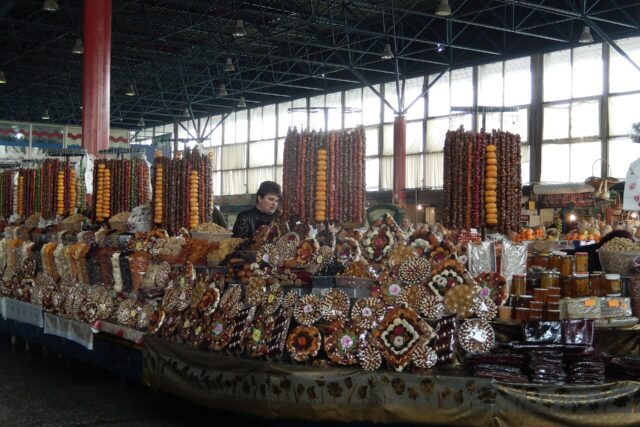
- Churchkhela and sweet sujukh — strings of walnuts (or other nuts) dipped repeatedly in thickened grape must, then dried into a chewy sweet. Note this sweet sujukh is completely different from the meat sausage of a similar name. Sold hanging in colourful strings at markets and roadside stalls.
These are best treated as snacks rather than meals, but they’re part of the everyday street-eating texture of the country.
Where to find street food in Yerevan
A few reliable hunting grounds in the capital:
- GUM Market (Yerevan Food Market) — a covered market packed with dried fruit, nuts, cheese, churchkhela and stalls where you can eat and sample. Good for market sweets and picking up snacks.
- Vernissage — the big open-air weekend market (busiest Saturday and Sunday). Primarily crafts, but food stalls and nearby quick eats make it an easy grazing stop.
- Bakeries around the centre — small neighbourhood bakeries near Republic Square, the Cascade and the main avenues sell gata, cheese pastries, lahmajun and ponchik through the day.
- Seasonal carts — corn, seeds and ice cream carts cluster around parks, the Cascade steps and popular viewpoints in season.
A simple rule for finding the good stuff
Follow the queues of locals, and favour places where you can see the food being cooked to order — the lahmajun coming out of the oven, the jingalov hats hitting the griddle. That’s where freshness and turnover are highest.
Street food beyond Yerevan
Outside the capital, the pattern is similar but more local. In the south (Syunik) and toward Karabakh’s cultural sphere, jingalov hats is more of a homeland dish and easy to find. Towns like Goris and Gyumri have their own bakeries turning out gata and pastries, and roadside stalls on tourist routes sell churchkhela, honey, dried fruit and nuts. On day trips — heading to Garni, Geghard or Lake Sevan — you’ll pass roadside grills and fruit-and-snack stands rather than dedicated street-food streets.
Seasonality matters more here than in Yerevan. Cart food (corn, fresh fruit, cold drinks) is a warm-months thing, while bakeries and grills run year-round. If you’re travelling in winter, lean on bakeries and lavash wraps rather than expecting a lot of open-air stalls, and check market days in smaller towns — weekend markets are busiest and best stocked.
What to drink
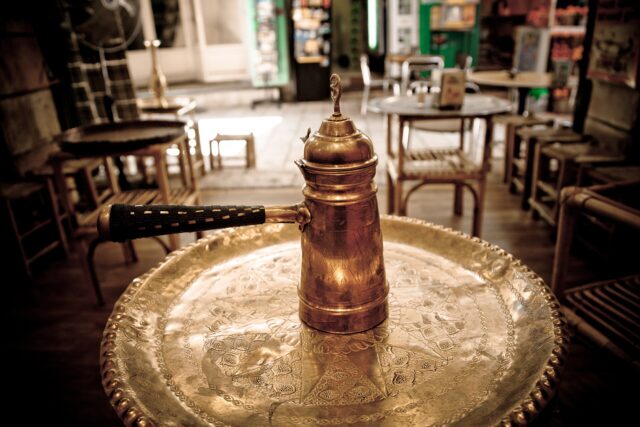
Two things pair naturally with a street snack. Tan is a salty, savoury yogurt drink (like ayran) that’s refreshing in the heat and cuts through fatty grilled food. Jermuk and other Armenian mineral waters — still and sparkling — are widely sold and cheap. Armenian coffee, served small and strong, goes with gata or a ponchik.
Vegetarian street food in Armenia
Vegetarians are reasonably well served on the street. Jingalov hats is the star meat-free option. Beyond it, look for grilled-vegetable lavash wraps, cheese-and-greens pastries, gata and other bakery sweets, corn on the cob, and market nuts and dried fruit. Armenia has a real meat-free “pasuts” (Lenten) tradition, so meatless dishes aren’t an afterthought. One honest caution: ask specifically for meatless (“pasuts”), since some fillings and stocks include meat. For a fuller rundown, see our vegetarian food in Armenia guide.
How much to budget
Street food is where Armenia’s low cost of eating shows most clearly. Most single items — a lahmajun, a jingalov hats, a lavash wrap, a bakery pastry — fall in a rough 1,000–3,000 AMD band (about USD 3–8 at roughly 370–385 AMD to the dollar; all figures approximate and worth reconfirming locally). Two or three items plus a drink still comes in well under the cost of a mid-range restaurant meal, which runs higher. For the full breakdown, see our Armenia budget guide.
Carry cash in small notes — market stalls and carts are cash-first even though card payment is common in Yerevan restaurants.
A practical grazing plan for one day
- Morning: a fresh ponchik or gata from a bakery with an Armenian coffee.
- Midday: one or two lahmajun, rolled with lemon and parsley.
- Afternoon: a jingalov hats as a walking snack, plus a tan to drink.
- Market stop: churchkhela, nuts and dried fruit from GUM Market to take away.
- Evening: a lavash-wrapped khorovats if you want something more substantial.
Do all of that and you’ve eaten well for a fraction of a single restaurant bill — which is the real appeal of Armenian street food.
Last verified: September 2026. Prices and market days can change; reconfirm locally.
Sources
- armenia.travel — official Armenia tourism portal (cuisine and destinations)
- Our own Armenian food guide and budget guide for cross-referenced 2026 prices
Frequently asked questions
What is the most famous Armenian street food?
Jingalov hats (also spelled zhingyalov hats) is the standout — a thin flatbread folded around a mix of chopped herbs and wild greens, dry-cooked on a griddle. It’s meat-free, cheap, and originally from Syunik and the Karabakh region, now common in Yerevan.
How much does street food cost in Armenia?
Most single items — lahmajun, jingalov hats, a lavash wrap or a bakery pastry — cost roughly 1,000–3,000 AMD (about USD 3–8 at ~370–385 AMD to the dollar). Figures are approximate; carts and markets are cash-first, so bring small notes.
Is lahmajun the same as pizza?
Not really. Lahmajun is a very thin flatbread topped with a thin layer of spiced minced meat, tomato and herbs, baked fast. It has no cheese and is usually rolled up with lemon and parsley and eaten by hand. People call it “Armenian pizza” loosely, but it’s closer to a savoury flatbread.
Where can I find street food in Yerevan?
GUM Market for nuts, dried fruit and churchkhela; the Vernissage weekend market for grazing; neighbourhood bakeries near Republic Square and the Cascade for gata, lahmajun and ponchik; and seasonal carts around parks and viewpoints for corn and roasted seeds. Follow local queues and pick places cooking to order.
Is there vegetarian street food in Armenia?
Yes. Jingalov hats is the best meat-free option, and you’ll also find grilled-vegetable lavash wraps, cheese-and-greens pastries, gata, corn on the cob, and market nuts and dried fruit. Armenia has a strong meatless “pasuts” tradition, but ask specifically for meatless, as some fillings and stocks use meat.
What should I drink with Armenian street food?
Tan, a salty yogurt drink, pairs well with grilled and fatty food. Armenian mineral waters like Jermuk are cheap and widely sold, and small, strong Armenian coffee goes with sweet bakery snacks like gata and ponchik.
Featured image: GeoO, CC BY-SA 4.0 — via Wikimedia Commons.