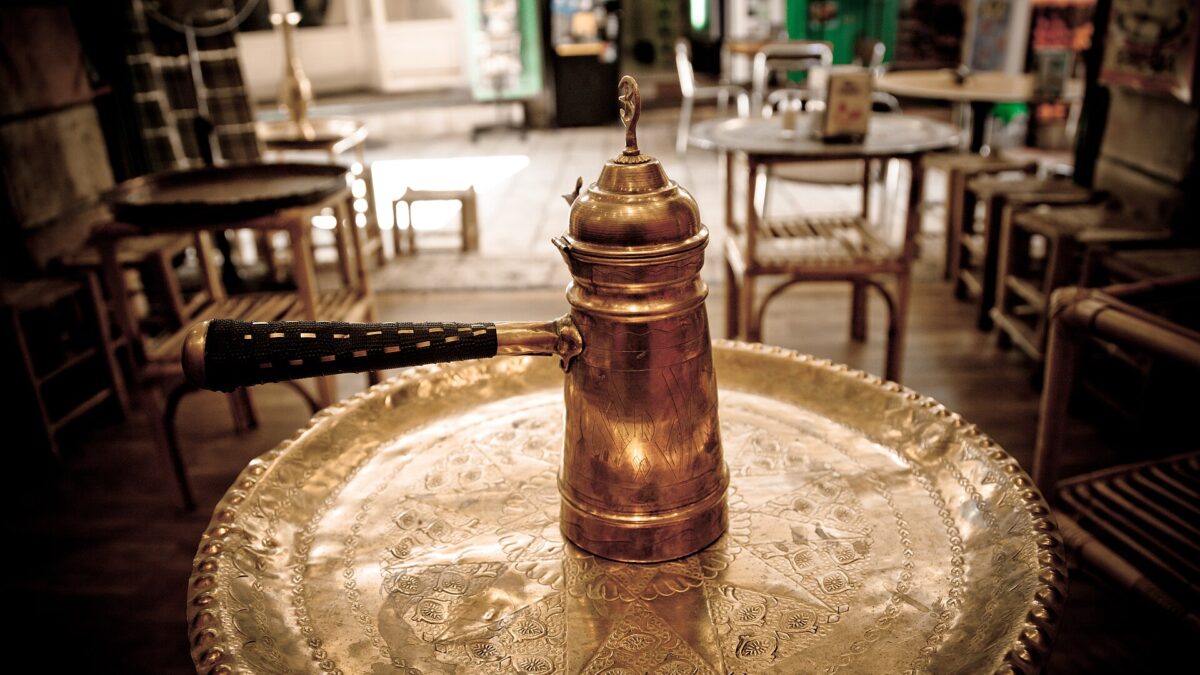
Armenian coffee, known locally as soorj, is a strong, finely ground coffee brewed unfiltered in a small copper pot called a jazve and served in tiny cups with the grounds left to settle at the bottom. Yerevan wraps this everyday ritual in one of the region’s busiest cafe cultures, where a coffee is less a caffeine hit than an invitation to sit and talk.
If you are planning where and what to eat and drink in the country, this pairs naturally with our Armenian food guide and the wider Food & Wine section. Below is how the coffee actually works, the fortune-telling habit that comes with it, and where to drink it in the capital.
What is Armenian coffee (soorj)?
Soorj is coffee ground to an almost powdery consistency, far finer than an espresso grind, then simmered with water (and sugar, if you want it) directly in the pot rather than filtered. The grounds are never strained out. You drink the liquid on top and leave the thick sediment behind, which is why the cups are small and the last sip is not meant to be swallowed.
Stylistically it belongs to the same regional family as Turkish and Greek coffee: the same fine grind, the same long-handled pot, the same unfiltered result. Armenians call the drink soorj and the pot a jazve (also spelled jazzve or cezve). Coffee reached the region several centuries ago through Ottoman and Persian trade and settled deep into daily social life, according to specialty roaster Henry’s House of Coffee. What makes the Armenian version its own thing is less the chemistry than the etiquette around it.
How is Armenian coffee made and served?
The method is simple to describe and easy to get slightly wrong. Into the jazve go cold water, a heaped teaspoon of very finely ground coffee per small cup, and sugar to taste. It is heated slowly over a low flame. As it warms, a layer of foam (the crema) rises toward the rim. The trick is to pull the pot off the heat just before it boils over, sometimes twice, so the foam builds without the coffee actually boiling. A copper pot is prized because copper spreads heat evenly and the narrow neck helps hold that foam, per the same roaster’s notes and brewing guides.
It is then poured straight into the cup, foam and all, and served immediately. A few points of custom that are easy to miss:
- Sugar goes in during brewing, not after. There is no spoon to stir at the table, so you choose sweetness when you order.
- The eldest or the guest is often served first as a gesture of respect.
- It usually arrives with something sweet on the side such as gata, chocolate or dried fruit, to offset the bitterness, and typically a glass of water.
- You wait a minute before drinking so the last of the grounds can sink.
Done properly it is dense and aromatic rather than bitter, and it is meant to be sipped slowly. Rushing it defeats the point. The foam is not decoration either; a good soorj is judged partly on whether the crema survives the pour intact, and coffee brought to a rolling boil is considered spoiled because the foam collapses and the flavour turns harsh.
In many households the same jazve does duty for one cup or six, and coffee is offered to anyone who walks through the door. Declining is unusual. If you are visiting family or a homestay outside Yerevan, expect a cup to appear within minutes of sitting down, often alongside dried apricots, walnuts or a slice of gata. Accepting it is part of the exchange, and it is the moment a visit properly begins.
What is Armenian coffee fortune-telling?
Once the cup is empty, the ritual is not over. In a widely practised tradition, the drinker turns the cup upside down onto the saucer and lets it cool. As the wet grounds slide down the inside of the cup, they leave a pattern of shapes and streaks, and a friend, relative or a practised reader interprets them, a custom often called tasseography. The reading is a social pastime, closer to a game played among friends than a solemn prediction, though some take it more seriously than others.
Certain symbols carry stock meanings. A guide from SupportArmenian notes that shapes like a snake are read as trouble or an enemy, while a flower suggests joy or good news, with roads, birds and hearts each carrying their own reading. Whether or not you believe any of it, being handed your cup to interpret is a genuine welcome into an Armenian household, and turning the cup over yourself marks you as someone who knows the custom.
Our honest take: treat it as the warm social ritual it is, not as tourist theatre to demand on cue. In a home it happens by itself; in a cafe it is not a menu item.
Why is Yerevan’s cafe culture so strong, and where do you go?
Yerevan runs on cafes. Coffee here is a reason to meet, and the city’s central streets are dense with places to sit outside for hours over a single cup. The official tourism board notes that cafes have clustered so heavily around the Cascade complex, Northern Avenue and streets like Mashtots, Abovyan, Tumanyan and Aram that they have become a driving force behind those areas’ popularity, per armenia.travel.
A few things worth knowing before you pick a spot:
- The Cascade and Northern Avenue are the showcase zones: pedestrianised, busy, full of terraces, and the easiest place to people-watch. Prices here run a little higher than side streets.
- The Old Town and Saryan Street (Yerevan’s informal “wine street”) lean more local and creative, with independent roasters mixed in.
- Two styles coexist. Traditional jazve soorj is served almost everywhere, but a modern specialty scene of espresso, flat whites and hand-dripped filter coffee has grown fast, so you can order either. Travel guides covering the city, including Absolute Armenia, map out both the old-style spots and the third-wave cafes side by side.
The mix is the appeal. You can drink a 600-dram soorj at a plastic table on a side street in the morning and a carefully weighed pour-over from a specialty roaster the same afternoon, sometimes within a block of each other. International chains have arrived too, including an Austrian Viennese-style brand with several branches around the centre, but the independent scene is where the character sits. What you rarely find is a takeaway rush. Even the modern cafes are built around staying, not grabbing and going, and outdoor seating stays busy from late morning well into the evening in the warmer months.
If you are building a wider city plan, our Yerevan travel guide covers these districts in detail, and coffee slots easily into the best things to do in Armenia. Vegetarian travellers will also find most cafes easy to navigate, something we cover in our vegetarian food in Armenia guide, and if you graduate from coffee to the local drinks scene, the Armenian wine guide picks up from there.
How do you order Armenian coffee, and what does it cost?
Ordering is about sweetness, chosen up front because there is no stirring at the table. Useful phrases, per ArmeniaInfo:
- No sugar — soorj arrants shakari
- Lightly sweet — kich shakarov soorj
- Medium sweet — mijin shakarov soorj
- Very sweet — shat shakarov soorj
“One coffee, please” is mek soorj, khntrem. If you want a modern espresso-style drink instead, plain English works in almost any central Yerevan cafe.
On price, a coffee in Yerevan runs roughly 500–1,000 AMD (about USD 1.35–2.70 at roughly 370 AMD to the dollar in 2026), with traditional soorj usually at the lower end and specialty flat whites or imported-bean drinks at the top. Last verified: July 2026 — treat these as approximate and expect Cascade and Northern Avenue terraces to sit slightly above neighbourhood cafes.
| Item | Rough price (2026) | Notes |
|---|---|---|
| Traditional soorj (jazve) | ~500–800 AMD | Small cup; cheapest and most authentic |
| Espresso / Americano | ~600–1,000 AMD | Widely available in central cafes |
| Flat white / specialty | ~800–1,200 AMD | Third-wave roasters, higher end |
Cards are accepted at most central cafes, but carry some cash for smaller spots. One honest call: do not judge the country by a rushed to-go cup. The point of soorj is the sitting, so give yourself half an hour and let the grounds settle before you decide what you think.
Prices from our Armenia fact base and cited guides; rates shift, so confirm locally.
Featured image: Michael Plutchok (CC BY-SA 3.0) via Wikimedia Commons