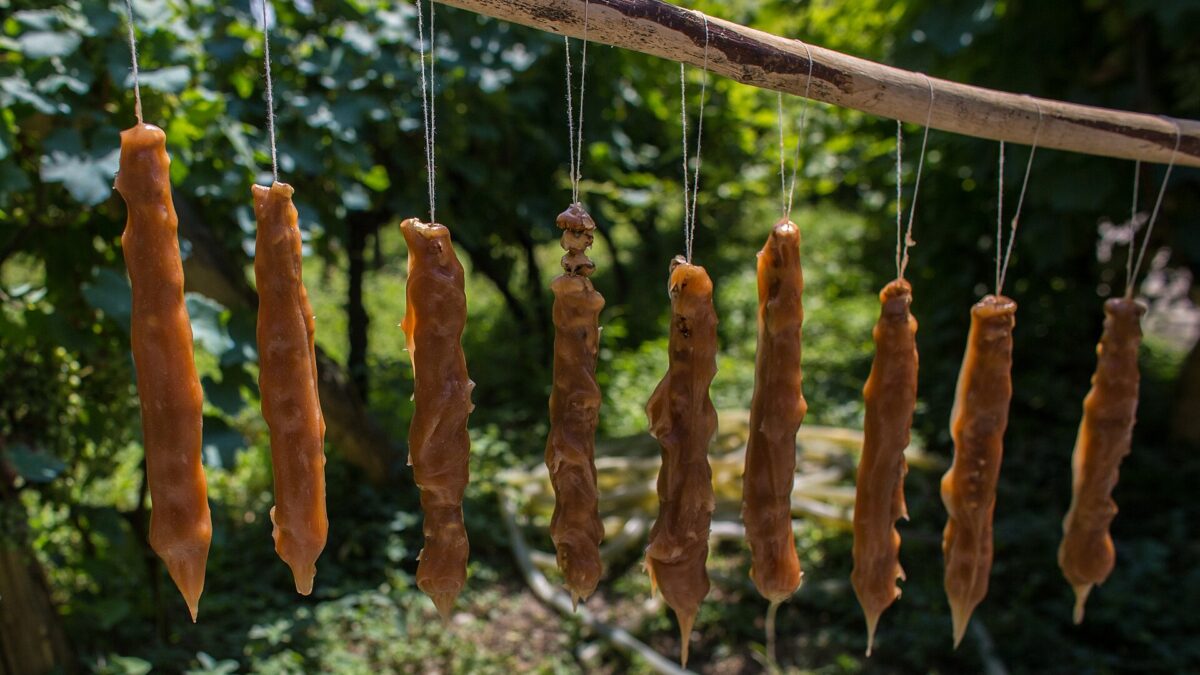
Armenian sujukh — also called sudzhukh or sharots, and known abroad by its Georgian name churchkhela — is a chewy autumn sweet made by threading shelled walnuts onto a string, then repeatedly dipping the string into thickened grape must (doshab) mixed with flour until it builds up into a firm, candle-shaped coating. The dipped strings are hung to dry for weeks, which sets the coating into a dense, leathery sweet that is high in energy and only mildly sugary. It is sold strung up in rows at markets and roadside stalls, most abundantly at grape harvest.
It is the sweet you see hanging like coloured candles at Yerevan’s Vernissage and the GUM market, and along highways in wine country every autumn. Below is what it actually is, how it is made, the one name mix-up worth clearing up before you order, and where to buy it.
What is Armenian sujukh?
Sujukh is a fruit-and-nut confection built around two things Armenia has in abundance: walnuts and grapes. Walnut halves are threaded onto a length of cotton thread to make a long garland. That garland is dipped, again and again, into a hot, thickened mixture of concentrated grape juice and flour. Each dip adds a layer; as the layers cool and set between dips, the string of nuts turns into a smooth, sausage-shaped bar. It is then hung up to air-dry, sometimes for several weeks, until the outside is firm and the texture is chewy rather than sticky.
The taste is not what most people expect from a “sweet”. The sweetness comes only from the grapes, so it is restrained — more like a dense fruit leather wrapped around crunchy nuts than a sugary candy. Because it is packed with nuts and concentrated grape sugars and keeps for a long time without refrigeration, it has historically been a traveller’s and shepherd’s food: compact, durable, and calorie-dense. That is also why it turns up on hiking-snack lists today.
The role of doshab and grape must
The coating starts as grape must — freshly pressed juice from the harvest — boiled down into a thick, dark syrup. In Armenia this reduced grape syrup is called doshab (rojik and sharots recipes lean on the same base). To make the dipping paste, the must or doshab is heated and thickened with flour into something between a batter and a custard, so it clings to the nuts in layers instead of running off. The proportion of flour, the number of dips, and the drying time are what separate a thin, glossy sweet from a fat, matte one. There is no single fixed recipe; it is a home and market craft passed down rather than standardised.
There is a practical logic to it, too. Sujukh is very much a product of the wine harvest — a way of using the season’s grape juice and turning it into something that lasts through winter. In an old farming rhythm, nothing from the pressing went to waste: the grapes became wine, the boiled-down must became doshab for the pantry, and the same syrup was put to work coating strings of nuts. That is why sujukh, doshab, and Armenian winemaking all sit in the same autumn moment, and why you’ll often see jars of dark grape syrup for sale on the same stall as the hanging strings.
Sujukh the sweet vs sujuk the sausage — don’t confuse them
This is the mix-up worth getting right. The word sujukh / sudzhukh used for this walnut-and-grape sweet sounds almost identical to sujuk (also spelled soujouk or sujuk), which is a completely different food: a dry, spiced, cured beef sausage eaten across Armenia, the Caucasus, Turkey, and the Middle East. One is a dessert made of nuts and grape juice; the other is a savoury garlicky sausage. They share only a similar-sounding name. If you ask a market vendor for “sujukh” and want the sweet, it helps to point — or use the name sharots or churchkhela — so you don’t end up with the sausage. To keep it straight: the sweet is nuts on a string dipped in grape syrup; the sausage is cured meat.
Is churchkhela Armenian or Georgian?
Both, and neighbours besides. The exact same sweet — nuts threaded on string and dipped in thickened grape must — is made across the South Caucasus and beyond, under different names. Armenians call it sujukh, sudzhukh, or sharots; Georgians call it churchkhela, which is the name most travellers have heard because Georgia markets it heavily to tourists. Similar versions exist in Azerbaijan, Turkey, Cyprus, and Greece. Rather than argue over ownership, it is more accurate to treat it as a shared regional sweet with a strong, genuine Armenian tradition of its own, tied to Armenia’s ancient grape-growing and winemaking culture in regions like Areni and the Ararat plain. When you see “churchkhela” on a sign in Yerevan, it is the same thing as sharots — the vendor is simply using the name foreign visitors recognise.
When is sujukh made and sold?
Sujukh is an autumn food at heart, because it depends on fresh grape must from the harvest. Grapes come in from roughly September into October, the must is pressed and reduced, and the dipping and drying happen in the weeks that follow. September is Armenia’s single best travel month — dry, golden, and lined up with the wine harvest — so a September or October trip is when you will see the most sujukh being made and hung out, and when roadside production is in full swing. See our guide to the best time to visit Armenia for how the seasons compare.
That said, because dried sujukh keeps for months, you will find it for sale year-round at Yerevan’s markets and souvenir stalls. It just tastes freshest, and comes in the widest variety, close to harvest.
Where can you buy sujukh in Armenia?
The easiest place for a visitor is central Yerevan:
- Vernissage market — the big open-air weekend market near Republic Square. Among the crafts and souvenirs you will find food stalls selling strings of sujukh in several colours, alongside dried fruit and nuts. Good for buying a few strings to take home.
- GUM Market (Yerevan’s covered food market) — a working produce market where vendors sell sujukh by the string next to dried fruit, spices, and cheeses. Prices here tend to be more everyday than at tourist-facing stalls, and you can often taste before you buy.
- Roadside stalls in wine country — drive south toward Areni and Vayots Dzor, or through grape-growing areas in autumn, and you will pass family stalls with rows of sujukh and jars of doshab hanging out front. This is the sweet at its most authentic and freshest. Our Noravank and Areni guide covers that route, and the Areni wine guide explains why this is Armenia’s grape heartland.
Sujukh also appears in supermarkets and airport shops in vacuum-packed form, which is convenient for gifts but firmer and less fresh than a string bought at market. On prices: we don’t quote a set figure because sujukh is sold by the string and by weight, varies with size and nut content, and is usually paid in cash — so carry small Armenian dram notes and expect the price to depend on the piece you choose.
How to buy and eat it
- Check it’s fresh, not rock-hard. A good string bends and is chewy; one that has dried to a solid, brittle bar has been sitting a long time. Buy the pliable ones.
- Ask what’s inside. Walnuts are the classic filling, but you’ll also see versions with hazelnuts or almonds, and “rojik” made with walnut kernels in a flatter sheet. The colour comes from the grape variety and any spices, not artificial dye in the better ones.
- Slice it, don’t bite a whole bar. Cut it into rounds; each piece is a nut in a grape-syrup coating. It pairs naturally with tea, Armenian coffee, or a glass of the local wine it comes from.
- It travels well. Dried sujukh keeps for months without refrigeration, which makes it one of the more practical edible souvenirs to carry home.
If you want to place sujukh among the country’s other sweets, our Armenian desserts and sweets guide covers gata, dried fruit, and the rest, and it gets a mention alongside the savoury classics in the broader Armenian food guide.
Why sujukh is worth trying
Sujukh is one of those foods that sums up a place. It is made from two things Armenia has grown for thousands of years, it needs nothing but grapes, walnuts, flour, string, and patience, and it is sold by the people who make it. It won’t taste like the sugary candy the candle shape suggests — it is chewier, nuttier, and quieter than that — but that restraint is the point. Buy a fresh string at GUM or a roadside stall in autumn, slice it with your afternoon coffee, and you’re eating the harvest.
Last verified: September 2026.
Sources
- Armenia Travel (armenia.travel) — official national tourism portal: Armenian cuisine, sweets, and the autumn grape-harvest season.
Frequently asked questions
What is Armenian sujukh?
Armenian sujukh (also called sudzhukh or sharots, and known abroad as the Georgian churchkhela) is a sweet made by threading shelled walnuts onto a string and repeatedly dipping it into thickened grape must (doshab) mixed with flour, then drying it for weeks into a firm, candle-shaped bar. It is chewy, nutty, and only mildly sweet, closer to a fruit leather with nuts inside than a sugary candy.
Is sweet sujukh the same as the sujuk sausage?
No. The sweet sujukh (sudzhukh/sharots) is walnuts on a string dipped in grape syrup. Sujuk, soujouk, or sujuk is a completely different food: a dry, spiced, cured beef sausage. The names sound almost identical, so when buying the sweet at a market it helps to point or to use the name sharots or churchkhela to avoid getting the sausage.
How is sujukh made?
Walnut halves are threaded onto cotton string to make a garland. Fresh grape must is boiled down into a thick syrup (doshab), then heated and thickened with flour into a dipping paste. The nut string is dipped repeatedly, with each layer cooling and setting between dips, until it forms a smooth sausage shape. The strings are then hung to air-dry for weeks until firm and chewy.
Is churchkhela Armenian or Georgian?
It is a shared regional sweet. The identical nut-and-grape-must sweet is made across the South Caucasus and beyond: Armenians call it sujukh, sudzhukh, or sharots; Georgians call it churchkhela, the name most travellers know. Armenia has its own long tradition of it, tied to its ancient grape-growing regions like Areni and the Ararat plain.
Where can I buy sujukh in Yerevan?
The Vernissage weekend market near Republic Square and the covered GUM Market are the easiest central spots, with strings sold alongside dried fruit and nuts. For the freshest, look for roadside stalls in grape-growing country such as the route toward Areni and Vayots Dzor. Supermarkets and airport shops sell vacuum-packed versions for gifts.
When is the best time to find fresh sujukh?
Autumn, at grape harvest, roughly September into October, when fresh must is pressed and the dipping and drying happen. September is also Armenia’s best overall travel month. Because dried sujukh keeps for months, it is sold year-round, but it is freshest and most varied around harvest.
Featured image: Jon Gudorf Photography, CC BY-SA 2.0 — via Wikimedia Commons.