Zhengyalov hats (ժենգյալով հաց, also written zhingyalov or jingalov hats) is a paper-thin unleavened flatbread folded around a mound of chopped greens — anywhere from 8 to 20 kinds — and cooked dry on a domed iron griddle called a saj. It is the signature dish of the Armenians of Nagorno-Karabakh (Artsakh), and until 2020 the honest advice was “go to Stepanakert market”. That is no longer possible, but the dish has followed the people: after the 2020 war and the 2023 displacement of the region’s entire Armenian population, families opened zhengyalov hats stalls, bakeries and bistros across Armenia, and it is now easier to find in Yerevan than lahmajo was a decade ago. This guide covers what it is, which herbs go in, where to eat it in Yerevan and beyond, what it costs, and how to tell a good one from a lazy one.
What zhengyalov hats actually is
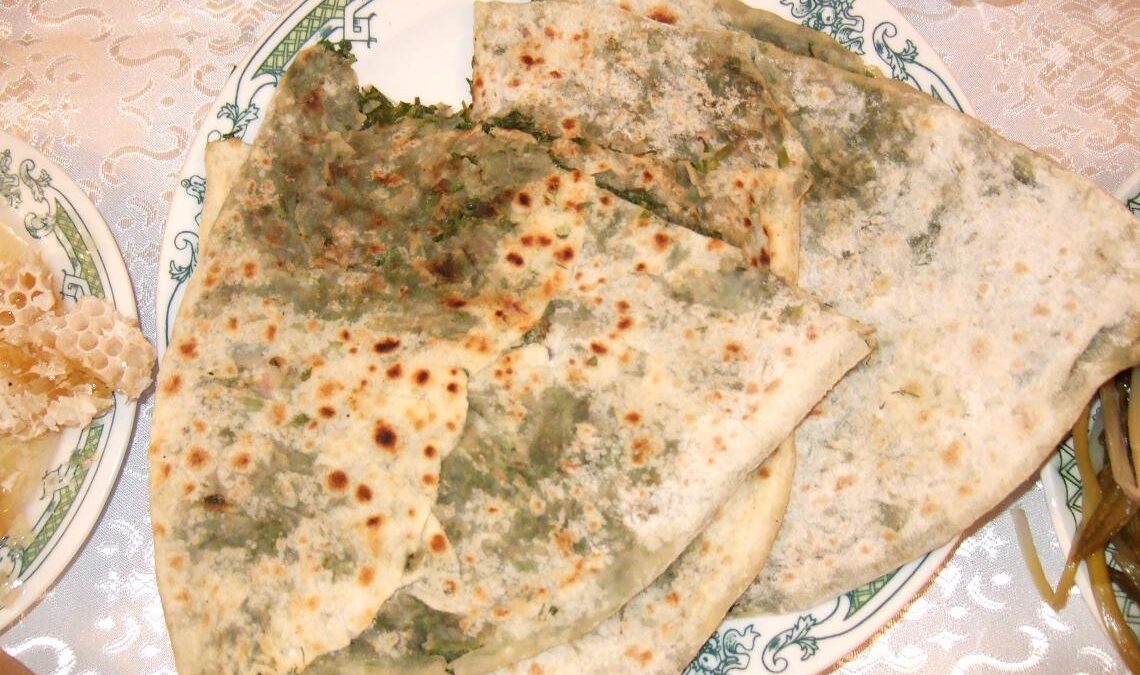
The name is Karabakh dialect for “bread with greens” (zhengyal = greens, hats = bread). The dough is nothing but flour, water and salt — no yeast, no egg, no fat. It is rolled until almost translucent, heaped with a salted, lightly oiled mix of finely chopped herbs, pinched shut along the top like a long boat, flattened with the palm, and slapped onto a hot saj for a few minutes a side. A finished one is oval, roughly 25–30 cm long, blistered and browned in patches, and should still be steaming when it reaches you.
Two things separate it from every other Armenian flatbread. First, the ratio: a good one is mostly filling, with the dough acting as a wrapper rather than the point. Second, the greens are raw going in and cook only from the heat of the griddle, so they keep a grassy, slightly sour bite. Think of it as a stuffed lavash crossed with a spring salad.
It is older and more rural than most Armenian street food. A piece from the American University of Armenia’s 1000 Leaf project quotes the local saying that “the people of Karabakh do not remain hungry”: this was what you made from whatever the forest and the vegetable patch gave you in a lean spring, hence its old nickname, “forest bread”.
The herbs: what goes in and when
There is no fixed recipe. Ethnographer Ruzanna Tsaturyan, quoted by RFE/RL in March 2024, puts the typical count at around 17 leafy greens; the record version baked in Hadrut in December 2018 used 26; displaced bakers told EVN Report in 2025 that their Karabakh recipe had 17 types and the Yerevan version they can source has about 9. Structure matters more than the number.
The logic, consistent across Armenian sources: mild leaves (spinach, chard, lettuce, chickweed) make up most of the filling; strong aromatics (cilantro, dill, green onion, tarragon, mint) add flavour; sour leaves add acid; bitter ones (dandelion, nettle) are used sparingly. Parsley is contested — one Karabakh cook told JAMnews it does not belong at all.
| Green | Armenian / Karabakh name | Role in the filling | Season in Armenia |
|---|---|---|---|
| Spinach | սպանախ (spanakh) | Bulk, mild | Spring, autumn |
| Chard / beet greens | ճակնդեղի տերև (chakndeghi terev) | Bulk, mild | Late spring–autumn |
| Chickweed | կնձմնձուկ (kndzmndzuk, dialect) | Bulk, wild | Early spring |
| Cilantro | համեմ (hamem) | Aromatic | Year-round, best spring |
| Dill | սամիթ (samit) | Aromatic | Spring–summer |
| Green onion | կանաչ սոխ (kanach sokh) | Aromatic, sharp | Spring |
| Tarragon | թարխուն (tarkhun) | Aromatic, aniseed | Spring–summer |
| Mint | անանուխ (ananukh) | Aromatic, small amount | Spring–summer |
| Sorrel | թրթնջուկ (trtnjuk) | Sour | Spring |
| Wild sorrel / dock | ավելուկ (aveluk) | Sour, tannic | Spring fresh; dried year-round |
| Stinging nettle | եղինջ (yeghinj) | Bitter-green, small amount | Early spring |
| Dandelion leaf | խատուտիկ (khatutik) | Bitter, sparse | Spring |
| Purslane | դանդուռ (dandur) | Mild, juicy | Summer |
Artsakh cooks also use wild plants with no English name that Yerevan bakers mostly cannot get — the Mirror-Spectator’s 2023 recipe piece lists chercheruk, smsemok and mokhratal. Some stalls add crushed barberries for acidity instead. Spring and autumn are best, when wild greens are tender; in winter you get a shorter mix built on spinach, chard, dill and cilantro. Still worth eating, but a March one is a different dish.
Origin, and how it came to Yerevan
The dish is from Nagorno-Karabakh and adjoining Syunik; written mentions go back about 200 years according to Tsaturyan, and it was listed on Nagorno-Karabakh’s register of intangible cultural heritage in 2013. It was a market food: at Stepanakert’s central market, women cooked it on saj griddles in front of customers, and a Zhengyalov Hats Festival ran in Martakert district — the 2019 edition in Aterk drew more than 12,000 people, per Kavkaz-Uzel.
Then the geography changed twice. In the 2020 war, around 100 people from Stepanakert and Martakert sheltered at a hotel in Dilijan and started baking; Hetq reported 700 loaves sold on day one and 3,000 orders within weeks, and RFE/RL recalls long queues in central Yerevan that autumn. In September 2023 the region’s entire Armenian population — over 100,000 people — fled to Armenia within days. Among the few things families could carry was a skill, and this one needs only flour, greens and a griddle.
EVN Report counted around 30 zhengyalov hats businesses opened in the Nor Nork district alone by early 2025; RFE/RL described stalls run by displaced families across the country and “pizza-like popularity”. The honest caveat: this is not a food trend in the ordinary sense. Several bakeries in those reports closed within months — the Grigoryan family’s Saroyan Bistro, named after a street in Stepanakert, lasted seven. When you buy one, you are often buying from someone who lost their home two or three years ago. Be a normal, polite customer; that is all anyone asks.
Where to eat it in Yerevan
Yerevan has had one dedicated zhengyalov hats café since long before 2020, and now has dozens of stalls. These are the sourced options; confirm opening hours before you go, because small refugee-run businesses move and close.
- Zhingyalov Hats, 62 Teryan Street (corner of Moskovyan). The original single-dish café in the centre: zhengyalov hats, baklava and drinks, made to order. Yandex Maps reviews from late 2025 put it at 900 AMD per piece, about 1,400 AMD average spend; HappyCow reviews run into autumn 2026. Small queue at lunchtime.
- Taste of Artsakh, Prospect Food Court, 5 Mashtots Avenue (the food hall opposite the Blue Mosque). The counter of a company that relocated from Nagorno-Karabakh after 2020; most of its roughly 10 staff are displaced (Armenpress, July 2024). About a dozen variants — classic, mushroom, rye-flour, dogwood — small around 500 AMD, 10:00–22:00 daily per 2025 listings. Ask for no sour cream if you want it vegan.
- Metro-station and street stalls. RFE/RL profiled a former literature teacher from Karabakh selling zhengyalov hats at 500 AMD from a booth outside Barekamutyun metro in 2024. These booths are the cheapest and often the best; look near metro exits, at the entrances to GUM and the other food markets, and along the main roads of Nor Nork, Ajapnyak and Avan, where many displaced families were housed.
- Restaurants. Sit-down places around the centre now list it at restaurant prices (one Abovyan Street menu shows 2,800 AMD for a 390 g, six-green version), usually made earlier and reheated. For the dish at its best, go somewhere that does nothing else.
Our where to eat in Yerevan guide has the restaurants; zhengyalov hats is the lunch between them.
Outside Yerevan
The dish has long been part of the cooking of Syunik, and Goris — the last big town before the former Lachin road — hosted thousands of displaced families in September 2023. Ask at any bakery or the town market; prices there are below Yerevan’s. Named refugee-run bakeries in Armenian media include Gayane Petrosyan’s “The Spirit of Artsakh” in Etchmiadzin (JAMnews, 2024), several businesses in Abovyan (RFE/RL), a bakery in Dilijan, and Artsakhi Hats in the Tavush village of Achajur, where the Hakobyan family bakes from 4 a.m. (FAR, December 2025). These are bakeries, not attractions; buy a few and go.
The big festivals were in Karabakh and no longer take place. The dish turns up instead at Yerevan food events — Armenpress reported it sold alongside Hadrut wines at a 2021 wine festival — so check autumn food and wine festival listings rather than looking for a dedicated event.
How it is served, what it costs, what to drink
You get it whole, on paper or a plate, cut in half or thirds if you ask. No sauce is traditional; some stalls offer matsun (yoghurt) or sour cream on the side. Eat it with your hands, and give it two minutes — the greens inside hold steam. One piece is a light lunch for one; two is a full meal.
Price band as of 2025–26 reporting: 500–900 AMD at stalls and the Teryan Street café, 1,000–1,500 AMD for large or specialty versions, 2,500–3,000 AMD in sit-down restaurants. That makes it one of the cheapest hot meals in the city.
Drink tan (salted yoghurt, often with mint), which cuts the oil and sourness. Karabakh families pair it with homemade red wine; the Teryan Street café sells beer.
How to spot a good one
- It is made in front of you. The saj should be visible and hot. A reheated zhengyalov hats is a soggy wrap; a fresh one is crisp on the ridges and soft underneath.
- Thin dough, thick filling. Hold one up: you should see green through the pale patches. If it is mostly bread, walk on.
- Count the colours. A good mix is visibly mixed — dark chard, pale chickweed, feathery dill, purple-stemmed sorrel. A uniform dark-green mush is usually spinach plus cilantro.
- Sourness and a little bitterness. If it tastes only of oil and salt, the sour and bitter leaves were skipped.
- Not greasy. The greens are dressed, not fried. Oil pooling on the paper is a bad sign.
- Season. March to May and September to October are when stalls have the wild leaves. In August or January, lower your expectations slightly.
Practical and dietary notes
The classic version is vegan: flour, water, salt, greens, vegetable oil — the most useful dish to know if you are vegetarian or vegan in Armenia, and a Lent staple for the same reason. Watch for sour cream, matsun or butter at some stalls; ask “arants matsun” (without yoghurt). Not gluten-free. The nettle is cooked and does not sting. Street stalls are usually cash-only.
Spelling varies — zhengyalov, zhingyalov, jingalov, jengyalov — but it is one dish. The Armenian sign to look for is ԺԵՆԳՅԱԼՈՎ ՀԱՑ.
Last verified: October 2026.
Verdict
Eat it at a stall or the Teryan Street café, in spring if you can, with a tan — then try one from a different seller the next day, because the mix changes house to house. It costs less than a coffee and tells you more about the last five years in Armenia than most museums will.
Frequently asked questions
Is zhengyalov hats vegan?
The traditional version is: unleavened flour-and-water dough, chopped greens, salt and vegetable oil. Some stalls brush it with butter or serve matsun (yoghurt) or sour cream on the side, so ask for it plain if that matters. It is not gluten-free.
How much does zhengyalov hats cost in Yerevan?
As of 2025–26 reporting, around 500–900 AMD per piece at street stalls and the dedicated Teryan Street café, 1,000–1,500 AMD for large or mushroom/rye versions at the food-court counter, and 2,500–3,000 AMD on sit-down restaurant menus.
What is the best season to eat zhengyalov hats?
Spring (March–May) and early autumn, when wild greens like chickweed, sorrel and nettle are tender. Winter and high-summer versions rely on fewer cultivated greens and taste flatter, though they are still sold year-round.
Where does zhengyalov hats come from?
From Nagorno-Karabakh (Artsakh) and neighbouring Syunik, where it was a market and festival dish and was listed as intangible heritage in 2013. After the 2020 war and the 2023 displacement of the region’s Armenian population, families who resettled in Armenia opened stalls and bakeries, which is why it is now common in Yerevan.
Featured image: Chaojoker, CC BY-SA 3.0 — via Wikimedia Commons.