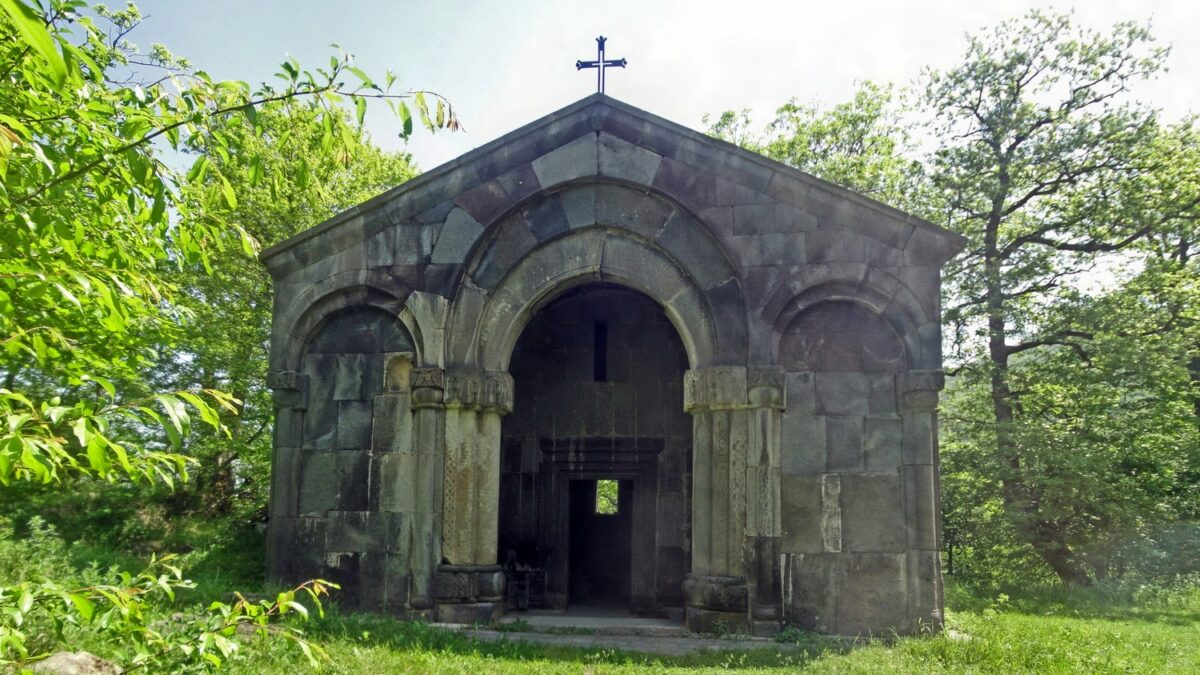
Bgheno-Noravank is a small 11th-century church on a wooded, triangular spur above the right bank of the Vorotan river, about 3 km east of Bardzravan village and roughly 21 km by road from Tatev Monastery. Two things make it worth the detour: a set of figurative biblical reliefs on the exterior walls that almost no other Armenian church of the period has, and a forest setting that is the opposite of Tatev’s bare cliff-top. It is also the place where the Echmiadzin Gospel, one of the most important manuscripts in the Matenadaran, was copied in 989. The honest caveat: the church is 9.5 m square, there are no facilities, and most of the relief slabs are no longer on the walls, so go for the quiet and the carving, not for scale.
History: from the 989 Gospel to the 1062 church
The site had two building phases, and the medieval historian Stepanos Orbelian (writing in the 1290s) is the source for both. Around 936 a priest named Stepanos put up a group of white-limestone buildings here: a church, halls and a gavit. That early church is the one named in the colophon of the Echmiadzin Gospel. According to the Matenadaran, the manuscript “was copied in 989 in St. Stepanos Church of Bgheno Noravank by order of priest Stepanos, by Hovhannes the scribe.” The Gospel later left Syunik: it was rebound with its famous ivory covers and sold in 1173, spent roughly 774 years at the monastery of Magharda, and was moved to Etchmiadzin in 1847 by Catholicos Nerses Ashtaraketsi. Today it is Matenadaran MS 2374, 232 leaves of parchment, and the two 6th–7th-century miniatures bound into it are among the oldest surviving Armenian book paintings.
The standing church belongs to the second phase. Its inscriptions, published in volume 2 of Sedrak Barkhudaryan’s corpus of Armenian inscriptions (1960), record that priests Grigor and Hovhannes rebuilt the church in dark basalt in 1062 at the order of King Grigor of Syunik. Grigor I reigned 1051–1072 and funded work at Tatev and Vahanavank in the same years, so Bgheno was part of a royal programme. For such a tiny building the epigraphic record is dense: Barkhudaryan catalogued 23 inscriptions here, including one naming three craftsmen, Sargis, Goltnatsi and Lianos, asking to be remembered in prayer.
Guidebooks give both 936 and 1062, and both are right: the first is the foundation, the second is the church you can touch.
The reliefs: what to look for
Armenian churches are usually ornamented with crosses, vines, interlace and donor portraits. Narrative scenes from the Gospels carved on an exterior wall are rare, and the usual comparison for Bgheno is the Church of the Holy Cross on Akhtamar (now in Turkey). The architectural historian Stepan Mnatsakanyan (1960) recorded eight carved limestone slabs with scenes from the life of Christ. Only two are still in position on the walls: the Annunciation and the Ascension. The rest fell or were removed over the centuries.
At least one slab is now in Yerevan. The History Museum of Armenia holds a sandstone relief of a seated angel from Bghen (inventory T 70-33) that was lent to the Metropolitan Museum of Art’s “Armenia!” exhibition in 2018–19. The Met’s label described the church’s programme as including “the Annunciation to the Virgin, the Oil-Bearing Women at the Tomb of Christ, and the Ascension of Christ,” with the angel belonging to the tomb scene. Note the dating disagreement: the Met catalogued the angel as 10th century, which would put it with the 936 limestone church rather than the 1062 basalt rebuild. That fits the material (limestone slabs set into a basalt building) and suggests the sculptures were salvaged from the earlier church and reused.
What to look at on site, in order:
- The gavit portal. The entrance hall (about 8.6 by 3 m) has the richest surviving carving: rows of beading, interlocking ribbon bands and leaf and pomegranate motifs around the door. Two yellow sandstone columns flank it and are badly weathered.
- The two in-situ slabs. Find the Annunciation (Gabriel and Mary) and the Ascension (Christ in a mandorla carried by angels). Both are small, worn and best read in low morning or late-afternoon light.
- The window arrangement. Paired arched openings on the north and south walls and a low east window give the interior far more daylight than a typical 11th-century Armenian church. Mnatsakanyan read this as deliberate: a church designed to look out at the forest.
- The inscriptions. Many are on the exterior walls at eye level. Even without reading Armenian you can pick out the 11th-century lettering.
- The khachkars and graves. Three cross-stones were found in excavations, and the cemetery lies south of the church across the path, with two small chapel-mausolea beside the main building.
Bakunts and the rediscovery
The standard line, repeated from the Armenian Concise Encyclopedia into every modern summary, is that the ruins were rediscovered in the 1920s by Aksel Bakunts, the Goris-born prose writer, while he was working as a district agronomist. The biographical frame checks out: Bakunts was born in Goris in 1899, studied agriculture in Kharkov from 1920 to 1923, and ran the land department in Goris from 1924 to 1926 before moving to Yerevan. He was shot on 8 July 1937 in the purges.
What I could not find is Bakunts’s own account. No article by him on Bgheno turned up in the Armenian academic repository or in his collected works, and the encyclopedia entry gives no date. So “rediscovered by Bakunts” is a reliable tradition rather than a documented event with a year. The site was certainly known to scholars by 1950, when excavation cleared buried sections, and the church was consolidated in 1957–62, when the covered gallery on three sides was added.
What else is on site, and in Bardzravan
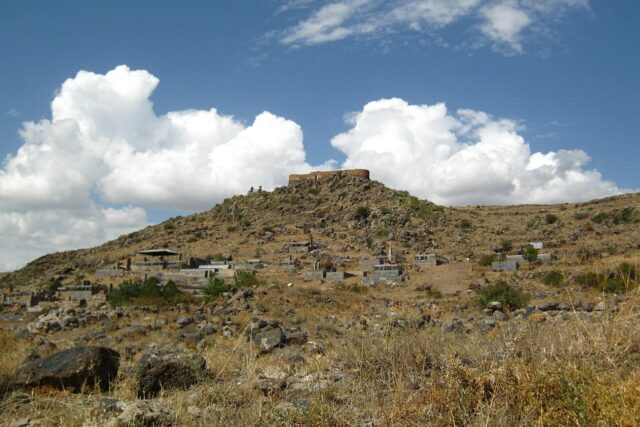
Beyond the church and gavit, the promontory holds the foundations of the monastery wall, remains of residential buildings on the slope, the cemetery and the two side chapels. It is a 20-minute site, or an afternoon with a picnic.
Bardzravan itself is a story of displacement. The village was called Yeritsatumb and stood lower in the gorge until the Zangezur earthquake of 27 April 1931 (magnitude 6.5), which destroyed or badly damaged 57 villages in the Sisian–Goris area and cracked Tatev. Forty-nine villagers died, and the survivors rebuilt on the plateau at about 1,500 m, taking the new name Bardzravan (“high village”). Population peaked at 406 in 1939 and has fallen steadily: 146 at the 2011 census, around 50 year-round residents according to a 2020s visitor account. In and around it:
- Surb Hripsime church above the gorge, rebuilt in the 19th century. Brady Kiesling’s gazetteer instead records a Surb Astvatsatsin of 1870 in the village; it may be the same building under two dedications. Do not photograph the military posts nearby.
- Old Yeritsatumb down in the gorge on the Legends Trail, with the small 1821 church of St Minas sunk in moss among boulders.
- A caravanserai of the 17th–18th century, a reminder that this was the old track between Tatev and the Goris side before the highway.
Getting there
By road from Goris or Tatev
Kiesling’s directions still hold. Take the main Goris–Kapan highway south; a kilometre or two beyond the pass after Vorotan village, a signposted road leaves west for Bardzravan. At 3.1 km from the turnoff a paved spur goes right onto the promontory and ends at the church. From Goris allow roughly 40 minutes. From Tatev, OneWayTour lists 21 km, but that is on the rough track through the gorge via Tandzatap; a 2024 visitor put it at an hour off-road. With a normal car, go round by Goris.
On foot: the Legends Trail
Bgheno sits on the Legends Trail, the 200-km route marked by People in Need from Khndzoresk to Mount Khustup, parts of which are now the Transcaucasian Trail. The relevant stages, from the trail brochure: Tatev to Tandzatap 3.1 km, Tandzatap to Bardzravan 12 km, dropping to the Vorotan and climbing out the other side. Wikiloc users log the Halidzor–Bardzravan variant through the Vorotan canyon as hard, “gaining altitude mostly all the way.” From Bardzravan the monastery is an easy 6 km round trip on the spur road. Day-tour operators from Yerevan run it as a 13 km walk. It belongs on any list of the best hikes in Armenia because it is empty.
When to go
May to mid-June for the forest and the Vorotan in spate; late September to October for colour and cooler walking. July and August are hot but the site is shaded. Snow can close the Bardzravan road in winter, and the gorge track from Tatev is mud in April. For the reliefs, morning light rakes the south and east faces; by mid-afternoon the carving flattens out.
Practical notes
- No facilities. No ticket, no caretaker, no toilet, no shop. Buy food and fuel in Goris.
- Camping. The flat, shaded ground by the church is a long-standing picnic and camp spot, and the site is close enough to the highway that a Kapan-bound minibus can drop you at the turnoff. A solar-powered community campsite in Bardzravan was being set up as of 2024; check locally whether it is open.
- Water. Carry it. Springs on the Legends Trail are seasonal; do not count on them in August.
- Forest. Check for ticks in May–June, and the gorge sides are steep. Stay on the spur road after dark.
- Border. Bardzravan is close to the Armenia–Azerbaijan line. Carry your passport and keep cameras away from anything in uniform.
Pair it with
Bgheno slots into a day that most people already have planned. Ride the Wings of Tatev cable car in the morning, see Tatev, then drive back towards Goris and take the Bardzravan turn in the afternoon when the tour groups have gone. Sleep in Goris and do the Khndzoresk cave village and swing bridge the next morning. If you are hiking, link it with Devil’s Bridge and the Vorotan gorge, which the Legends Trail does for you. Drivers continuing to Kapan and Meghri can treat it as a 40-minute stop on the southern Armenia road trip.
Worth it?
Yes, with expectations set. Bgheno-Noravank is not a second Tatev; it is a 9.5-metre church in a wood. Its value is in three specifics: a documented link to a 989 manuscript you can later see in Yerevan, Gospel scenes carved on the outside of an 11th-century church, which you will not find at Tatev, Noravank or Haghpat, and total quiet. With a car and a spare 90 minutes on the Goris side, do it. On a tour-bus schedule, skip it and see the angel in the History Museum instead.
Last verified: October 2026.
Frequently asked questions
Is Bgheno-Noravank the same as Noravank near Areni?
No. Noravank in Vayots Dzor is the famous 13th-century Orbelian monastery in the red Amaghu canyon. Bgheno-Noravank is a much smaller 11th-century church in the forest above the Vorotan gorge in Syunik, between Tatev and Goris. Both names mean ‘new monastery’.
Can I reach Bgheno-Noravank with a normal car?
Yes, from the Goris side. Leave the Goris–Kapan highway at the signposted Bardzravan turn and after 3.1 km a paved spur leads right to the church. The direct track from Tatev through the gorge via Tandzatap needs high clearance and takes about an hour.
Are the famous reliefs still on the church?
Only two of the eight recorded slabs are still in place, the Annunciation and the Ascension. The rest fell or were removed; a sandstone relief of a seated angel from the tomb scene is in the History Museum of Armenia in Yerevan (inventory T 70-33).
Was the Echmiadzin Gospel really written here?
Yes, according to its colophon as read by the Matenadaran: copied in 989 in the St Stepanos church of Bgheno Noravank by the scribe Hovhannes for the priest Stepanos. The manuscript itself (Matenadaran MS 2374) is in Yerevan, not at the site.
Featured image: vahemart, CC BY-SA 3.0 — via Wikimedia Commons.