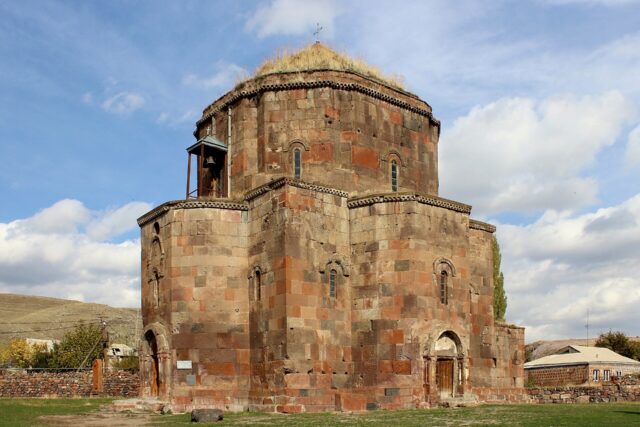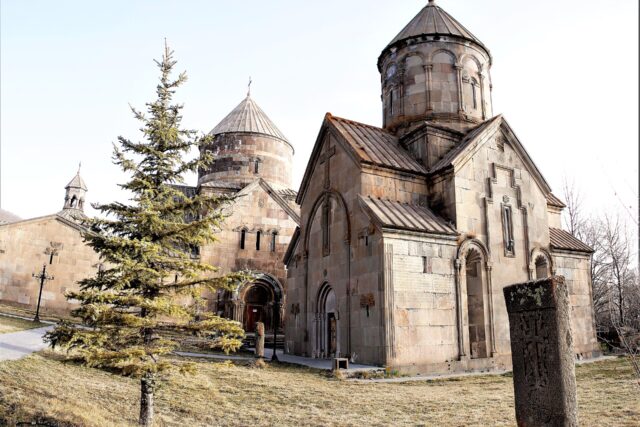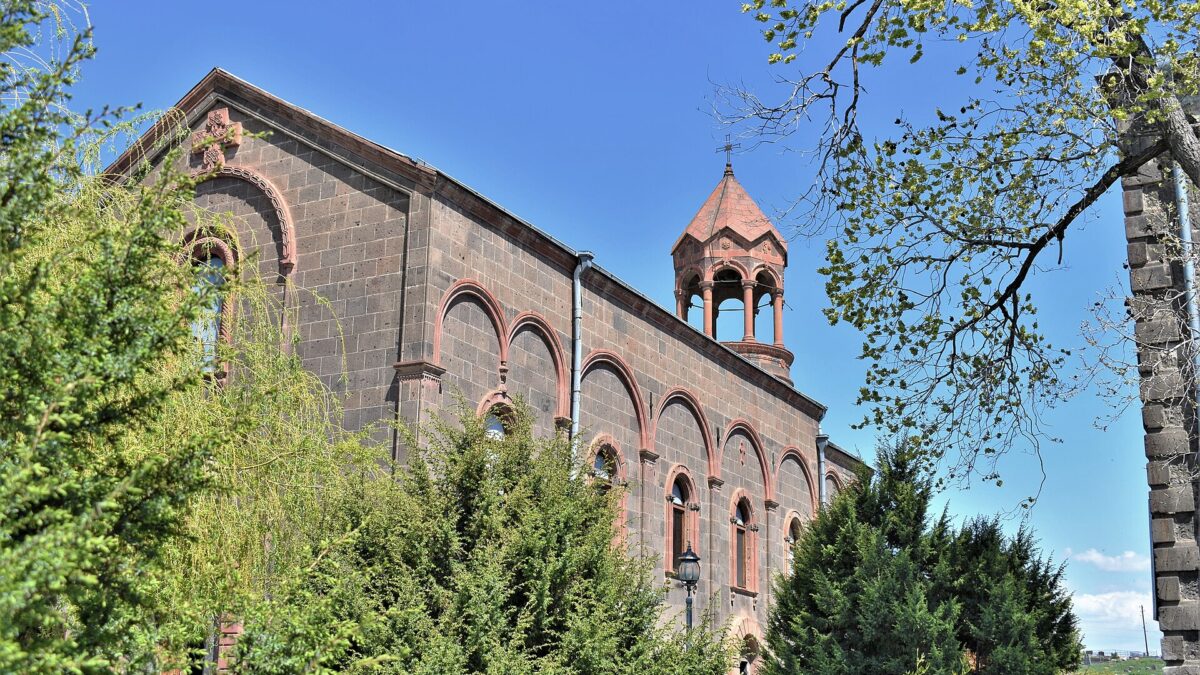
Oshakan is a village of a few thousand people 3 km southwest of Ashtarak and about 30 km from Yerevan, and it holds the one grave every Armenian schoolchild knows: Mesrop Mashtots, who created the Armenian alphabet in 405, was buried here in 440. The church above the tomb dates from the 1870s, the crypt is under the altar, and the courtyard has a row of 39 letter-shaped khachkars that most visitors photograph before they have found the door. It is a 40-minute drive, not a day trip on its own, so pair it with Ashtarak and the Kasagh gorge monasteries. Go in October if you want to see what the place actually means to people.
Who Mashtots was, and why he is buried in Oshakan
Mashtots was a court secretary turned monk who, with the backing of Catholicos Sahak and King Vramshapuh, produced a 36-letter alphabet for Armenian in or around 405 AD. Before that, Armenian liturgy ran in Greek and Syriac; after it, the Bible was translated within a generation and a written national culture started. If you want the full story, we cover it in our guide to the Armenian alphabet, and the oldest surviving manuscripts sit in the Matenadaran in Yerevan.
The burial is unusually well documented for the 5th century because Mashtots’ own pupil Koriun wrote his biography a few years after his death. In chapter 26 of the Life of Mashtots (English text on the Armenian Cathedral’s “12 Historians” site), Koriun says Mashtots died on the 13th of the month Mehekan, six months after Sahak, in the city of Vagharshapat. The hazarapet Vahan Amatuni and the general Hmayeak Mamikonian carried the body, with a crowd behind it, to Oshakan, Vahan’s home village, with “a luminous vision resembling a cross” reported over the house where he died. Three years later, Koriun writes, Vahan built a church of finely cut stone over the grave and fitted the tomb with gold and silver vessels. That is 443, and it is the first of several buildings on this spot.
The short version: Oshakan became holy because a powerful minister wanted his teacher buried on family land.
The church and the crypt
What you see today is a 19th-century domed basilica in grey-orange tuff. Catholicos Gevorg IV had it built over the earlier chapel; sources differ on whether work began in 1873 or 1875, but they agree it was consecrated on 21 October 1879. The cylindrical bell tower on the east side, behind the apse, was added in 1884. That placement is odd for an Armenian church (bell towers normally stand over the western entrance), and it is the detail architecture students are sent here to notice.
The tomb is in a small crypt under the main altar, reached by a short stair. It is where the pilgrimage happens: people go down one or two at a time, touch the stone, light a candle, come back up. Church-history sources (Teryan’s 1963 study, as cited by secondary accounts) record a marble gravestone placed in 1884 and replaced in 1962; travel sources describe the current slab as onyx laid during a 1960–64 restoration. Treat the material as unconfirmed and look for yourself.
The interior frescoes are the other reason to come. They were painted in 1961–64 by Hovhannes Minasyan with Henrik Mamyan, and are among the few large church murals produced in Soviet Armenia. The centrepiece triptych, “Glory to Armenian Letters and Schooling,” shows Mashtots and Sahak with pupils, and had deteriorated badly from damp before a restoration funded by President Armen Sarkissian in 2019–20 at the request of the Aragatsotn Diocese (president.am press releases, November 2019 and August 2020). Expect bright colour, Ararat, pomegranates, and a style closer to a Yerevan metro mural than to a medieval monastery.
The alphabet garden and the Mashtots museum
In the churchyard stands a line of 39 khachkar-style stones, one per letter of the modern alphabet (36 original letters plus the three added later). Each letter carries a carved motif: Ա with Mount Ararat, Մ with Mashtots, Ց with a wheat stalk. Several sources attribute them to the khachkar sculptor Ruben Nalbandyan and date them to 2005, the 1,600th anniversary of the alphabet; we could not confirm the year against a primary record, so take “around 2005.” An earlier open-book alphabet monument at the village entrance (a 1960s design attributed to Baghdasar Arzumanyan) is often confused with it online.
Next to the church is a long rectangular building that began as a parish school in 1913, housed orphans who survived the 1915 Genocide during the war years, served as a Soviet state school, and was reopened in October 1998 as a dpratun (study house) with exhibition rooms and a library on Mashtots and the alphabet. Guidebooks call it the Mashtots Museum. The honest caveat: it is small, labels are mostly Armenian, and it is not always open on weekdays. Ask at the church if the door is shut.
Oshakan’s other sights
The Oshakan bridge (1706)
South of the village, a five-arched bridge of red tuff crosses the Kasagh river. Armenian sources give its date as 1706 (travel sources say simply “early 18th century”), which makes it the best-preserved of the Persian-period bridges in Aragatsotn. You can still walk across. It is a five-minute drive or a 20-minute walk from the church.
Didikond hill
The hill rising just south of the village, 1,121 m at the summit, has an Urartian fortress on top covering about a quarter of a hectare, with a settlement on the north-east slope and a cemetery on the northern and eastern sides. Armenian archaeologists S. Esayan and A. Kalantaryan dug it in 1972–75; since 2012 a joint Yerevan State University–LMU Munich project led by Hayk Avetisyan and Michael Herles has excavated tombs on Didikond and the neighbouring Pokr Blur (LMU Near Eastern Archaeology project page). Nothing is fenced or signposted, so it is a walk with a view and some stone outlines, not a site.
St Sion and the village chapels
St Sion, in the Mankanots valley north of the village, is a small 7th-century church which local tradition links to the Byzantine emperor Maurice, who some medieval historians claim was born in Oshakan. There is no evidence for the claim, but the chapel is old and quiet. Scattered around the village are smaller shrines: St Thaddeus, St Grigor, St Sargis, a rock-cut Holy Mother of God chapel and a 13th-century Tukh Manuk. None justifies a separate trip.
Pilgrimage days: Translators’ Day and the first-grade tradition
The Armenian Church honours Mashtots and the Holy Translators twice a year, once in early summer and again in October, and both are kept at Oshakan with a liturgy led by the Bishop of Aragatsotn. The October feast, Targmanchats, falls on the second Saturday of October and is a national cultural holiday in Armenia (see our list of Armenian public holidays). The Mother See’s own report of the June 2024 liturgy puts the tradition plainly: “on this day, the already literate first graders visit the St. Mashtots Church.”
That is the ritual worth planning around. First-year pupils, usually in white shirts, come by bus from across the country, are led through the church, recite or “learn” the first letter Ա at the tomb, and receive a blessing. Many schools frame it as an oath to the letters; the wording varies and there is no official text. Travel operators say it happens “every September,” which matches the start of the school year, but the church-anchored date is the feast itself. Yerevan State University’s theology faculty also sends its first-year students on a pilgrimage here on Translators’ Day. On these days the village is full, parking is impossible and the crypt queue is an hour long. It is also the only time the place feels like what it is.
Getting there
- By car or taxi: From Yerevan take the M1 toward Ashtarak (about 25 km), then the local road south-west for 3 km to Oshakan. 35–45 minutes. A taxi by app from central Yerevan costs roughly 4,000–6,000 AMD one way; agree a waiting fee if you want the driver to stay.
- By marshrutka: Minibuses to Ashtarak leave frequently from Yerevan (ask for the Ashtarak marshrutka; the departure point has moved between stations in recent years, so confirm locally the day before). From Ashtarak’s centre, a local minibus or a 1,000–1,500 AMD taxi covers the last 3 km. Return minibuses from Ashtarak to Yerevan run until early evening.
- Tours: Almost every “Aragatsotn” day tour from Yerevan stops here, usually for 30–40 minutes, which is enough for the church and letters but not the museum or bridge.
A half-day with Ashtarak, Saghmosavank and Hovhannavank, or Amberd
| Route | Stops | Time | Who it suits |
|---|---|---|---|
| Gorge loop | Oshakan, Ashtarak (Karmravor church, Kasagh bridge), Hovhannavank, Saghmosavank | 5–6 hrs | Most people; flat roads, open year-round |
| Mountain loop | Oshakan, Byurakan observatory, Amberd fortress | 6–7 hrs | June–October only; Amberd road closes in snow |
| Quick visit | Oshakan alone from Yerevan | 2–2.5 hrs | Pilgrims, alphabet enthusiasts |
Do Oshakan first in either loop: the crypt is calmer before 11:00, and tour buses arrive late morning. The gorge loop is the better all-rounder. The mountain loop is the better view, and our Amberd fortress guide covers the road conditions.
When to go
April–June and September–October are the comfortable months; the churchyard is exposed and July afternoons pass 35°C. The second Saturday of October is the big day. If crowds bother you, avoid it; if you want to understand the site, it is the only date that matters. Winter visits are fine; the road rarely closes.
Practical notes
- Entry is free. The church is generally open daylight hours; the museum keeps shorter and less predictable hours. Confirm locally.
- Dress as for any Armenian church: shoulders and knees covered, no hats for men. Women are not required to cover their hair here, but many do in the crypt.
- Photography is allowed in the church and courtyard. Do not photograph people praying in the crypt.
- A small shop and a café or two sit on the village road; Ashtarak has proper restaurants.
- Allow 45–60 minutes for the church, letters and museum; add 30 for the bridge.
Last verified: October 2026.
Verdict
As architecture, Oshakan is a decent 1870s church with good 1960s murals. As a place, it is the grave of the man who gave Armenians the tool that kept them a people through 1,500 years without a state, and the country still sends its seven-year-olds here to say so. Visit for the second reason, spend 45 minutes, and fold it into a Kasagh gorge day rather than treating it as a destination. Read it alongside our pieces on the Armenian Apostolic Church and you will understand why a small village has a bigger bell tower than its monastery neighbours.
Frequently asked questions
Is Mesrop Mashtots really buried in Oshakan?
Yes. His pupil Koriun, writing within a few years of his death in 440, records that Vahan Amatuni and Hmayeak Mamikonian carried the body to Oshakan and that Vahan built a church over the grave three years later. The tomb is in the crypt under the altar of the present 1879 church.
How do I get from Yerevan to Oshakan without a car?
Take a marshrutka to Ashtarak (about 25 km, confirm the current departure point in Yerevan locally), then a local minibus or short taxi for the last 3 km. A direct app taxi from Yerevan is roughly 4,000–6,000 AMD each way and takes 35–45 minutes.
When do first graders visit Oshakan?
On the Feast of the Holy Translators, which the Armenian Church keeps in early summer and again on the second Saturday of October (Targmanchats Day). Schools also bring first-year pupils in September at the start of the school year. The children visit the tomb, learn the first letter and receive a blessing; the exact format varies by school.
Can I combine Oshakan with Saghmosavank and Amberd in one day?
Oshakan with Ashtarak, Hovhannavank and Saghmosavank is an easy 5–6 hour loop. Adding Amberd and Byurakan makes a full 7–8 hour day and only works from roughly June to October, when the Amberd road is open.
Featured image: Yerevantsi, CC BY-SA 4.0 — via Wikimedia Commons.