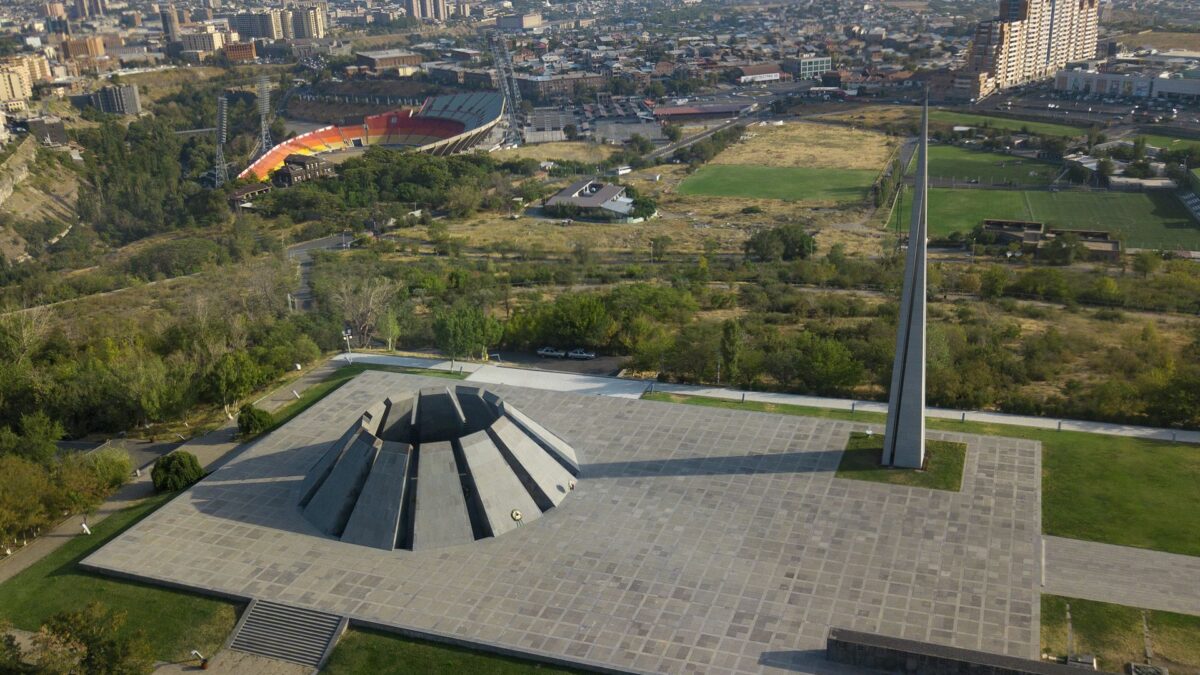
Tsitsernakaberd, the Armenian Genocide Memorial, stands on a hill above Yerevan and commemorates the roughly 1.5 million Armenians who died during the events of 1915. Entry is free. The outdoor memorial — twelve inward-leaning basalt slabs around an eternal flame, beside a 44-metre spire — is open at any hour, and a separate museum tells the history below ground.
It is the most visited site of remembrance in Armenia, drawing an estimated 200,000 people a year, and its meaning is central to how Armenians understand their modern history. This guide explains what the memorial is, the history it marks in brief and measured terms, what the museum holds, the practical details of visiting, and how to conduct yourself at a place of mourning. Last verified: July 2026 — confirm museum hours on the official site before you go.
What is Tsitsernakaberd?
Tsitsernakaberd is Armenia’s national memorial to the victims of the Armenian Genocide, built on a hill of the same name overlooking the Hrazdan gorge on the western edge of Yerevan. The name translates roughly as “swallow’s fortress.” The complex has two parts: an open-air memorial that anyone can walk to freely, and the Armenian Genocide Museum-Institute, a modern museum built into the hillside nearby.
The monument was completed and opened on 29 November 1967, designed by architects Artur Tarkhanyan and Sashur Kalashyan, whose plan was chosen from dozens of submissions (genocide-museum.am). The museum opened later, in April 1995, on the 80th anniversary of the events it records (Wikipedia: Tsitsernakaberd).
Three elements make up the memorial. A long wall of grey basalt runs along the approach. Beyond it, twelve tall slabs lean inward in a circle around an eternal flame set below floor level, in a space meant for quiet reflection. Alongside rises a slender 44-metre stele, split down much of its length into a taller and a shorter needle. Each part carries meaning, which the next section explains.
What do the parts of the memorial mean?
The twelve leaning slabs are the memorial’s most recognised feature. They are commonly described as representing the twelve provinces of historic Western Armenia now lying within Turkey, though the museum notes that the designers also arrived at the number through the geometry of the circle. Their inward tilt is read as a gesture of mourning, figures bowed around the flame at the centre (Wikipedia).
The eternal flame burns continuously in the sunken centre of the circle, the focus of the whole site. Visitors descend a few steps toward it, and on days of remembrance the ground around it is covered in flowers.
The 44-metre spire stands for the survival and rebirth of the Armenian people. Its lengthwise split, into a larger and a smaller shaft, is often interpreted as the divided Armenian nation — the larger part in the present-day republic, the smaller for the communities lost in the west. The 100-metre memorial wall records the names of towns and villages where massacres and deportations took place; a section on its far side honours foreigners who spoke out or helped, among them Johannes Lepsius, Franz Werfel and Henry Morgenthau Sr (Wikipedia).
Around the monument spreads a memorial park. Many of its trees were planted by visiting heads of state and other dignitaries, each marked with a small plaque — a living record of official visits paid over the decades.
What history does the memorial mark?
The memorial commemorates the Armenian Genocide, the mass killing and deportation of Armenians in the Ottoman Empire during the First World War. It is generally dated from 24 April 1915, when Armenian community leaders and intellectuals were arrested in Constantinople; that date is now observed as Armenian Genocide Remembrance Day. Widely cited estimates put the number of Armenians who died at around 1.5 million (Wikipedia: Tsitsernakaberd).
The scale of what happened in 1915 later helped shape the very word used to describe it: the legal scholar Raphael Lemkin, who coined the term “genocide” in the 1940s, cited the fate of the Ottoman Armenians as a formative example. The events are recognised as genocide by many governments, historical associations and scholars, and are officially commemorated as such in Armenia. Turkey’s official position disputes that characterisation, and the question remains politically contested internationally. Travellers do not need to arrive with a settled view of that debate; the memorial itself is a place of mourning rather than argument, and the museum sets out the documentary record for those who want to understand it. This site sits within the wider story of Armenian identity and faith explored in our guide to Armenia as the first Christian nation.
What is inside the museum?
The Armenian Genocide Museum-Institute, a short walk from the monument, presents the history through documents, photographs, maps, official telegrams, survivor testimony and archival film. It traces the Armenian presence in the Ottoman Empire before 1915, the deportations and killings, and the international response, including reports from foreign diplomats and missionaries of the period.
The displays are informative rather than graphic, built around evidence and record. Beyond the public galleries, the institute is also a working research and archival body, gathering documents and testimony from around the world; the museum is the visible face of that scholarship rather than a simple exhibition. Exhibits carry English alongside Armenian, and the building’s design — partly underground, austere in tone — is deliberately restrained. Allow around an hour, more if you read the material closely. Photography rules can change, so check the signage or ask staff on the day. If the history moves you, the small on-site shop sells scholarly books in several languages.
How do you visit? Hours, entry and getting there
Both the memorial and the museum are free to enter. The open-air memorial is accessible at any time, day or night. The museum keeps shorter hours, typically Tuesday to Sunday, roughly 11:00 to 16:00, and is closed on Mondays. Hours shift with the season and around public holidays, so confirm current times on the official site before travelling (genocide-museum.am). Last verified: July 2026.
| Detail | Information |
|---|---|
| Entry (memorial & museum) | Free |
| Outdoor memorial | Open any time |
| Museum days | Tuesday–Sunday (closed Mondays) |
| Museum hours | Roughly 11:00–16:00 (reconfirm) |
| Time needed | 1–2 hours for both |
The complex sits on Tsitsernakaberd hill, west of the city centre across the Hrazdan gorge. There is no convenient direct bus for most visitors, so the simplest way is a metered ride booked through the GG or Yandex Go apps, which usually costs somewhere between 500 and 2,000 AMD from central Yerevan and takes around 15 minutes. Ask the driver for Tsitsernakaberd; the hill is well known. From the drop-off it is a short walk along the memorial wall to the monument, and the hilltop also gives a broad view over the city and, on a clear day, toward Mount Ararat on the horizon. There is no entry gate and no ticket line, so you can arrive and leave in your own time. Many visitors pair it with the rest of the capital — see our Yerevan travel guide and our list of the best things to do in Armenia for how it fits into a wider itinerary.
If your dates are flexible, 24 April is the day of national commemoration, when large crowds walk to lay flowers at the flame. It is a moving time to witness but also very busy; on any other day you will find the site calm. Our guide to the best time to visit Armenia covers the seasons in more detail. For general reassurance about travelling in the country, see whether Armenia is safe for tourists.
How should you behave at the memorial?
This is a place of mourning, and visitors are asked to treat it as one. A few simple points of conduct matter more here than at ordinary sights.
- Keep your voice low, especially in the sunken space around the eternal flame.
- Dress modestly, as you would for a solemn or religious site.
- Take photographs quietly and with discretion. Avoid posed or smiling pictures at the flame; many people around you may be grieving.
- Do not climb on the slabs or the stele, and do not disturb the flowers left by others.
- Give space to anyone who has come to remember family. For a good number of Armenians, the losses of 1915 are personal.
Handled with that care, a visit to Tsitsernakaberd is one of the most meaningful hours you can spend in Yerevan. It asks little of you and explains a great deal about the country you are travelling through.
Featured image: Aleksey Chalabyan (Xelgen) (CC BY-SA 4.0) via Wikimedia Commons