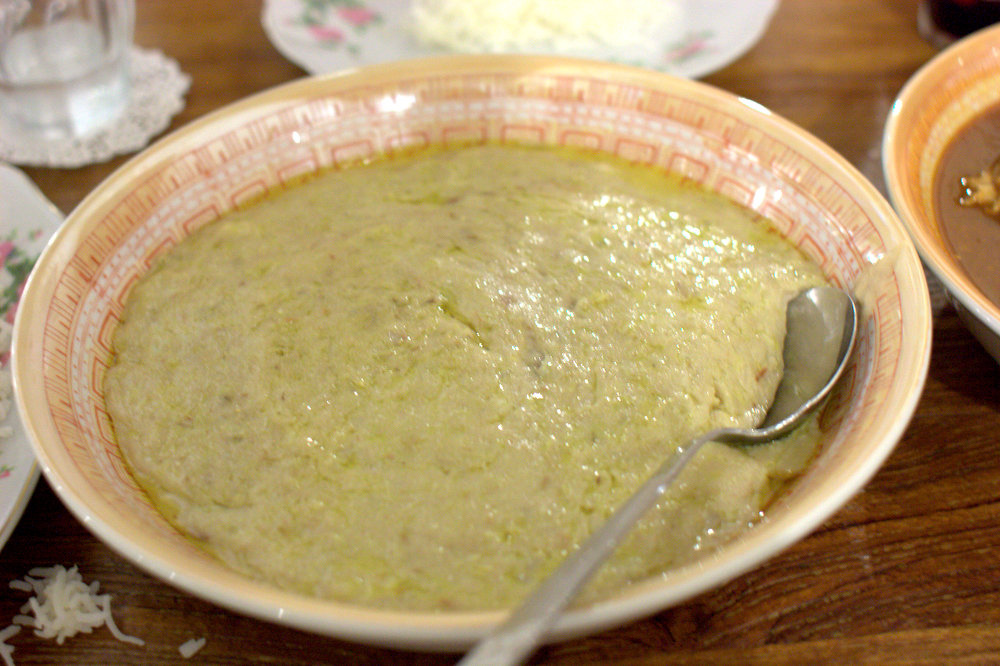
Armenian harissa (հարիսա) is a thick, savoury porridge of skinned wheat slow-cooked with chicken or lamb until the grains and meat collapse into one smooth, creamy paste. It is a comfort dish and a ritual dish rather than a restaurant staple, and it is emphatically not the fiery North African chili paste that shares the name. Armenian harissa carries no heat at all: the flavour comes from long cooking, salt, and a finishing pour of melted butter.
If you have only ever met “harissa” on a jar in the spice aisle, this dish will surprise you. Below is what harissa actually is, how it is made, why Armenians treat it as more than food, and how a traveller can realistically taste it.
Isn’t harissa a chili paste? Clearing up the name clash
This is the confusion worth settling first. There are two completely unrelated foods spelled almost identically in English:
- Maghrebi harissa — a hot red condiment from Tunisia and the wider North Africa region, built on chili peppers, garlic and spices. Spicy, spreadable, sold in tubes and jars.
- Armenian harissa (harisa) — a mild, porridge-like dish of wheat and meat, eaten with a spoon like a thick pottage. No chili, no fire.
The overlap is coincidental. They come from different culinary worlds and are prepared, served and eaten in entirely different ways. So if a Yerevan host offers you harissa on a cold morning, you are being offered a bowl of gentle, buttery wheat porridge, not a mouthful of chili. Keep the two straight and you will avoid the single most common mistake foreigners make with this word.
You will also see the Armenian dish written as harisa with one “s”, partly to distinguish it from the chili paste and partly because transliteration from the Armenian alphabet is inconsistent. Both spellings point to the same porridge. If you are searching menus or asking a host, either form works, but saying it out loud (roughly “ha-REE-sa”) and adding “the wheat one, with chicken” removes any doubt.
What is in Armenian harissa, and how is it made?
Harissa is defined by patience more than by ingredients. The core recipe is short:
- Shelled or skinned wheat — traditionally korkot (also called pokind), which is hulled, coarsely broken wheat prepared specifically for slow cooking.
- Meat — most often chicken in the classic version, though lamb is common in some regions and households.
- Salt, and usually water or the meat’s own broth.
- A finish of melted butter poured over the top just before serving, sometimes with a dusting of cumin.
The technique is what turns those plain parts into harissa. The wheat and meat are simmered together for many hours over low heat and beaten or stirred repeatedly so the fibres of the meat shred and the wheat breaks down. The goal is a homogenous, silky, almost pudding-like consistency where you can no longer tell grain from meat. It is closer to a porridge or a savoury paste than to a soup or a stew.
Because it needs long, attentive cooking and a big pot, harissa was historically a communal effort, made in quantity for a crowd rather than portioned per person. That practical reality is a large part of why it became a dish of gatherings, holidays and shared occasions rather than a weeknight plate. For the wider spread of dishes it sits alongside, see our Armenian food guide.
Why harissa means more than breakfast
To many Armenians, harissa is bound up with memory, faith and endurance. It is a food of villages and of the church calendar, cooked for feast days and saints’ days and handed out to whoever gathered. It also carries a reputation as restorative, nourishing food — the sort of thing given to the sick, the elderly and the tired, and eaten warm on a hard winter’s day.
Part of that meaning is simply the labour behind it. A pot of harissa represents hours of communal cooking and stirring, so serving it signals care and occasion. Part of it is scarcity turned into virtue: a dish that stretches a modest amount of meat across a large pot of wheat to feed many people is, by its nature, a dish about sharing.
There is also a devotional strand to it. In many villages harissa has long been cooked as a matagh-adjacent offering — food prepared and given away as an act of thanksgiving or in fulfilment of a vow, distributed to neighbours and the needy rather than sold. That giving-away is the point as much as the eating, which is why a bowl of harissa can feel less like a meal and more like a gesture.
Harissa and Musa Ler: a dish of remembrance
No account of Armenian harissa is complete without Musa Ler (Musa Dagh). The dish is especially, and movingly, tied to the community descended from Musa Dagh, a mountainous coastal district in the former Ottoman Empire.
During the 1915 Armenian Genocide, villagers of Musa Dagh mounted an armed defence on the mountain and held out for roughly forty days before survivors were rescued by sea. That resistance became one of the most retold episodes of the period. Descendants who eventually settled in Armenia founded the village of Musaler (in Armavir province, west of Yerevan), and there they keep the memory alive through harissa.
Every year, the community holds a large commemorative gathering — commonly in mid-to-late September — at which enormous cauldrons of harissa are cooked in the open and shared with all who come. The giant pots are the visual centre of the event: harissa here is not a snack but a living act of remembrance, feeding a crowd in honour of those who defended the mountain and those who did not survive. Handled with the respect the history deserves, it is one of the most powerful food-and-memory traditions a visitor can witness in Armenia. For context on the wider history, see our guide to the Tsitsernakaberd Genocide Memorial.
Where and when can travellers try harissa?
Here is the honest part: harissa is not something you will find on every Yerevan menu, the way you will find khorovats (barbecue) or dolma. It is more of a home, holiday and community dish than a tourist-restaurant item, so tasting it takes a little intention. Realistic options:
- Traditional and regional restaurants — some restaurants in Yerevan and the regions that focus on old Armenian home cooking serve harissa, sometimes only on certain days or by request. Ask specifically; it may not be printed on the menu.
- Festivals and commemorations — the Musa Ler gathering in Musaler village (typically September) is the most iconic occasion to see and taste harissa cooked communally in large cauldrons. Check local listings for the exact date each year.
- Holidays and feast days — if you are hosted by an Armenian family around a major holiday or a church feast, harissa may well appear, especially in villages.
- Cold-season timing — like other slow, hearty Armenian dishes, harissa suits winter and cool mornings; you are more likely to encounter it then.
A practical tip: if trying harissa matters to you, treat it like a small mission rather than an assumption. Tell your guide or host in advance that you would like to try it, and be flexible about where and when. Because it is not a mass-produced restaurant dish, we would not build a whole day around finding it — but if the timing lines up with the Musa Ler commemoration, it is well worth planning for.
How harissa is eaten
Harissa is served hot, usually in a bowl, with the melted butter (and sometimes cumin or a little pepper on the side for those who want it) worked in at the table. It is eaten on its own as a substantial dish rather than as a side, often with bread. It is filling, mild and rich, so a modest portion goes a long way.
Harissa vs. other Armenian comfort foods
| Dish | What it is | Spicy? | Typical occasion |
|---|---|---|---|
| Harissa | Slow-cooked wheat + chicken/lamb porridge | No | Holidays, commemorations, communal cooking |
| Khash | Winter broth of cow’s feet/tripe | No (garlic-heavy) | Winter mornings, an acquired taste |
| Spas | Yogurt-and-wheat soup (usually meat-free) | No | Everyday, warming, vegetarian-friendly |
| Maghrebi harissa | Chili-and-garlic condiment (North African, unrelated) | Yes | A condiment, not an Armenian dish |
Grouping it this way makes the point clear: within Armenian cuisine, harissa belongs with the slow, communal, cold-weather comfort foods — and the chili paste of the same name simply does not belong on this list at all.
For more on Armenia’s food and drink traditions, browse our food guide, the vegetarian eating guide, and the story of how Armenia became the first Christian nation, which shaped many of its feast-day food customs.
Last verified: September 2026.
Sources
- Armenia Travel (armenia.travel) — official national tourism portal, Armenian cuisine and culture.
Frequently asked questions
Is Armenian harissa spicy like the North African chili paste?
No. Despite the near-identical spelling, Armenian harissa is a mild wheat-and-meat porridge with no chili at all. The North African harissa is a hot chili-and-garlic condiment and is a completely unrelated food that just happens to share the name.
What is Armenian harissa made of?
Skinned or shelled wheat (traditionally korkot, also called pokind) slow-cooked for hours with chicken or, in some regions, lamb, seasoned simply with salt and finished with melted butter, sometimes a little cumin. It is stirred until the wheat and meat break down into a smooth, creamy paste.
Why is harissa important to the Musa Ler community?
Descendants of Musa Dagh, whose villagers famously resisted during the 1915 Armenian Genocide, keep the memory alive through harissa. Each year, usually in September, the community at Musaler village cooks huge cauldrons of harissa and shares it with all comers as an act of remembrance.
Where can I try harissa in Armenia?
Harissa is more of a home, holiday and community dish than a standard restaurant item. Look for traditional Armenian restaurants that serve it (often by request), and above all the Musa Ler commemorative gathering in Musaler village, typically in September, where it is cooked communally in giant pots.
When is harissa usually eaten?
It is a cold-season comfort food and a dish for feast days, church holidays and commemorations rather than an everyday plate. You are most likely to encounter it in winter, on holidays, or at the annual Musa Ler event.
Is harissa a vegetarian dish?
No. Traditional harissa is built around chicken or lamb cooked into the wheat, so it is not vegetarian. Travellers who avoid meat should look instead at dishes like spas (a yogurt-and-wheat soup) or Armenia’s Lenten pasuts dishes.
Featured image: Krista, CC BY 2.0 — via Wikimedia Commons.