Armenia has two wild berries that locals treat as medicine, snack and souvenir at once: hon (հոն, cornelian cherry, Cornus mas) and chichkhan (չիչխան, sea buckthorn, Hippophae rhamnoides). Hon is a small red, olive-shaped fruit from forest-edge trees in the north; chichkhan is the tiny orange berry that lines the shores of Lake Sevan. Both are sour enough to make you wince raw, which is exactly why Armenians cook them into jam, compote, fruit leather and spirits. If you visit in September or October you can eat them fresh; the rest of the year you are buying them in a jar.
Hon: the cornelian cherry
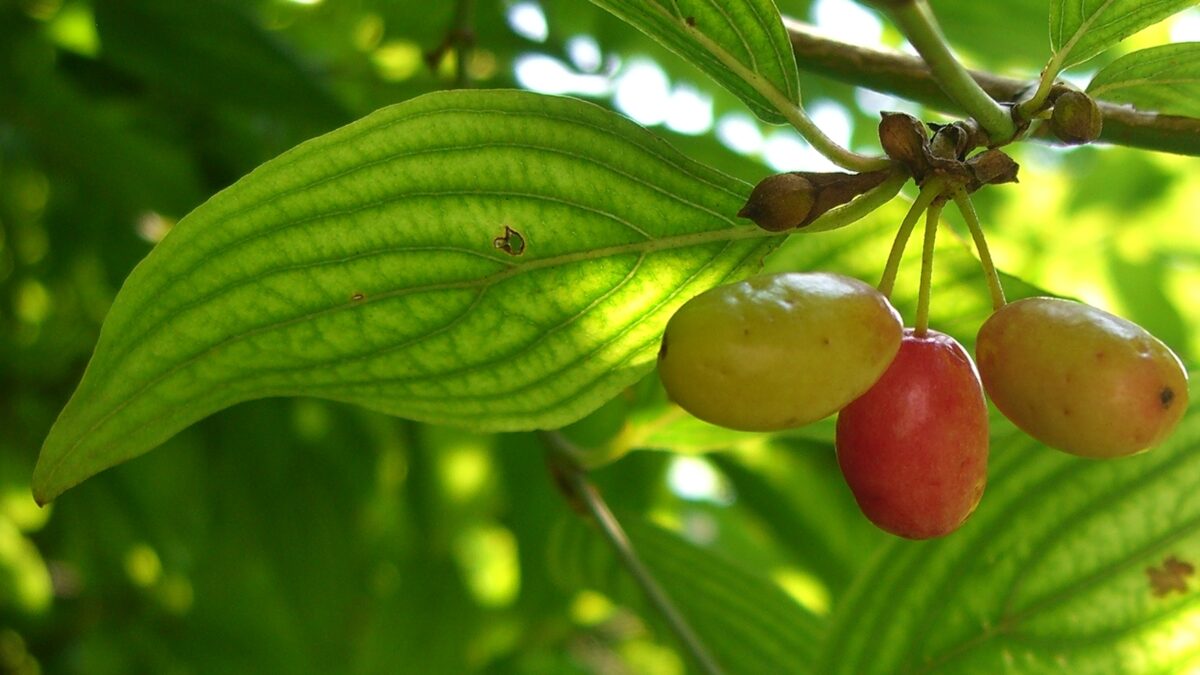
Hon is a dogwood, not a cherry. The tree grows 5 to 12 metres tall, flowers yellow in late winter before the leaves, and carries oblong red fruit about 2 cm long. The USDA’s germplasm records list wild collections from Dilijan National Park in Tavush (7 September 2002) and near Alaverdi in Lori (14 September 2002), with the note that in Armenia the fruit is “sold locally for juice and jam”. That matches what you will see on the ground: the wet, forested north (Tavush, Lori) is hon country, and early-to-mid September is when ripe fruit is coming down.
The taste is the thing to prepare for. An American writer living in Armenia described it as closer to cranberry than to any cherry; the USDA entry calls it a mix of cranberry and sour cherry. Fresh hon is acidic, slightly astringent, and the stone is large relative to the flesh. Fully ripe, dark-red fruit that has dropped from the tree is noticeably sweeter than the bright red fruit still hanging.
Chichkhan: sea buckthorn
Sea buckthorn is a thorny, silver-leaved shrub whose berries sit on the branch so densely that an Armenian chemistry paper compares the look to a corn cob. In Armenia it is both wild and planted. A Soviet-era study in the Armenian Academy of Sciences’ biology journal records that it occurs wild in river floodplains across many districts, and that it was planted on a large scale to stabilise the stony, sandy land exposed when Lake Sevan’s water level was lowered, as well as in roadside shelter belts; it put the planted area at roughly 6,000 hectares at the time (1980s). The ecokayan Armenian nature site adds that it also grows in Vayots Dzor and Syunik, and that you can see the orange bushes around Sevan between August and October.
Timing matters more than for most fruit. A 2020 paper in the Chemical Journal of Armenia (Armbiotechnology centre, Yerevan) says that in Gegharkunik the berries are best picked for juice at the very start of ripening, which it puts at the end of October, and for oil at the end of November when the berries are fattest. Commercial pickers, it notes, often wait for frost: frozen berries come off whole when you tap the trunk with a stick over a plastic sheet. Ecokayan adds that ripe berries stay on the branch until spring and that frozen ones taste faintly of pineapple. So “sea buckthorn season” at Sevan runs from September into early winter, not just a few weeks.
The orange juice is the signature product. Pressed berries give a thick, sharp, slightly oily juice that is almost always diluted and sweetened; the leftover pulp and seeds are extracted for the deep-orange oil. The Academy’s Armbiotechnology centre sells sea-buckthorn oil itself. A 2015 news.am report said a producer was planning an oil-and-juice plant in Martuni, on Sevan’s southern shore, to use the wild stands there; a juice maker called SIS Natural lists “ecologically clean” sea-buckthorn juice in the Spyur business directory. We have not verified either product on a shelf, so treat these as leads, not recommendations.
How Armenians eat them
Almost never raw in quantity; both are too acidic, so the kitchen does the work. The table summarises uses attested in Armenian sources (jam-news, the Smithsonian’s 2018 Armenia folklife programme, ecokayan, the Intangible Heritage office).
| Form | Hon (cornelian cherry) | Chichkhan (sea buckthorn) |
|---|---|---|
| Muraba (fruit in syrup) | Classic. Whole fruit with stones, spooned into tea in winter | Made, but less common; the berry collapses |
| Jam and puree | Common; sold by the jar at GUM | Jam exists; more often juice or puree |
| Compote / juice | Pink-red compote served cold | The main product; diluted and sweetened |
| Ttu lavash / pastegh (fruit leather) | One of the traditional fruits for sour leather | Rare |
| Dried | Dried whole, stones in | Rarely dried at home; sometimes frozen on the branch |
| Oghi (fruit spirit) | Honi oghi, a prized village distillate | Liqueur and infusions, per ecokayan |
| Oil | No | Yes: pressed or extracted from pulp and seed |
Two notes. Muraba is not jam: the fruit stays whole in syrup, and the normal way to eat hon muraba is a spoonful in a glass of hot tea, chewing the flesh off the stone. Honi oghi, the spirit distilled from hon, is rarer than the mulberry oghi you will be offered everywhere. The writer quoted above called it more refined than mulberry; a Tavush distillery, Dovegh, now sells a bottled cornel vodka alongside quince, wild pear and blackthorn versions (a 2024 Aniarc piece lists 16 varieties at roughly 4,000 to 7,000 AMD per half-litre). See our guide to Armenian sweets for the rest of the preserve shelf, and the sujukh and fruit-leather post for how ttu lavash is made.
Folk uses, attributed
Armenians will tell you both berries are “for the immune system”. Hon muraba is the thing a relative brings when you are ill, and families keep a jar specifically for winter colds; the ecokayan site says sea-buckthorn oil is used locally on wounds, burns and skin irritation, and the 2020 Chemical Journal paper frames the oil as a medicinal product with carotenoid content measured in the dozens of milligram-percent. The Armenian Intangible Heritage office’s ethnographer Anzhela Amirkhanyan documents a parallel tradition for rosehip, which was both a folk medicine and a charm against evil spirits. None of this is a health claim on our part. These are traditional uses, reported as such, and the honest summary is: the berries are rich in vitamin C, the rest is folklore and small Armenian lab studies.
Where to taste and buy
Yerevan
Start at GUM market (35 Movses Khorenatsi Street, near Zoravar Andranik metro). The front hall is dried fruit, candied fruit, nuts and sujukh; everything is sold by weight and vendors will hand you samples before you have asked. In autumn the jar stalls carry hon muraba and, less reliably, sea-buckthorn jam or puree; dried hon and sheets of dark-red fruit leather are there most of the year. Ask for “honi muraba” or “chichkhani hyut” (juice). Larger supermarkets usually have bottled sea-buckthorn juice from Armenian brands; read the label, because much of it is sweetened nectar.
Lake Sevan
The bushes are visible from the road along both the west and south shores from late summer. In September and October you will pass people selling bottles of home-pressed orange juice and plastic tubs of berries from car boots near Sevan town, Martuni and the Sevanavank turn-off. This is the only place in Armenia where sea buckthorn is cheap and fresh. Our Lake Sevan guide has the driving loop.
Vayots Dzor and the north
Vayots Dzor has wild sea buckthorn in its river valleys; village shops and guesthouses around Yeghegnadzor sell jars from family batches. Tavush and Lori are the hon regions: the Berd honey-and-berry festival in August, village stalls in September, and almost any guesthouse table in autumn. Ask your host; the best muraba is never for sale, it is given.
A season calendar
- May to June: mulberry (tut) season, the sweet one. Nothing wild and sour yet.
- August: first sea-buckthorn colour at Sevan; early hon in low Tavush valleys; Berd honey and berry festival.
- September: peak hon in Tavush and Lori; rosehip and hawthorn starting; Sevan roadside juice begins.
- Late October: the Armbiotechnology paper’s recommended juice harvest for Gegharkunik sea buckthorn; wild pear and apple drops in the forests.
- November to February: oil harvest and frozen-berry picking at Sevan; jars and dried fruit everywhere; fresh hon is gone.
Windows shift a week or two with altitude and weather. If berries are a reason for your trip, late September is the best single date; our best-time-to-visit guide explains what else that month gets you.
Other wild fruit worth knowing
The Smithsonian’s 2018 Armenia programme lists the standard village forage: wild pear, wild apple, rosehip, cornelian cherry, blackberries and nuts, with knowledge passed orally and specific to each village’s hillsides. A 2008 Yerevan State University botany paper counts 59 wild fruit and berry species in 17 families. The ones you will actually meet:
- Masur (rosehip): gathered in autumn while still firm; dried for tea, boiled into juice and jam, and cooked into dishes with names like masramatsun and masuri spas.
- Szni (hawthorn): drier eastern and southern regions; eaten raw, jammed, or dried for tea.
- Blackthorn and wild plum: distilled in the north (Dovegh’s list includes a blackthorn vodka); sour plums go into the pantry as fruit leather.
- Wild pear and apple: dried in slices and strung up for winter compote; wild pear also becomes oghi.
Practical notes
- Foraging etiquette: the Sevan shore plantings are state forest, not a free-for-all. Picking a handful is nobody’s problem; filling buckets near a village is taking someone’s income. Hon trees near houses are private even when they look wild. Ask.
- Thorns: sea buckthorn has real spines. Gloves, or buy it.
- Washing: roadside berries have been near a road. Rinse; the skins are thin and bruise.
- Stones: hon stones are large and hard. Muraba is eaten around them; do not bite down.
- Jars in luggage: muraba travels fine in checked bags; home-bottled juice does not. Tape the caps.
Verdict
Hon and chichkhan are not on café menus and you will not find a sea-buckthorn latte in Yerevan. They are a pantry culture: jars, bottles, dried sheets and a spoon in tea. The honest caveat is that fresh, they are sour, seasonal and only worth chasing in September and October, and only in the regions that grow them. The upside is that a jar of hon muraba from GUM or a bottle of Sevan juice from a car boot is a better souvenir than anything in a gift shop, and it is the version Armenians actually eat.
Last verified: October 2026. Prices and availability are seasonal and from a single visit window; harvest timing follows Armenian academic and local sources cited above.
Frequently asked questions
What does cornelian cherry (hon) taste like?
Sour and slightly astringent, closer to cranberry or sour cherry than to a sweet cherry, with a large stone. Fully ripe, dark-red fallen fruit is sweeter than bright-red fruit still on the tree. Most Armenians eat it cooked: as muraba in tea, jam, compote, fruit leather or distilled as honi oghi.
When is sea buckthorn season at Lake Sevan?
The berries colour up in August and are picked from September onwards. An Armenian Academy of Sciences paper recommends late October for juice and late November for oil in Gegharkunik, and notes that commercial pickers often wait for frost, when the frozen berries drop whole when the trunk is tapped. The berries stay on the branch into winter.
Where can I buy hon or sea buckthorn products in Yerevan?
GUM market (35 Movses Khorenatsi Street) sells hon muraba, dried hon and fruit leather by weight at the dried-fruit stalls in the front hall, and sea-buckthorn jam or puree in autumn. Supermarkets carry bottled sea-buckthorn juice and jam from Armenian brands; check the label for added sugar.
Are the health claims about sea buckthorn oil true?
Armenian sources report sea-buckthorn oil being used traditionally on burns, wounds and skin irritation, and small Armenian lab studies measure its carotenoid and vitamin content. These are traditional uses and lab figures, not clinical evidence. Treat it as a food and folk remedy, not a medicine.
Featured image: Philipp Weigell, CC BY 3.0 — via Wikimedia Commons.