There is no Sisian honey festival. Search results sometimes suggest one, but what actually exists in Syunik is a “Sisian honey” regional brand project backed by the Lithuanian Embassy, a World Vision raspberry festival near Shaki Waterfall, and a scatter of family apiaries around Goris, Sisian and Tatev that sell from the house, the roadside and a few hotel kitchens. It is still worth buying here: late, slow honey flows from oak forest and alpine meadow, at roughly 3,500–4,500 AMD per kilo (about US$9–12). Here is where it comes from, who you can actually visit, how to spot fakes, and how to get a jar home.
Why Syunik makes good honey
Three things work in the region’s favour: altitude, mixed flora and a long, staggered season. A 2024–2025 field study published in BIO Web of Conferences (AFE-2025) tracked 120 colonies across Armenian apiaries from 600 to 2,000 m and found that honey flows arrive in waves by elevation — lowlands from late May to mid-June, foothills from mid-June to mid-July, and mountain sites from late July to mid-August. Beekeepers who move hives uphill through summer can roughly triple their take, which is why trailers of hives sit on Syunik’s high pastures in July and August. Oak forest dominates the southern provinces; alfalfa and sweet clover are the main cultivated sources.
The Smithsonian’s My Armenia programme (USAID-funded) describes beekeeping as one of Syunik’s most traditional occupations, “thanks to the region’s favorable climate and mixed vegetation”, and records that bread with butter and honey is the area’s most common breakfast — more on that in our Armenian breakfast guide.
The honest caveat: Armenian beekeeping is small-scale and struggling. The same academic paper puts colony numbers at around 200,000, down from 260,000–300,000 in the Soviet period, with average yields falling from 30–40 kg to 5–10 kg per colony. Ampop.am’s analysis of the sector counts roughly 11,000 beekeepers averaging just 17 hives each. A government pilot programme launched in August 2024 subsidises 50% of new colonies. Good honey, in other words, but not much of it.
The “Sisian honey” brand project
According to a news item on the Lithuanian Embassy in Armenia’s website (am.mfa.lt), the embassy took part in the closing event of a project called “Sisian honey brand” on 22 October; the brand created during the project was intended to help beekeepers around Sisian reach buyers inside Armenia. The year of that post is not stated clearly in the version I could read, and I found no evidence of a current shop, website or festival carrying the “Sisian honey” name — so treat it as a label you might see on jars in Sisian, not a destination. If you see the label, ask which village and which beekeeper; it was built as a regional umbrella, not a single producer.
Sisian’s actual summer event is the Raspberry Festival organised by World Vision Armenia at the meadow by Shaki Waterfall, a few minutes from town. Armenpress reported the fourth edition on 27 July 2019 with around 70 Syunik raspberry producers; It is a berry festival first; check World Vision Armenia for whether a given year’s edition is running. For 2026, Armenpress also listed a Navasard Armenian-Iranian culinary festival in Sisian on 10–11 August.
Beekeepers you can visit
Goris: Grisha Harutyunyan and Yeghevnut
The only Syunik beekeeping experience with a documented, bookable format is in Goris. Grisha Harutyunyan — “Grandpa Grisha”, with more than 50 years at the hives — and his daughter-in-law Anush Malintsyan host visitors at his 1913 townhouse, one of the oldest in Goris, which he bought derelict in 1993 and restored. Per the My Armenia programme page: you suit up, open hives with Grisha, then make a beeswax hand cream with Anush (melted wax blended with sunflower, olive or sea-buckthorn oil) and finish with mountain tea and Grisha’s honey. Anush co-founded the Yeghevnut hotel in Goris, which is the practical contact point; the experience is also listed through online tour marketplaces as “beekeeping traditions and beeswax balm making in Goris”. No price is published — confirm with the hotel. It pairs naturally with a day in Goris and Khndzoresk.
Also in Goris, the Smithsonian’s “sweetest route” singles out the Mirhav hotel-restaurant for pakhlava made with honey from the Goris mountains; you can order it or book a class.
Karahunj village: wild cliff honey
Hetq profiled Edward Sinanyan of Karahunj, the village just north of Goris, back in 2013: a beekeeper since 16 who had grown from three hives to 130 and was also harvesting wild honey from the cliffs, which he said sold for three times the price of hive honey. The report is over a decade old, so do not plan around him, but it tells you what to ask for between Goris and Sisian: hive honey (meghr) is standard; wild “cliff” honey is rare and expensive.
Tatev and Sisian: roadside and village sales
I found no individually documented, bookable beekeeper around Tatev or Sisian. What exists is informal: jars sold outside village houses, at the stalls near the Wings of Tatev cable car station in Halidzor, and from car boots on the M2 highway. Fine places to buy if you follow the checks below; for a guaranteed hive visit, go to Goris.
Armenia’s honey types
Armenian honey is mostly polyfloral — the mountains are too mixed for true single-flower honeys, and that is the selling point. Labels and sellers use these categories:
| Type | What it is | Look and taste | Where |
|---|---|---|---|
| Mountain (lernayin) | Polyfloral from alpine and subalpine meadows, typically above 1,500 m | Dense, dark gold, strong; crystallises over winter | Syunik, Vayots Dzor, Gegharkunik |
| Forest (antarayin) | From forest flora, in the south mainly oak woodland and understory | Darker, more aromatic, sometimes slightly bitter | Goris–Tatev–Kapan belt, Tavush, Lori |
| Flower / field (tsaghkayin) | Lowland and foothill meadows, alfalfa, orchards | Lighter, milder, the everyday jar | Ararat valley, foothills everywhere |
| White / sweet-clover | Melilotus (white sweet clover) monofloral; also the pale, fine-grained crystallised honey many sellers call “white” | Very pale, creamy when set, delicate | Small plantings; one Arka-reported apiary grows 10 ha at 2,300 m |
| Thyme, acacia, lime | Partial monoflorals where the plant dominates locally | Thyme: herbal, resinous; acacia: clear, slow to set | Thyme on dry southern slopes; acacia in lowlands |
Two things to know. First, a jar labelled “white honey” is usually mountain honey that has crystallised fine and pale, not a separate botanical type; ask what the bees were on. Second, Vayots Dzor and Syunik honeys are close cousins; the Smithsonian treats them as one “sweetest route”.
Buying honey: markets, roadside and festivals
Where
- From the beekeeper — in Goris, Karahunj, the villages around Sisian, and Halidzor. Best price, best provenance, and you can see the hives.
- Roadside on the M2 — fine, but the seller is often a reseller. Ask which village it comes from and whether they keep the bees.
- Yerevan Honey Fest (“Sweet Days in Yerevan”) — the national honey fair, run by the Beekeeping Workshop Educational Center. The 2025 edition was 27–28 September at Yeraz Garden, 1/8 Tbilisyan Street, 11:00–20:00, free entry, with 20-minute producer masterclasses (listed on armenia.travel). It is the easiest way to taste Syunik against Tavush or Gegharkunik side by side. Confirm 2026 dates on armenia.travel.
- Yeghegis Fest, Vayots Dzor — a honey-centred village festival at Hors, organised by FPWC with the UK Darwin Initiative, the Bears in Mind foundation and the Tourism Committee. Armenpress reported the 2026 edition for 25 July with 40 stalls, 1,500 AMD masterclasses and a 4,000 AMD taxi fare from Yeghegnadzor. It is on the road south to Syunik, so it slots into a southern Armenia road trip if your dates line up.
What to look for
- Crystallisation is good news. Real mountain honey bought after autumn is usually set or setting. A jar that is still water-clear in February is either acacia, heated, or not honey.
- Ask about treatments. Varroa was present in 47% of colonies in the AFE-2025 study; organic-acid treatments leave no residue, synthetic acaricides can.
- Taste before buying. Any honest seller will open the jar. Mountain honey should have bitterness and length, not just sweetness.
- Price that is too low is a flag. Hetq noted back in 2007 that beekeepers hold prices up because customers read cheap honey as fake.
Fake-honey caveats
Adulteration with sugar syrup exists in Armenia as everywhere, and the usual tourist tests (the water-drop test, the “thumb test”) are folklore, not chemistry. The more documented problem is residues: Armenia’s Food Safety Inspection Body’s 2024 report, as summarised by JAMnews, found unacceptably high antibiotic levels in honey samples from Vayots Dzor, Gegharkunik and Lori. Syunik was not named, but it has the same small-apiary structure. Buying from a named beekeeper is the only real protection.
Prices
The AFE-2025 study used market prices of 3,500–4,500 AMD per kilogram for its 2024–2025 economics; FAOSTAT’s producer-price series gives an Armenian farmgate figure of 4,820 AMD (about US$12.50) per kg for early 2025. In practice, as of 2025–2026 reporting, expect roughly 3,500–5,000 AMD per kilo from a village beekeeper in Syunik, more for small branded jars in Yerevan shops or at the cable-car stalls, and a large premium for anything sold as wild or cliff honey. A half-litre jar holds about 700 g. Prices move with the harvest — Hetq reported a 75% regional loss in Syunik in 2021 from drought and disease — so confirm with the producer.
Carrying it home
- Cabin bags: honey counts as a liquid or gel, so the 100 ml rule applies at Zvartnots and at your transfer airport. Put jars in checked luggage, bagged and wrapped in clothing, lid taped.
- EU: personal imports of honey from non-EU countries are permitted in small quantities (the commonly cited limit is 2 kg per person under the EU’s personal-consignment rules); check the current rules for your entry country before you fly.
- UK and US: honey for personal use is generally allowed; declare it if asked.
- Leaving Armenia: no problem with a few jars. (Bringing honey into Armenia, the State Revenue Committee allows 5 kg of packaged animal products without a veterinary certificate.)
Pair it with
Honey is the easy souvenir on a two-day Syunik loop. From Yerevan, stop at Yeghegis or Areni on the way down, sleep in Goris, do the Harutyunyan hive visit in the morning, then the Tatev cable car (jars at the Halidzor stalls), and come back via Sisian and Zorats Karer with Shaki Waterfall — the raspberry festival site — ten minutes off the road.
Verdict
Come for the beekeeper, not a festival that does not exist. Syunik’s honey is late-season mountain polyfloral from oak forest and high meadow, produced by a few thousand very small apiaries, and at 3,500–5,000 AMD a kilo it is one of the better-value things you can carry out of Armenia. Do the Goris hive visit, ask which village and which treatments, and skip anything you cannot trace to a person.
Last verified: October 2026. Festival dates, the Honey Fest venue and prices are from 2025–2026 reporting and should be confirmed with the organisers or producer before you travel.
Frequently asked questions
Is there a honey festival in Sisian?
No. Sisian has a World Vision raspberry festival at Shaki Waterfall (reported editions up to 2019) and a “Sisian honey” regional brand project supported by the Lithuanian Embassy, but no honey festival. Armenia’s honey festivals are the Yerevan Honey Fest in late September and Yeghegis Fest at Hors in Vayots Dzor in late July.
Where can I visit a beekeeper in Syunik?
The documented option is in Goris: beekeeper Grisha Harutyunyan and his daughter-in-law Anush Malintsyan host hive visits and beeswax-cream workshops at his 1913 house, booked through the Yeghevnut hotel. Around Tatev and Sisian, sales are informal, from village houses and roadside stalls.
How much does honey cost in Armenia?
As of 2024–2025 reporting, 3,500–4,500 AMD per kilogram at market, with a FAOSTAT farmgate figure around 4,800 AMD. Expect more for branded jars in Yerevan and a large premium for wild or cliff honey. Confirm with the seller.
Can I take Armenian honey home on a plane?
Yes, in checked luggage; honey counts as a liquid under the 100 ml cabin rule. EU travellers can bring small personal quantities (commonly cited as up to 2 kg) from non-EU countries; UK and US travellers can generally bring honey for personal use. Check your entry country’s current rules.
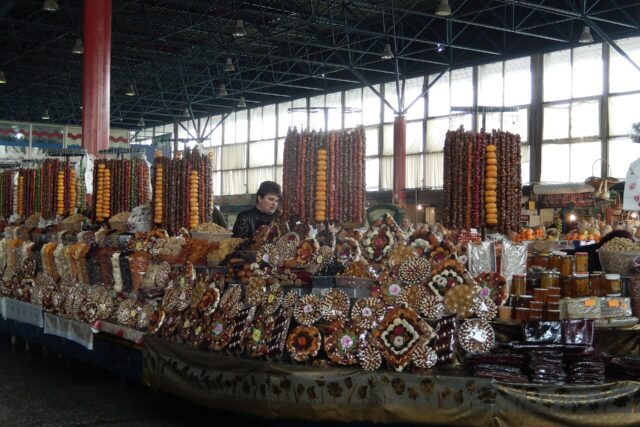
Featured image: Narek Avetisyan /Narek75/, CC BY-SA 4.0 — via Wikimedia Commons.