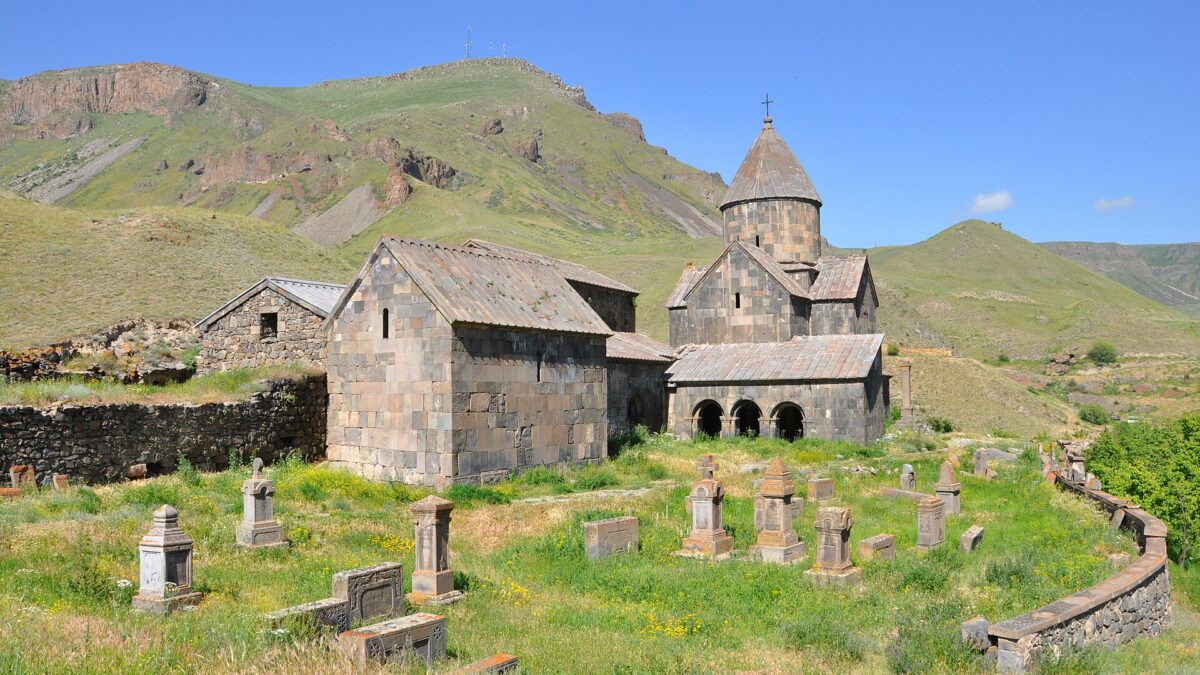
Vorotnavank is a walled monastery on the lip of the Vorotan river canyon, roughly 14 km east of Sisian in Syunik, between the villages of Vaghatin and Vorotnavan. Queen Shahandukht of Syunik built its main church, Surb Stepanos, in the year 1000, and her son Sevada added Surb Karapet six or seven years later; the whole thing was wrecked by the 1931 Zangezur earthquake and has been pieced back together since 1980. The gorge below it carries the rest of the story: the Vorotnaberd fortress on the opposite cliff, an 1855 stone bridge, 37 °C hot-spring pools, and 6 km on the other side of Sisian, the 18 m Shaki waterfall. It is the best half-day near Sisian, and almost nobody on the Tatev run stops.
History: Shahandukht, Sevada and the kingdom of Syunik
Around the year 1000 Syunik was a small Armenian kingdom run from Kapan, and its royal women were serious builders. Shahandukht was the widow of King Smbat of Syunik; Stepanos Orbelian, the 13th-century bishop whose History of the Province of Syunik is the primary source for everything here, records her gifting the village of Tegh to Tatev in 998 in her husband’s memory. Two years later she put up Surb Stepanos at Vorotnavank. The building inscription naming her survives on the church (hushardzan.am, the state heritage register, and the Armenian-language monument literature both cite it). Her younger son, Prince Sevada, built Surb Karapet beside it in 1006–1007.
The site was not empty before them. Orbelian says a small single-nave church of Surb Grigor already stood here, founded in tradition by Gregory the Illuminator and rebuilt by a hermit named Stepanos. That older chapel, not the royal churches, is the one with the snakebite reputation: Orbelian describes it as a place of pilgrimage where people bitten by snakes came to be healed. The gorge’s basalt is full of snakes in summer, which explains the tradition well enough.
After the kingdom fell, the monastery changed hands with the fortress across the river. Seljuk Turks took both in 1104; Ivane Zakarian retook them in the early 13th century and handed them to Liparit Orbelian, which is how the Orbelian family came to own this stretch of the Vorotan. Princes Burtel and Bugda Orbelian paid for repairs in 1315. In the 1340s the philosopher Hovhan Vorotnetsi (1315–1386), who later founded the university at Tatev, moved his school here from Gladzor, and his pupil Grigor Tatevatsi copied a manuscript at Vorotnavank in 1386, the same year Timur’s army besieged the fortress below. An abbot rebuilt Surb Grigor in 1438; by the early 20th century the monastery had stopped functioning.
What’s on site
The complex sits inside a roughly rectangular enclosure wall on a spur above the canyon. Inside, from west to east:
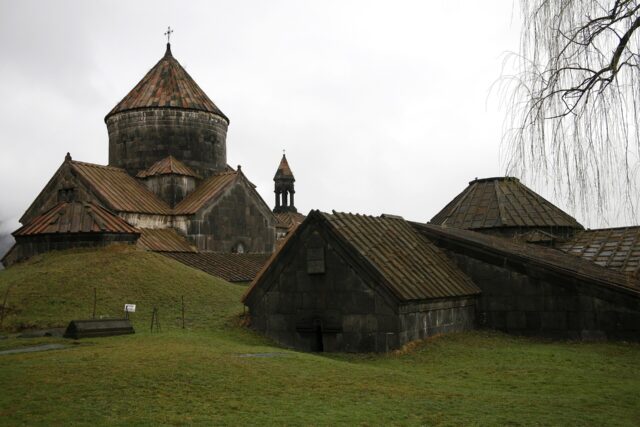
- Surb Stepanos (1000) – the main church. A domed cross-plan with four corner chambers, built of local basalt. In an apse there is a fragment of fresco: an angel against a dark blue, star-filled sky. It is faint, but it is one of the few medieval wall paintings in Syunik outside Tatev.
- Surb Karapet (1006–1007) – Sevada’s church, attached on the east side, taller than its neighbour, a domed hall with four sacristies. This is the building the earthquake destroyed; its dome and roof are reconstruction.
- The gavit – a vaulted narthex added to the west of Surb Stepanos at the start of the 11th century. Its floor is paved with gravestones.
- Surb Grigor – the small single-nave chapel, still partly ruined, with the pilgrimage tradition described above.
- Khachkars and gravestones – the cemetery and walls carry cross-stones dated from the 9th to the 14th century and some well-cut figurative gravestones. Look at the cornices of the oldest chapel for carved plant and animal motifs.
- Service buildings – Shahandukht’s foundation included a guesthouse, workshops and storerooms; a seminary, a hospice and the burial vault of a local princely family are also recorded.
The honest caveat: a lot of what you see is 1980s–2010s masonry. It uses the same basalt and does not shout, but for untouched medieval fabric concentrate on the Stepanos interior, the gavit and the khachkars.
The 1931 earthquake and today’s condition
On 27 April 1931 a magnitude 6.5 earthquake centred in the Zangezur mountains destroyed or badly damaged 57 villages in the Sisian–Goris area (ISC-GEM catalogue figures). At Vorotnavank it brought down the dome and roofs of Surb Karapet, toppled khachkars and colonnades, and collapsed sections of the enclosure wall and outbuildings. Reconstruction began in 1980 and further phases are recorded for 2012 and 2017; the standing churches are now roofed and the walls rebuilt. It is not an active monastery. There is no ticket office, no fixed opening hours and, on the visits reported by travellers, usually no one in attendance; treat it as an open monument and confirm locally in Sisian if you want to be sure someone will have unlocked the church doors.
The Vorotan gorge around it
Vorotnaberd (Davit Bek’s castle)
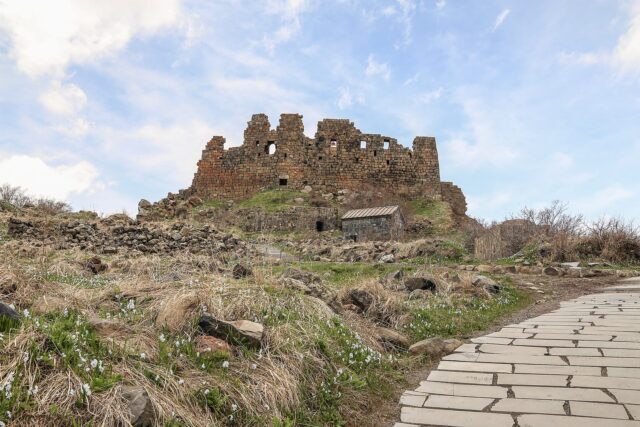
Across the river and about 3 km south-east of the monastery, on a triangular rock on the right bank, is the ruin of Vorotnaberd, the fortress that controlled this valley. The chronicler Eghishe already mentions it in the 450s. Its known owners run from King Senekerim of Syunik (1075–1094) through the Seljuks, the Orbelians, Timur’s siege in 1386 (two Orbelian princes were carried off to Samarkand) and Kara Yusuf in 1407, to Davit Bek, who took it from a local melik in 1724, which is why villagers call it Davit Bek’s castle. What survives: stretches of basalt wall 3–5.5 m high, a semicircular tower at the eastern end, a cistern, and the trace of a passage down to the river that supplied water during sieges (the ethnographer Ervand Lalayan recorded it). It is a scramble, not a path.
Melik Tangi bridge and the hot springs
Directly below the fortress a single-arch stone bridge built in 1855 by Melik Tangi crosses the Vorotan, about 20 km east of Sisian by road. Beside it a thermal spring at a steady 37 °C was channelled into concrete pools in the Soviet period. Locals swim here in summer; it is free and unsupervised. Further downstream the river is dammed into the Shamb reservoir, part of the Soviet-era Vorotan cascade of three reservoirs that also feeds a 21.6 km tunnel to Lake Sevan.
Shaki waterfall
Shaki is 6 km north of Sisian, on the opposite side of town, where a tributary drops 18 m over a basalt ledge. A small hydropower plant takes the water, and until 2017 the falls were often dry when tourists arrived. Since 2017 a government water-use regime bars the plant from diverting the stream between 11:00 and 17:00 from 15 March to 30 April and 1 October to 15 November, and 11:00 to 19:00 from 1 May to 30 September. Outside those windows, and in the winter months, expect a trickle. The environmental group EcoLur filmed the plant running inside the banned hours in August 2020, so the schedule is a rule, not a guarantee; if the falls matter to you, ask in Sisian that morning.
The Tatev side and the “swinging bridge”
The same river carves the canyon under Tatev, 45 minutes further on, where the natural travertine arch called Devil’s Bridge and its warm pools sit on the canyon floor. One clarification, because the phrase gets attached to this gorge: there is no verified “swinging bridge” on the Vorotan near Vaghatin. The swinging bridge people mean is the 160 m suspension footbridge at Khndzoresk near Goris (opened June 2012, 63 m above the ravine), which is on a different river entirely; see our Goris and Khndzoresk guide.
Getting there
| Leg | Distance | Notes |
|---|---|---|
| Yerevan → Sisian | ~207 km, 3 h | M2 south via Yeghegnadzor and the Vorotan pass; Sisian is 4 km off the highway |
| Sisian → Vorotnavank | ~14 km, 20–25 min | East through Aghitu and Vaghatin; the last stretch descends into the canyon |
| Goris → Sisian | ~38 km, 35 min | M2 north-west; easy to fold in on a Tatev day |
| Sisian → Shaki waterfall | ~6 km, 10 min | North of town, signed |
From Sisian take the road east along the north side of the river through Aghitu to Vaghatin, then follow the road down toward the gorge; the monastery is on the right on a short paved spur. The canyon road is narrow, with hairpins, and in places broken; any car does it in dry weather, but go slowly after rain and in early spring. If you are driving yourself, our car rental and driving guide covers what to expect on Syunik roads. There is no public transport to the monastery; a Sisian taxi for the loop (Vorotnavank, hot springs, back) is the usual fix.
From Goris or Tatev the simplest plan is to sleep in Goris, do Sisian’s sights as a morning, and continue to Yerevan, which is how most southern Armenia road trips run it.
A Sisian-area half-day
- 09:00 – Zorats Karer (Karahunj), 3 km north of Sisian on the highway side. Early light is best on the stones.
- 10:00 – Vorotnavank. Allow 45 minutes to an hour.
- 11:15 – Continue down to Melik Tangi bridge and the hot pools; look up at Vorotnaberd. Swim if it is warm.
- 12:30 – Back through Sisian for lunch.
- 13:30 – Shaki waterfall, timed inside the 11:00 flow window.
Doing Shaki last is deliberate: it is the one stop that depends on the clock.
When to go
May to June and September to mid-October. The gorge is green in late spring and the waterfall schedule is in force. July and August are hot on the exposed spur (Vorotnavank is around 1,400 m but has no shade) and the snakes are active, which is worth keeping in mind on the fortress scramble. From mid-November to March the Shaki plant has no flow obligation and the canyon road can ice.
Practical notes
- Entry is free; there is no ticket, no toilet, no shop. Bring water.
- The enclosure is unfenced on the canyon side; watch children at the wall’s edge.
- Phone signal is patchy in the gorge; download the map first.
- Combine with Tatev only if you start early: Sisian to the Tatev cable-car station at Halidzor is about 55 km.
Last verified: October 2026. Waterfall hours, road condition and whether the churches are unlocked change; confirm locally in Sisian.
Worth it?
Yes, and more than most second-tier Syunik monasteries. Tatev gets the crowds; Vorotnavank gets a queen’s inscription, a starry fresco, a fortress to look across at and a canyon without a ropeway over it. The honest ranking: if you have one day in the south it is still Tatev. If you have a night in Sisian or Goris, this half-day is the best thing you can do with the morning.
Frequently asked questions
How far is Vorotnavank from Sisian and can I get there without a car?
About 14 km east of Sisian by road via Aghitu and Vaghatin, roughly 20–25 minutes. There is no public transport to the monastery; hire a Sisian taxi for the loop or drive yourself.
Is Shaki waterfall always flowing?
No. A small hydropower plant diverts the stream. Since 2017 it must leave the water in the river 11:00–17:00 (15 Mar–30 Apr, 1 Oct–15 Nov) and 11:00–19:00 (1 May–30 Sep). Outside those hours and in winter the falls can be nearly dry, and the rule has been broken before, so ask in Sisian that morning.
Which church at Vorotnavank is the snakebite church?
The small, older Surb Grigor chapel, not the royal churches. Stepanos Orbelian’s 13th-century history describes it as a pilgrimage place where people bitten by snakes came for healing.
Is there a swinging bridge in the Vorotan gorge?
Not near Vorotnavank. The 1855 Melik Tangi bridge below Vorotnaberd is stone. The swinging bridge people mean is the 160 m suspension footbridge at Khndzoresk near Goris, on a different ravine.
Featured image: Soghomon Matevosyan, CC BY-SA 4.0 — via Wikimedia Commons.