Nardi (նարդի) is what Armenians call backgammon, and in Armenia it is less a board game than a background noise. From May to October the clack of checkers comes out of courtyards, park benches and the pavement tables of cafés, almost always with two men over sixty bent over a walnut board and a third man commenting. This guide covers how the two local variants differ from the backgammon you may know, the Persian-derived words players shout at the dice, the bronze player on Gevorg Kochar Street, where to watch or get invited into a game, what a hand-carved board costs, and the etiquette that keeps you from being the annoying foreigner at the table.
Nardi in daily life
The first thing a visitor notices is who plays and where. In 2007 the blogger Onnik Krikorian, quoted by Global Voices, called nardi-playing seniors “an omnipresent sight” in Yerevan whenever the weather is warm, and nothing has changed since. Travel writer Sharon Paige described the “clack-clack-clack” from shaded courtyards and sidewalk cafés as the city’s pulse. The Soviet-era courtyards (բակ, bak) of Kentron and Arabkir are the classic setting: a folding table, a board that has lost half its varnish, and an audience that never stays quiet.
It is officially a men’s game and in practice a mixed one. A 2012 Armenpress feature put the National Nardi Federation at about 300 members, a third of them women, and quoted the federation president Khachik Melikyan on rising interest at both amateur and tournament level. Ethnographer Suren Hobosyan, in the same piece, described the typical player as a hot-blooded man who hates to lose, which explains the volume. The federation runs tournaments in both variants; a 2019 event in Ejmiatsin (Vagharshapat) drew about 30 players, the youngest 19, with separate prizes for short and long nardi.
It is also a café game, paired with Armenian coffee the way chess pairs with tea in Russia. Older cafés often keep a board behind the counter; ask for it, buy something, hand it back.
Long nardi vs short nardi: the rules a visitor needs
Armenians distinguish երկար նարդի (yerkar nardi, long) and կարճ նարդի (karch nardi, short). Short nardi is essentially Western backgammon. Long nardi is the variant you will see on most courtyard tables across the Caucasus and the ex-Soviet world, and it is the one most likely to confuse you, because it removes the single mechanic a backgammon player relies on: hitting.
| Rule | Long nardi (երկար) | Short nardi (կարճ) = standard backgammon |
|---|---|---|
| Starting position | All 15 checkers stacked on one point, the “head” (Russian golova), in your far-left corner | Split across four points (2-5-3-5) |
| Direction | Both players move counter-clockwise along parallel tracks; you never meet head-on | Opposite directions |
| Hitting | Never. One opposing checker fully blocks a point | A lone checker is hit and re-enters from the bar |
| Leaving the head | Only one checker per turn (a first-roll double of 6-6, 4-4 or 3-3 usually allows two) | No such restriction |
| Blocking | You may not build a wall of six consecutive points unless at least one enemy checker is already ahead of it | Six-primes are legal and encouraged |
| Doubling cube | Not used in casual play | Used in club and tournament play |
| Scoring | 1 point (oyn) for a win, 2 for a mars (opponent has borne off nothing) | 1, 2 for a gammon/mars, 3 for a backgammon/koks |
The long-nardi column follows the Russian-language rule sets (Lifehacker, the Russian sports backgammon federation) that Caucasus players broadly share; the six-block and first-double exceptions vary by table, and Armenpress noted in 2012 that rules common in Armenia differ from those used at European and world championships. The honest caveat: ask before the first roll which variant and which house rules apply. With no hitting, long nardi is all tempo and lane-blocking; expect to lose your first ten games to anyone over fifty.
The vocabulary of the dice
Players across the former Persian and Ottoman world call out dice rolls with Persian numerals, and the Armenian table is no exception. The core set is yek (1), du (2), se (3), chahar or jahar (4), panj or penj (5) and shesh (6). The 2017 North American Computational Linguistics Olympiad used Turkish tavla roll names as a puzzle precisely because they are a “curious mixture of Persian and Turkish” with heavy regional variation; the same mixture shows up around Yerevan tables.
- Du-shesh (2-6): the most-shouted call; dü şeş in Turkish, the same words in Persian.
- Shesh-besh (6-5): Persian shesh (six) plus Turkish beş (five). It is so famous it became another name for the game from Israel to the Caucasus, as the Jewish Journal and Encyclopaedia Judaica both note.
- Du-bara (2-2) and the doubles generally get their own cries; hep-yek (1-1, “all ones”) is the roll you groan at.
- Chahar-u-se, panj-u-du, shesh-u-yek: the pattern is simply the two numbers joined, higher number first, sometimes with the Persian connector u.
Steingass’s Persian dictionary lists shash u panj, “sixes and fives”, as a word for both dice and confusion, which shows how old the habit is. Two cautions: pronunciation shifts by speaker, and Armenian players also use plain Armenian numbers (մեկ, երկու, վեց) when not performing; and we found no scholarly list of specifically Armenian roll names, so treat the forms above as the regional lingua franca, not a fixed Armenian canon. The numbers in our Armenian phrases guide will get you further than a Persian glossary.
The Yerevan backgammon-player statue
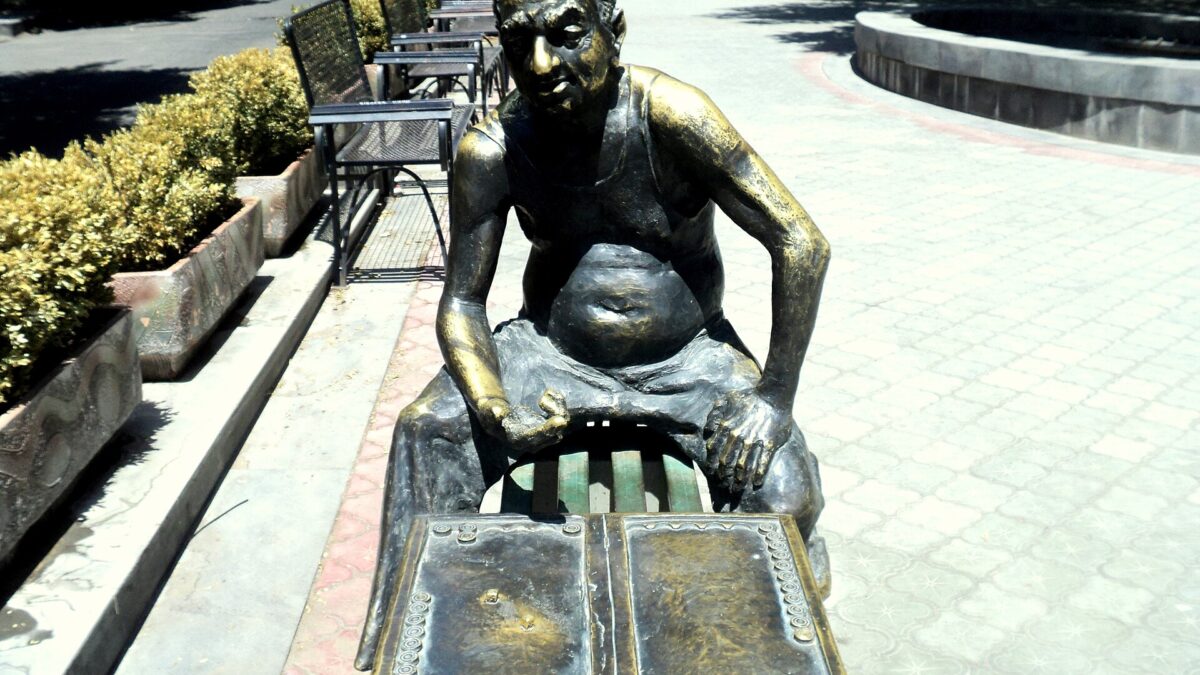
Yerevan put the game in bronze. In 2007 the city raised “The Backgammon Player”, the first in a planned series called Characters of Yerevan, on Gevorg Kochar Street in Kentron, a few steps from the Hrachya Ghaplanyan Dramatic Theatre and about ten minutes’ walk from Republic Square. The sculptor was Eduard Shakhikyan, who worked with students of the Yerevan State Institute of Theatre and Cinema; the Kentron district administration backed the project, and the stated aim was to evoke the old Yerevan courtyards “where, on summer evenings, people gather and play their favourite game” (Yerevan Magazine, via idea.am). The life-size figure hunches over a detailed board; the seat opposite is empty, which is the point. Sit, take the photo. Some travel aggregators credit the concept to a student project mentored by Ruben Jaghinyan; we could not confirm that from a primary source.
Where to watch or join a game
Being honest: there is no scheduled, ticketed nardi experience, and that is the appeal. What works:
- Courtyards off Mashtots, Sayat-Nova and Komitas avenues, late afternoon onward from May to October. Stand at a polite distance, watch two games, then ask “կարելի՞ է” (kareli e?, “may I?”) with a nod toward the board. You will usually be waved to a chair or, more often, told to play the winner.
- Parks. Spotted by Locals lists Prague Park, off Komitas Avenue in Arabkir, as a regular spot for chess and nardi.
- Old-style cafés and teahouses. Ask for a board (նարդի) rather than waiting to be offered one.
- Federation tournaments. The National Nardi Federation and municipalities (Ejmiatsin in 2019, for instance) hold open events; spectators are welcome, but dates are announced on Armenian-language social media, so ask your host to check.
Outside Yerevan it is the same, only friendlier. See the Yerevan travel guide for the neighbourhoods where courtyard life is still intact.
Buying a board
The Vernissage market, the weekend craft market a block east of Republic Square, is where most visitors buy. Boards there are carved from walnut or oak with Mount Ararat, Tsitsernakaberd, grape vines or the Armenian alphabet on the lid, as the Fund for Armenian Relief’s portrait of the market describes. The Ohanyan workshop in Armavir (profiled by Homo Faber) says a board passes through at least 14 production stages, which is why a serious one is not cheap.
What to check before paying:
- Solid wood, not veneer over MDF. Look at the edge of the lid; end grain should be visible.
- Flat playing surface and clean hinges. Warped boards and loose brass hinges are the two common faults on cheap stock.
- Checkers and dice included, ideally wooden checkers that are all one weight. Count them: 15 per colour.
- Size. A 30 cm board fits a carry-on; a full-size 50 to 60 cm board needs checked luggage.
Price is the part we cannot pin down with a source. Armenian-made carved boards sold online list at roughly US$120 (30 cm), US$150 (40 cm) and US$290 (60 cm); at Vernissage expect less for plain boards, more for inlaid ones, and 10 to 20 percent bargaining. Orientation figures, not quotes.
Etiquette: how not to embarrass yourself
- Ask which variant before the first roll. Assume long nardi in a courtyard, short nardi in a federation hall.
- A die that lands cocked or off the board is re-rolled; your opponent will say so loudly.
- Snap the checker down. The slam is part of the game, not aggression.
- Shouting the roll name is welcome. Swearing at the dice is traditional. Swearing at your opponent is not.
- Winner stays; loser gives up the chair. If you win, expect a rematch demand.
- No money. Casual games are for coffee, not cash, and a visitor offering stakes reads badly.
- Thank the table (շնորհակալություն, shnorhakalutyun) and offer to buy the coffee if you played in a café.
A short regional history
Keep this one neutral: nardi is a game of the whole Persianate and Caucasian world, and nobody in Yerevan seriously claims otherwise. The name comes through Persian nard, short for Middle Persian nēw-ardaxšīr, “brave Ardashir”, linking it to the Sasanian dynasty’s founder. The best-known origin story is the Middle Persian text usually translated as The Explanation of Chess and the Invention of Backgammon, in which the sage Wuzurgmihr beats an Indian envoy at chess and then invents nard, loading the board with cosmology: the counters turn like the days and the dice roll like fate. Christopher Brunner published the standard English treatment in 1978 (Journal of the Ancient Near Eastern Society), dating the text in its present form to around the ninth century but its courtly tale to the reign of Khosrow I (531 to 579). Iain Gardner’s 2020 article in the Bulletin of SOAS pushed the motif back further with a parallel fourth-century source, so the legend is older than the manuscript.
Race games with dice are older still; the Encyclopaedia Judaica entry on sheshbesh notes board variants in Sumer around 2600 BCE. The game spread under dozens of names: takht-e nard in Iran, tavla in Turkey, tavli in Greece, nardi across the South Caucasus. Armenia sat between all of them under Persian, Ottoman and Russian rule in turn, which is how Persian numerals survived on Armenian tables. The Soviet period, which put benches in every courtyard, is the era today’s players actually learned in.
Verdict
Learn long nardi before you arrive, if only on a phone app, because that is the game on the table. Then spend one late afternoon in a Kentron courtyard losing gracefully. The statue is a two-minute photo; the game is the thing. A carved walnut board is the one souvenir you will still be using in twenty years, provided you check the hinges.
Last verified: October 2026. Federation details and tournament dates change; confirm locally.
Frequently asked questions
Is nardi the same as backgammon?
Short nardi (karch nardi) is standard backgammon with hitting and the usual split start. Long nardi (yerkar nardi), the common courtyard game in Armenia and the wider Caucasus, starts with all 15 checkers on one point, moves both players the same direction and has no hitting at all, which changes the strategy completely.
Where is the backgammon player statue in Yerevan?
On Gevorg Kochar Street in central Kentron, next to the Hrachya Ghaplanyan Dramatic Theatre, about ten minutes on foot from Republic Square. The bronze by Eduard Shakhikyan was installed in 2007 as the first of the city’s Characters of Yerevan series. It is free and outdoors; the empty seat opposite is for your photo.
Can a tourist join a nardi game in Armenia?
Yes, and it is the best way to meet older Yerevan residents. Watch a couple of games in a courtyard or park, ask ‘kareli e?’ (may I?), and you will usually be told to play the winner. Expect long nardi rules, no money, loud dice calls, and a rematch demand if you win.
How much does a hand-carved nardi board cost at Vernissage?
There is no fixed price list. Armenian-made carved walnut or oak boards sell online for roughly US$120 (30 cm) to US$290 (60 cm); at the Vernissage market in Yerevan plain boards go for less and heavily carved or inlaid ones for more, with 10 to 20 percent bargaining normal. Check for solid wood, flat surface, sound hinges and a full set of 30 checkers.
Featured image: Armineaghayan, CC BY-SA 3.0 — via Wikimedia Commons.