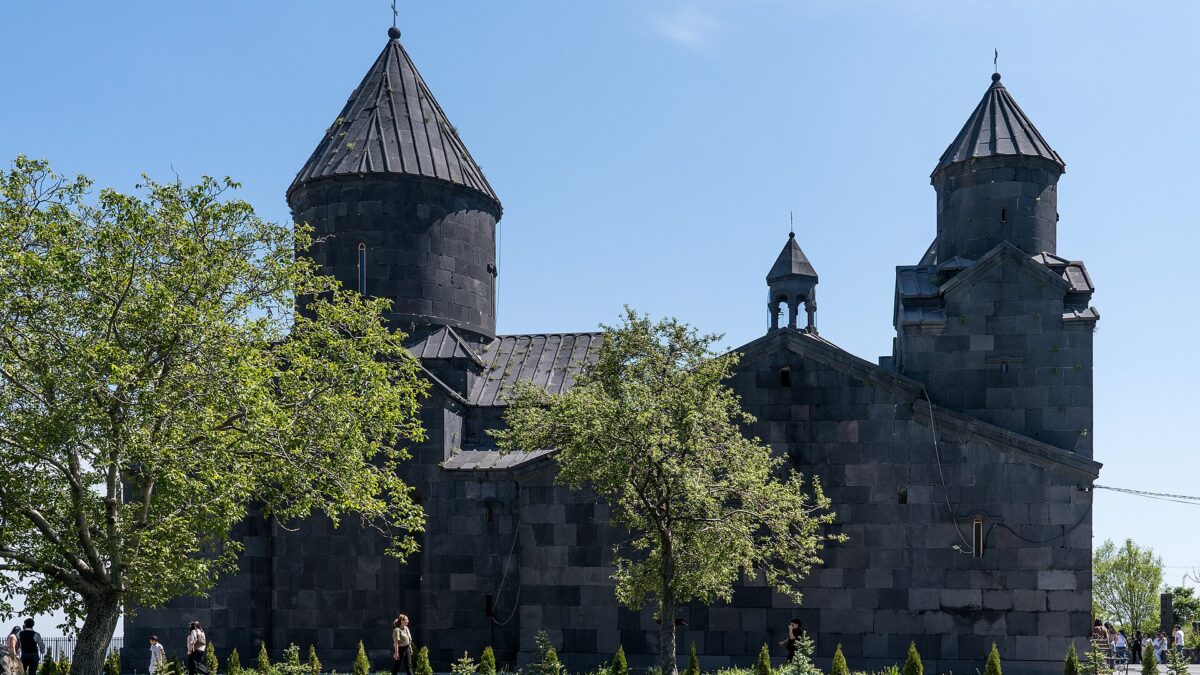
Tegher Monastery (Տեղերի վանք) is a 13th-century church-and-gavit complex at roughly 1,690 m on the southern flank of Mount Aragats, about 40 km north-west of Yerevan and a 15-minute drive above Byurakan. It was paid for by Princess Mamakhatun of the Vachutian family between 1213 and 1232, and its gavit is one of only two in Armenia with full domed chapels built on the roof corners. Almost nobody stops here: tour buses go to Amberd and Saghmosavank instead. That, plus a clean view across the Ararat plain, is why it belongs on your Aragats day.
History: the Vachutians and Mamakhatun
Nothing in the medieval chronicles describes Tegher. Everything we know comes from the 57 inscriptions cut into its walls, read and re-read by scholars from the 1830s to a full survey by Samvel Karapetian of Research on Armenian Architecture (RAA), published in 2013 for the monastery’s 800th anniversary. It is the source for the dates below.
The patrons were the Vachutians, a princely house that rose under the Zakarian brothers Zakare and Ivane, who ran northern Armenia for the Georgian crown in the early 1200s. Vache I Vachutian held Aragatsotn, Amberd and Nig; a 1213 inscription at Tegher names him as the district overseer appointed by Zakare. His wife Mamakhatun was the daughter of Prince Abusir (Apusehr), who appears in the Horomos inscriptions. The couple were serial builders: Saghmosavank’s main church in 1215, Surb Karapet at Hovhannavank in 1216-1221, and Tegher.
The sequence at Tegher, per Karapetian’s reading of the stones:
- 1213 – the church of Surb Astvatsatsin (Holy Mother of God) is finished. Three inscriptions carry this date, one of them naming “Zakare the Shahenshah and Ivane”.
- 1221 – the architect signs the gavit. On a pillar capital: “In the year 670 (1221), I, architect Aghbayrik, built this church and narthex.” Aghbayrik, a vardapet (learned cleric), also worked at Saghmosavank and Hovhannavank, and the RAA credits him with the prototype of Tegher’s rooftop chapels at Yeghipatrush.
- 1232 – Mamakhatun’s own inscription on the gavit’s west door records that she built “the large and small churches, together with a narthex, in memory of my husband Vache and me.” Karapetian reads 1232 as the completion date of the whole complex, slowed by the first Mongol raids, not as a second building phase.
Sources differ on details: 19th-century clerics dated the foundation to 1231 or 1232, and one modern view holds the rooftop chapels were a 1232 afterthought, which the RAA rejects because donation inscriptions on the west gable also carry 1221. Mamakhatun is said to be buried in the gavit, which holds 44 tombstones. From the 1600s the monastery was also called Lrjakapuyt Surb Nshan (“Azure Holy Sign”).
It then had a long, poor afterlife. In 1766 Catholicos Simeon toured Aragatsotn and found Tegher in debt, earthquake-cracked and neglected; his plan to revive it never happened. The 1948 earthquake split the walls, and Soviet restorers rebuilt the drums in 1950-1953 and the roofs in 1975-1976.
Architecture: church, gavit, rooftop chapels, columns
Everything is dark grey basalt, dressed and almost undecorated. If you have been to Hovhannavank you will recognise the family resemblance; a traveller in 1816 said as much.
The church (1213)
Surb Astvatsatsin is a small domed hall with a cruciform interior, a two-storey corner chamber in each angle, and a semicircular apse. Interior columns: none; the drum rests on the corner piers. Outside it is a plain rectangle with a pointed, umbrella-style roof on the drum, a few wall niches and windows on three sides, and ornament limited to cornice mouldings and arch edging.
The gavit (1221-1232)
The gavit is bigger than the church it serves, which is normal for Vachutian commissions. Four free-standing columns, each cut from a single block of stone according to an 1830s description, carry intersecting arches, and on the square they form sits a dome with a central oculus. The columns are massive and stubby, the floor is paved with grave slabs, and the space feels like a crypt until your eyes adjust. Look for Aghbayrik’s 1221 signature on the north face of the south-east pillar capital, and for the donor crosses on the walls: each cross relief with a line of text beside it is a paid memorial.
The rooftop chapels
This is the reason to come. On the south-west and north-west corners of the gavit roof stand two complete small churches, each with its own drum and conical dome, each with an altar inside. Their doors open onto the roof. From a distance the complex reads as three domes, one big and two small, which is why old descriptions call Tegher a “three-domed” monastery. Double-domed gavits exist elsewhere (Horomos, Nor Varag), but there the chapels sit beside the hall. The RAA notes that only Tegher and Yeghipatrush put the churches directly on top of the gavit. One guidebook tradition says the upper rooms housed the monastery’s students and served as a refuge in troubled times; the inscriptions do not say this, so treat it as plausible rather than proven.
The honest caveat: you cannot normally get onto the roof, so you see the chapels from below and from the slope above the monastery.
What you will see, and the view
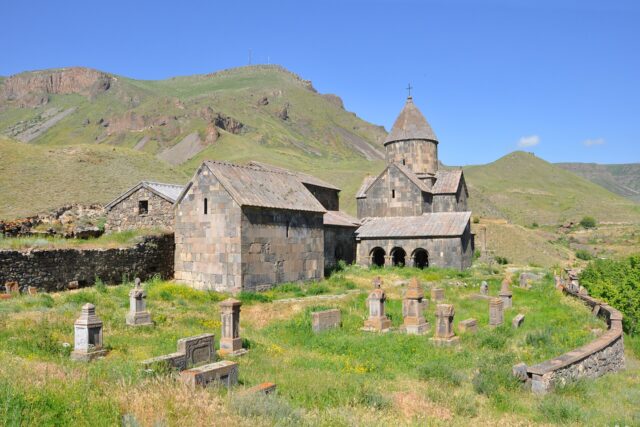
The complex sits on a shelf at the edge of a small gorge that drains into the Amberd ravine. Inside the walls (rebuilt in the 15th century and again in the late 1700s) you get: the church, the gavit, khachkars from the 11th to 16th centuries set into the walls and lying around the yard, and fragments of a 5th-7th-century red-tuff cross and a 1180 cross-stone reused inside the gavit, proof that a khachkar cemetery stood here before the monastery. A short walk away are the ruins of Old Tegher (a 9th-century village), the Tukh Manuk chapel and an old cemetery.
The view is south over the Ararat plain. On a clear day Mount Ararat stands behind the Byurakan telescopes; in summer haze you get the plain and not the mountain. Mornings are clearer than afternoons.
Getting there
| Leg | Distance / time by car | Notes |
|---|---|---|
| Yerevan to Ashtarak | ~20 km, 30 min | M1 highway, then follow signs for Byurakan |
| Ashtarak to Byurakan | ~13 km, 15 min | Paved; observatory is at the top of the village |
| Byurakan to Tegher | ~15 min | Via Orgov village; the monastery is 1.2 km west of Orgov and signposted off the road |
| Tegher to Amberd | ~20 min | Rejoin the Amberd/Kari Lake road above Byurakan |
| Amberd to Kari Lake | ~20-25 min | Only when the road is clear of snow |
Public transport reality. Bus 519 runs from Yerevan’s Kilikia bus station to Byurakan, about 70 minutes and roughly 400 AMD; the timetable published by Wikivoyage lists departures at 10:30, 13:00, 14:25, 15:50, 17:40 and 19:55, but buses are known to skip runs, and locals share taxis when that happens. From Byurakan you are on your own: no scheduled service goes to Tegher (population under 60 at the last census). Either walk about an hour via Orgov, or negotiate a taxi in Byurakan. For a day covering Amberd and Kari Lake too, a hired car or taxi from Yerevan is the only arrangement that works; see our driving and car-rental guide.
The Aragats day: Tegher, Byurakan, Amberd, Kari Lake
The four sites line up on one mountain, but the order matters because of altitude and light.
- 08:00 leave Yerevan.
- 09:00 Tegher first. You get the panorama before haze builds, and you will have the place to yourself. 45-60 minutes.
- 10:15 Byurakan Observatory. Guided visits need pre-booking and run around 1.5-2 hours; the standard tour shows the 2.6 m and 1 m Schmidt telescopes and the Ambartsumian house-museum. Details in our Byurakan Observatory guide. If you want the night-sky programme instead, do the mountain in the afternoon and finish here after dark.
- 12:30 Amberd. The 7th-13th-century fortress and the 1026 Vahramashen church at about 2,300 m, 20 minutes above Byurakan. One to 1.5 hours. Full write-up in our Amberd fortress guide.
- 14:30 Kari Lake, 3,200 m, the trailhead for the Aragats southern-summit climb. Half an hour by the lake, then 1.5 hours back to Yerevan.
Total driving is under four hours. With only half a day, pair Tegher with Amberd; both are Vachutian-era sites facing Ararat.
When to go
Tegher itself, at 1,690 m, is reachable all year; snow on the village road is cleared, but check after a storm. The constraint is the rest of the mountain. The Kari Lake road is usually open from roughly mid-May to mid-October and snowbound otherwise; Amberd’s road opens a little earlier and closes a little later. The lake can still have ice and snowbanks into July. Best months for the full loop are June and September: June for green slopes and wildflowers, September for stable weather and the clearest Ararat views.
Practical
- Entry: free. There is no ticket office and no fixed hours. The yard is always open; the church and gavit are generally unlocked in daytime, but it is a working Armenian Apostolic church with services held on feast days and a caretaker from the village looks after it. If you find the door shut, ask at the first houses in Tegher for the key (confirm locally; this is how most small Armenian village churches work).
- Facilities: none at the monastery. No cafe, no toilets, no shop. Byurakan has small shops and guesthouses; Ashtarak has restaurants.
- Village etiquette: Tegher is tiny and the monastery is the villagers’ parish church, not a museum. Dress modestly inside, keep voices down if a service is on, do not climb on the gavit roof, and do not move or lean on khachkars.
- Condition: the RAA flagged loose roof slabs in 2013. Some are still displaced; watch your footing in the yard after rain.
- Time: 45-60 minutes, more with the walk to Old Tegher.
Worth it?
Yes, with one condition: go in combination, not as the day’s goal. As a building, Tegher sits a tier below Geghard, Haghpat or Noravank, and not far behind its siblings Saghmosavank and Hovhannavank. What lifts it is the rooftop chapels, which you will not see anywhere else in the country, and the fact that in two visits’ worth of time you are likely to be alone. If you are already driving to Amberd or the observatory, the detour costs 30 minutes and is the best half hour of the day. If you are compiling your own list from our best monasteries in Armenia, Tegher is the one to add for architecture nerds and for anyone who wants Ararat without a crowd.
Last verified: October 2026. Dates and inscription readings follow S. Karapetian, “Tegher Monastery”, Vardzk no. 10 (RAA, 2013). Transport times are typical driving times; bus schedules change, so check the Kilikia station board on the day.
Frequently asked questions
Who built Tegher Monastery and when?
Princess Mamakhatun, wife of Prince Vache I Vachutian, between 1213 and 1232. The church was completed in 1213, the gavit was signed by architect Aghbayrik in 1221, and Mamakhatun’s own inscription on the gavit door is dated 1232, which the RAA survey treats as the completion of the whole complex.
What is unusual about Tegher's gavit?
Two complete small domed churches stand on the north-west and south-west corners of its roof, each with its own altar. Only Tegher and Yeghipatrush in Armenia have chapels built directly on top of the gavit; elsewhere, such chapels sit beside the hall.
Can I visit Tegher Monastery without a car?
Partly. Bus 519 from Yerevan’s Kilikia station reaches Byurakan in about 70 minutes, but nothing scheduled continues to Tegher village. From Byurakan you walk roughly an hour via Orgov or take a local taxi. For Tegher plus Amberd and Kari Lake in one day, hire a car or a taxi from Yerevan.
Is there an entrance fee or opening hours?
No fee and no fixed hours. The yard is always accessible and the church is usually open in daytime; it is still a working village church. If the door is locked, ask in Tegher village for the keyholder.
Featured image: Alexkom000, CC BY 4.0 — via Wikimedia Commons.