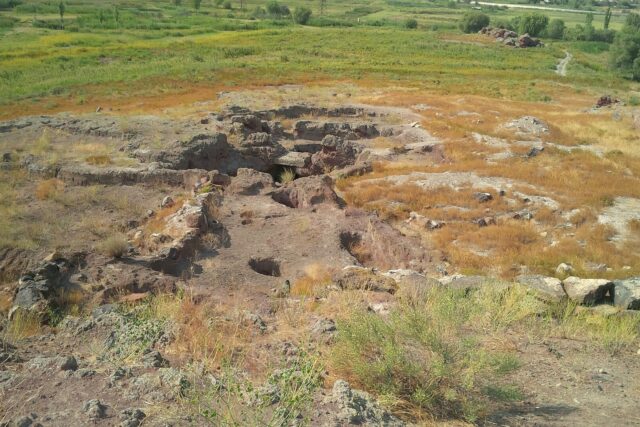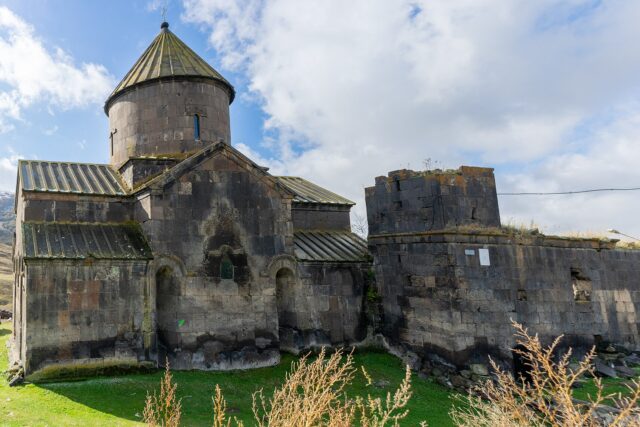
Vanevan Monastery (Վանևան) is a small 10th-century complex in the gorge at the southern edge of Artsvanist village, on the quiet south-east shore of Lake Sevan in Gegharkunik province. Its main church, Surb Grigor, was built in 903 by Shapuh Bagratuni, brother of King Smbat I, with their sister Mariam, and medieval Armenian tradition says it became the king’s grave in 914 after his execution by the Sajid emir Yusuf. It sits about 20 km east of Martuni, 145 km from Yerevan, and gets a tiny fraction of the visitors that Sevanavank gets across the water. Come for a royal story with a genuine historical argument attached, two rough basalt churches, a spring and a cave, and the emptiest stretch of the lake.
The 903 foundation and the Bagratuni family
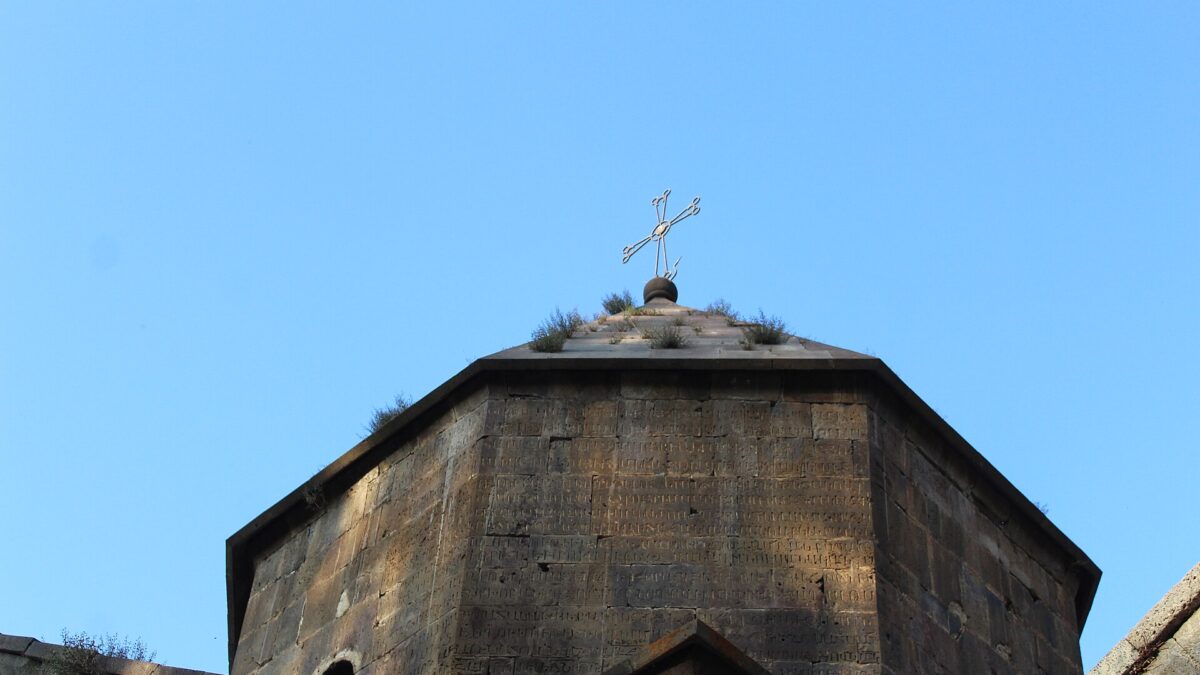
The date is not folklore. An inscription on the south-east side of the drum records that the main church was finished in 903; the Russian-language Hayazg encyclopedia (drawing on Cuneo’s architectural survey and the Soviet Corpus of Armenian Inscriptions, vol. 4) and Brady Kiesling’s Rediscovering Armenia gazetteer give the same year and the same builders: Prince Shapuh Bagratuni, sparapet (commander-in-chief), and his sister Mariam.
The family matters. Shapuh and Mariam were children of Ashot I, who restored an Armenian kingdom in 884/885 after two centuries of Arab rule. Their brother Smbat I had been king since 890. Mariam had married Vasak Gabur, prince of Syunik, and was by 903 a widow and a serious church patron: the churches on Sevan island (874) are hers, and her son Grigor Supan II built Makenyats Vank and Kotavank on this same shore. Vanevan is the Bagratuni side of the family building in Syunik-ruled Gegharkunik, with Mariam as the bridge.
A second inscription records the endowment: according to the Armenian-language summaries of the Corpus and Sevan National Park’s heritage listing, the sparapet granted the new brotherhood four villages and their water mills. None of those villages survives under its medieval name; the land lies within modern Artsvanist and its neighbours.
King Smbat I and the burial question
In 913 Smbat I, worn down by years of war with the Sajid emir Yusuf and deserted by several of his own princes, surrendered at the fortress of Yernjak (Alinja, now in Nakhichevan) under a sworn safe-conduct. Yusuf broke it. The contemporary account is Catholicos Hovhannes Draskhanakerttsi’s History of Armenia, chapter 49 (Maksoudian’s English translation is online at attalus.org): Smbat was starved, beaten, racked and beheaded, and Yusuf “ordered him not to be buried”. The body was fixed to a pole and displayed in Dvin. He then describes miracles at the cross; the Armenian Church counts Smbat a martyr.
What Draskhanakerttsi does not say is where the body went afterwards. Chapter 50 records Smbat’s mother and a son buried at the cathedral gates in Dvin; for the king himself the text stops at the cross.
The Vanevan claim comes from later writers. Stepanos Orbelian, the 13th-century bishop-historian of Syunik, states in his History of the Province of Sisakan that Smbat was buried at Vanevan in 914, and the Armenian encyclopedias follow him. The logic is sound: the family retrieving the body from Dvin for its own eleven-year-old church is what you would expect. But Orbelian wrote three centuries after the event, which is why the English Wikipedia entry on Smbat, citing Armen Manuk-Khaloyan’s work on Bagratuni royal tombs, marks the burial place “Artsvanist (?)”. One more wrinkle: the Armenian Wikipedia entry on Shapuh gives his death as 912, before his brother’s, so any burial would have been Mariam’s doing or his heirs’, not his.
The honest summary: Vanevan is the only place any medieval source names as Smbat I’s grave, no tomb has been identified on site, and the one eyewitness historian is silent. Treat it as a strong tradition, not a carved fact. It is still the best reason to stand in this gorge.
What’s on site
Surb Grigor, the main church
The church on the left as you arrive is the 903 building: a compact cruciform plan with four semicircular apses and two small corner chambers flanking the east apse, in roughly dressed basalt with tufa for the arches and dome. Inside, the four central arches widen step by step towards the dome through an extra masonry course at each corner, a device the Italian survey literature singles out: Vanevan and Tatev are its earliest surviving examples. The octagonal drum once carried a pyramidal roof, now damaged. Decoration is almost nil, just a moulded band at the base of the half-domes.
The second church and the gavit
The right-hand church is a single-nave hall whose barrel vault has collapsed; its cornice matches the main church, so surveyors think it is contemporary or nearly so. Between the two sits a gavit with a heavy flat roof, a false vault and a central skylight, partly fallen in. Armenian sources credit the gavit and a general renovation to Gagik Bagratuni in the 980s, when he was heir to Ashot III; the Hayazg entry, citing Orbelian, has Gagik I (r. 990–1020) renovating the main church and walling the complex. Either way, the Bagratuni kings kept investing here for most of the 10th century.
Inscriptions and khachkars
Both inscriptions are worn; photograph them in low side-light. Khachkars stand in the courtyard, including one raised over Bishop Melkiset, buried here in 1502, proof the monastery was still a working church centre at the start of the 16th century. If cross-stones are your interest, read our guide to khachkars, then drive 3–4 km south of the village to the broken 1284 boundary khachkar: 2.5 m tall, snapped in the middle and reassembled in 2007, it carries a legal text fixing which days each neighbouring village could draw irrigation water (Armenpress, citing Sedrak Barkhudaryan’s Corpus).
The spring and the cave
Behind the monastery is a spring and a shallow cave. Kiesling mentions both without embroidery; local telling adds that the cave once ran to the top of the ravine and served as an escape route during raids. Nothing we found confirms the tunnel version, so file it under village memory.
Later history and abandonment
Vanevan collected donations through the 13th and 14th centuries and was still burying bishops in 1502. In the 16th century the Ottoman–Safavid wars and Turkic tribal raiding emptied the village, and the monastery was abandoned with it. The present village is young: Artsvanist was founded in 1829–30 by Armenians from Alashkert (now Eleşkirt in eastern Turkey) and was called Nerkin Aluchalu until 1968. The Armenian sources record an abbot, Teodoros of Shirak, repairing the buildings in 1871–80, and Kiesling, writing around 2000, found a village priest trying to make it an active parish again. It belongs to the Armenian Apostolic Church, which keeps it open but has not restored it: the main dome stands, the rest is roofless or partly collapsed.
Getting there
| Leg | Distance | Time by car |
|---|---|---|
| Yerevan → Martuni (via Sevan town, west shore) | 125 km | about 2 h |
| Martuni → Artsvanist | 20 km | 25 min |
| Artsvanist → Vardenis | 23 km | 30 min |
| Artsvanist → Makenis (Makenyats Vank) | 16 km | 25 min |
| Artsvanist → Nerkin Getashen (Kotavank) | 20 km | 35–40 min |
By car. M4 to Sevan, then the M10 down the west shore through Gavar and Martuni. Artsvanist is the village after Tsovinar. In the centre bear half-left at the war memorial and follow the lane down the gorge a few hundred metres; the last stretch is unpaved but fine for a normal car in dry weather. Coming from the south, take the Selim pass road from Yeghegnadzor to Martuni rather than looping through Yerevan. See our driving guide for the practicalities.
By marshrutka. Minibuses to Martuni (roughly 3.5 h) leave Yerevan’s Kilikia central station; Vardenis-bound services (165 km) run from the Northern station and pass the Artsvanist road. Ask the driver for the Artsvanist turn and walk or hitch the 2 km into the village. Return services thin out mid-afternoon, so a taxi from Martuni for the round trip with an hour’s wait is the realistic carless option; fix the price first.
The quiet south shore
Vanevan alone is a 45-minute stop. The reason to drive this far is the cluster of 9th–10th-century foundations that Mariam’s family left on the south shore, which almost nobody combines in one day.
- Makenyats Vank, in Makenis south of Vardenis: Surb Astvatsatsin built by Grigor Supan II (sources give 851 or the end of the 9th century) inside a walled enclosure, with a reputation as the region’s chief medieval school. The bigger and better-kept site.
- Kotavank, on the ridge above Nerkin Getashen about 5 km from Martuni: another Grigor Supan church, 9th century, with a large khachkar cemetery and a view down the Argichi valley.
- Beaches. The south shore is the lake’s least developed: shingle, reed beds and a few family rest-houses near Tsovinar and Tsovak rather than the resort strip at Sevan town. The water is cold even in August.
- Vardenis, 23 km on, has the only hotels and petrol at this end of the lake. Functional, not pretty.
A workable loop: leave Yerevan early, Kotavank mid-morning, Vanevan at noon, Makenyats early afternoon, back along the shore via Noratus, home by dark. Our Lake Sevan guide covers the north-shore pieces.
When to go
Late May to early October. The village sits at 1,940 m, the gorge holds snow into April, and the lane turns to mud in the thaw. June is green and cool; September has the clearest air. In July and August the monastery is still empty even when Sevanavank is a car park.
Practical notes
- Hours and entry: no ticket, no gate, no fee. Like most village churches in Armenia it is open in daylight; one operator quotes 09:00–18:00, but that is a convention, not a schedule. Confirm in the village if arriving late.
- Dress: consecrated church; shoulders and knees covered, a scarf for women is appreciated but not enforced.
- Safety: the gavit roof is partly collapsed and the second church’s vault is gone. Do not climb the walls; the rock by the spring is slippery.
- Facilities: none at the site. Shops and fuel in Martuni, a small shop in the village. Cash only on this shore; ATMs in Martuni and Vardenis.
Last verified: October 2026.
Worth it?
Yes as part of a south-shore day; no as a solo target from Yerevan. The architecture is modest and half-ruined, and you will spend more time driving than looking. What Vanevan offers that the big names in our best monasteries in Armenia list cannot is being alone in a 903 church that a king’s brother built and that a medieval historian says holds that king’s bones, with a spring behind it and the lake below. If that sentence does something for you, go. If you want carved portals and a café, stay on the north shore.
Frequently asked questions
Is King Smbat I really buried at Vanevan?
Medieval Armenian tradition, recorded by the 13th-century historian Stepanos Orbelian, says he was buried at Vanevan in 914. The contemporary account by Catholicos Hovhannes Draskhanakerttsi only says Yusuf had the body displayed on a pole in Dvin and never mentions a burial. No royal tomb has been identified on site. Treat it as a strong tradition rather than a proven fact.
How far is Vanevan Monastery from Yerevan and Martuni?
About 145 km from Yerevan by road (roughly 2.5 hours via Sevan and Martuni) and about 20 km east of Martuni on the Martuni–Vardenis road. The monastery is a few hundred metres down the gorge from the centre of Artsvanist village.
Can I get to Vanevan without a car?
Yes, with effort. Take a marshrutka from Yerevan’s Kilikia station to Martuni (about 3.5 hours) or a Vardenis-bound minibus from the Northern station, get off at the Artsvanist turn and walk about 2 km into the village. A taxi from Martuni for the round trip is the simpler option.
Is there an entry fee or set opening hours?
No fee and no formal hours. The monastery is a working Apostolic church and is open in daylight; one operator quotes 09:00–18:00 but it is not enforced. Arrive before mid-afternoon to be safe.
Featured image: Ավետիսյան91, CC BY-SA 4.0 — via Wikimedia Commons.